
Birthright citizenship, the Warren Court, and theoretical inversions in American jurisprudence
An examination of the ways in which John Roberts' tenure as chief justice inverts the civil rights focus of the Warren Court, in service of a conservative legal project meant to undermine liberal democracy.

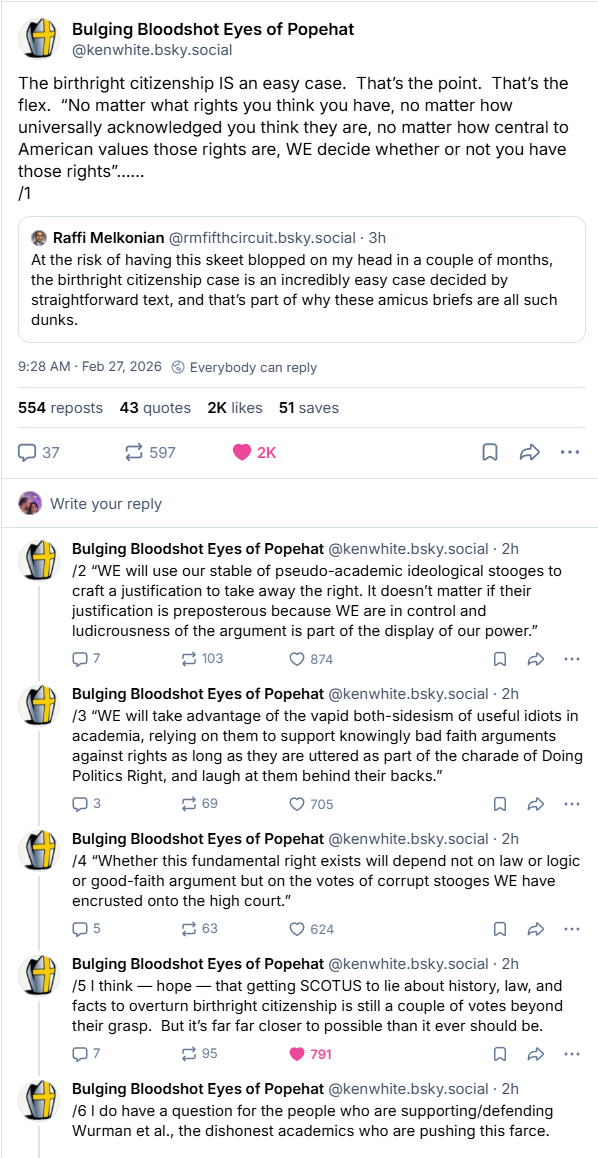
There is a thread making the rounds on Bsky of late, posted by friend-of-the-blog Ken "Popehat" White, that captures something essential about the current Supreme Court term and the birthright citizenship case (Trump v. Barbara) heading for oral argument on April 1. Ken's argument, surprising no one, cuts through the jurisprudential fog to the raw exercise of power underneath:
The birthright citizenship IS an easy case. That's the point. That's the flex. "No matter what rights you think you have, no matter how universally acknowledged you think they are, no matter how central to American values those rights are, WE decide whether or not you have those rights."
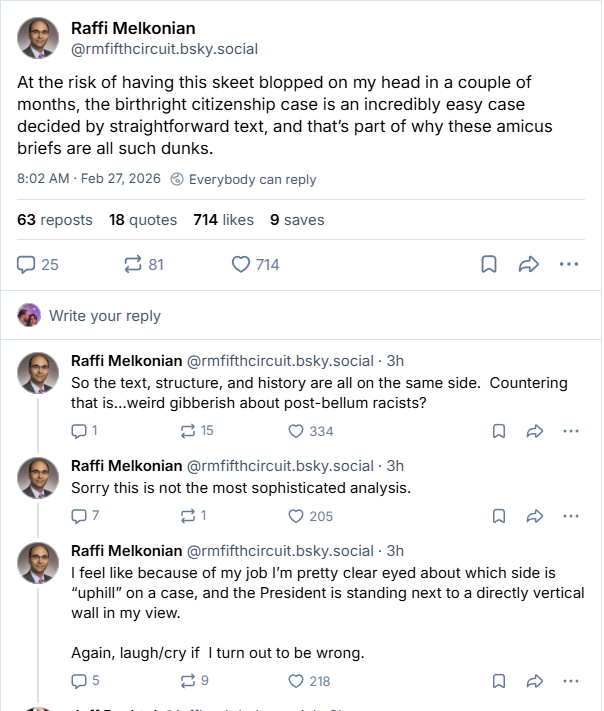
This was itself a response to other friend-of-the-blog appellate attorney Raffi Melkonian, who had observed (with the weary precision of someone who has read too many amicus briefs) that "the birthright citizenship case is an incredibly easy case decided by straightforward text, and that's part of why these amicus briefs are all such dunks."
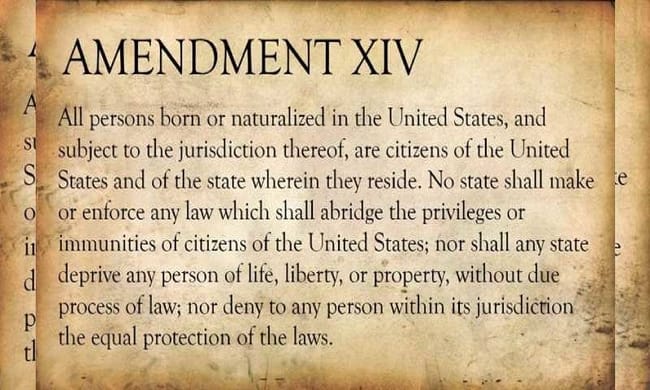
Both Ken and Raffi are correct, of course. The Fourteenth Amendment says what it says: "All persons born or naturalized in the United States, and subject to the jurisdiction thereof, are citizens of the United States and of the State wherein they reside." The Supreme Court has said what it said, in United States v. Wong Kim Ark in 1898, and in a string of denationalization cases from 1955 to 1967 where even a bitterly divided Court was unanimous on one point: being born in the United States, to foreign parents, made you American. Congress has said what it said, codifying birthright citizenship into the Immigration and Nationality Act. The text is plain. The precedent is settled. The statute is clear.
And that, as Ken argues, is precisely the point. The ease of the case is the demonstration of power, particularly if it results in an upheaval of over 100 years of settled post-bellum law. The quiet part, said loud across a six-post thread, goes something like this: "WE will use our stable of pseudo-academic ideological stooges to craft a justification to take away the right. It doesn't matter if their justification is preposterous because WE are in control and ludicrousness of the argument is part of the display of our power."
I want to take Ken's political reading and Raffi's legal reading (which are correct) and push them into legal/philosophical/theoretical territory, because I think what we are witnessing is not only a political flex but a fundamental transformation of what conservative constitutional interpretation is, from its stated pre-Trump 2025 Federalist Society goals into the Project 2025, Schmitt-esque vision of near total executive power, with the conservative legal commentariat providing vizier services behind the throne.
With that in mind it is best understood as an inversion, the mirror image, of the Warren Court that originalism/formalist textualism was invented to oppose.
The Warren Court's Original Sin
The standard conservative critique of the Warren Court, the one that launched originalism as a movement, goes something like this: The Warren Court "found" constitutional rights that were not in the text. Through penumbras and emanations, through substantive due process and evolving standards, the Warren Court read into the Constitution rights that its text did not explicitly enumerate. The right to privacy. The right to marry. Various criminal procedure protections. The Warren Court expanded the Constitution beyond the four corners of its text by treating the document as gesturing toward principles broader than its specific language. This sort of "living constitutionalism" meant that the Constitution set forth values, not necessarily concrete standards.
This is not a new debate; the opposition to including the Bill of Rights in the original Constitution was not mere stubbornness. It reflected a coherent theory of constitutional structure.
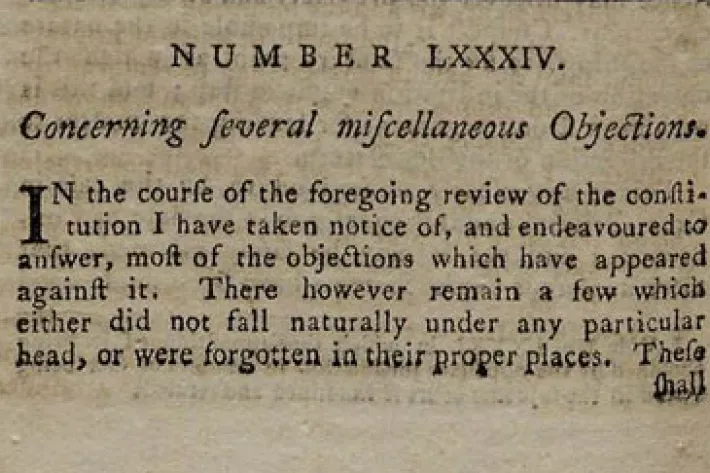
Hamilton's argument in Federalist No. 84 is the canonical statement. He argued that a bill of rights was not merely unnecessary but positively dangerous. The logic was syllogistic: if the Constitution creates a government of enumerated powers, then there is no need to say the government cannot abridge the freedom of the press, because the government was never granted power over the press in the first place. But if you enumerate that right, you imply that the government does have power over everything else: that the enumerated rights are exceptions to a general governmental authority rather than islands in an ocean of reserved individual liberty.
The deeper premise is the one worth holding onto: the Federalists operated from a natural rights framework in which liberty was the baseline and governmental power was the exception requiring justification. Rights didn't come from the Constitution; they inhered in persons. The Constitution was an instrument of delegation, not creation.
Madison's solution to the anti-federalist demand for a bill of rights was not to abandon the Federalist concern but to try to neutralize it through what became the Ninth Amendment: "The enumeration in the Constitution, of certain rights, shall not be construed to deny or disparage others retained by the people."
This is an extraordinary provision because it is purely meta-textual. It does not enumerate any right but instead provides a rule of construction for the enumeration that surrounds it. It explicitly acknowledges that the list is incomplete and commands that incompleteness not be weaponized. The rights retained by the people are real and enforceable; the Constitution simply declines to catalogue them exhaustively.
The structural parallel to the Tenth Amendment is significant. The Tenth reserves to the states or the people powers not delegated to the federal government. The Ninth reserves to the people rights not enumerated in the text. Together they establish the foundational architecture: government has what it's given; the people retain the rest, both in terms of power and rights.
Had decisions like Roe v. Wade been made not within the "penumbra" of the Fourth Amendment, but a combination of the Fourth Amendment with the Ninth Amendment's understanding, I believe they would be on more solid footing today, and not, well, you know how that went. The structural weakness of decisions like Roe is what permitted the Federalist Society and its goons to eventually obtain Dobbs v. Jackson Women's Health Organization: a crack in the armor through with the nascent monarchist movement could slip its common-good-shaped tentacles.
And so, the living constitution tradition, particularly in its most sophisticated philosophical forms, is arguably a jurisprudential response to the same problem Hamilton and Madison identified: the risk that fixing meaning at a historical moment will cause future generations to read the document as exhaustive.
Ronald Dworkin's framework is perhaps the clearest articulation of this. For Dworkin, the Constitution's great clauses (liberty, equal protection, due process, cruel and unusual punishment) are not rules but principles, or more precisely, they invoke moral concepts rather than specific conceptions. When the Fourteenth Amendment guarantees equal protection of the laws, it commits the Republic to the value of equality, not to whatever late-19th century legislators happened to think equality required. The concept transcends any particular historical conception of it.
This maps directly onto the Federalist concern. The Founders weren't trying to codify a snapshot of 1789 moral philosophy; they were trying to establish enduring commitments to values they understood to be transcendent, id est, liberty, dignity, equal standing before the law, while explicitly acknowledging (via the Ninth Amendment) that the text couldn't contain them all. Reading those provisions as frozen in their historical applications is to mistake the finger for the moon.
And yet, the critique of the Warren Court's expansive view of personal liberty and civil rights lead directly to the birth of originalism. This was the critique that animated Robert Bork's 1971 article, Ed Meese's 1985 ABA speech, and the entire Federalist Society project of the last four decades. The Constitution means what it says, they argued. It means what its words meant when they were enacted. Judges who go beyond that plain meaning are legislating from the bench.
The argument can be made that originalism, whatever its other virtues, recreates precisely the interpretive error the Ninth Amendment was designed to foreclose.
Originalism in its modern forms, whether original intent or original public meaning, insists that constitutional provisions mean what they meant at ratification (or, in the public meaning variant, what a reasonable person at ratification would have understood them to mean). Applied to rights, this means that unenumerated rights either don't exist or are cognizable only insofar as they were recognized at founding. This is, structurally, exactly the negative inference from enumeration that Hamilton warned about: if a right wasn't understood to exist in 1789 (or 1868), it's not in the Constitution.
Justice Goldberg's concurrence in Griswold v. Connecticut made this point with particular force. Against Justice Black's textualism (which insisted that because privacy wasn't in the text it wasn't a constitutional right) Goldberg argued that the Ninth Amendment was itself a textual instruction that the enumeration was not exhaustive and that unenumerated rights retained by the people deserved constitutional protection. Black's position, Goldberg argued, was the very interpretive error Madison had anticipated.
The deeper irony is this: the original understanding of the Constitution's structure was not that the text is exhaustive. The original understanding was that the people retain rights beyond what the text enumerates, and that this retention is legally operative. Originalism, applied faithfully to the question of the Ninth Amendment and the Founders' natural rights framework, would seem to require something like a living constitutionalist approach to unenumerated rights... or at minimum, cannot coherently deny it.
Agree or disagree with the Warren Court's methods, the conservative critique had a certain logical coherence. If you're going to constrain judicial discretion, anchoring interpretation to the text is at least a principled starting point.
What is happening now is something fundamentally different, and, for all that, worse.
The Inversion: From Finding to Erasing
The current Court (and more broadly, the current conservative legal movement spawned from Federalist Society crèches) is not "finding" rights in constitutional implications. It is using a fabricated, revisionist historical "context" to reinterpret the plain language of the text in order to deny rights that are explicitly written down.
This is the Anti-Warren Court. Where the Warren Court was accused of reading rights in, the current Court is engineering rights out. And it is doing so not by amending the Constitution, not by persuading the public, not even by the honest route of saying "we think the Fourteenth Amendment was a mistake," but by constructing a fake history to make the text mean something other than what it says.
The birthright citizenship case is the purest specimen of this technique, but it is not the first. Dobbs used a selective historical survey to conclude that the Fourteenth Amendment's liberty protections did not encompass reproductive autonomy, despite the word "liberty" sitting right there in the text. Bruen imposed a "historical analogues" test on the Second Amendment that arguably is not square with any preceding Second Amendment cases, including D.C. v. Heller, which was already an expansive textual reorganization of how the Second Amendment should be read as providing an individual, rather than a societal, right to bear arms. In case after case, "history and tradition" operates as a one-way ratchet: invoked to restrict rights, ignored when it would expand them.
Justice Sotomayor was not being rhetorical when she observed that "history matters to this Court only when it is useful." She was describing a method.
The Warren Court, whatever its methodological sins, was engaged in a project that had at least a defensible relationship to the constitutional structure. It was giving content to open-textured provisions (equal protection, due process, the right to counsel) in ways that expanded the practical scope of individual liberty against governmental power. It was filling the Constitution's acknowledged silences in a direction consistent with the document's underlying premise: that governmental power is limited and individual rights are presumptively protected, consistent with (I argue) the Ninth Amendment.

The current Court is doing something structurally different. It is not merely declining to extend rights; it is withdrawing recognition of rights that had been incorporated into the constitutional order, and doing so in ways that expand the relative power of government, particularly state governments, over individual persons. Dobbs is the paradigm case, but the pattern runs through Bruen's restructuring of Second Amendment doctrine in ways that constrain legislative regulation, through the administrative law decisions that concentrate power in the political branches while stripping regulatory agencies of authority, through the evisceration of the Chevron doctrine, through the major questions doctrine.
The through-line is not consistent libertarianism, as the Court does not apply skepticism of governmental power evenhandedly. It applies it selectively: expanding state power over bodies and private conduct while constraining federal regulatory power over economic activity. That selectivity is itself revealing.
The Warren Court's methodology, at its best, was: The Constitution commits the Republic to values (liberty, equality, dignity) that exceed any historical application. Where existing law fails to honor those commitments, the Court's role is to bring law into conformity with constitutional principle. The direction of error-correction runs from inadequate application toward fuller realization of the principle.
The Roberts Court's methodology, at its best, is: constitutional meaning ought to be fixed at the time of the "original understanding" of that text at the time it was adopted, regardless of whether that is determinable from a historico-critical context or whether there was debate as to it. All language has but one original meaning, and that meaning itself must be adopted from the framework of achieving the social and legal goals of an ideological movement that is at once distrustful of federal power to improve the lives of its citizens but in favor of federal power when it comes to policing the same.
The inversion isn't merely that one reads rights in and the other reads rights out; it's that they have opposite baseline assumptions about where the burden of justification falls. For the Warren Court tradition, the burden falls on government to justify restrictions on liberty. For the current Court, the burden falls on the rights-claimant to demonstrate the appropriate historical pedigree or face a nearly-unrestricted federal government that may do to you what it wishes.
This is precisely the inversion Hamilton warned about. Hamilton's concern was that enumeration would shift the baseline from liberty as default, power as exception to power as general, rights as exception. The current Court's historical-pedigree requirement does exactly that. If a right lacks deep historical roots, it isn't protected—which means governmental power over that domain is presumptively valid. The natural rights framework the Founders inherited assumed the opposite.
Roe and Casey were grounded in a substantive due process tradition holding that the liberty clause protects personal decisions of fundamental importance, namely, an unenumerated rights framework that at least gestures toward the Ninth Amendment's logic. Whatever its flaws, the analytical move was to identify a category of decisions so central to personal autonomy that the government must demonstrate compelling justification to intrude.
Dobbs doesn't merely overrule Roe; it adopts a framework that is structurally incapable of protecting any unenumerated right that lacks historical pedigree. The Alito majority holds that substantive due process rights must be "deeply rooted in this Nation's history and tradition" and "implicit in the concept of ordered liberty." Applied honestly, this framework would have precluded Griswold (Connecticut criminalized contraception for most of the nation's history), Lawrence (sodomy laws were common at founding and through most of American history), and arguably Loving (anti-miscegenation laws had long historical roots). The majority's assurances that those cases are safe are difficult to reconcile with the logic of the opinion, and this was intentional. No one should take Alito at face value that those are safe, particularly because even the dullest legal reasoners could see that his argument was patently false. It was a signal that those cases were next on the block and their adherents could do little to prevent it, because the structural analysis had just changed.
The structural point: Dobbs doesn't just remove a right. It adopts a methodology that systematically disadvantages rights that lack historical recognition, which means it systematically disadvantages the rights of groups that lacked political power at the founding. Women could not vote. LGBTQ persons were criminalized. The historical baseline the Court adopts is one set when those groups were excluded from the political process that generated the history. Using that history as the ceiling for constitutional protection is not neutral; it encodes the exclusions of the founding era into permanent constitutional doctrine.
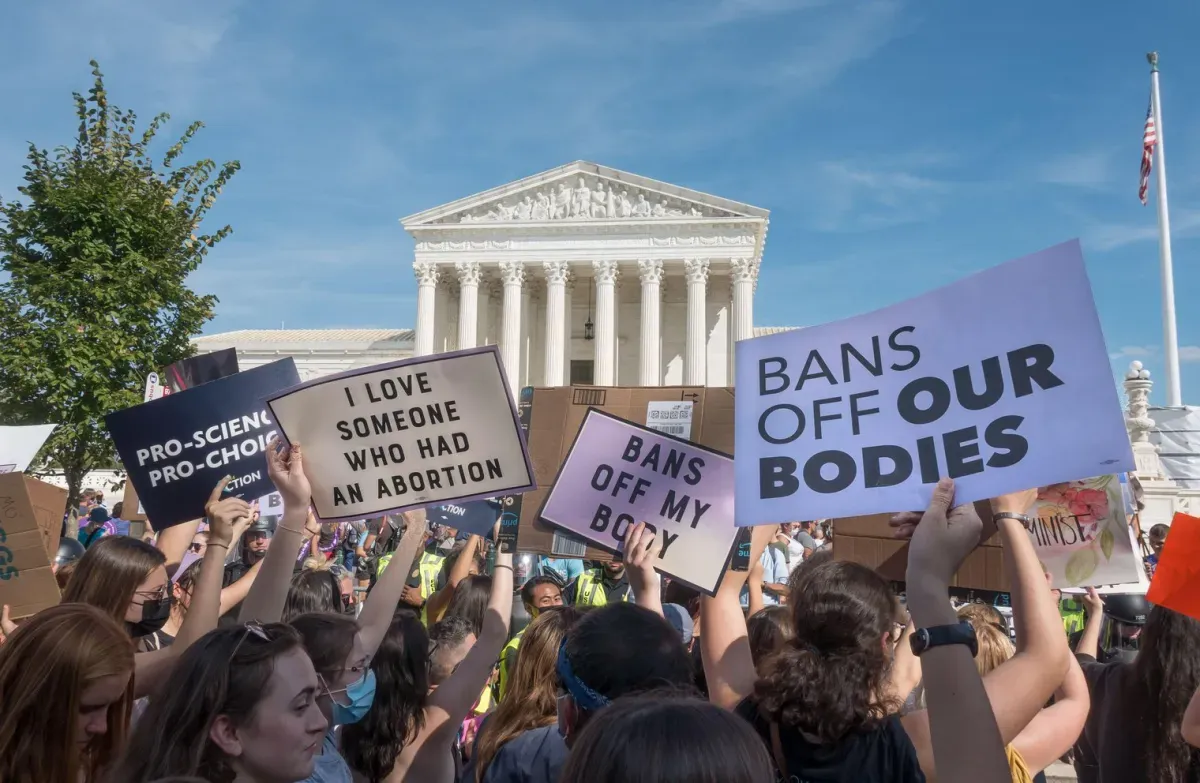
The standard charge against the Warren Court is counter-majoritarian activism: unelected judges overriding democratic choices in the name of constitutional values not clearly in the text. The current Court's defenders argue they are simply returning questions to democratic resolution. But this defense proves too much and too little simultaneously.
If counter-majoritarianism is the sin, the current Court is not innocent. Bruen struck down a New York gun regulation supported by democratic majorities. The administrative law decisions constrain regulatory agencies acting under broad congressional delegations. The major questions doctrine requires Congress to speak with extraordinary clarity before agencies can act on major policy questions, which is itself a judicially-imposed super-majoritarian requirement with no textual basis. The Court is not deferring to democracy; it is reshaping which democratic actors get to act, and on what.
The counter-majoritarian difficulty is not a bug in constitutional adjudication; it is the feature. The Constitution is designed to place certain questions beyond ordinary democratic resolution. The question is not whether courts should constrain majorities (they must, or the Constitution is toothless) but which constraints are legitimate. A Court that reads the Ninth Amendment as an inkblot and the historical-pedigree requirement as the exclusive test for liberty is making a choice about which constraints are legitimate, and it is making that choice in a way that systematically favors governmental power over individual liberty. That is not a neutral methodology. It is a substantive political commitment dressed in the language of interpretive restraint.
The Birthright Citizenship Case as Specimen
Consider the specific mechanics of what the revisionists are doing in Trump v. Barbara.
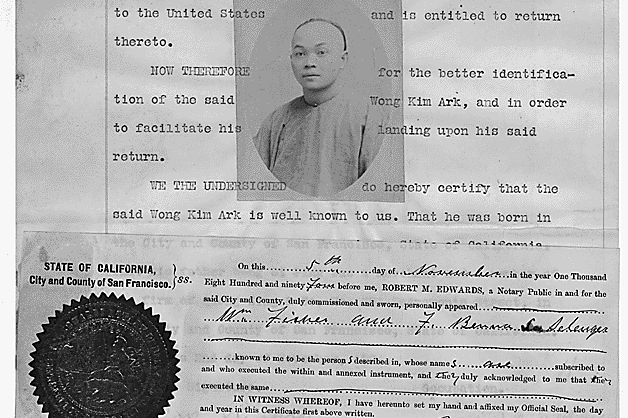
The Fourteenth Amendment's Citizenship Clause was enacted for a specific, well-documented purpose: to repudiate Dred Scott v. Sandford, which denied citizenship to people of African descent. The Clause accomplished this repudiation by establishing a rule of maximum breadth: all persons born in the United States and subject to its jurisdiction are citizens. The breadth was the point. The framers of the Fourteenth Amendment chose expansive, universal language precisely because the evil they were correcting (the holding in Dred Scott that citizenship could be denied based on parentage and race) demanded a rule that could not be narrowed by future interpreters to exclude disfavored groups.
The revisionist argument, advanced primarily by Professors Ilan Wurman and Randy Barnett and enthusiastically adopted by Solicitor General D. John Sauer, attempts to collapse this universality back down. Their argument is that "subject to the jurisdiction thereof" should be read as requiring something like "allegiance," and that children born to parents who are undocumented or on temporary visas lack sufficient "allegiance" to qualify.
This argument has been systematically dismantled by serious scholars. Evan Bernick, Paul Gowder, and Anthony Kreis published a devastating response in the Cornell Law Review under the title "Birthright Citizenship and the Dunning School of Unoriginal Meanings." The "Dunning School" reference is doing critical work here. William Archibald Dunning led the post-Reconstruction historiographic movement that recast Reconstruction as a tragic, misguided experiment and minimized the revolutionary scope of the Reconstruction Amendments. What Bernick, Gowder, and Kreis argue (persuasively) is that what Barnett, Wurman, and their colleagues are doing is not originalism at all; it is a repetition of the Dunning School's project: using pseudo-historical revisionism to shrink the Fourteenth Amendment back down to a size that is comfortable for the current political project.
The tell is the anachronism. The originalists' basic claim (that the Reconstruction Congress didn't think birthright citizenship applied to the children of undocumented immigrants) is only true in the trivial sense that "illegal" immigration as a legal category did not yet exist. Reading a twenty-first century immigration enforcement regime back into an 1868 constitutional provision and calling that "original meaning" is not originalism. It is historical fiction wearing originalism's clothes.
Even Michael Ramsey (himself an originalist scholar) has published a new paper, "Birthright Citizenship Re-Examined," reaffirming that Wurman's and Lash's revisionist accounts are ultimately unpersuasive and that the Citizenship Clause encompasses all persons born under U.S. sovereign authority.
And then there is the authorship of the amicus briefs. The Claremont Institute's brief, positioning itself at "the forefront of scholarly research" challenging birthright citizenship, was authored by John Eastman, a man who orchestrated the legal architecture for overturning the 2020 election and has been banned from practicing law in California. That this is the intellectual vanguard of the anti-birthright-citizenship movement tells you everything about the seriousness of the underlying scholarship.
Pseudo-Originalism as Ideological Apparatus
Here is where it becomes necessary to step back from the doctrinal analysis and ask what is actually happening at the level of method.
Originalism was marketed as a constraint on judicial power. Its entire legitimating claim was that by tethering interpretation to original public meaning, judges would be prevented from imposing their policy preferences on the Constitution. The text means what it means. The judge is (or, at least, ought to be) a referee, not a legislator.
What has emerged in practice is something entirely different. "Original public meaning" has been quietly replaced by "original historical context," and "context" is infinitely manipulable. You do not need to change the text if you can change the story you tell about the text. If you can construct a historical narrative in which the Fourteenth Amendment was "really" only about freed slaves and their children (never mind the universal language chosen by its drafters), then you can read the Citizenship Clause as narrowly as you wish while claiming fidelity to the original meaning.
This is the move. Not textualism (not attention to what the words say) but contextualism, where the "context" is a curated, revisionist history assembled for the purpose of reaching a predetermined conclusion. It is the legal equivalent of what propagandists do when they quote someone "in context" by carefully selecting which context to provide.
Ken's thread names this dynamic with characteristic bluntness: "Whether this fundamental right exists will depend not on law or logic or good-faith argument but on the votes of corrupt stooges WE have encrusted onto the high court." And: "WE will take advantage of the vapid both-sidesism of useful idiots in academia, relying on them to support knowingly bad faith arguments against rights as long as they are uttered as part of the charade of Doing Politics Right, and laugh at them behind their backs."
This raises his final question (posed to those supporting the Wurman line) which deserves to be treated as more than rhetorical: "Are there any limits to what arguments you will defend, so long as they are done in the rituals and style of academia?" Stated differently, is there any other purpose to your legal philosophy than the acquisition of and maintenance of power?
The Machine That Eats Its Own Justification

This is why I liken the modern FedSoc-poisoned judiciary to the Nazi Germany jurist Carl Schmitt: Schmitt famously made himself a handmaiden to power and provided legal justification for even the worst of Hitler's excesses. Schmitt upended centuries of legal philosophy and theory to enable Hitler to do things that clearly and openly violated the European legal tradition by tying them back to imagined, pseudohistorical traditions. One of his most fervent points was a Catholic-friendly doctrine of exceptional power to the sovereign to decide cases outside those circumscribed by legal norms. Starting to sound familiar?
If I may be permitted a theoretical observation: what we are watching is an ideological apparatus consuming its own foundations. Originalism justified itself by appeal to constraint, to textual fidelity, to the rule of law over the rule of judges (which is why it appeals to natural law theorists over realists). The current practice of originalism has abandoned every one of these commitments: constraint is abandoned in favor of executive maximalism, textual fidelity is abandoned in favor of historical revisionism, and the rule of law is abandoned in favor of a jurisprudence that produces whatever result the political project requires.
The Warren Court, whatever its faults, was at least engaged in a project of expansion, of reading the Constitution as a charter of liberation whose principles reached further than its specific historical applications. You could disagree with the method while acknowledging the aspiration.
The Anti-Warren Court is engaged in a project of contraction, of reading even the most explicit constitutional guarantees as secretly narrower than their text suggests, as constrained by a manufactured historical "context" that conveniently aligns with the political preferences of the current majority. It is not finding rights in silences. It is manufacturing silences in the text.
And that is what makes the birthright citizenship case so revealing. The text could not be clearer. "All persons born... in the United States, and subject to the jurisdiction thereof, are citizens." The word "all" is doing exactly the work its drafters intended it to do. The revisionist project is to make "all" mean "some"; to reintroduce exactly the kind of parentage-based qualification that the Fourteenth Amendment was written to abolish.
The Warren Court's critics accused it of treating the Constitution as a living document. The Anti-Warren Court treats it as a dead letter, killed not by amendment but by "reinterpretation," its plain words and stated values overridden by a story about what those words "really" meant, told by people who need those words to mean something other than what they say, and who reject its liberal values in favor of a monarchistic, unitary sovereign worldview in which the executive is embodied with imperial powers to effectuate a social order that liberal democracy prohibits by its very nature.
The current Court has inverted the constitutional baseline. The document establishes a framework in which individual liberty is presumptively protected and governmental power requires justification. The current Court's historical-pedigree requirement inverts this: unenumerated rights require historical justification, and governmental power in domains without that justification is presumptively valid. This doesn't just make the Court activist in the same sense as the Warren Court. It makes the Court structurally unfaithful to the constitutional architecture in a way that the Warren Court, whatever its other sins, was not.
The strong version is the one that connects most tightly to the philosophical groundwork, because it ties the inversion to the exact concern Hamilton raised in Federalist No. 84, makes the Ninth Amendment structurally central rather than peripheral, and frames living constitutionalism not as a liberal departure from the founders but as the methodology most consistent with what the founders actually thought they were building.
Whether the Court actually takes the bait (whether it has the votes to overturn more than a century of settled law on the strength of what amounts to historical fan fiction) remains to be seen. Ken thinks it's still a couple of votes beyond their grasp. I hope he's right. But as he also says: "It's far far closer to possible than it ever should be."
The arguments are set for April 1. The irony of that date requires no elaboration.