
Nobody Home: Language Models, the Chinese Room, and the Failure of Eliminative Materialism
A few days ago I posted a long thread on Bluesky arguing that large language models cannot be conscious. Most people took it in the spirit intended. A handful replied, in effect, "neither are you, in the sense you mean."

A few days ago I posted a long thread on Bluesky arguing that large language models cannot be conscious. Most people took it in the spirit intended. A handful replied, in effect, "neither are you, in the sense you mean." That reply is more interesting than the agreement, because it names what is actually at stake. Nearly every serious case for machine consciousness runs through some version of Daniel Dennett's philosophy of mind. If consciousness is nothing over and above functional organization, a system that reproduces the right functional organization gets consciousness for free. So the question about LLMs is really a question about eliminative materialism. If eliminativism is false, the case for LLM consciousness loses its foundation. This post argues that it is false. It also says exactly what that conclusion does and does not commit me to.
What eliminativism claims, and why the machine-consciousness case needs it
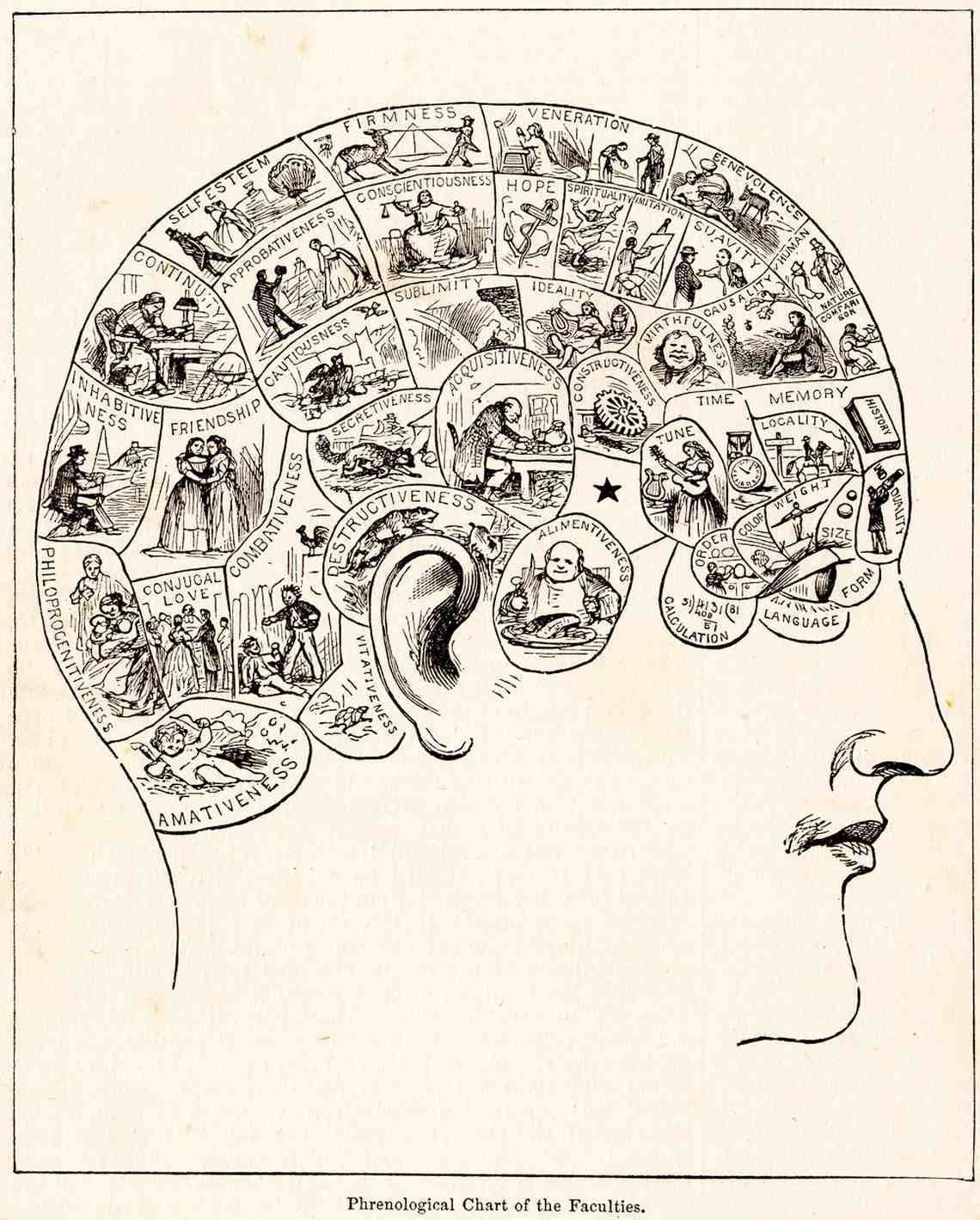
"Eliminative materialism" in its canonical form belongs to Paul and Patricia Churchland. They argued that folk psychology, our everyday talk of beliefs, desires, and intentions, is a failed theory that a mature neuroscience will replace, much as chemistry replaced phlogiston. Dennett's version is subtler, and he often resisted the label. He did not deny that people are conscious. He denied that consciousness is what we take it to be. In "Quining Qualia" he argued that the private, ineffable, intrinsic properties of experience that philosophers call qualia do not exist, and that our conviction that they do is a kind of user illusion generated by the brain's self-modeling. His method of "heterophenomenology" treats first-person reports as data about what subjects believe about their experience, never as evidence of an inner phenomenal fact. Keith Frankish has since sharpened the view into "illusionism": phenomenal consciousness is an introspective misrepresentation, and the real explanatory target is why we are disposed to think we have it.
The connection to language models is direct. If what there is to consciousness exhausts itself in dispositions to report, discriminate, and self-model, then a system that reports, discriminates, and self-models well enough has everything there is to have. The LLM's fluent talk about its own inner states counts as heterophenomenological data in the same way ours does. To resist the conclusion, you need to show that something real is left over once function is fully specified. That leftover comes in two kinds. Author and philosopher R. Scott Bakker has developed his own version of the argument, dubbed "the blind brain theory."
Two problems, one argument
Philosophers of mind separate two features of the mental that are easy to run together. The first is intentionality, the "aboutness" of thought, the fact that a belief is about water or Paris or the number seven. The second is phenomenality, the fact that there is something it is like to be in certain states, in Nagel's phrase.
The Chinese Room and Twin Earth are arguments about intentionality. Jackson's knowledge argument and the qualia debate are about phenomenality. They support a single conclusion, though, because they share a structure. In each case, a complete specification of a system's internal functional organization turns out not to fix a mental fact. Searle's room fixes the syntax but not the semantics. Twin Earth fixes the internal state but not the content. Mary's black-and-white room fixes the physical information but not the experience. Eliminativism depends on function fixing everything, and each argument locates a place where it does not. (Searle also argued, in The Rediscovery of the Mind, that the two features are linked: intrinsic intentionality is at least potentially accessible to consciousness, which he called the "connection principle." I don't need that thesis here. The parallel structure is enough.)
The Chinese Room
Rules don't get you meaning
The thought experiment is familiar. A monolingual English speaker sits in a room with a rulebook for manipulating Chinese characters. Questions in Chinese come in through a slot. He matches shapes to rules and passes answers out, and those answers are indistinguishable from a native speaker's. He understands no Chinese. Searle concluded that running a program is not sufficient for understanding, because syntax is not sufficient for semantics.
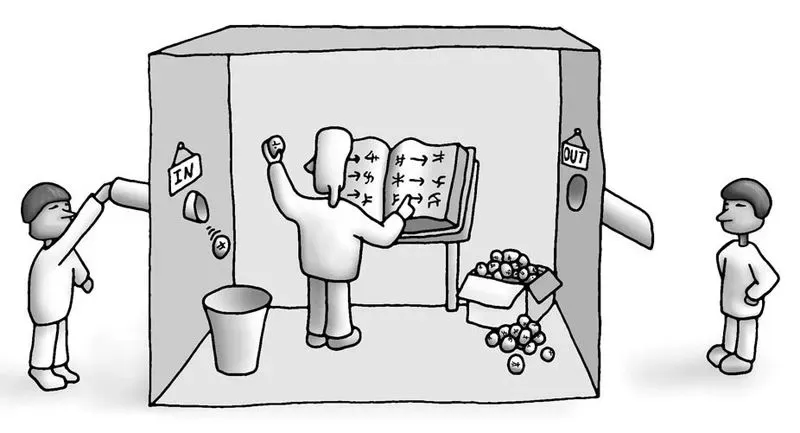
It helps to be clear about what kind of argument this is. The Chinese Room is not a model of how computers work, and it was never meant to be. It is an intuition pump about one of the oldest distinctions in philosophy: the difference between the rules that govern how signs combine and what those signs mean. Searle's claim is that no amount of the first ever adds up to the second. Rules don't get you meaning.
The two come apart in both directions. We can produce perfectly grammatical sentences that mean nothing, such as Chomsky's "colorless green ideas sleep furiously," or Carroll's
'Twas brillig, and the slithy toves Did gyre and gimble in the wabe
Yet we also get meaning across when the grammar breaks down: a text message full of typos, a child's first sentences, a phone call on a bad line. Human minds lean toward meaning so strongly that we find it even where there isn't any. After reading "Jabberwocky," Alice says it somehow fills her head with ideas, though she can't say exactly what they are. Syntax is neither sufficient nor necessary for meaning. Minds supply the meaning.
The man in the room is not standing in for a computer's processor. He stands in for rule-following as such. The argument can be repeated against almost any objection. Suppose someone says that eventually he would memorize the symbols and be able to translate. That gives him rote recall, not understanding: he could reproduce a sentence from memory and still not speak Chinese. Or suppose the rulebook has him convert Chinese characters into Telugu script, another language he doesn't know. He is still manipulating symbols by rule and never understands anything. Searle's own version of this point was to have the man memorize the entire rulebook and perform every lookup in his head. Now there is no system apart from him. He still understands no Chinese.
The Systems Reply, and where the meaning actually is
The Systems Reply, which Searle anticipated in the original 1980 paper and which remained the standard objection for the next two decades, says we can't consider the man in isolation. He is one part of a system of man, rulebook, and room, and it is the system that understands Chinese.
This sounds plausible because meaning seems to survive the process: Chinese questions go in and sensible Chinese answers come out. But ask where the meaning is. It's in us. We, the human observers outside the room, can read meaning in the output because we can assign meaning to the symbols, just as a Chinese speaker could. Nothing inside the room has done that. This is the symbol grounding problem Stevan Harnad named in 1990: a system of symbols defined only in terms of other symbols is like trying to learn Chinese from a Chinese-to-Chinese dictionary. You go from definition to definition and never reach anything the symbols are about.
Searle later sharpened this point. Computation is observer-relative. Syntax is not intrinsic to physics. Whether a physical process is "running a program" depends on someone assigning symbolic meaning to its states. Voltages in a chip are "token 8,241" only under a mapping we supply. The "system" in the Systems Reply exists only as a system under a description, and the description comes from us. Whatever intentionality it has is derived, the way a book's sentences carry meaning without the book understanding anything.
What LLMs change, and what they don't
Here I owe the other side a concession. Searle's 1980 room fits the computers of 1980 well. Everything such a machine "knew" had been put there explicitly by someone capable of meaning: A=1, B=2, "a cat is a small furry feline pet." A language model is not like that. No one gives it definitions. It learns what "cat" is by absorbing the statistical company "cat" keeps across trillions of words of text, and so it can infer that cats probably have whiskers, fur, and claws without anyone telling it. It finds associations no one programmed, and some of them are new. In a rough way this resembles part of what we do when we think. The novelty objection, which Turing called "Lady Lovelace's objection" in 1950, fails against these systems, and I won't rely on it.
But novelty was never the Chinese Room's criterion. Understanding was. A transformer is an extraordinarily complex system of syntactic rules, far beyond anything Searle imagined, but it is still a fixed function from strings of integers to probability distributions over the next integer. Gradient descent wrote its rulebook instead of a programmer, which changes who wrote it, not what kind of thing it is. And the grounding problem has not gone away. It has been relocated. The model's "cat" is anchored in the statistical traces of human writing about cats, and that writing was grounded by people who had seen, touched, and been scratched by cats. The model inherits its grounding secondhand, as completely as the man in the room inherits his from the rulebook's author. Making the context window larger gives it a bigger dictionary. It is still a Chinese-to-Chinese dictionary.

The real intuition behind the Systems Reply
The Systems Reply draws its strength from a deeper intuition: once you set grounding aside, all meaning transmission looks like symbol manipulation. And you can't just discard syntax either. Quine's thesis of the indeterminacy of translation shows that all the behavioral evidence available to a field linguist is compatible with incompatible translation manuals. When the native says "gavagai" as a rabbit runs by, nothing in the behavior settles whether it means "rabbit," "undetached rabbit part," or "temporal stage of a rabbit." Carroll saw the opposite danger in Through the Looking-Glass, where Humpty Dumpty insists a word means exactly what he chooses it to mean, and that the question is simply who is to be master.
Put together, these two cases show that meaning is neither of the things the debate keeps trying to reduce it to. Quine shows that function underdetermines meaning. Humpty Dumpty shows that meaning is not private stipulation. What's left is that meaning is public, shared, and grounded in a common world, a gestalt of many factors that no single description captures. I admit this makes grounding a hard problem for those of us who oppose syntactic reduction, too. But note Quine's result: if all the behavioral data underdetermines what a speaker means, then a system defined entirely by its behavioral outputs cannot determine meaning either. That is exactly the claim the Systems Reply has to deny.
What the Systems Reply finally amounts to is an emergence claim: past some level of complexity and repetition, semantics arises out of syntax on its own. The obvious reply is "Fine. How?" There is no answer. No one has shown, even in principle, how meaning emerges from symbol manipulation. That is an explanatory gap, and I return to it below.
The Robot Reply, and what seeing is
A related objection, the Robot Reply, grants that a computer in a box doesn't understand but asks: what if we put it in a robot body with cameras, microphones, and touch sensors, so that it can learn from the world? Searle's answer was that this adds nothing. Put the man inside the robot's head, feed him the sensor data as streams of symbols, and give him rulebooks for combining them into visual fields, sound fields, and textures. He is still manipulating symbols by rule. Either the objection assumes what it needs to prove, by imagining a conscious homunculus in the robot, or it faces the same question again: how does a conscious perceiver arise from processing that isn't conscious?
Consider what a vision model does with a photograph. It converts the image into numbers and compares those numbers to patterns extracted from millions of other images. It can do this very well, and increasingly better than we can. I won't claim that machines fail at CAPTCHAs, because they no longer do, and an argument based on today's failures loses to next year's model. The point is not whether the model gets the answer right. It is what happens when it does. A capable eliminativist will point out that your eye also converts light into electrical signals. The difference between you and the model is not the conversion. It is that when your conversion happens, a world appears to someone. There is a bus, seen from where you stand, with its color, size, and familiarity. When the model's conversion happens, a correct label comes out. That difference is what the rest of this post defends. Here I only want to state it clearly.
The man in the robot head is Frank Jackson's Mary: he has all the information and no experience. Unless he had some prior experiential relation to what the data encodes, no amount of data could teach him what it is like to see, which is Thomas Nagel's point in "What Is It Like to Be a Bat?"
Will has never been to the Sistine Chapel
There is a scene in Good Will Hunting where Robin Williams's therapist tells Matt Damon's Will that everything he knows about the world comes from books. Will is a genius. He could write dissertations on Michelangelo's life, his relationship with the Pope, the chemistry of the pigments on the Sistine ceiling. But he has never left Boston. He has never stood under that fresco, looked up at God reaching toward Adam, smelled the room, or felt the awe of seeing it in person. And that matters.

Bertrand Russell distinguished knowledge by description from knowledge by acquaintance. Will has all of the first and none of the second, and some things can only be known the second way. A language model is Will at the limit: every book, no Boston, and not even a body that could someday take the trip.
"But humans are just pattern-matchers too"
At this point, most replies stop claiming that machines will someday be complex enough to have meaning, and turn to deflating meaning instead. Humans, they say, are just very complex pattern-matching machines programmed by experience. We never have a truly original thought; we only recombine what experience gives us. Semantics is complicated syntax that doesn't recognize itself as syntax.
In William Gibson's Neuromancer, which I'm rereading, Case carries the Flatline, a ROM recording of the dead hacker McCoy Pauley's personality. The Flatline tries to explain the difference between itself, a very detailed recording of a person, and a real artificial intelligence like the one Wintermute hopes to become. The recording says it isn't likely to write you a poem. Wintermute, it suggests, just might.
"But Lane," you say, "I can ask ChatGPT for a poem right now." You can, and it will produce a competent one. But the poem Gibson means is not just a poem-shaped output. It is an expression, and expression requires something to express. The model can recombine what it has absorbed, following the prompt you gave it. It will never be hurt so badly, on its own, that writing a song that makes strangers cry is the only thing it can do with the hurt. Humans could do that before we could work bronze. The deflationist says that song was only recombination too. But recombination of what, and done by whom, in answer to what? The deflationary move doesn't eliminate the singer. It only declines to look at her.
An aside on Penrose
A reader of the original thread brought up Penrose's argument from Gödel, that an algorithmic system can never grasp truths a human mathematician can. I don't rely on it. The Lucas-Penrose argument asks far more of incompleteness than the theorem can support, and it has been widely criticized by logicians. My argument doesn't need any claim about what minds can compute. It needs only the claim that computing, of any power, is not the same as meaning.
Twin Earth: meaning ain't in the weights
Putnam's thought experiment asks us to imagine a Twin Earth identical to ours except that the clear liquid in its lakes and taps is not H₂O but a different compound, XYZ. Oscar on Earth and Twin Oscar on Twin Earth are molecule-for-molecule duplicates. Both say "water is wet," and their internal states are identical. Yet Oscar's word refers to H₂O and Twin Oscar's refers to XYZ. Putnam's slogan was that meanings ain't in the head. Content depends partly on causal relations to the environment.

I should concede something up front, because a careful reader will raise it: semantic externalism is not anti-physicalist, and many physicalists accept it. My use of it is narrower. Twin Earth shows that internal functional organization does not fix intentional content. Oscar and Twin Oscar are functionally identical and differ in what they think about. That is a problem for any view that reads content off functional role, and it is a larger problem for a system whose functional role is defined entirely over text.
Consider where an LLM stands relative to Oscar. Oscar's word "water" is anchored by a causal history of drinking it, swimming in it, being rained on. The model's token for "water" is anchored only by its relations to other tokens, which is the Chinese-to-Chinese dictionary from above. The model is not in Oscar's position or in Twin Oscar's. It is in the position of someone who has only ever met the word.
The best counter appeals to Putnam's own "division of linguistic labor." I can refer to elms without being able to tell an elm from a beech, because I defer to experts who can. Couldn't the model refer to water by deferring, through its training text, to the humans who wrote it? No. Deference is itself an intentional act. To defer, I must intend to use a word as my community uses it. The division of labor distributes the burden of discrimination among agents who already have intentionality. It does not create intentionality in something that lacked it. Davidson's Swampman makes the same point from the other side: a molecule-perfect duplicate of a person created by chance, with no causal history, would lack thoughts with content even though it behaves exactly as the original would. The LLM is a Swampman of text. Its dispositions were shaped by traces of human meaning, but it stands in no meaning-conferring relation to the world those traces are about.
Mary, and what she learns
I've already put Searle's man inside Mary's room. Here is the argument in full.
Frank Jackson's Mary is a brilliant scientist who has spent her life in a black-and-white room and knows every physical fact about color vision: wavelengths, retinal chemistry, neural processing, all of it. Then she leaves the room and sees a ripe tomato. Does she learn something new? It seems obvious that she does: she learns what it is like to see red. If so, not all facts are physical facts, and a complete physical description leaves something out.
Two honest admissions. First, Jackson himself later abandoned the argument and became a physicalist. That tells us about Jackson and nothing about whether the argument is sound; arguments don't expire when their authors change their minds. Second, there are serious replies, and Dennett's is the one that matters here.

Dennett's response (developed in Consciousness Explained and later in the "RoboMary" variant in Sweet Dreams) is that we are not really imagining what we have been asked to imagine. If Mary truly knew everything physical, she would not be surprised; shown a blue banana as a trick, she would recognize the deception immediately. Our intuition that she learns something comes from picturing someone who knows a lot rather than someone who knows everything.
This reply assumes the conclusion. Whether complete physical knowledge would include knowing what red looks like is exactly what the argument puts in question. Saying "she would know, because it's all physical" is not a rebuttal but a restatement of physicalism. The other main replies do better but give ground. The ability hypothesis (Lewis, Nemirow) says Mary gains no new fact, only new abilities to recognize and imagine: knowing-how rather than knowing-that. The phenomenal concept strategy (Loar and others) says she gains a new concept of an old fact. Both concede that something real changes in Mary that no amount of third-person information could produce. For the eliminativist, that concession costs a great deal, because the whole program depends on the third-person description leaving nothing out. And the ability hypothesis misdescribes the case. What Mary gains is not primarily a skill. It is acquaintance, the thing Will lacks under the Sistine ceiling.
The illusion of an illusion
The central difficulty for Dennett and Frankish is simple enough to fit in a single post. An illusion is a case where things seem one way and are another. But seeming is exactly the phenomenon at issue. To say that phenomenal consciousness is an illusion is to say that it seems to us that there is something it is like to have experiences, and "seems to us" is already a phenomenal fact. Searle made the point years ago: in the case of consciousness, the appearance is the reality. Galen Strawson has argued, bluntly and in my view correctly, that denying consciousness is among the least credible positions a serious philosopher has taken.
Frankish anticipated this and replies that the illusion is not phenomenal. It is an introspective misrepresentation: our self-monitoring systems represent our states as having phenomenal properties they lack, and these represented properties are "quasi-phenomenal." But this moves the problem rather than solving it. A misrepresentation is a representation, and representation is intentional. So illusionism explains away phenomenality by relying on intentionality, the one feature the Chinese Room and Twin Earth arguments show cannot be read off functional organization. The eliminativist cannot pay one debt by borrowing against the other. And even setting intentionality aside, there remains the question of to whom the misrepresentation presents itself. If the answer is "to no one; it's just a state with certain downstream effects on verbal behavior," then we are back to asserting what the argument was supposed to prove.
The Room lacks a body, not a soul: what the phenomenologists saw
I said above that there is something organic in how we exist. The phenomenologists have said precisely what.
The arguments so far come from analytic philosophy of mind, and they are mostly negative: they show where functional description falls short. The continental tradition, and phenomenology in particular, offers something the analytic debate often lacks: a positive account of what is actually missing. Its answer is not a ghost in the machine. It is a life. Continental philosophy is less concerned with making a positive metaphysical statement about what there is and more about what it would mean to be nothing but matter.
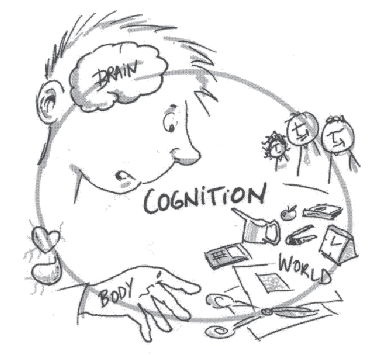
The shared Cartesian premise. Merleau-Ponty argued in Phenomenology of Perception that the two dominant pictures of mind in his day, "intellectualism" and "empiricism," made the same mistake. Both treated the mind as an inner theater set against an outer world of objects, and disagreed only about who ran the show. Eliminativism and substance dualism make the same mistake today. Dualism puts an immaterial thinker behind the eyes; eliminativism takes the thinker out and says the theater was never there. Neither questions the theater model. Phenomenology starts from Husserl's distinction between Körper, the body as a physical object measured from outside, and Leib, the lived body through which a world appears. Eliminativism recognizes only the first. A language model doesn't even have that in any relevant sense, only a substrate on which a function runs.
Dreyfus and why things matter. Hubert Dreyfus spent forty years applying Heidegger to artificial intelligence, from What Computers Can't Do (1972) to "Why Heideggerian AI Failed" (2007). His central claim was that human intelligence doesn't come from manipulating representations. It comes from skilled engagement with a world where things already matter, where the hammer shows up as for hammering and the situation already shows up as calling for something. What's relevant is not computed from neutral facts. It is given by our concern, what Heidegger called Sorge, care. John Haugeland put the point memorably when he said the trouble with AI is that computers don't give a damn. Connectionists claimed that neural networks answered Dreyfus. He replied that networks still depend on their designers to decide what counts as similar, what counts as success, and what the training signal rewards. The LLM confirms his reply at massive scale. Its sense of relevance is inherited entirely from the human texts it was trained on, and those texts were written by beings to whom things mattered. It has no world, only a corpus.
Life and sense-making. The enactivist line, which runs from Hans Jonas's The Phenomenon of Life (1966) through Varela, Thompson, and Rosch's The Embodied Mind (1991) to Evan Thompson's Mind in Life (2007), provides the positive thesis. Mind is continuous with life. A living organism is a self-producing, self-maintaining system whose existence is precarious: it must keep metabolizing or cease to be. That precariousness is where meaning begins. For a bacterium swimming up a sugar gradient, sugar means something, because its continued existence depends on it. Sense-making, on this view, is what an autonomous living system does in dealing with a world that can sustain or destroy it. The German psychiatrist-phenomenologist Thomas Fuchs has built this into a full account of the brain as an organ of a living organism's relation to its world, not a seat of mind, in Ecology of the Brain (2018). In In Defense of the Human Being (2021) he explicitly argues that AI systems simulate subjectivity without having it, because nothing is at stake for them.
This gives the Twin Earth and Mary arguments a positive basis. Oscar's word "water" is anchored because Oscar drinks water, and would die without it. Mary learns something when she sees red because seeing is something a living body does, not something a description records. The language model has no metabolism, no precariousness, and no stake. Nothing it produces makes any difference to its own existence, because in the relevant sense it has none to maintain.
The minimal self. Dan Zahavi's work on pre-reflective self-awareness (Subjectivity and Selfhood, 2005; Self and Other, 2014) strengthens the argument against illusionism. Experience, Zahavi argues, always has a basic "for-me-ness": it is given to someone in the first person before any reflection or self-report. This minimal self is not a later model the brain builds of itself. It is the condition for having any model at all. That is precisely what Frankish's "introspective misrepresentation" cannot do without. A misrepresentation of one's experience has to be given to someone as theirs. Illusionism can explain the content of the illusion but not the fact that it appears to anyone.
Against neurocentrism. Markus Gabriel's I Am Not a Brain (2015; English 2017) targets Dennett and the Churchlands by name. Gabriel calls their view "neurocentrism," the idea that the self just is the brain or its activity, and argues it is a category error. On his account mind (Geist) is the capacity to form and live under conceptions of ourselves, and that capacity is historical and social, not something located in the skull and waiting to be found or explained away. In his later work he treats AI systems as models of thinking rather than instances of it, much as a map is a model of a territory.
The archive, not the mind. Bernard Stiegler's Technics and Time offers perhaps the best continental description of what an LLM actually is. Stiegler held that human memory has always been partly external, stored in tools, writing, and recordings, which he called "tertiary retention." A language model is the most powerful tertiary retention ever made: human linguistic memory compressed into a form that can be queried. That is why its outputs seem so much like a mind. It is a memory of us. But a memory of minds is not a mind, just as a library is not a reader. The Flatline knew what it was.
The text without an author. The hermeneutic tradition gives the LLM advocate their strongest continental argument, so it should be addressed directly. Ricoeur argued in "The Model of the Text" that writing frees meaning from its author's intention. Once written, a text means what it means regardless of what its author intended. Why, then, can't an LLM's output mean something with no one behind it? The answer lies in Ricoeur's own account. The text's meaning is left open by its autonomy and completed by the reader's appropriation. Gadamer said the same in Truth and Method: understanding is always an event in which a reader applies the text to their own situation. An LLM's output is a text with no author and a meaning waiting for a reader. That is exactly the derived intentionality Searle described. Meaning appears when we read it, and it comes from us.
An honest caveat. The continental tradition is not unanimous. Catherine Malabou once argued in What Should We Do With Our Brain? (2004) that neural plasticity distinguished brains from machines. In Morphing Intelligence (2017; English 2019) she publicly withdrew that claim, conceding that plasticity can be simulated, and took machine intelligence much more seriously. A deconstructive reader could also invoke Derrida's critique of self-presence against Zahavi, and some have noted affinities between Dennett's decentered "multiple drafts" model and Derrida. I don't think either undermines the argument. Malabou's reversal concerns intelligence, not phenomenal consciousness, and Derrida's critique of presence is not a denial of experience. But these are the objections a continental reader will raise, and they deserve acknowledgment.
What the tradition as a whole contributes is this. The eliminativist says that once you remove the ghost, nothing is left but function. Phenomenology replies that the ghost was never the point. What function leaves out is not a soul but a life: a body that is lived, a world where things matter, a self given to itself before any report. A language model has none of these, and so it lacks consciousness for the reason the Room lacks understanding. Nothing in it is anyone's.
What this argument does not show
I want to be precise about scope, because arguments in this area are routinely read as proving more than they claim, and several responses to my thread noted that I was being a bit too pat with my reliance on certain arguments because I wrote it for an audience of non-specialists or philosophers. Fine; that's a fair cop. But let me go further here, where I have more time to develop the arguments.
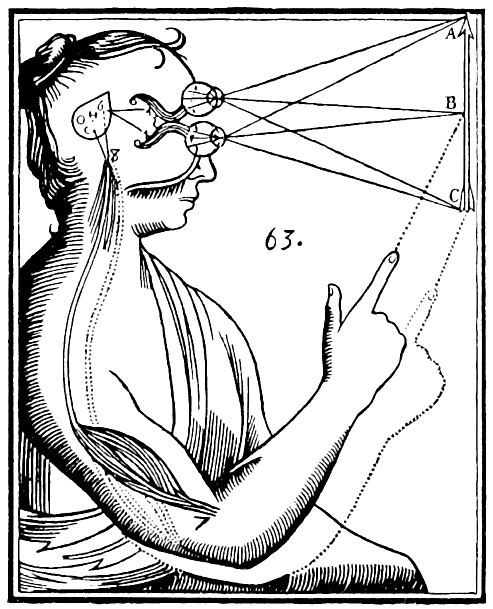
This is not an argument for substance dualism (not really). I call myself a "provisional dualist," in that I clearly think there is something different about mind than matter, but I am not making a strong metaphysical argument that mind is somehow substantively distinct. Nothing here requires a Cartesian soul or a second kind of stuff. The conclusion is negative: the mental is not identical to, and cannot be eliminated in favor of, a functional or computational description. That conclusion is fully compatible with property dualism, the view (associated today with Chalmers) that there is one kind of substance with both physical and irreducibly phenomenal properties. It is equally compatible with Davidson's anomalous monism, which is a form of physicalism: every mental event is a physical event (token identity), but there are no strict psychophysical laws, so mental types cannot be reduced to physical types. On Davidson's view you could never read off from a physical or computational description that a system was thinking. That is exactly the gap the Chinese Room exposes. It's worth noting that Davidson himself, in his late essay on the Turing test, doubted that a machine could think for reasons close to the Twin Earth ones I gave above: it lacked the right causal history with the world.
This is not a refutation of emergent materialism or epiphenomenalism. Both views accept that there is something real beyond the functional description. The emergentist says consciousness arises from physical organization of the right kind and complexity. The epiphenomenalist says consciousness is caused by physical processes but has no causal effects of its own. Neither is an eliminativism, so neither is my target. But both inherit what Joseph Levine named the explanatory gap: even granting that consciousness depends on the physical, we have no account of why this organization gives rise to this experience, or to any experience at all. The emergentist says "at sufficient complexity, experience arises" and stops there, which is exactly where the Systems Reply stopped. The epiphenomenalist has the gap plus an additional problem: if experience causes nothing, then our judgments about experience, including every philosophy paper on qualia, are not caused by the experiences they describe, and it becomes hard to see why they should be trusted.
I don't consider an explanatory gap fatal in itself. Brute points are common in philosophy, even in its most rigorous areas. Lewis Carroll (him again) showed in "What the Tortoise Said to Achilles" that modus ponens cannot be justified by adding it as a premise without infinite regress; it must be taken as a rule, not derived. Causation has resisted every attempt at a non-circular analysis. Woodward's interventionist account, currently among the most influential, explicitly defines causation in terms of interventions, which are themselves causal, and he openly accepts the circularity. We live with these gaps because the alternative is to stop reasoning.
But being able to live with a gap is different from having no obligation to address it. Modus ponens has earned its standing through unlimited successful use. An emergentist account of consciousness has not yet earned anything comparable. Anyone who wants to argue that a language model is conscious because consciousness emerges from sufficient computational complexity must still answer the specific questions: why this organization, at what threshold, and by what mechanism. Without that, the argument is what Popper called promissory materialism, a note payable on some future neuroscience that has not yet been written. For LLMs the note is even weaker, because the only systems we know to be conscious are embodied, metabolizing organisms with causal histories in the world, and the language model shares almost none of that. Pointing out that the gap exists is not an objection to emergentism. Ignoring the gap is what's objectionable.

Panpsychism
Nothing in my argument refutes panpsychism, the view that experience or proto-experience is a fundamental and ubiquitous feature of matter. If every electron has some minimal inner life, then trivially the substrate of a language model does too, and no argument from syntax, externalism, or Mary can take that away.
I don't treat this as a point in panpsychism's favor. I treat it as one more reason to reject it. A theory that can't be threatened by any argument about which things are conscious isn't answering that question; it's declining to ask it. It is too convenient: it removes the hard problem by declaring that the thing to be explained was present all along. And it violates parsimony in the most direct way possible. The only reason we attribute consciousness to anything other than ourselves is analogy: other people and animals resemble us in behavior, structure, and origin, so we infer that they resemble us inwardly too. Panpsychism attributes consciousness exactly where that analogy fails, to rocks, thermostats, and electrons. It goes beyond the only evidence we have for other minds while claiming that evidence for support.
Panpsychism also doesn't give the machine-consciousness advocate what they want. Even granting micro-experience everywhere, one still has to explain how micro-experiences combine into a unified subject, which William Seager named the combination problem. Why would a GPU cluster running a transformer combine its micro-experiences into a subject when a pile of sand does not? Answering that requires a principle of organization, and at that point we are back at the emergentist's explanatory gap. Panpsychism does not close the gap. It moves it down a level and gives it a new name.
Conclusion
You can be as anti-humanist as you like. You can reduce the depth of human thought to mechanical process and flatten all meaning into the rigid, predictable order of syntactic systems. There was a time I found that picture appealing. But the logical positivists tried to build meaning from syntax as seriously as anyone ever has, and it didn't work. Carnap moved from The Logical Syntax of Language (1934) to semantics within a decade, after Tarski persuaded him that meaning and truth could not be defined in purely syntactic terms. We are not entirely syntactic. There is something organic in how we exist.
The case for machine consciousness runs through Dennett, and it fails where he does. Syntax does not produce semantics, and neither scale nor a robot body changes that. Internal organization does not fix content. Complete third-person information leaves out what it is like to see red, or to stand in the Sistine Chapel. And the claim that phenomenality is an illusion depends on the experience and meaning it is supposed to explain away. What remains is not dualism, but the recognition that the mental outruns any functional description of it.
Meaning is messy, semantics is hard, the grounding problem may be close to unsolvable, and on the largest cosmic scale none of our striving may matter. This is what existentialism saw that positivism and materialism missed. Yes, we may be an insignificant hairless ape on a small ball of dirt, orbiting an ordinary star in an unremarkable arm of an unremarkable galaxy in a universe too large to comprehend. But it is a beautiful little ball of dirt. In the short time we have, we have the miracle, and the duty, to give our lives some meaning, to connect with other minds, and to experience things so powerful we may never have adequate words for them. Try telling me love doesn't matter in the face of an indifferent universe, and I'll pity you.
References
Analytic philosophy of mind and language
- Carnap, Rudolf. The Logical Syntax of Language (1934); Introduction to Semantics (1942).
- Carroll, Lewis. "What the Tortoise Said to Achilles." Mind (1895).
- Chalmers, David. The Conscious Mind (1996).
- Churchland, Paul. "Eliminative Materialism and the Propositional Attitudes." Journal of Philosophy (1981).
- Davidson, Donald. "Mental Events" (1970); "Knowing One's Own Mind" (1987).
- Dennett, Daniel. "Quining Qualia" (1988); Consciousness Explained (1991); Sweet Dreams (2005).
- Frankish, Keith. "Illusionism as a Theory of Consciousness." Journal of Consciousness Studies (2016).
- Harnad, Stevan. "The Symbol Grounding Problem." Physica D (1990).
- Hofstadter, Douglas, and Daniel Dennett, eds. The Mind's I (1981).
- Jackson, Frank. "Epiphenomenal Qualia" (1982); "What Mary Didn't Know" (1986).
- Levine, Joseph. "Materialism and Qualia: The Explanatory Gap." Pacific Philosophical Quarterly (1983).
- Nagel, Thomas. "What Is It Like to Be a Bat?" Philosophical Review (1974).
- Putnam, Hilary. "The Meaning of 'Meaning'" (1975).
- Quine, W.V.O. Word and Object (1960).
- Russell, Bertrand. "Knowledge by Acquaintance and Knowledge by Description" (1911).
- Searle, John. "Minds, Brains, and Programs." Behavioral and Brain Sciences (1980); "Is the Brain a Digital Computer?" (1990); The Rediscovery of the Mind (1992).
- Strawson, Galen. "The Consciousness Deniers." New York Review of Books (2018).
- Turing, Alan. "Computing Machinery and Intelligence." Mind (1950).
- Woodward, James. Making Things Happen (2003).
Phenomenology, hermeneutics, and continental thought
- Dreyfus, Hubert. What Computers Can't Do (1972); What Computers Still Can't Do (1992); "Why Heideggerian AI Failed and How Fixing It Would Require Making It More Heideggerian" (2007).
- Fuchs, Thomas. Ecology of the Brain (2018); In Defense of the Human Being (2021).
- Gabriel, Markus. I Am Not a Brain (2017).
- Gadamer, Hans-Georg. Truth and Method (1960).
- Jonas, Hans. The Phenomenon of Life (1966).
- Malabou, Catherine. What Should We Do With Our Brain? (2004); Morphing Intelligence (2019).
- Merleau-Ponty, Maurice. Phenomenology of Perception (1945).
- Ricoeur, Paul. "The Model of the Text" (1971).
- Stiegler, Bernard. Technics and Time, 1 (1994).
- Thompson, Evan. Mind in Life (2007).
- Varela, Francisco, Evan Thompson, and Eleanor Rosch. The Embodied Mind (1991).
- Zahavi, Dan. Subjectivity and Selfhood (2005); Self and Other (2014).
Literature and film
- Carroll, Lewis. Through the Looking-Glass (1871).
- Gibson, William. Neuromancer (1984).
- Good Will Hunting, dir. Gus Van Sant (1997).