
Stage Four, Part Three: The War Did Take Place
The map has not abolished the territory. It has enclosed it: the facts still exist, but access to them, and the power to make them count, has been fenced off. You cannot organize against the absence of the real. You can organize against a fence.
In Part Two, I took the Iran war as the specimen case and asked what that costs and who pays. The answer was a class analysis (a narrative-shaping class that pours the moulds of political reality, a reception class cast in them) with a girls’ school in Minab as its limit case.
Part Two ended by conceding that the individual act of interruption is not enough, and that what we need are forms of knowledge production structurally different from the apparatus. It did not say what those forms are. Part Three is the attempt.
“Don’t care. We’ll see him on December 3.” — Pete Hegseth, Secretary of Defense, asked whether Nidal Hasan had made any final requests, October 2026
On the afternoon of Thursday, October 8th, two announcements entered the feed. The first was a post on Truth Social in which the President of the United States informed his followers that Minnesota was being overrun by Somali immigrants, that violence and murder and mayhem had spread across the state, and that its people must fight back.1 The second, later that same afternoon, was a Pentagon official telling Reuters that the Army’s firing-squad execution of Nidal Hasan, scheduled for December 3rd at Fort Hood, would be livestreamed.2 Within a day the first had drawn condemnation from the governor of Minnesota and the second from the United Nations. Within a week both will have been absorbed into the scroll, and replaced.
Consider what kind of objects these are. Neither refers to anything that has happened. No one, so far as anyone knows, has yet fought back against anyone in Minnesota in answer to the President’s call; no rifles have yet been raised at Fort Hood. Both are announcements of events that may never occur, and one lawyer who represents the condemned told the BBC he would be surprised if the execution happened at all.3 And yet both had done their work before the sun went down: the engagement harvested, the outrage and the satisfaction distributed to their respective poles, the authority performed. They are, in the precise sense this series has been developing, Stage Four objects. They do not wait for the territory. They do not need it.
They are also, I will argue, what an apparatus does when its preferred stimulus has stopped working, and that is where this third part has to begin, because the six months since Part Two have tested its claims against the territory in ways I did not entirely anticipate.
A reader asked for Part Three. It is a fair request; I promised one “when I get around to it,” which in the tempo of the feed is a promise to forget. But six months is a long time in the scroll and no time at all in the territory, and the territory has been busy. The girls of Minab are still dead, and we now know rather more about who killed them. The war that was won in March is still being fought in October. The president’s approval is the lowest it has ever been. And the apparatus, as if sensing that the drug was wearing off, has started reaching for stronger ones.
In January 1991, as the bombers were being readied over the Gulf, Jean Baudrillard published an essay in Libération titled “The Gulf War Will Not Take Place.” Five weeks later, with the bombing under way, he asked whether it was really taking place. In March, when it was over, he published the third: “The Gulf War Did Not Take Place.”4 I have now written two essays on a war through Baudrillard’s eyes. This third takes its title in opposition to his, and the reason for that opposition, which is also the reason this series has to end somewhere other than where Baudrillard ended, is the subject of everything that follows.
The war did take place. Attend.
1. Six Months Later
In which we audit our own predictions, and find the map has been busy
Part Two made a prediction about the school in Minab, and it is only fair to hold the essay to the standard it demanded of everyone else. I wrote that the question of who struck the school “will probably remain open,” not because the truth was unknowable, but because the apparatus had no structural incentive to force the reckoning. Let us consult the record.
In March, the New York Times reported that the military’s own preliminary investigation had traced the strike to a targeting error: officers at Central Command had generated the coordinates from outdated Defense Intelligence Agency data that did not distinguish the school from the naval compound beside it.5 The president, for his part, continued to suggest that Iran might be responsible, and that Iran might possess Tomahawks of its own. In May, an admiral testified that the investigation was complex. In July, more than two dozen Democratic senators wrote to demand that its findings be released within a week; a Pentagon official answered that the investigation was ongoing, and the president offered that it might never be clear who was responsible.6 Meanwhile, the researchers at Forensic Architecture, working with Sky News, reconstructed the strike from satellite imagery and established that the building had served continuously as a school for more than a decade. By 2018, they found, its walls had been painted pink and blue to distinguish the girls’ school from the boys’.7
Satellites can see paint.
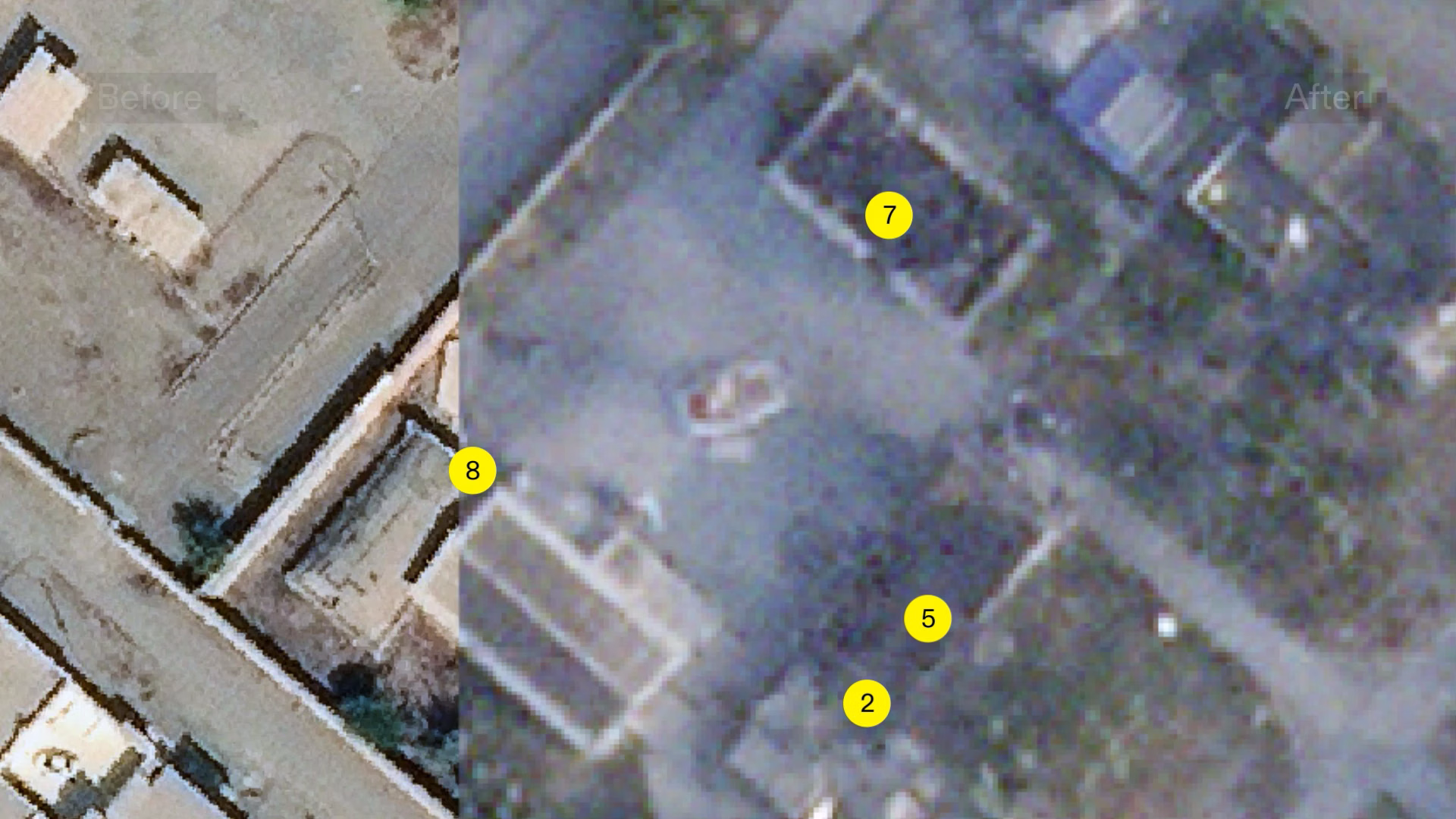
So I was wrong, and wrong in an instructive way. The question did get answered. It was answered by open-source investigators working from public imagery, by weapons analysts who examined photographs of missile fragments with markings consistent with recent-production Tomahawks, and, most damningly, by a leak of the military’s own preliminary finding. The answer exists. It is known. It has simply not been made to count. Part Two distinguished a question that is answerable from one that is answered. The distinction that actually matters turns out to be the next one along: between a question that has been answered and a question that has been adjudicated, entered into a forum with the power to make the answer bind someone. The deficit was never epistemic. It is institutional. Hold on to that; that is my signpost for where I want to take us with this essay.
The second prediction concerned the liar’s dividend. Part Two argued that Iran’s information operation, by flooding the commons with fabrications, had pre-discredited the grief of its own civilians: “The bodies are real. The claims about the bodies are contaminated in advance.” What I did not anticipate was who would come to collect. According to Democracy Now’s coverage of the Forensic Architecture findings, the President of the United States suggested that images of the destroyed school were AI-generated.8 The dividend, it turns out, is payable to bearer. Tehran built the instrument; Washington cashed it. That should not have surprised me. The liar’s dividend accrues to whichever party is most comfortable living without a referent, and Part Two spent several thousand words establishing which party to this war fits that description.
Then there is the war itself. Part Two identified four propositions in the April 1st address that could not all be true at once: the war is necessary, the war has been won, the war must continue, the war will end soon. The president had in fact declared on March 24th that the war was won. A two-week ceasefire followed in April; the talks in Islamabad failed; there was a naval blockade, then a memorandum in June, then a resumption of fighting on July 8th. By late July the number of American service members killed had reached eighteen.9 Part Two counted thirteen, and observed that their names were not in the address because the dead are low-engagement. Five more names, then, also unspoken. As I write in October the war is not over, and the four propositions have been running concurrently for seven months without anyone, so far as I can tell, being required to reconcile them. That is not a failure of the simulacrum. It is the simulacrum working as designed.
And then there is the number. In August, a Reuters/Ipsos poll put the president’s approval at 33 percent, the lowest of either of his terms; the Economist/YouGov tracker found the same figure, with a net approval of minus 29, the worst it has recorded.10 Coverage of the slide tied it to the war and to inflation. Part Two’s diner patron, it will be recalled, felt the war but could not evaluate it; she knew the price on the pump as first-order knowledge, but not the causal chain behind it. Six months on, her feeling has become a number, and the number has become a political fact. When Minnesota’s governor answered the October 8th post, he did not engage its claims about Somali Minnesotans at all. He called it a distraction from a war being lost and costs being driven up.11 Whatever one thinks of Tim Walz, notice what he reached for. Not the map. The pump.
This matters for the theory, not only as a matter of keeping score. If the territory had genuinely been supplanted, as Part Two at one point claimed, there would be no channel through which a war fought on the far side of the planet could register in the approval of the man who ordered it. There is such a channel. It runs through the gas tank, the grocery bill and the names of the dead; it is slow, and lossy, and it works. The territory leaks. Section 4 will have to account for that. First, though, we need to look at what the apparatus does when it notices the leak.
2. Tolerance
In which the dose stops working, and the dose goes up
The temptation, confronted with the October 8th post, is to call it unhinged. Plenty of people did; the governor of Minnesota called it deranged. I want to resist the word, not out of any tenderness toward its object, but because it concedes the argument this series has been making. Part One insisted that Trump is not a psyche to be diagnosed but a product to be understood: a fourth-order image, assembled over four decades by tabloids and wrestling rings and reality television, whose relationship to the apparatus is structural rather than personal. To call the post unhinged is to step back into the frame of the individual, and to invite the reply that has been waiting in the wings since 2016, namely that the derangement belongs to the critic. Diagnosis at a distance is a game the simulacrum always wins.
Pharmacology offers a better word. Part One argued that the media is neither for Trump nor against him but addicted to him, and that what distinguishes him from every other political figure of his era is not ideological but pharmacological. Any pharmacologist, and any addict, can tell you what happens when a stimulus begins to produce diminishing returns. The receptors adjust. The same dose no longer delivers the same effect, and so the dose goes up. This is called tolerance, and it is the most predictable thing in the world.
A 33 percent approval rating is a tolerance curve. It means the superstimulus has stopped working on the middle of the distribution: the people who were neither enthralled nor enraged, whose attention could be captured without their allegiance. The apparatus does not respond to tolerance by changing the substance. It responds by raising the dose. You do not need to know what is in anyone’s head to predict the escalation that follows. The structure predicts it whether or not anyone intends it.
That last point deserves emphasis, because the second of October 8th’s announcements did not come from the president at all. The White House declined to say whether he supported livestreaming Hasan’s execution, and referred questions to the Pentagon. Speaking the next day, he said Hasan deserved the firing squad and reminisced about the strong laws of the early twentieth century, without mentioning the stream.12 The livestream belongs to Pete Hegseth. This is not a complication for the argument but a confirmation of it. Part Two said the conspiracy is structural, not personal: the narrative class consists of people responding rationally to the incentive structures of their institutions. A Secretary of Defense who understands that his department’s real currency is now attention will reach for the stronger dose without needing to be told. The escalation does not require an author. It requires only an apparatus, and a falling number.
Two specimens, then, both from the same Thursday afternoon. Take the post first.
Fight back.
It begins, as the most effective Stage Four communication always does, with something real. In the preceding weeks, law enforcement had tied a shooting at an Eden Prairie football game, shots fired at an Eden Prairie gas station and a shooting in Bloomington to Somali gang activity, and Somali community leaders in Eden Prairie had publicly addressed the youth violence themselves.13 These are first-order events. They happened to real people in real places, and honesty requires saying so plainly, because an essay that pretended otherwise would be doing exactly what it accuses the post of doing.
Now watch what the post does with them. Three incidents in two suburbs become a state under takeover. Gang activity becomes violence, murder and mayhem spread across Minnesota. A community of some eighty thousand people, most of them American citizens and a majority of them born here, becomes a single agent with a single attitude toward you, which the post helpfully supplies: contempt. Then it issues an instruction: “Fight back Minnesota, fight back!” It closes by promising federal rescue if needed, and by directing the governor and the mayor of Minneapolis to request federal help and leave the remainder to Washington. NBC asked the White House how, exactly, the president wanted Minnesotans to fight back. The White House did not immediately answer.14

Part Two drew a distinction between two kinds of lies. Iran’s were factual: specific claims about specific events, checkable against the territory, and failing the check. Trump’s were semantic: unfalsifiable claims about meaning, an assertion of “narrative authority, the authority to determine, retroactively and without justification, what was meant by prior statements.” Fight back is that authority held in reserve. Read one way, it is a call for political pressure: lean on Walz and Frey until they ask for federal help, then let Washington handle it. The post’s final sentence supports that reading, and a defender will quote it. Read another way, by a Somali father in Eden Prairie, or by someone in Bloomington who has been waiting for permission, it is permission. Both readings are fully available. The post does not have to choose between them, because the speaker will choose afterwards, depending on what happens. If nothing happens, it was a call for federal assistance. If something happens, it was a lone actor who misread it.
Jamal Osman, a Minneapolis city council member and himself Somali-American, put the point with more economy than I can manage: when a president singles out an entire community and tells people to fight back, “those words carry consequences.”15 Precisely so. The genius of the semantic lie, at this register, is that the consequences can arrive without the words ever having to own them. There is a name for this, which I use with some reluctance because it has been worn smooth by overuse: stochastic terrorism, the public vilification of a group in terms that make violence against its members statistically predictable while no individual act is ever directed. The term matters less than the structure. The post takes a first-order event, three shootings, and produces from it an n-th order object, a state under ethnic occupation. Then it hands that object back to the territory with an instruction attached. In Part One the map preceded the territory. Here it issues orders to it.
Section 5 will return to this post, because the law has a doctrine for speech that calls for violence, and the doctrine’s silence here is instructive. For now, note only the escalation. Calling Somalis “garbage” at a cabinet meeting last December was a stimulus.16 Telling Minnesota to fight back in October, with the approval number at 33, is a dose.
3. The Scaffold
In which I break a promise to my readers, and we do a piece of Foucault after all
In Part One, beneath an image of Magritte’s pipe, I promised my readers that we were not doing a piece of Foucault, and that this was final. I would like it noted that I held out for two essays. Foucault is a notoriously difficult and controversial thinker, not least for reasons beyond his thought such as his personal life. I would like to eschew that kind of discussion, but as with so much of modern politics, Michel is indispensible, whatever one makes of him as a thinker or as a person.
The facts first, because the facts are the territory. In November 2009, Nidal Hasan, then an Army psychiatrist, opened fire in a medical building at Fort Hood, killing thirteen people and wounding more than thirty. A military jury convicted him and sentenced him to death in 2013, and his direct appeals were exhausted in 2025. On Monday, October 5th, the Pentagon announced that the president had approved, on Hegseth’s recommendation, his execution by Army firing squad: the first American military firing-squad execution since 1945. The acting Army secretary set it for December 3rd, at Fort Hood itself, and Hegseth explained that the time, the day of the week and the place had been chosen to match the 2009 shooting: a Thursday, about one in the afternoon, the same base.17 On October 8th, a Pentagon official told Reuters the execution would be livestreamed, and Hegseth confirmed it on X, saying people needed to see that such acts carry serious consequences. No country is known to televise or livestream a legal execution. Army regulations currently limit witnesses at a military execution to categories such as journalists and relatives, and exclude anyone under eighteen; the Pentagon has not said whether those rules will be waived.18
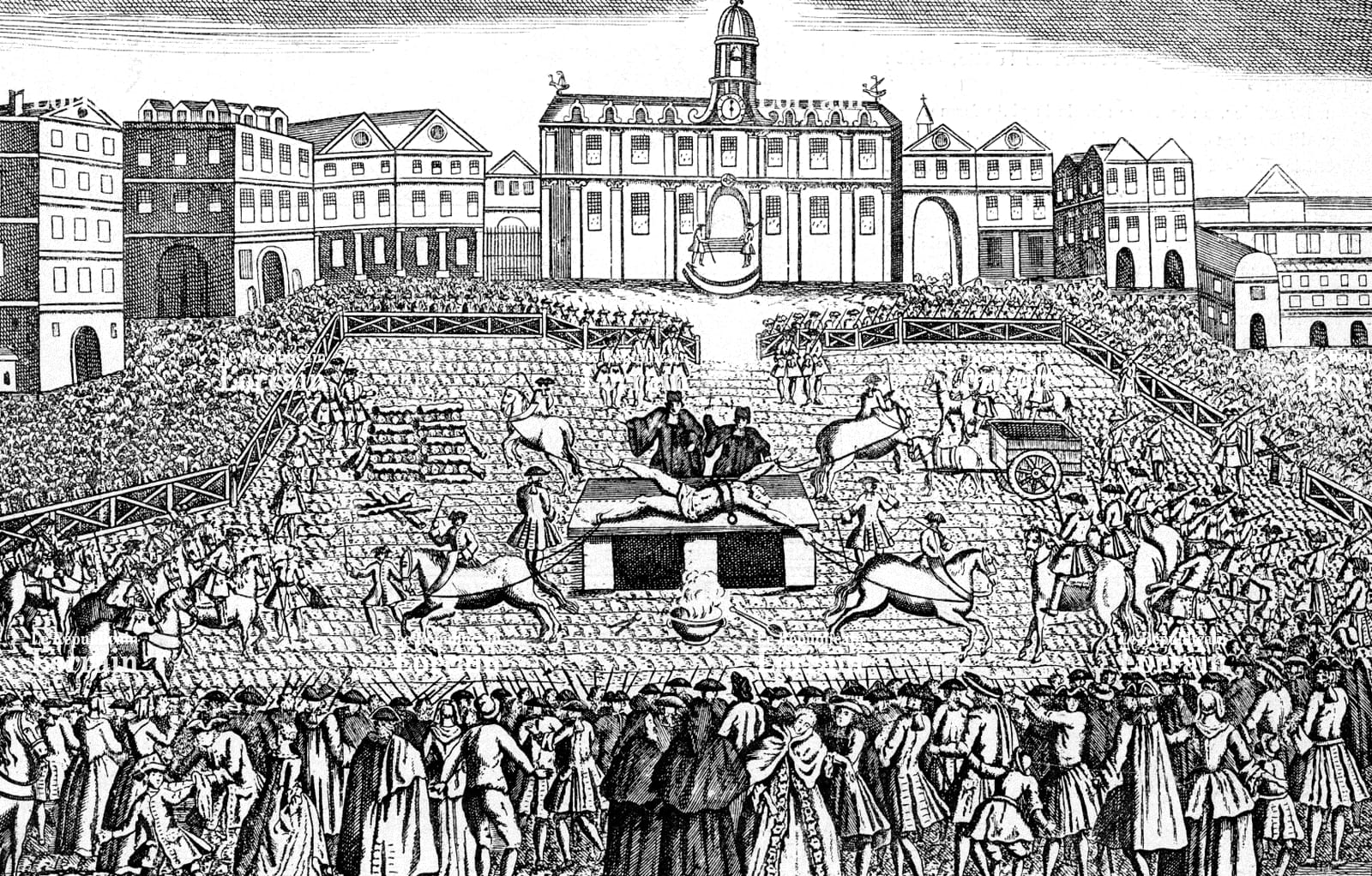
Discipline and Punish opens with Robert-François Damiens, who in 1757 attempted to kill Louis XV, and whose body was taken apart in public at the Place de Grève.19 Foucault lingers on the scene because of what it was for. The public execution was not justice in our sense. It was a ceremony in which sovereign power, wounded by the crime, was restored by being displayed, in excess, on the body of the one who had wounded it. The crowd was indispensable: it was the witness before which the sovereign’s power was made manifest. The crowd was also the danger, because crowds could turn, could side with the condemned, could riot at the foot of the scaffold. Within eighty years, Foucault argues, punishment had withdrawn from public view into the prison, the timetable and the examination: a power that no longer needed to be seen, because it did the seeing.
Set Hegseth’s rationale beside the scaffold’s and they are very nearly the same sentence: the people must see, so that they understand. The staging is older still. An execution performed at the scene of the crime, on the weekday and at the hour of the crime, is a ritual of overwriting, the punishment as re-enactment, a copy of the original event produced in order to replace it in memory. The scaffold’s choreographers understood this; executions were sometimes carried out at the very place the offence had been committed. Baudrillard would recognise the move. So would anyone who has watched a network schedule a rerun.
But the stream is not a return of the scaffold, and the difference is this whole series in miniature. Damiens’s crowd was there. It stood in the territory; it could smell it; it could riot. The scaffold, for all its horror, was a first-order event. A livestream has no crowd. It has an audience: distributed, at n removes, each member alone with a screen, the footage available to be clipped, looped, slowed, captioned, set to music, and (Part Two’s liar’s dividend being what it is) declared fake by some fraction of its viewers within the hour. The livestream is not the scaffold reborn. It is the scaffold’s simulacrum, the form of public execution without its public. Foucault’s disciplinary society made punishment invisible so that power could see. The Stage Four state makes punishment hypervisible so that power can be seen, and harvested.
How does that make us different from Iran?
It was the question many people reached for first, and it deserves a better answer than either the one its askers intend or the one its targets will give. Public executions have become rare in the world. Amnesty International counted eleven in Iran last year and six in Taliban-run Afghanistan; they are the only two states known to have carried any out. So the comparison is not idle. But the more unsettling answer is that the American plan would go beyond Iran. Iran hangs people from cranes in public squares. No state anywhere is known to livestream a legal execution. The Iranian public execution is a Stage One spectacle, crude and physical and witnessed: al-Sahhaf’s model of punishment, all territory. The American plan is Stage Four. Part Two’s two kinds of lies have become two kinds of killing. And when Senator Chris Murphy reached for a precedent, he found it not among states at all but in the filmed executions of the Islamic State: the one prior producer of execution as distributed media content, an organisation whose entire strategy was the apparatus.20
And yet honesty requires the other half of the answer. Hasan is not a protester hanged after a summary trial. He had a court-martial, a jury, and more than a decade of appellate review. The difference between the American and Iranian systems is real, and it lives entirely in the procedure: the trial, the record, the appeals, the rules about who may watch. That is territory. The stream will show none of it. On a screen a volley is a volley; twelve years of process do not render at 1080p. The broadcast erases precisely the thing that distinguishes us. So the honest answer to the question is this: it makes us different only in the part that will not be shown.
There is an American precedent, too, and Reuters, to its credit, named it. The last legally sanctioned public execution in the United States took place in 1936, when thousands watched the hanging of a young Black man convicted of raping a white woman; and lynchings, overwhelmingly by white mobs against Black Americans, remained public spectacles well into the twentieth century.21 Those spectacles were also the first American mass media of execution: photographed, printed as souvenir postcards, and sold.22 I do not raise this to assign the Fort Hood stream a motive it does not need. I raise it because the form has a history, and the history is not neutral, and because on the same Thursday afternoon the same executive branch announced that it would stream the execution of a Muslim man and told a state to fight back against a Black Muslim immigrant community. I do not claim the two announcements were coordinated. This series has argued from the start that they need not be.
One more feature of the stream is something Part One could have predicted. Hasan represented himself at his court-martial, called no witnesses and gave no testimony, and his court-appointed lawyers worried openly that he was seeking a death sentence.23 Broadcast the death of a man who wanted martyrdom, in the middle of a war with Iran, and the same ninety seconds of footage will serve two audiences at once: for one, justice made visible; for the other, a martyr made. Maximum arousal at both poles. Part One’s thesis, delivered as a single image.
Witness and audience.
The person in this story who understands it best is Alonzo Lunsford. A sergeant at Fort Hood in 2009, he was shot seven times and survived by playing dead. He told the BBC that he supports the firing squad as fitting for what Hasan did. He does not think everyone should be able to watch the stream, because he worries about what it will teach the young. But he believes the survivors and the families of the dead should be able to see it, uncensored, and he plans to be there in person. Before the rifles are raised, he wants Hasan to look him in the eye. “I want him to know he failed. I’m still here.”24
That is the whole of Part Three in two sentences. The survivor wants the territory: presence, the eyes, the witness who was there and is still there. The Secretary wants the map: the stream, the audience, the content. These are not two degrees of the same thing. They are opposites. When Timothy McVeigh was executed in 2001, the Justice Department arranged a closed-circuit feed for survivors and families in Oklahoma City.25 Whatever one thinks of that arrangement, it was an extension of witnessing to the people who had stood in the territory. The Fort Hood stream is the replacement of witnesses by an audience, and the difference between the two is the difference between justice as a relation between persons and justice as content.
The best argument for the stream deserves a hearing, and it comes from an unexpected direction. Deborah Denno, who has spent decades studying American execution methods, told the BBC that a livestream would force a transparency the country has never seen, and that a nation where most people support the death penalty should have to see how it is carried out. Two-thirds of Americans told Pew this summer that they support executing murderers. The argument has an honourable and largely abolitionist pedigree: journalists have tried before to televise executions, precisely so that the public would have to look, and the courts have stopped them. The week before the Fort Hood announcement, Tennessee’s attempt to execute Christa Pike by lethal injection failed, and she woke in a hospital bed, shackled to it.26 Transparency, on this view, is the cure for exactly the abstraction this series has been diagnosing.
I take the argument seriously, and I think it fails, for reasons Part One supplied in advance. Transparency presupposes a particular kind of viewer: Swift’s reader, Ebert’s reader, the one who holds an image in suspension and interrogates it against what they know. The stream will not reach that viewer. It will reach the one the feed has spent fifteen years training: process the surface, react, move on. It will arrive without the record, without the twelve years, without Lunsford’s eyes; it will be harvested at both poles; and it will be superseded by Friday. A Stage One public could have been made to look. A Stage Four public can only be made to watch.
The execution may never happen at all. John Mills, a lawyer who represents people sentenced to death, told the BBC that Hasan’s appellate process is not over, that a federal habeas petition would likely stay the execution, and that he would be surprised if it went ahead; he called the plan attention-seeking, unlikely to occur, and less likely still to deliver anything resembling justice.27 If he is right, the Fort Hood stream will be the purest Stage Four event of this entire war: an execution that exists only as an announcement, and that has already done everything it was for (the engagement harvested, the resolve performed, the enemy named) without a shot being fired. Baudrillard’s first Gulf War essay said the war would not take place. The execution may not either. It has already taken place in the only location the apparatus recognises.
Which brings us, finally, to Baudrillard, and to the reason this series cannot end where he did.
4. The War Did Take Place
In which we part company with the master, and find the door he never thought to look for
Baudrillard’s Gulf War essays are routinely misread as denying that anything happened in the Gulf, so it is worth being fair to him before parting from him. He did not say that no bombs fell or that no one died. His argument was that what Western audiences consumed as “the Gulf War” was not a war in any classical sense, but an asymmetric, pre-scripted operation whose outcome was known in advance and which was experienced almost entirely as image: the nose-cone footage, the green night-vision skies of cable news, the briefings. The war as an event, a contest in which something was genuinely at stake between adversaries, did not take place. What took place was its simulation.28
That is a defensible thesis, and much of it anticipates this series. But titles do what titles do, and the most furious answer came from the British philosopher Christopher Norris, whose Uncritical Theory (1992) argued that a theory which cannot say plainly that the Gulf War took place, that there is a truth of the matter about bombs and bodies, has disarmed itself at precisely the moment critique was most needed.29 If the referent has dissolved into the sign, then the official account of the war is not false; it is merely one sign among others, and the intellectual who wishes to oppose it has nowhere to stand. Norris’s charge was that postmodern theory had talked itself out of the ability to say this is a lie.
I owe the reader a confession here, because this series has been trying to have it both ways. Part One borrowed Baudrillard’s taxonomy wholesale. Part Two ended by insisting “that there is still a territory, that it matters, and that the people who live in it and die in it are not characters in a narrative someone else is producing.” That is Norris’s position, not Baudrillard’s. Yet earlier in the same essay I wrote that in the fourth stage the noumenon “has not merely receded, as Kant understood it to recede. It has been ontologically supplanted.” That is Baudrillard’s position, not Norris’s. They cannot both stand, or at least they must stand in uneasy superposition.
Minab decides between them. If the territory has been supplanted, then there is no atrocity at Minab, only a contested sign: an image the American president can call AI-generated and the Iranian state can call martyrdom, with no fact beneath either to adjudicate between them. The girls become characters in competing narratives, which is exactly what Part Two accused the apparatus of making them. A theory that cannot tell the difference between a satellite photograph of pink and blue walls and a deepfake is a theory that completes the apparatus’s work for it. So the Kant paragraph has to be corrected. The territory was not supplanted. It was enclosed.
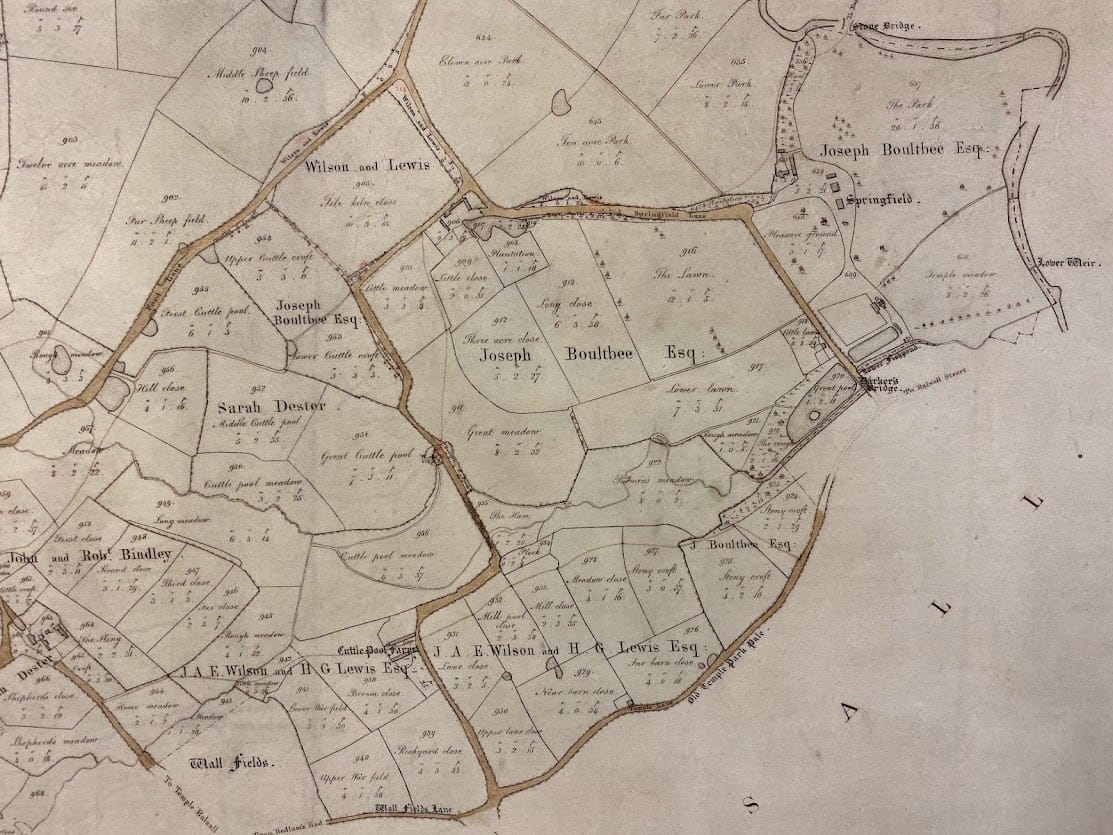
Enclosure.
The word is chosen with care. When the English commons were enclosed, the land did not go anywhere. The fields, the woods and the grazing remained exactly where they had always been. What changed was access: the customary right of ordinary people to walk on the land, gather from it and live from it was fenced off and converted into somebody else’s property. Marx called this the so-called primitive accumulation, the process by which people were separated from the means of their own subsistence and made dependent on those who held the fences.30
The commons of first-order knowledge has been enclosed in the same way. The strait is still twenty-one miles wide. The Tomahawk fragments were photographed. The satellite images exist. Forensic Architecture reconstructed the school, the military’s own investigators reached the same conclusion, and the price is still on the sign above the pump. None of it has gone anywhere. What has been fenced off is access to it and, more importantly, the right to make it count: the infrastructure through which a fact about the territory becomes a consequence in the polity. That infrastructure is held, in the sense Part Two developed, by the narrative class.
This is a class claim rather than a metaphysical one, and that is its whole advantage. You cannot organise against the absence of the real; Baudrillard’s later work is a long and elegant demonstration of that. But you can organise against a fence. Enclosures have been resisted before, and sometimes broken, and the history of that resistance is a history of institutions. The enclosure account also predicts what Baudrillard’s cannot, namely the leak documented in Section 1. Fences are never perfect. The land is still there, and sometimes it gets in. The pump price gets in. The names of the dead get in. A survivor who wants to be looked in the eye gets in.
Borges, it is worth noticing, understood this better than Baudrillard did. Baudrillard inverted the fable, so that the map came first and the real was what rotted in the desert. But in Borges’s original it is the map that ends in tatters in the western deserts, inhabited by animals and beggars. The territory outlasts it.
The pharmakon.
If the problem is enclosure, then the question becomes what kind of institution can cut the fence without becoming a new fence-holder. That is the Fox News problem from Part Two, in which every seizure of the apparatus simply installs a new narrative class. Part Two offered the rhizome as an orientation, but not as a design. There is a better guide, and it has been hiding in the vocabulary of Part One all along.
In the Phaedrus, Socrates tells the story of the Egyptian god Theuth, who brings the invention of writing to King Thamus and offers it as a pharmakon, a remedy for memory. Thamus refuses the gift: “this discovery of yours will create forgetfulness in the learners’ souls,” he says, because they will trust to external marks and cease to remember for themselves.31 Derrida’s “Plato’s Pharmacy” turns on the word. Pharmakon means both remedy and poison, and Plato’s text cannot settle which writing is; it is both, irreducibly.32 McLuhan’s typographic man, the reading citizen this whole series has been mourning, was produced by exactly the drug Thamus feared.
Bernard Stiegler spent the last decade and more of his life applying this insight to the attention economy. The psychotechnologies of television and the feed, he argued, wage a war on the attention of the young, capturing it for markets and in the process destroying the capacity for sustained attention on which education, culture and democratic life depend.33 But Stiegler refused the conclusion that the technology must therefore be fled, because there is no outside to flee to. Every form of human attention, including the reading attention McLuhan celebrated, is formed through some technics, and every technics is a pharmakon. The question is never whether to take the drug, but how it is dosed, under what discipline, and toward what end. Stiegler’s word for the answer was therapeutics: practices and institutions that turn the pharmakon toward care.
This dissolves the dilemma Part Two left hanging. Seizing the apparatus fails because it changes who holds the syringe and nothing else. Fleeing the apparatus fails because there is nowhere to go. What remains is the construction of therapeutic institutions: structures that take the very capacities the feed exploits (attention, judgment, the hunger to know what happened) and discipline them toward the territory rather than away from it. Part One called Trump’s value to the apparatus pharmacological by way of diagnosis. Part Three takes the word as a programme. And it turns out that we do not have to invent the first of these institutions. We have had it for centuries.
5. The Forum
In which the author confesses his day job, and finds that the counter-apparatus has been under his nose all along
Part Two asked for forms of knowledge production that would make the pause possible “not just for the reader who already knows to look for it, but for the diner patron who was never told it was missing.” I have spent my professional life inside one, and it took me two essays to notice.
The law of evidence is, among other things, a technology built over several centuries against precisely the epistemic condition this series has been describing. Consider its parts as if for the first time.34
The hearsay rule excludes out-of-court statements offered to prove the truth of what they assert. Strip away the exceptions, of which there are many, and what remains is a rule against n-th order knowledge. Part Two traced seven or eight removes of mediation between the closing of the Strait of Hormuz and the woman at the pump. In a courtroom, every one of those removes would draw an objection, and most of the objections would be sustained.
The personal-knowledge requirement goes further. Under Rule 602, a witness may testify to a matter only if there is evidence that the witness has personal knowledge of it. First-order contact with the territory is not merely preferred. It is the precondition of being allowed to speak at all.
Then there are prior inconsistent statements. “We never said regime change,” the president told the nation on April 1st, and then, in the next breath, that regime change had occurred. Part Two called the attention economy an amnesia machine, and the address relied on it: the audience would release the first claim before the second arrived. Put the same speaker on the stand and the two statements would be read back to him in thirty seconds, and the jury would be entitled to weigh one against the other. The feed scrolls. The record does not. Every word stays where it was put, and can be read back.
Authentication is the answer to the liar’s dividend, or at least the beginning of one. Before an image is admitted, someone must produce evidence sufficient to support a finding that it is what its proponent claims it is. The president can call a photograph of a destroyed school AI-generated on Truth Social. In a courtroom, someone would have to put the photographer, or the satellite operator, or the forensic analyst on the stand, and the other side could cross-examine them. It is slow, and expensive, and adversarial. That is the point. The friction that print culture supplied by accident, the forum supplies by design.
And then there is the jury. Take twelve people drawn more or less at random from the population: diner patrons, in the language of Part Two, the reception class itself. Instruct them to withhold judgment until all the evidence is in. Forbid them to consult the feed. Make them hear the same evidence at the same time, in the same room, in sequence, tested by an adversary. Require them to deliberate together, face to face, until they agree. Then make their decision bind. Nothing about the people has changed. Only the room.

This is the empirical answer to the objection to which Part Two is most exposed. An unsympathetic reader could fairly say that “reception class” is false consciousness in a fresh coat of paint, a theory that requires contempt for the woman at the pump, who is presumed incapable of the slow, comparative, suspended judgment the essay prizes. The jury shows the opposite. Ordinary people, given a structure that demands slowness, comparison and the record, do the work. Not perfectly, but well enough that the law stakes liberty and life on it every day. The deficit is not cognitive. It is architectural.
The jury has one further property that matters for the class analysis. It is drawn by lot, it is temporary, and it dissolves the moment it renders its verdict. No juror holds the seat long enough to begin pouring moulds. In this one respect it is the most rhizomatic institution the West has produced: a node of judgment that appears, decides and vanishes back into the substrate, leaving only the record behind. The narrative class cannot capture it, because there is nothing persistent to capture.
Forensis.
Eyal Weizman, who founded Forensic Architecture, likes to point out that forensis is Latin for “pertaining to the forum”: forensics was originally not a laboratory science but the art of presenting evidence before a public assembly.35 That is exactly what his group did for Minab. They took satellite imagery, video and photographs and produced first-order knowledge, outside the apparatus’s tempo and against its incentives. Then they presented it, to a news outlet, to the public, to anyone who would look. What they could not do was present it to a forum with the power to compel an answer. Answered, not adjudicated: that is Minab’s condition, and it is the condition of most of the truths that matter in this war.
Nor is the courtroom the only model. Between 2016 and 2018, Ireland convened a Citizens’ Assembly of ninety-nine randomly selected citizens and a chair, who spent months hearing expert testimony and deliberating on the Eighth Amendment, the constitutional provision that effectively prohibited abortion and the most divisive question in the country’s politics.36 The Assembly recommended change, a referendum followed in 2018, and the amendment was repealed. Whatever one thinks of the outcome, the process showed that a randomly drawn body of citizens, given time, evidence and a room, could deliberate on a question the feed would have rendered undeliberable. Part Two observed that Congress let the War Powers question drift, because its members watch the same television as everyone else. Imagine instead a randomly drawn body of citizens with the power to summon witnesses on the conduct of the war: the investigators from Minab, the targeting officers at Central Command, the families. It would at least have had to read the report.
Where the forum fails.
The two specimens from Sections 2 and 3 meet here, and between them they show both what the forum can do and where it stops.
Take the post first. The constitutional test for incitement, set out in Brandenburg v. Ohio, permits the government to punish advocacy of force only where it “is directed to inciting or producing imminent lawless action and is likely to incite or produce such action.”37 The test was built for a world in which the speaker and the crowd stood in the same street. Hess v. Indiana made the point concrete: a protester who shouted that the crowd would take the street later could not be punished, because his words were addressed to no one in particular and called at most for action at some indefinite future time. Now consider a post to millions of followers that names no act, no time and no place, and carries a ready-made alternative reading in its final sentence. It falls through Brandenburg in exactly the way the semantic lie falls through fact-checking. The doctrine was designed for Stage One speech, and Stage Four speech is not where it is looking.
I want to be precise about the conclusion, because it is not the one a certain kind of reader will expect. Brandenburg’s imminence requirement is not a defect. It is one of the great achievements of American constitutional law, and anyone who has watched the state reach for speech it dislikes should be in no hurry to weaken it. The point is not that the forum should punish the post. It is that the forum’s tools for policing speech are rightly narrow, and so the answer to Stage Four incitement cannot be found in the criminal law. It has to be found in forums of a different kind: places where the post’s claims about Minnesota (eighty thousand people, three shootings, a state supposedly taken over) could be entered into a record and tested against the territory, by the people who have to live with the consequences.
Now the stream. An execution is the forum’s output: the end product of a court-martial, a jury and more than a decade of appellate review. To livestream the volley without the record is to convert the forum’s product into feed, to take the one institution that runs on friction and strip-mine its most dramatic moment for content. But notice that the forum is also where the stream will meet its first real resistance. Hasan can seek federal habeas review, which would likely stay the execution. The military-law scholar Eugene Fidell has observed that Hasan would have to sue in federal court to block a public display of his death, and that the Supreme Court has never addressed the question.38 The Army’s own regulation on who may witness an execution would have to be waived or rewritten. Courts have blocked earlier attempts to televise executions.39 In the whole American polity, the courtroom is the one place where the Secretary of Defense’s announcement must be justified on a record, in writing, against an adversary, before a judge who must give reasons. That is why the apparatus wants the forum’s outputs and not its tempo.
An honest account must also admit the forum’s failures, and a criminal defence lawyer is not short of examples. The courtroom is arborescent architecture par excellence: the bench is literally raised, the judge sits at the root, and the whole procedure flows down from it. Trials are theatre, and for thirty years they have also been television. Juries read the news, whatever they are told. Procedure is expensive, and justice tends to flow toward those who can pay for it. And the forum can be overwhelmed. In May 1989, a New York real-estate developer bought full-page newspaper advertisements calling for the return of the death penalty in the wake of the Central Park jogger case. Five teenagers were convicted; their convictions were vacated in 2002, after another man confessed and DNA evidence confirmed it.40 The man who bought the advertisements is the subject of Part One. The map has been trying to try cases for a long time, and he was an early adopter.
But what these failures show is not that the forum is no better than the feed. They show that the forum’s virtues are fragile, and that they depend on friction and the record rather than on hierarchy. The arborescent model’s real vice was never its height. It was that information flowed in one direction, from the root outward. The adversarial courtroom is built so that information flows both ways, under rules, and so that the record holds both. Strip out the friction, try the case in the newspapers before the jury is seated, and the forum degrades toward the feed. Protect the friction, and it remains the most effective counter-apparatus we have.
What would it mean to build more of them, at the scale of the diner patron rather than the federal judiciary? I do not have a programme, and I distrust anyone who claims one. But the forum suggests five design principles that travel:
- First-order access as a precondition. The witness over the commentator; the person who was there over the person with a take.
- The record. Persistence against amnesia, so that the earlier claim is still there when the later one arrives.
- The adversary. Structured contradiction rather than bilateral stimulation: two sides testing a claim, not two audiences consuming it.
- The lot. Temporary, randomly drawn bodies of ordinary people, which cannot harden into a narrative class because they do not persist.
- Consequence. Some mechanism by which an answered question becomes an adjudicated one, so that knowledge binds somebody.
A newsroom that runs its corrections in the same slot as its errors has one of these. A citizens’ panel with the power to call witnesses has four. A reading group that takes one long thing slowly and argues about it in person has more than you might think. None of them will save the republic. All of them are fences cut.

Coda: The Brooklyn Diner, Revisited
Part Two opened with a photograph: a woman in a Midtown restaurant named for a borough it is not in, watching the president address the nation on a war she could not see. I described her as the reception class in a single frame, saturated with information and starved of knowledge, feeling the war and unable to evaluate it.
Imagine instead that she had been summoned. Not to watch the address, but to hear it read back to her, the two sentences about regime change set side by side. To hear from the analyst who reconstructed the school from satellite imagery, and from the officer who generated the coordinates, and from the families. To be told: take your time; you may not consult the feed; you must decide together with these other people, face to face; and your decision will count. Nothing about her would need to change. She is not stupid, and she is not deceived in the way the old theories of false consciousness supposed. She is simply standing in the wrong room. The whole of the counter-apparatus is a matter of building better rooms.
Alonzo Lunsford is going to Fort Hood on December 3rd, if the execution goes ahead, to look a man in the eye. The Secretary of Defense is going to make sure the rest of us can watch. Between the witness and the audience lies the whole distance between the territory and the map, and which side of that distance we choose to stand on is, in the end, the only political question this series has really been asking.
The war did take place. The school at Minab took place, and so did its pink and blue walls, and so did the investigation that found what everyone already knew. The shootings in Eden Prairie and Bloomington took place, and whatever fight back turns out to have meant will take place too, or not, in the territory, to real people. The map will claim all of it. The work, at whatever scale is available to you, is to build rooms where the territory can be entered into the record.
This essay is not one of those rooms. At best, it is a summons. I cannot give you answers, or even really a method, but perhaps the genesis of a method. You are going to have to figure out what knowledge means in this brave new world, and how to assess, organize, store, and regurgitate that knowledge in ways that communicate meaning and value to a world inundated with noise and increasingly immune to signal.
I have remarked before that the constant stream of atrocity flowing from Washington is mentally, physically, and spiritually exhausting, and then quipped that that is very much the point. When everything bad comes at you so fast you cannot catch your footing, you lose all moorings that make the kinds of critical judgments necessary to proper cognitive function possible. And indeed, as Part Two pointed out, that is a way that the producer/consumer of information class divide works. When you become audience, rather than an active narrative participant, you lose the ability to shape the narrative according to your desire. You are still a desiring machine, still a cog in the flow, but now you are separate from your means of action, your means of breaking the flow. This is the Deleuzean coda to this whole thing: if you are going to break the flow, to grow new rhizomatic tendrils, to effectively organize and fight back yourself, you cannot do it within the epistemic frame gifted to you by a modernity born of a past age.
1. Donald J. Trump, Truth Social post, October 8, 2026, as reproduced in KSTP, “Minnesota leaders respond to President Trump’s comments about Somali community,” October 8, 2026, and quoted in Kyla Guilfoil, “Trump urges Minnesotans to ‘fight back’ against Somali immigrants,” NBC News, October 8, 2026. ↩
2. Phil Stewart, “US to livestream Army firing squad execution of Fort Hood shooter, Pentagon says,” Reuters, October 8, 2026. ↩
3. Sareen Habeshian, “Firing squad execution to be livestreamed, Pentagon says,” BBC News, October 9, 2026 (statement of John Mills). ↩
4. Jean Baudrillard, La Guerre du Golfe n’a pas eu lieu (Paris: Galilée, 1991), collecting the three essays first published in Libération in January, February and March 1991. English translation: The Gulf War Did Not Take Place, trans. Paul Patton (Bloomington: Indiana University Press, 1995). ↩
5. “Targeting error behind deadly US Tomahawk missile strike on Iranian school – report,” IOL/Xinhua, March 13, 2026, summarising New York Times reporting on the preliminary military investigation. See also Al-Monitor, “Pentagon elevates investigation into Iran school strike,” March 2026. ↩
6. Sky News, “Senators demand Pentagon reveals outcome of Minab school strike probe,” July 13, 2026. ↩
7. Forensic Architecture with Sky News, “Airstrikes on Minab Primary School” (2026). ↩
8. Interview with Samaneh Moafi, assistant director of research at Forensic Architecture, Democracy Now!, via Truthout, “A New Report Reveals Key Details About the US’s Bombing of Minab School.” ↩
9. “2026 Iran war ceasefire,” Wikipedia (accessed October 9, 2026); Just Security, “Early Edition: July 20, 2026.” ↩
10. Reuters/Ipsos poll, August 14–17, 2026; Economist/YouGov tracking poll, as reported in Newsweek, “Trump breaks his own lowest approval record with top pollster” (2026). ↩
11. Statement of Gov. Tim Walz, in KSTP, note 1. ↩
12. Stewart, Reuters, note 2 (the White House declining to comment); Habeshian, BBC News, note 3 (the president’s remarks of October 9). ↩
13. KSTP, note 1 (law enforcement’s attribution of the Eden Prairie and Bloomington incidents to Somali gang activity, and the response of Eden Prairie’s Somali leaders). ↩
14. Truth Social post, note 1; Guilfoil, NBC News, note 1 (the White House’s non-response). Population figures from Reuters, “Minnesota officials defend Somali community against Trump’s attacks,” December 2, 2025, and AP, “Trump targets Minnesota’s Somali community with harsh words and policies,” December 3, 2025. ↩
15. Statement of Council Member Jamal Osman, in KSTP, note 1. ↩
16. Reuters, December 2, 2025, note 14. ↩
17. AP, “Firing squad execution of Fort Hood shooter Nidal Hasan scheduled for December,” October 7, 2026; Stewart, Reuters, note 2. ↩
18. Stewart, Reuters, note 2 (the livestream, Hegseth’s confirmation, and the absence of any televised legal execution elsewhere); Habeshian, BBC News, note 3 (Army Regulation 190-55). ↩
19. Michel Foucault, Discipline and Punish: The Birth of the Prison, trans. Alan Sheridan (New York: Pantheon, 1977), Part One, “Torture.” ↩
20. Habeshian, BBC News, note 3 (Amnesty International’s figures for 2025; Sen. Chris Murphy); Stewart, Reuters, note 2. ↩
21. Stewart, Reuters, note 2. ↩
22. James Allen, Hilton Als, John Lewis and Leon F. Litwack, Without Sanctuary: Lynching Photography in America (Santa Fe: Twin Palms, 2000). ↩
23. “Trump approves firing squad for Nidal Hasan, US military base shooter,” Khaleej Times, October 2026. ↩
24. Habeshian, BBC News, note 3 (Alonzo Lunsford). ↩
25. The June 11, 2001 execution of Timothy McVeigh at the federal penitentiary in Terre Haute, Indiana, was transmitted by closed-circuit feed to survivors and family members of victims gathered in Oklahoma City, under an arrangement approved by Attorney General John Ashcroft. ↩
26. Habeshian, BBC News, note 3 (Deborah Denno; the July Pew survey); Stewart, Reuters, note 2 (earlier attempts to televise executions; the Christa Pike execution attempt). ↩
27. Habeshian, BBC News, note 3 (John Mills). ↩
29. Christopher Norris, Uncritical Theory: Postmodernism, Intellectuals and the Gulf War (London: Lawrence & Wishart, 1992). ↩
30. Karl Marx, Capital, Volume I (1867), Part VIII, “So-Called Primitive Accumulation.” ↩
31. Plato, Phaedrus 275a, trans. Benjamin Jowett (1892). ↩
32. Jacques Derrida, “Plato’s Pharmacy,” in Dissemination, trans. Barbara Johnson (Chicago: University of Chicago Press, 1981). ↩
33. Bernard Stiegler, Taking Care of Youth and the Generations, trans. Stephen Barker (Stanford: Stanford University Press, 2010); What Makes Life Worth Living: On Pharmacology, trans. Daniel Ross (Cambridge: Polity, 2013). ↩
34. Fed. R. Evid. 602 (personal knowledge); 613 and 801(d)(1)(A) (prior inconsistent statements); 801–802 (hearsay); 901 (authentication). The Texas Rules of Evidence track the federal rules closely on each point. ↩
35. Forensic Architecture (ed.), Forensis: The Architecture of Public Truth (Berlin: Sternberg Press, 2014); Eyal Weizman, Forensic Architecture: Violence at the Threshold of Detectability (New York: Zone Books, 2017). ↩
36. The Citizens’ Assembly (Ireland), First Report and Recommendations of the Citizens’ Assembly: The Eighth Amendment of the Constitution (2017). The amendment was repealed by referendum on May 25, 2018. ↩
37. Brandenburg v. Ohio, 395 U.S. 444, 447 (1969) (per curiam); Hess v. Indiana, 414 U.S. 105 (1973) (per curiam). On true threats, see also Counterman v. Colorado, 600 U.S. 66 (2023). ↩
38. Stewart, Reuters, note 2 (Eugene Fidell). ↩
39. See Houchins v. KQED, Inc., 438 U.S. 1 (1978); KQED, Inc. v. Vasquez, No. C-90-1383 (N.D. Cal. 1991) (rejecting a public television station’s bid to film an execution at San Quentin). ↩
40. On the May 1989 advertisements and the 2002 vacatur of the convictions, see Sarah Burns, The Central Park Five: A Chronicle of a City Wilding (New York: Knopf, 2011). ↩