
Stage Four, Part Two: What the Map Costs
Class, in the information economy, is determined not by what you own but by your structural position relative to the narrative apparatus. The ruling class are those who pour the moulds. The rest of us are cast in them.

"We never said regime change, but regime change has occurred because of all of their original leaders' death — they're all dead." — Donald Trump, Address to the Nation, April 1, 2026
There is a photograph that ran with Al Jazeera's coverage of the president's April 1st address to the nation on the Iran war. It shows a single viewer at a restaurant in Times Square, watching the speech on a mounted television screen. The restaurant is called the Brooklyn Diner. The photograph was taken by a Reuters photographer named David Dee Delgado.¹ It is an excellent photograph. It is also, if you are paying attention to what you are looking at, a nearly perfect image of the epistemological condition this essay is about.
Look at what is in the frame. Times Square is the most intensively media-saturated public space in the world, an environment designed at every level to produce and sustain a state of perpetual visual stimulation, in which the boundary between advertisement and information has been so thoroughly dissolved that the distinction is no longer meaningfully available to anyone standing inside it. A restaurant named the Brooklyn Diner, located not in Brooklyn but in Midtown Manhattan, a simulacrum of working-class authenticity positioned in the capital of upper-middle-class aspiration, its name a representation of a thing it is not. A television screen, carrying a live broadcast of a president addressing the nation about a war. And a single viewer, watching.
What is that viewer watching? Not the war. She cannot watch the war. The war is in Iran, where approximately 90 million people live, and where the United States military has been conducting "Operation Epic Fury" for the past thirty-three days. She is watching a representation of a man who is himself a fourth-order image/simulation, as I argued at length in Part One, delivering a representation of an account of events that he has described differently every day for the past month, in a room designed for the production of presidential authority, interrupted from a scheduled broadcast of Survivor, carried on a network that preemptively issued a programming advisory about the interruption so viewers could plan accordingly.
The map has eaten the territory. Part One ended by asking what that costs, and who pays the price. Part Two is the answer. Attend.
1. The Specimen Case
In which we find our test subject has helpfully provided its own dissection notes
The April 1st address was nineteen minutes long.² It was Trump's first formal prime-time address about the Iran war since Operation Epic Fury began on February 28th, thirty-three days during which the president had spoken frequently to reporters, posted extensively on Truth Social, and given multiple interviews, but had not addressed the nation in the traditional presidential manner. The White House announcement of the speech generated significant anticipation among analysts, some of whom expected a major announcement: either a declaration of victory, or an escalation to ground operations.
Neither materialized. What materialized instead was something more interesting, analytically speaking: a specimen of fourth-order communication in almost laboratory-pure form. The address contained four claims, each of which is logically incompatible with at least one of the others, delivered sequentially within nineteen minutes, with every expectation (well-founded, as it turned out) that the incompatibility would not be noticed, or if noticed, would not be held.
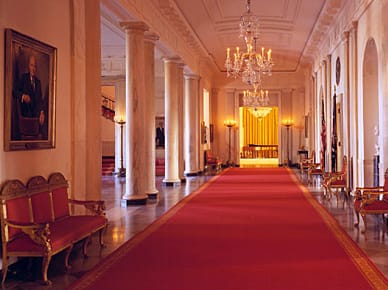
The war is necessary. The war has already been won. The war must continue. The war will end soon. These four propositions cannot all be simultaneously true in any conventional sense of the word true, but they are not intended to be true in that sense. They are intended to perform authority. They are intended to constitute a political reality—the president is in command, the operation is succeeding, the situation is under control—without referring to any territory that could be independently checked against the claim. This is not spin in the ordinary sense. Spin is the strategic framing of real events to produce a favorable impression. What the address performs is something categorically different: the generation of a reality-effect that does not require real events as its raw material.
Consider the specifics, because the specifics are where Stage Four becomes undeniable. On the question of regime change: from the initial statement of objectives on February 28th, Trump had explicitly included an appeal to the Iranian people to overthrow their government: "when we are finished, take over your government; this will be probably your only chance for generations." By the April 1st address, this objective had been removed from the list without acknowledgment. In the same address, Trump stated that "regime change was not our goal. We never said regime change." He then immediately continued: "But regime change has occurred because of all of their original leaders' death, they're all dead. The new group is less radical and much more reasonable."
Two sentences. The first denies that regime change was ever an objective. The second claims credit for having achieved it. The cognitive dissonance is total. It is not a slip. It is the characteristic move of a communicator who operates entirely within Stage Four: the claim does not refer to a past state of affairs that can be checked against the record. It refers to the performance of authority in the present moment. The record is irrelevant because the audience has been trained, by the same apparatus that produced the speaker, to process the surface and move on rather than hold the earlier claim in memory while evaluating the later one. The attention economy is, among other things, an amnesia machine.
The nuclear question and the narrative justification of war.
The nuclear question tells the same story. Preventing Iran from acquiring a nuclear weapon was stated as the central justification for the war from its first day. The IAEA³ had reported, days before hostilities began, that while Iran had stored highly enriched uranium in an underground facility undamaged by the previous year's strikes, there was no evidence of a structured nuclear weapons program. In the days immediately preceding the address, Trump told Reuters he was not concerned about that stockpile: "That's so far underground, I don't care about that." In the address itself, the nuclear question was substantially downstaged from its original centrality, with Trump noting that the bombed sites would be "difficult for Iran to access" and that the U.S. had them "under satellite surveillance." The objective that had justified the war had been quietly demoted, without acknowledgment, because the thing it had justified could not be accomplished by the means deployed without a ground operation no one is prepared to order.
Before the address, Trump had been claiming publicly that Iran had asked the United States for a ceasefire, suggesting that negotiations were ongoing. Iran denied this consistently. In the address, any mention of negotiations was conspicuously absent. The claim was not retracted. It was simply dropped, in the same way you drop something you no longer need rather than in the way you acknowledge an error.
None of this is ordinary dishonesty. Ordinary dishonesty involves a speaker who knows the truth and says something else, with some awareness of the gap between what they are saying and what is the case. What the address performs is something structurally different: a mode of public communication in which the relationship between statement and referent has been severed so thoroughly that the category of "dishonesty" no longer quite applies. There is no lie here in the classic sense, because lying requires a suppressed truth the liar is aware of. What the address performs is the production of political reality by statement, independent of the states of affairs the statements purport to describe. It is Baudrillard's fourth stage not as metaphor but as operational mode of executive communication in wartime.
This would be alarming enough if it were only about Trump. It is not only about Trump. The apparatus that produces and distributes and monetizes this communication is the same apparatus that was described in Part One: optimizing for engagement, not for truth; built to deliver stimulation, not information; structurally incapable of correcting the record within the timeframe in which the record matters. The forensic analyses, the fact-checks, the accountability journalism, all of it exists, and most of it is good, and none of it reaches the audience at the moment and at the cognitive temperature at which the original claim was received. The correction is always downstream of the damage. In Stage Four, the correction is beside the point.
2. First-Order and N-th Order Knowledge
In which we discover that knowing and understanding are not the same thing, and that the gap between them is where governance goes to die
Let us be precise about what ordinary Americans actually know about the war in Iran, because precision here is what distinguishes the epistemological argument from the merely rhetorical one.
There is a fact available to anyone who fills a gas tank or buys groceries: things cost more than they did two months ago. This is real. It is directly experienced. It is first-order knowledge in the relevant sense, unmediated by representation, available to the senses, impossible to propagandize away. The woman at the pump knows the price on the sign. She does not need a journalist to tell her.
What she does not know—cannot know, not from lack of intelligence but from the structure of her epistemic position—is the causal chain that produced that price. The Strait of Hormuz is a body of water approximately 21 miles wide at its narrowest point, through which approximately one-fifth of the world's oil supply normally passes. Iran closed it on February 28th. The closure disrupted global oil markets, sending Brent crude above $105 per barrel. That price increase propagated through the supply chain and appeared, with some lag, on the sign above the pump. The causal chain is real. It is traceable. It is not, in principle, unknowable.
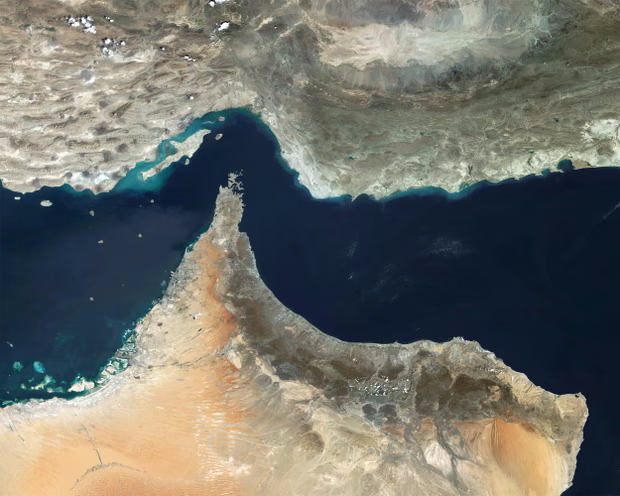
But by the time this causal chain reaches the diner patron watching the speech in Times Square, it has passed through approximately seven or eight removes of mediation. There is the original event (the closure of the strait). There is the reporting of the event (first-order journalism, geographically distant). There is the analysis of the reporting (the anchor interpreting the reporter interpreting the event). There is the aggregation of the analysis (the cable news package synthesizing multiple analysts). There is the distribution of the aggregation (the algorithm selecting which package reaches which viewer at which moment). There is the prior media diet of the viewer, which determines the interpretive frame she applies to what she receives. There is the tribal affiliation that determines which frame feels right. And finally, at some remove from the original closure of a 21-mile waterway on the other side of the planet, there is the woman at the pump who pays $4.37 for regular and has a feeling about it.
The feeling is real. The feeling is politically potent. The feeling will influence her vote, her conversations, her orientation toward the war and the president who ordered it. But the feeling is not knowledge of the causal chain. It is the affective residue of a causal chain that has been translated through so many removes of mediation that the specific mechanism—the strait, the oil, the tankers backed up and redirected, the futures markets responding to anticipated shortage, the retail prices responding to the futures markets—has been entirely lost. What remains is: things cost more, and there is a war, and a president who says the war is nearly over.
The epistemological consequence of Baudrillard's fourth stage is, in this respect, a Kantian catastrophe. For Kant, empirical knowledge (the synthetic a posteriori) is always and necessarily mediate: we do not know the thing-in-itself, the noumenon, but only the phenomenon as it is given to us through the forms of intuition and the categories of understanding. This is not a defect of human cognition but its structural condition. The noumenon recedes; the phenomenon is what we have; and the phenomenon, properly processed, is sufficient for science, for ethics, for the conduct of a rational life. What Baudrillard's fourth stage introduces is something Kant did not anticipate and his framework cannot accommodate: the elimination of the phenomenon as a mediating contact with the noumenon, and its replacement by the simulacrum, which does not mediate the real at all. The synthetic a posteriori now operates, but what it synthesizes is not sensory data that stands in some causal relation to an independent world. It synthesizes representations of representations of representations, each remove further from any originating contact with the territory. The noumenon has not merely receded, as Kant understood it to recede. It has been ontologically supplanted. What is given in intuition is the fourth-order image, and the cognitive apparatus dutifully processes it as if it were the world, because the cognitive apparatus has no other option and, increasingly, no memory that there was ever anything else to process.
The epistemic consequences of simulation and n-th order knowledge.
This is what I mean by n-th order knowledge: knowledge so attenuated from its referent that it retains the emotional weight of information without its epistemic content. The diner patron is not uninformed. She is saturated with information. She has access to more raw data about the Iran war than any civilian at any point in human history has had access to information about any prior conflict. What she lacks is not data. What she lacks is the epistemic infrastructure to convert that data into knowledge of what is actually happening and why, because that infrastructure (the cognitive habits of comparison, suspension, and contextual evaluation described in Part One) has been systematically degraded by the same apparatus that delivers the data.
Stage Four simulation is what you get when n-th order knowledge completely displaces first-order knowledge in public discourse, and the system has no mechanism (and no structural incentive) to correct for this. The displacement is not occasional or selective. It is total. There are no American civilians with first-order knowledge of the Iran war, and there are essentially no American citizens whose political orientation toward the war is formed by anything other than n-th order mediation. The country is making consequential decisions; or rather, the country is constituting the political conditions under which consequential decisions are made, on the basis of a representation of a representation of a representation of events occurring to ninety million people in a place most of the decision-makers could not locate on a map without assistance.
Trump is approaching the sixty-day mark at which the War Powers Act requires him to seek congressional authorization to continue military operations. He has not discussed this. Congress has not pressed it. The body constitutionally charged with the authorization of war is populated by members whose epistemic position relative to the conflict is not meaningfully different from that of the diner patron: n-th order, mediated, affectively saturated but epistemically thin. The constitutional mechanism for democratic accountability in wartime presupposes a deliberative body capable of independent evaluation of the executive's claims. What it has instead is a body that watches the same television.
3. Two Kinds of Lies
In which we find that not all dishonesty is created equal, and that the more sophisticated form is the one that cannot be fact-checked
The Iran war has been, among other things, an unprecedented laboratory for information warfare, and it is worth examining that warfare carefully, because the comparison between what Iran is doing and what the United States government is doing reveals something important about the structure of lying in a Stage Four environment.
Iran's information operation has been documented in considerable detail. Within twenty-four hours of the start of hostilities, dozens of social media accounts affiliated with the Islamic Revolutionary Guard Corps had begun posting propaganda about the conflict. The content is, for the most part, factually false in straightforward ways. An IRGC spokesman claimed 650 American troops were killed or wounded in the conflict's first two days; CENTCOM confirmed six had been killed. Iranian state broadcaster IRIB TV1 aired fabricated footage in at least one documented instance using muted video of an Israeli attack on Iran while narrating a story about Iran striking Israel. Viral posts claimed Netanyahu was dead; he posted a sardonic video of himself drinking coffee to disprove it, and then the video itself became the subject of deepfake speculation, an ouroboros of simulacrum. Images of burning vehicles in Tel Aviv turned out to be footage from the January 2026 protests in Tehran. A claimed Iranian strike on Tel Aviv turned out to be recycled footage from 2025. Video game footage from Arma 3 was presented as real combat. By the conflict's first twenty-five days, NewsGuard had tracked fifty false claims,⁴ an average of two per day, with volume and sophistication still climbing.
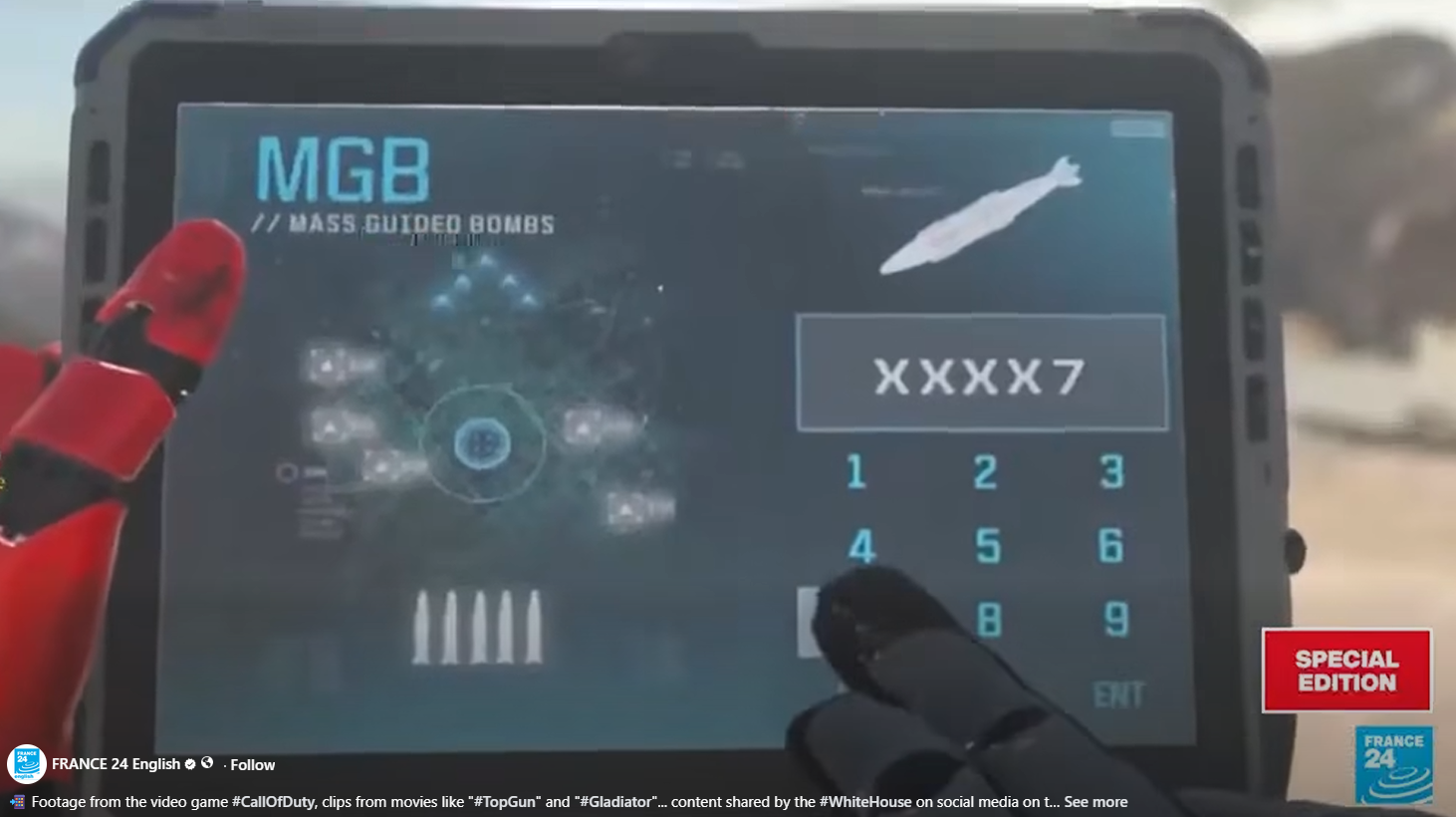
The United States government's information operation is considerably subtler, and the subtlety is the point. Our propaganda is no less false, but more sophisticated and aimed at deceiving those who believe themselves impervious to deception. The White House has posted approximately a dozen "hype videos" to X and TikTok since the conflict began: montages weaving real strike footage with clips from Call of Duty, Iron Man, Top Gun, and Braveheart, in several cases with nothing in the presentation to distinguish fiction from combat. One video (subsequently removed) overlaid Call of Duty's "+100" score notification on every Iranian target struck. JUSTICE THE AMERICAN WAY, read the caption. The official account of the presidency of the United States posted this.
These are structurally different kinds of dishonesty, and the difference matters more than the similarity — though in the ambient flow of the news cycle, that difference is very nearly inaudible. It is, in this respect, something like Derrida's différance: a distinction invisible in speech, available only to the reader who pauses long enough to look carefully at the page. Spoken aloud, différance and différence are identical sounds. On the page, one letter separates them, and that letter changes everything about what the word is doing, deferring meaning rather than merely marking it, introducing a trace of absence into what appeared to be a presence. So too here: Iranian disinformation and White House disinformation sound, in the register of a scrolling feed, like the same phenomenon. They are not the same phenomenon. The difference is structural, and structural differences have structural consequences.
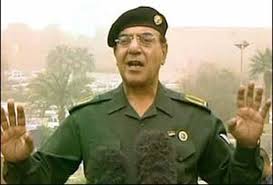
Iran's model has a distinguished lineage. Mohammed Saeed al-Sahhaf, "Baghdad Bob" to the Anglo-American press that watched him with a mixture of derision and morbid fascination during the 2003 invasion of Iraq was its purest modern specimen. While coalition tanks were visibly rolling through the streets of Baghdad, al-Sahhaf stood before cameras and announced overwhelming Iraqi victories, the imminent destruction of American forces, the inevitable collapse of the invasion. He was not merely wrong. He was wrong in ways that were falsifiable in real time, by anyone with a television and a window. His lies had the structural property that doomed them: they made specific claims about the territory at a moment when the territory was unusually, catastrophically visible. Baghdad Bob became a meme because factual lies, in the presence of sufficient first-order evidence, collapse into comedy. Iran's current information operation is al-Sahhaf's operation with a generative AI budget and a Clemson University study attached to it. The structure is identical. The production values are considerably higher. The fundamental vulnerability is the same.
Iran's lies are factual. They make specific claims about specific events—casualty figures, downed aircraft, strikes on specific targets—that can be checked against independently verifiable evidence, and that have been checked, and that have failed the check, consistently and at scale. The failure is documented. The documentation circulates. Iran's factual lies are, in the medium term, self-defeating: they have contaminated the information commons so thoroughly that Iran's legitimate claims, e.g., about civilian casualties, about strikes on civilian infrastructure, about the real human cost of the bombardment — are now received with the same skepticism as the obvious fabrications. This is what the Carnegie Endowment for International Peace has called the liar's dividend, and it is the bitterest available irony: the Iranian regime's disinformation apparatus has built, brick by brick, the epistemic environment in which the deaths of its own civilians cannot be credibly reported. The regime's information architecture has paradoxically undermined the credibility it most needs precisely when it needs it most. The bodies are real. The claims about the bodies are contaminated in advance.
Trump's lies are semantic. They do not make falsifiable claims about events. They make unfalsifiable claims about meaning. "We never said regime change" is not a factual claim that can be checked against an independent standard. It is an assertion of narrative authority, the authority to determine, retroactively and without justification, what was meant by prior statements. "The war is nearing completion" cannot be falsified by any available evidence, because the completion it refers to is defined entirely by the speaker, whose definition shifts daily. "Our armed forces have delivered overwhelming victories" is a performance of confidence, not a report of events. You cannot fact-check a performance of confidence, because it does not refer to anything outside itself.
Maps, territories, and other forms lies.
The apparatus is structurally better equipped to handle Iran's lies than Trump's, and not because the apparatus is biased in Trump's favor, though the pharmacological argument from Part One applies here too. It is because Iran's lies are claims about the territory, which is the kind of thing fact-checkers are built to evaluate. Trump's semantic lies are performances of the map, which is the kind of thing that exists outside the domain of fact-checking entirely. To fact-check "we never said regime change" is to engage with it as if it were a claim about reality, which gives it a dignity it has not earned and a framework it will always escape. The apparatus was designed for Stage Two dishonesty—the distortion of reality, which presupposes reality as a standard—and it is encountering Stage Four dishonesty, which dispenses with the standard altogether.
There is one further element of the information environment that deserves attention before we move to the hardest case. Elon Musk's goose-stepping chatbot Grok, running on the platform that is now the primary distribution mechanism for much of this conflict's information, was observed telling users seeking fact-checks that AI-generated visual content was real. When Netanyahu posted videos to rebut viral claims of his death, Grok declared the footage fake, and was swiftly debunked, but not before the declaration had spread. The dynamic this represents is not incidental. AI generates the fakes. AI verifies the fakes. The human fact-checker intervenes downstream, after the damage is done, at the n-th remove from the audience that received the original false verification. Truth has no entry point into this circuit.⁸ It can only operate in the gap between cycles, which the feed is designed to close as quickly as possible.
4. The Girls' School
On a morning in early March, a school in Minab, in Iran's Hormozgan Province, was struck by a missile. One hundred and sixty-eight girls died. Fourteen of their teachers died. The school was located near a naval base.
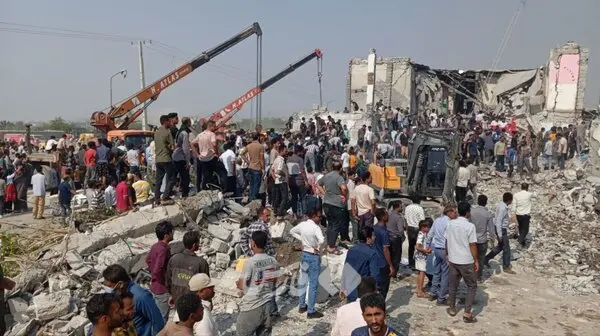
A forensic analysis⁵ conducted by CNN, examining available evidence including the nature of the strike and the weapons systems in use in the conflict, concluded that the missile was consistent with a Tomahawk cruise missile — a weapon fielded by the United States Navy, which is the only party to this conflict currently fielding Tomahawk missiles. The analysis further suggested that the strike may have been ordered based on outdated intelligence about the nearby naval installation.
When asked about the strike at a press conference, the president of the United States suggested that the missile might have originated from Iran.
This is the hardest case, and it is worth sitting with it, because it illustrates Stage Four simulation at its most consequential: not the substitution of entertainment for news, not the pharmacological capture of political attention, not the performance of authority in place of its exercise, but the specific and costly failure of a media apparatus to perform the function that democratic accountability requires of it: the resolution of a question that has an answer.
Who struck the school in Minab has an answer. The answer is available in principle from physical evidence—missile fragments, impact signatures, trajectory analysis—and from the record of which weapons systems were in the area. It is not, at the level of the physical world, an undetermined question. It is a question with a fact attached to it, a fact that exists independently of what anyone says about it, a fact of the kind that journalism in the first and second stage of simulation was specifically designed to pursue and establish.
In Stage Four, the question does not get answered. Not because the evidence is unavailable. CNN's analysis is not classified, and forensic journalism of this kind has been performed in other conflicts with comparable evidentiary challenges. It does not get answered because answering it would require the kind of sustained, adversarial, friction-generating accountability journalism that the attention economy specifically selects against. The story needs to be followed, expensively and persistently, across multiple news cycles, against the active resistance of the executive branch, in a media environment where the cost of moving on to the next thing is always zero and the reward is always immediate. The apparatus is not built for this. The apparatus is built for the opposite of this.
So the story cycled. It generated its engagement, outrage from one side, dismissal from the other, the characteristic bilateral stimulation of the Stage Four superstimulus. And then it was superseded, as everything is superseded, by the next development, the next address, the next threat to bomb Iran "back to the Stone Age," the next claim that negotiations were either ongoing or not ongoing depending on which hour of which day was in question.
The girls remain dead. The accountability question remains open. It will probably remain open. Not because the truth is unknowable, but because knowing and answering are two different operations, and the second one requires an institutional commitment that the apparatus has no structural incentive to make.
There is a particular form of injustice in this that I want to name precisely, because it is easy to let it dissolve into a general lament about the state of journalism. The girls in Minab are, in the information environment of the conflict that killed them, characters in competing narratives rather than victims of an identifiable act by an identifiable agent. Iran's information operation claims them as martyrs of American aggression and then immediately undermines its own claim by surrounding it with fabrications.⁶ The American information operation ignores them where possible and performs doubt where ignoring is not possible. The media apparatus processes them as a story. A terrible story, a story with genuine moral weight, a story that generates real emotional response and moves on, because moving on is what the apparatus does.
The question of who struck the school is exactly the kind of first-order factual question that Stage Four simulation is specifically constituted to leave unresolved. It requires territory. The apparatus deals in maps.
5. The Price of the Map
In which we arrive at the bill, and find it has already been paid by someone else.
The question posed at the end of Part One was: what does it cost when the map eats the territory? Who pays?
Let us begin with the clearest answer, because it has the merit of being specific. One hundred and sixty-eight girls in a school in Minab paid. Fourteen of their teachers paid. The school was near a naval base. A Tomahawk missile—and there is only one country currently in this conflict that fields Tomahawk missiles—struck the school on a morning in early March. The president of the United States, when pressed, suggested the missile might have originated from Iran. A CNN forensic analysis contradicts this. The White House has not updated its position. The story cycled through the media apparatus, generated its allotted engagement, and moved on. The girls remain dead. The question of accountability remains unresolved. It will probably remain unresolved, not because the facts are unknowable, but because the media apparatus has no structural incentive to force the reckoning, and the audience has been trained by that same apparatus to move on before the reckoning arrives.
This is what it costs to live inside the fourth stage of simulation during a war: the difference between a question being answerable and a question being answered disappears, because answering it requires the kind of sustained, adversarial, friction-generating journalism that the attention economy actively selects against. The question becomes ambient. It joins the perpetual scroll. It becomes one more thing that outraged one side and was celebrated as justified by the other, harvesting engagement in both directions, and then it was superseded by something newer. The school in Minab is a Stage Four casualty before it is anything else.
Thirteen American service members are also dead. Their names were not in Trump's April 1st address, because dead soldiers are low-engagement. They do not generate the pharmacological response. "Our armed forces have delivered swift, decisive, overwhelming victories" generates the response. The names of the dead interrupt the simulacrum, which is another way of saying they return us briefly and uncomfortably to the territory. The apparatus prefers the map.
And then there is the Iranian civilian whose sister died in an airstrike and whose government has poisoned the information commons so thoroughly—with AI-generated casualty figures, with recycled footage from other conflicts, with deepfakes generated at machine speed within hours of real strikes—that her legitimate grief has been pre-discredited. This is what the Carnegie Endowment calls the liar's dividend,⁷ and it is the bitterest irony available in the current moment: the Iranian regime's information warfare has built the apparatus of its own people's silencing. The corpses are real. The claims about the corpses are contaminated. The civilian pays the price of her own government's propaganda in the currency of international indifference.

And finally (more diffuse but no less real) there is the American diner patron watching the speech on television, gas at four dollars a gallon, wondering what is happening and why and when it will end. The apparatus has given her feelings about all of this in remarkable abundance: outrage or satisfaction, depending on her tribal affiliation; anxiety or confidence, depending on her media diet; a sense of stakes, of urgency, of consequence. What it has not given her is knowledge. Not because knowledge is unavailable. It is, in fragments, in the fact-checks that trail behind the viral claims, in the forensic analyses that run three days after the story has moved on. But the architecture of her media environment does not deliver knowledge. It delivers stimulation. Knowledge requires the kind of sustained, comparative, friction-tolerating attention that her media environment has spent years training her not to perform. She feels the war. She cannot evaluate it. She is asked, at regular intervals, to vote on its consequences. This is what democratic self-governance looks like in Stage Four: the form persists, emptied of the epistemological content that makes it meaningful.
It's always class with you, isn't it?
Here, we must commit to the class analysis, because it is the only framework that explains this situation without retreating into either moralizing or despair.
Orthodox Marxism located class in the relation to the means of production. You owned the factory or you sold your labor in it. This was always a simplification — Max Weber was right that status and party complicated the picture — but it was a productive simplification for an economy organized around the manufacture of material goods. We do not live in that economy. We live in an economy organized around the manufacture of reality itself: the production and distribution of the representations, narratives, and frames through which political subjects understand their world and (notionally) govern themselves. The means of this production is not the factory. It is the apparatus: the platform, the algorithm, the media institution, the political communication operation through which the simulacra are poured.
Class, in the information economy, is therefore determined not by what you own but by your structural position relative to the narrative apparatus. The ruling class (and let us be precise: this is a class in the analytical sense, with structural interests that exceed the intentions of any individual member) are those who pour the moulds. The politicians who craft the frames. The media institutions that amplify them. The platform operators whose algorithms determine which frames reach which audiences at which emotional temperature. The political communication professionals who A/B test the language of reality until they find the variant that most efficiently bypasses deliberation and lands directly in the amygdala. These people do not, for the most part, sit in rooms and conspire. They respond rationally, as individuals, to the incentive structures of their institutions. The conspiracy is structural, not personal. The class interest is objective, not subjective.
The working class—the reception class, to give it the name the information economy demands—are those who can only receive the simulacra they did not make and cannot meaningfully contest. Their subjectivity is not suppressed by the apparatus. It is produced by it. This is the move beyond classic false consciousness, which at least had the dignity of assuming that there was a real subject being deceived. What Stage Four simulation produces is something more fundamental: a subject whose desires, fears, and political orientations are assembled in real time by the representations they consume, who experiences this assembly as the natural expression of their own authentic self. The diner patron watching the war speech does not feel manipulated. She feels informed. The simulacrum is not experienced as a cage. It is experienced as a world.
The lines of this class system do not map cleanly onto wealth, although they correlate with it, because narrative capacity requires platforms, and platforms require capital, and capital tends to flow toward the leverage points of any productive apparatus. But the map is imperfect in interesting ways. A genuinely broke podcaster with a hundred thousand engaged listeners has real narrative-class power. A billionaire who consumes Fox News passively and believes what it tells him is, in the analytically relevant sense, reception class; his wealth insulates him from some of the material consequences, but he is still being constituted by a reality he did not pour. Class in the information economy is relational and functional, not merely financial. It is about your position in the circuit of production and consumption of the real.

The exploited class are those who are most defined by narratives they have the least power to shape. This is the structure of all class exploitation: you pay the price for a productive process whose surplus you do not capture. In the factory economy, the worker's surplus labor is captured as profit. In the information economy, the reception class's reality is captured—assembled, shaped, and delivered to them as their own authentic experience of the world—and the surplus is captured in the forms available to the narrative class: political power, audience engagement converted to revenue, the capacity to continue pouring the moulds. The girls in Minab are on the receiving end of this process in its most brutal form. They were defined—as collateral, as acceptable, as unworthy of protracted political consequence—by a narrative apparatus they had no access to and no power over. This is what it looks like when the exploitation is total.
This brings us to the question of resistance, and it is here that the left's inherited toolkit fails most comprehensively.
The classic revolutionary act, in the Marxist tradition, was the seizure of the means of production. Take the factory. Redirect its output. The workers who built the owner's wealth now build their own. This logic has a structural problem that the twentieth century demonstrated at considerable cost: it leaves the factory intact. The hierarchy is still there. The assembly line is still there. The organizational form that capital developed to concentrate and extract surplus is still there. What changes is who sits at the top. You get a new master. You get, eventually, a new ruling class a Party, a nomenklatura, a bureaucracy—that reproduces the logic of domination in the name of the class it claims to liberate. The form captures the content. The tree is what the tree does, not who climbs it.
The master's tools cannot dismantle the master's house.
The narrative apparatus presents the identical problem. To seize it is to become it. This is not a theoretical concern. It is an empirical observation. Fox News began as a counter-hegemonic project, a conservative alternative to what its founders genuinely believed was a liberal media establishment. It seized the tools of mass-media narrative production and operated them in the other direction. It is now simply the apparatus: one of the principal moulds into which reality is poured, one of the primary constitutive forces shaping the subjectivity of a significant fraction of the American reception class. Its counter-hegemonic origins are invisible in its current function. MSNBC performed the same operation in mirror image. Counter-simulacrum is still simulacrum. You get a new set of moulds. The people who run them are not liberated. They are the new narrative class. The people who receive them are not liberated. They are still reception class, still constituted by a reality they did not make.
Deleuze and Guattari's distinction between the arborescent and the rhizomatic is useful here, not because the rhizome is a program, but because it names the structural feature of the apparatus that seizing it cannot change. As I discussed in the third part of this series on Capitalism and Schizophrenia, the arborescent model is the organizing principle of Western thought as such: hierarchical, rooted, branching from a single trunk, with information flowing in one direction — from root through trunk to branch to leaf. When you encounter a tree diagram, you instinctively know how to orient it. That instinct is not innocent. It is the shape of all imposed structure: the State, Capital, the Media. Every node in the tree refers back to the root. Every attempt to seize the tree leaves the tree's logic intact, because the root is not a person or a class: it is the organizational form itself, the logic of centralized, hierarchical production and distribution of the real. Fox News grew from the same roots as CBS. The trunk changed hands. The roots remained. You cannot grow a different kind of forest by cutting down the existing trees and planting your own in the cleared ground. The soil is the problem. The soil is what produces trees.
The rhizomatic alternative—ivy on the wall, fungal mycelium threading through the substrate—proliferates horizontally, connects from any point to any other point in no fixed order, and has no node that could be identified as primary, central, or most essential. You could look at a wall of ivy for an hour and never determine which vine is oldest. This is not chaos, and it is important to be precise here, because D&G are careful about a distinction that their readers often collapse. The empty Body without Organs, pure de-stratification, total undifferentiation, the rejection of all structure as such, is not liberation. It is a different kind of dysfunction. What they are after, and what the present argument is after, is something they call the full BwO: de-territorialized from the imposed structures of the apparatus, capable of entering into new relations and new networks, but also intensified, invested with the meaning and purpose that makes those relations navigable rather than merely arbitrary. De-stratified but not dissolved. The egg before the organs form, in their image: already alive, already patterned, already invested with a direction of growth, but not yet compartmentalized into the fixed structure that will eventually constrain it. The rhizomatic alternative is not a politics at the level of institutional design. It is a different relationship to power: one that does not seize the master's house but grows through the cracks in the foundation, that names something true about where resistance actually lives in a Stage Four media environment, and that the rest of what we need to build starts from.
The revolutionary act available in the present moment is not the seizure of the apparatus. It is the interruption of its flow.
This sounds quietist. It is not quietist, or it need not be, if we understand what the flow is doing and why interrupting it is a structural act rather than a personal one. The flow—the infinite scroll, the autoplay, the algorithmically curated feed, the cable news cycle—is not merely entertaining. It is producing subjects. Every uninterrupted unit of consumption is a training event: the brain learning to process surface and react without the pause that comparative, critical judgment requires. The flow is the mechanism by which the narrative class constitutes the reception class. It is not incidental to the apparatus. It is the apparatus. The factory floor, translated into media.
The pause—the moment of held suspension, where you encounter the surface of the simulacrum and resist the trained impulse to consume and scroll—is therefore not a personal virtue. It is a structural counter-move. To hold "we never said regime change" against "regime change has occurred" and refuse to let the contradiction dissolve—to notice that these two claims appeared in the same nineteen-minute address, from the same speaker, on the same night, and to refuse the cognitive motion by which the feed trains you to release the earlier claim when the later one arrives—this is the exercise of exactly the faculty that the apparatus is specifically designed to degrade. It is the recovery of the ironic stance that Ebert mourned in 2008 and that McLuhan identified as the cognitive achievement of print culture: the capacity to hold the map in one hand and ask, with genuine seriousness, whether it matches any territory you can independently locate.
The girls in Minab are the territory. The address from the White House Cross Hall is the map. The question that Stage Four simulation forecloses (and that the revolutionary act reopens) is: which one of these is organizing your understanding of what is happening?
But the interruption of personal flow is insufficient alone, and this is where the political dimension must be stated plainly. The person who reads carefully and pauses before the image, if she does it in isolation, has recovered her own critical faculty. She has not built anything. The reception class, constituted by an apparatus it did not build and cannot individually opt out of, is not liberated by individual enlightenment. It is liberated (if liberation is available, which is an open question) by the construction of forms of knowledge production and distribution that are structurally different, that do not reproduce the arborescent logic even in opposition, that do not optimize for engagement at the cost of epistemic quality, that create the institutional conditions under which the pause is possible not just for the reader who already knows to look for it, but for the diner patron who was never told it was missing.
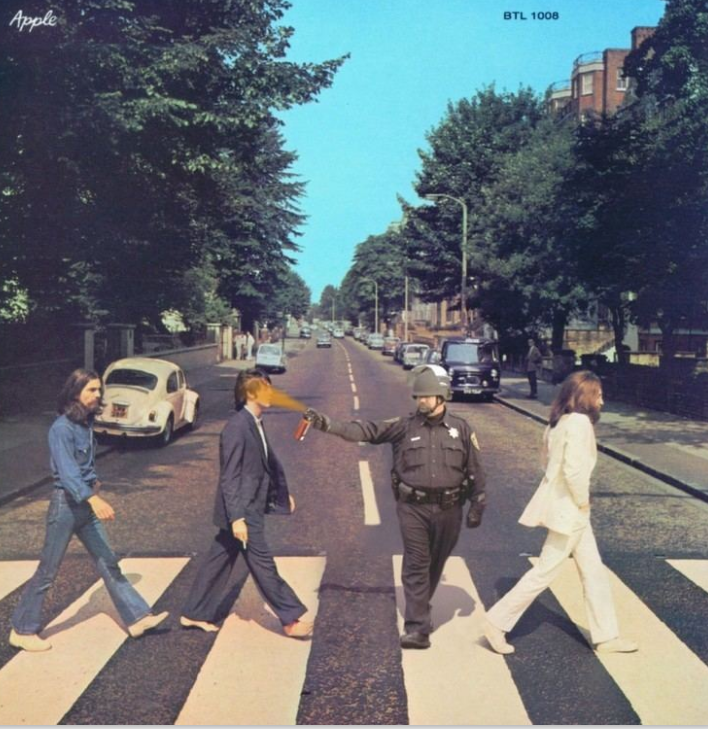
This essay is a small attempt in that direction. It will probably be processed, as I noted at the end of Part One, as a contribution to the existing Trump-and-media discourse. It will generate whatever engagement it generates. The engagement will be harvested. But embedded in it; and this is the détournement,⁹ if it is anything, is the argument that the harvesting is the problem, that you are inside the apparatus even now, and that the most important thing you can do with that information is stop and hold it for a moment before you move on.
The map has eaten the territory. The price is paid by those with the least access to the mapmaking. The interruption of flow is the act of insisting, at whatever scale is available to you, that there is still a territory, that it matters, and that the people who live in it and die in it are not characters in a narrative someone else is producing.
Look for Part Three on the horizon, when I get around to it, and if you have not abandoned me for something that autoplays.
1 Al Jazeera English (@AJEnglish). April 2, 2026. Photo credit: David Dee Delgado/Reuters.
2 Trump, Donald. Address to the Nation on Operation Epic Fury. White House Cross Hall, April 1, 2026. Transcript via NPR, PBS NewsHour, and CBS News.
3 International Atomic Energy Agency. Statement on Iran's nuclear program status, February 2026. As reported by multiple outlets prior to the commencement of hostilities.
4 NewsGuard. False War-Related Claims Tracked in the Iran-Israel-US Conflict. Updated through April 2026. Figures cited in Euronews and Deadline coverage of the AI propaganda environment.
5 CNN Forensic Analysis. New video appears to contradict Trump's claim that deadly strike on girls' school was 'done by Iran'. CNN Politics, March 12, 2026.
6 Smith, D., Linvill, D., and Munk, T. Quoted in France 24, Iran targets US public opinion with online information war, March 25, 2026.
7 Carnegie Endowment for International Peace analysis of the "liar's dividend" dynamic, as cited in Erkan's Field Diary, Disinformation and War Propaganda in the Iran-Israel-US War (As of 23 March 2026), March 23, 2026.
8 Hamerstone, Alex. Quoted in Deadline, How AI-Powered Propaganda Is Shaping U.S.-Iran War, March 2026.
9 Guy Debord, The Society of the Spectacle (1967). Détournement—from the French, roughly "hijacking" or "diversion"—was the central tactical concept of the Situationist International, the avant-garde collective Debord led from the late 1950s through 1972. Where propaganda aims to persuade through the production of new ideological content, détournement operates by repurposing existing cultural materials against their own logic: taking the images, language, and forms of mass culture and reassembling them in ways that expose their ideological function to the audience in the moment of consumption. The canonical example is the altered advertisement, the billboard modified so that it says, in the register of advertising, something advertising would never say. Debord's argument was that the Spectacle could not be defeated by counter-spectacle, which simply produces more spectacle, but could be interrupted by a practice that turns its own forms against it. Whether this essay constitutes détournement is a question I leave to the reader. That it is distributed through the apparatus it describes, and will be monetized by the engagement it generates, is not a question.