
The Phenomenology of Law and Power: Why Legal Reasoning Is Ontological Cover for the Exercise of Dominance
Legal indeterminacy isn't a bug. It's ontological.

1. A Software Engineer Walks Into a Courtroom
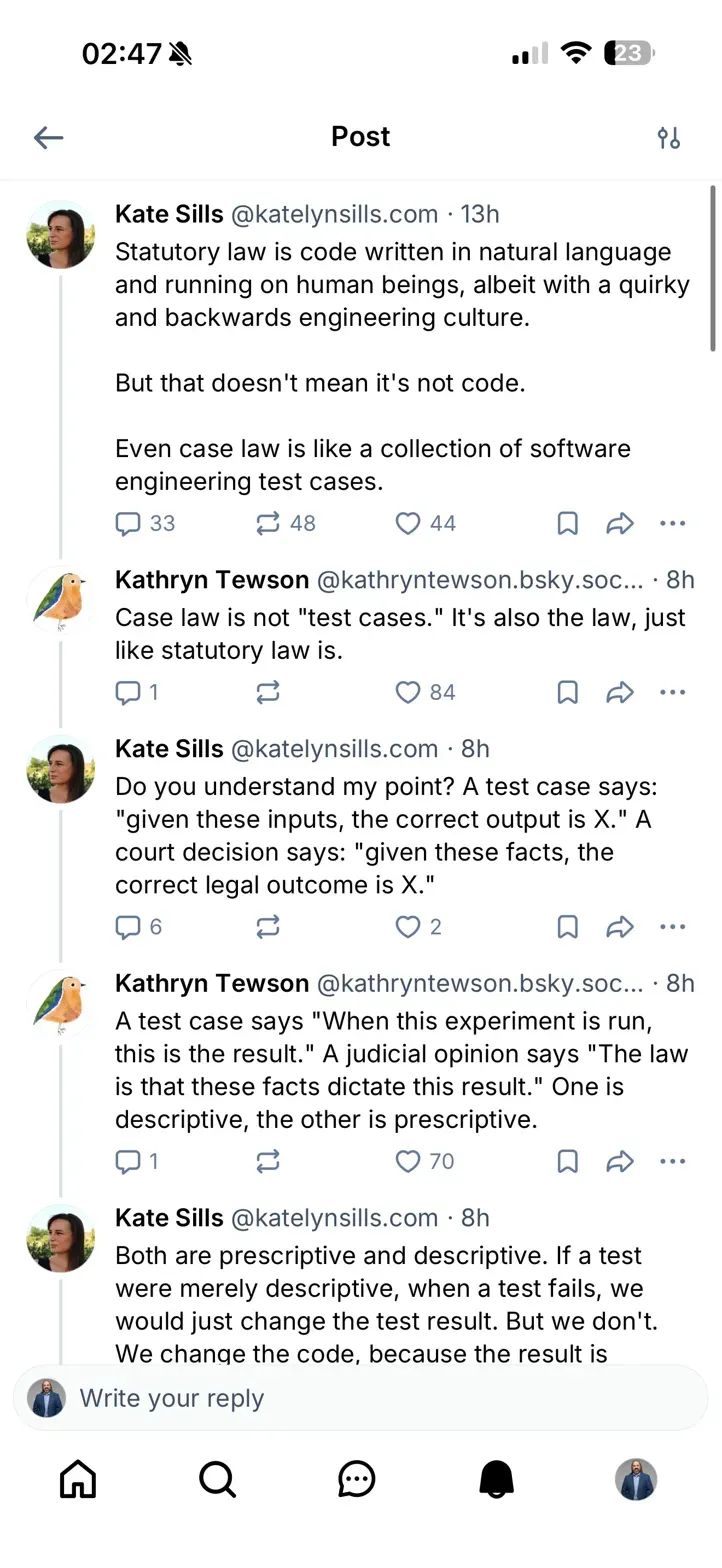
A thread appeared on Bluesky recently that crystallized, in miniature, one of the deepest unresolved problems in legal philosophy. Kate Sills, a software engineer, proposed what seemed like a clean and satisfying analogy: "Statutory law is code written in natural language and running on human beings, albeit with a quirky and backwards engineering culture." Case law, in this framing, becomes a collection of test cases: prior fact-outcome pairs against which new legal arguments can be validated. Given these inputs α and β, the correct legal output is 𝛙.
The analogy is seductive. It captures something real about the aspiration of legal formalism, or the dream that law could function as a closed system, a deterministic machine that takes facts in and produces outcomes. It's the same dream that animates originalism, strict constructionism, mandatory sentencing guidelines, and algorithmic risk assessment tools. If law is code, then legal disputes are bugs. The system needs better documentation, not philosophical hand-wringing. It gives us hope that there is a mechanistic, computable way to resolve all disputes, that ultimately, everything will have one correct solution (or at least a range of correct solutions).
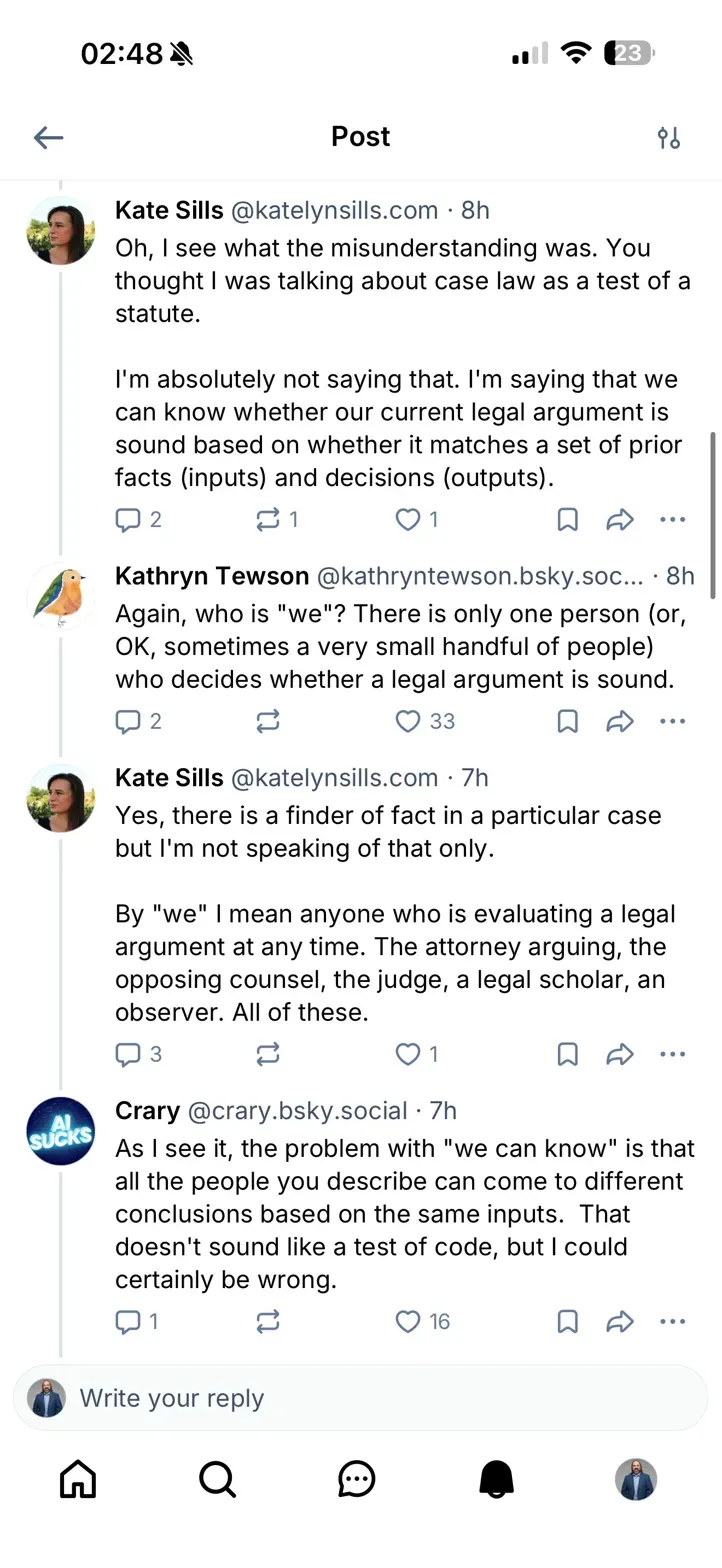
But the thread itself demonstrated why the analogy collapses under even moderate pressure. Paralegal and investigator extraordinaire Kathryn Tewson immediately identified the descriptive-prescriptive confusion at its core: a software test reports what code actually does; a judicial opinion declares what the law requires. One is descriptive, the other prescriptive. Sills attempted to save the analogy by invoking test-driven development—you write the tests first, then ensure the code conforms—but this only deepened the problem. In that environment, there is no ambiguity about whether the test passes or fails. The output either matches the expected value or it doesn't. In law, reasonable professionals disagree about what the "correct" output is, even when they agree on both the applicable rules and the relevant facts.
As a third commenter, user Crary, put it: "The problem with 'we can know' is that all the people you describe can come to different conclusions based on the same inputs. That doesn't sound like a test of code."
Exactly. And this is where I entered the thread.
2. The Practitioner's Rejoinder
As someone who now practices in the other professional role—that of the criminal defense attorney rather than the software engineer—I offered a different account of what actually happens in legal proceedings. The response is worth reconstructing because it reveals something that formal models of law systematically suppress.
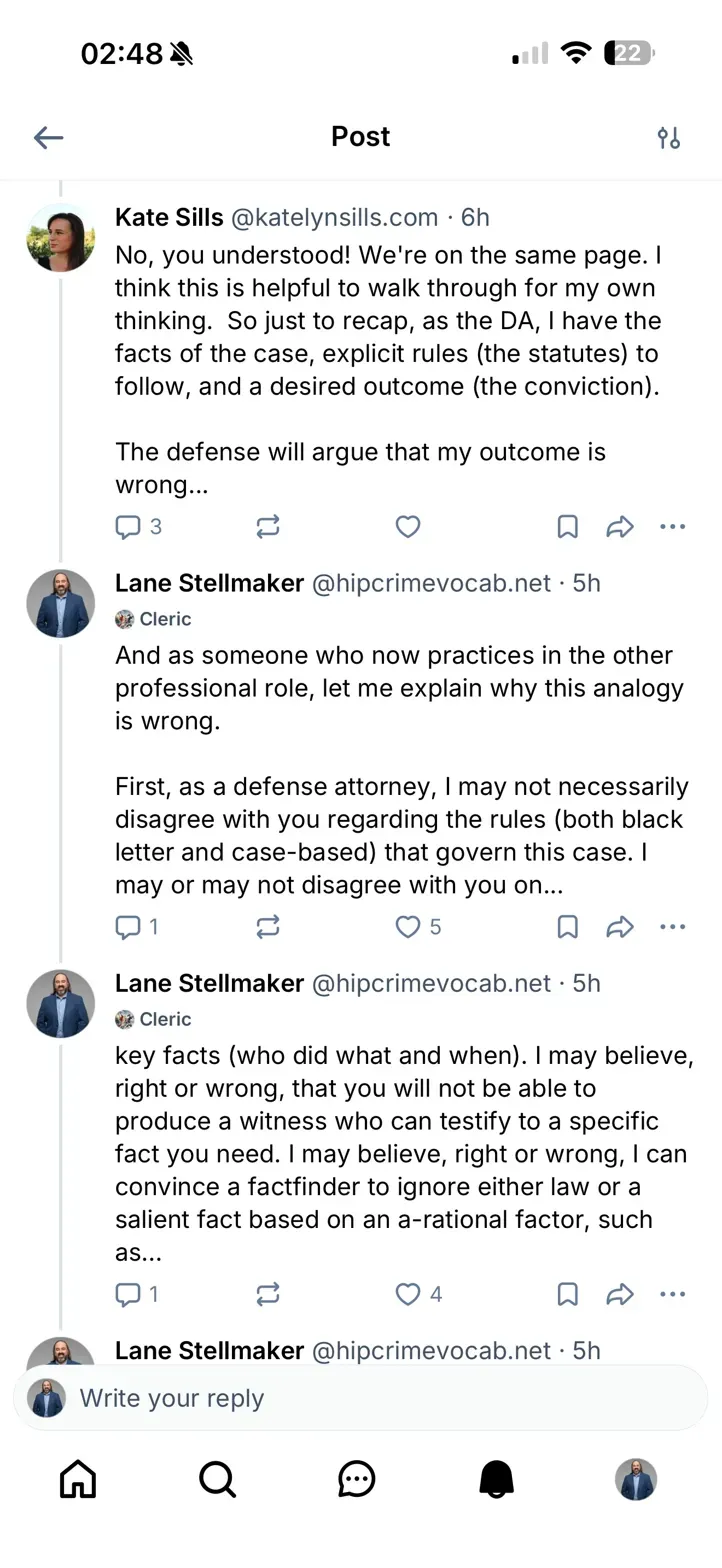
As a defense attorney, I may not necessarily disagree with the prosecution regarding the applicable rules (both the black-letter statutes and the case law governing interpretation). I may not even disagree about the key facts: who did what and when. And yet I may still expect to prevail, for reasons that have nothing to do with the "inputs" and "outputs" of legal "code."
I may believe, rightly or wrongly, that the prosecution will be unable to produce a witness who can testify to a specific fact they need. I may believe I can convince a factfinder to ignore either law or a salient fact based on an a-rational factor—sympathy, emotional resonance, an appeal to some concept like mercy or second chances that appears nowhere in the statutory text. All results are ultimately underdetermined by their inputs, because at every step of the way, each professional involved is vested with discretion and autonomy that can act contrary to or even at odds with what the "code" would dictate.
The police officer decides whether to arrest. The prosecutor decides whether to charge, and what to charge. The grand jury decides whether to indict. The judge decides what evidence is admissible, how jury instructions are worded, how sentencing guidelines are applied. The jury decides whom to believe and what matters. At every node in this chain, a human being exercises judgment that cannot be derived from the legal materials alone. These aren't bugs in the system. They are the system.
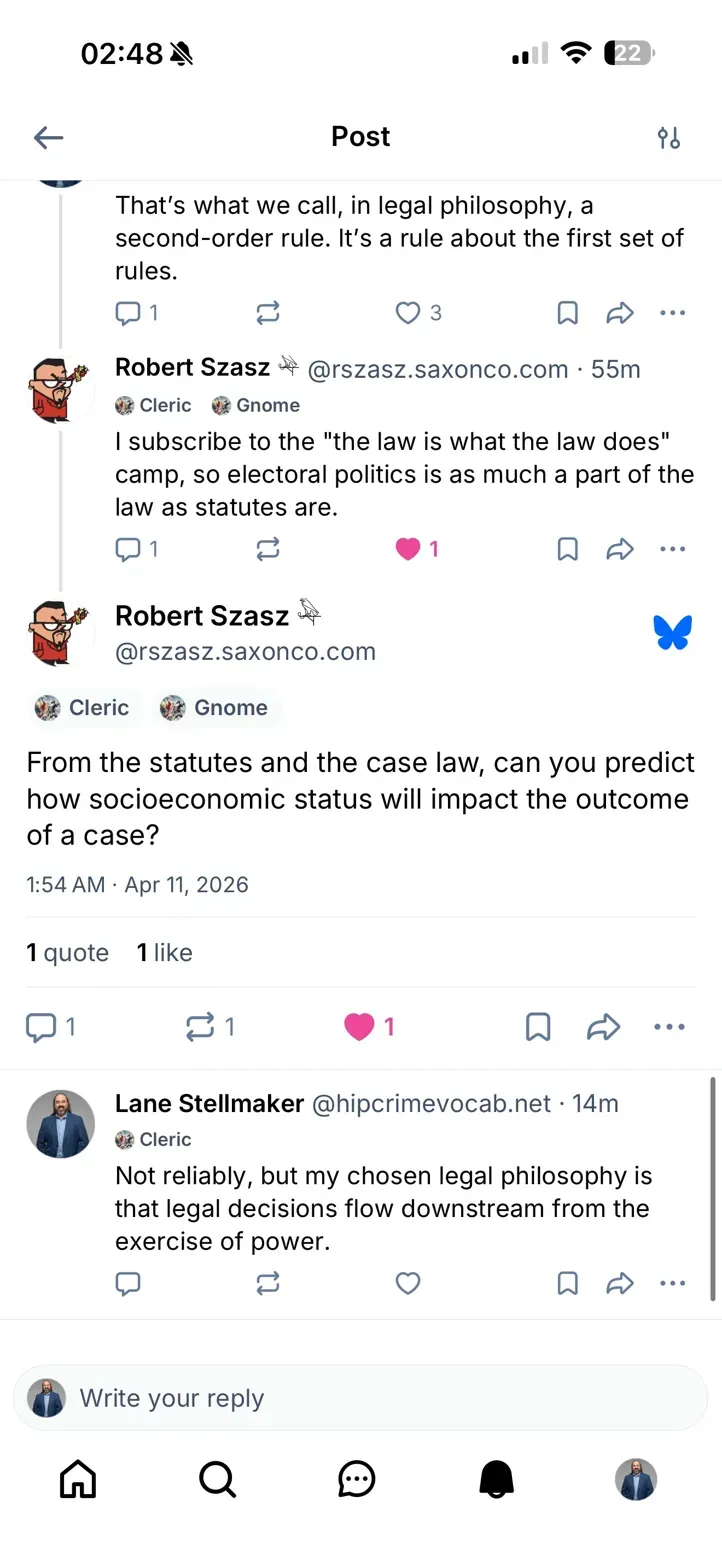
My conclusion in the thread was blunt: legal decisions flow downstream from the exercise of power. This is not a novel observation. But its implications, when traced through the major currents of twentieth-century continental philosophy, are more radical and more generative than the critical legal studies movement—which first popularized the "indeterminacy thesis" in American legal academia—ever fully realized.
3. Foucault: Power Without Semantics
Michel Foucault spent his career dismantling the assumption that modern institutions represent rational progress. His central insight—that power and knowledge are co-constitutive, that systems of knowledge always serve and are shaped by power relations—provides the first and most obvious philosophical framework for understanding what the Bluesky thread exposed.
Sills's analogy implicitly assumes that law is a knowledge system: a set of rules that, properly applied, yield determinate outputs. Foucault's entire project is demonstrating that knowledge systems are always already power systems. The courtroom is not a processor executing legal code. It is what Foucault would call a dispositif, an apparatus in which power circulates through institutional roles, professional credentialing, evidentiary rules, architectural arrangements (who sits elevated, who stands, who is permitted to speak and when), and what he called the micro-physics of examination and judgment.
Discipline and Punish (1975) doesn't merely critique the prison. It critiques the trial as a ritual of truth-production—a ceremony in which "facts" are not discovered but constituted through adversarial contestation, rules of evidence, credibility determinations, and narrative framing. The "inputs" to a legal proceeding are not data points waiting to be processed by legal code. They are products of a process saturated with power at every stage: what gets investigated, what gets charged, what evidence is preserved, what witnesses are available, how testimony is elicited and constrained, what questions are permitted and what are excluded.
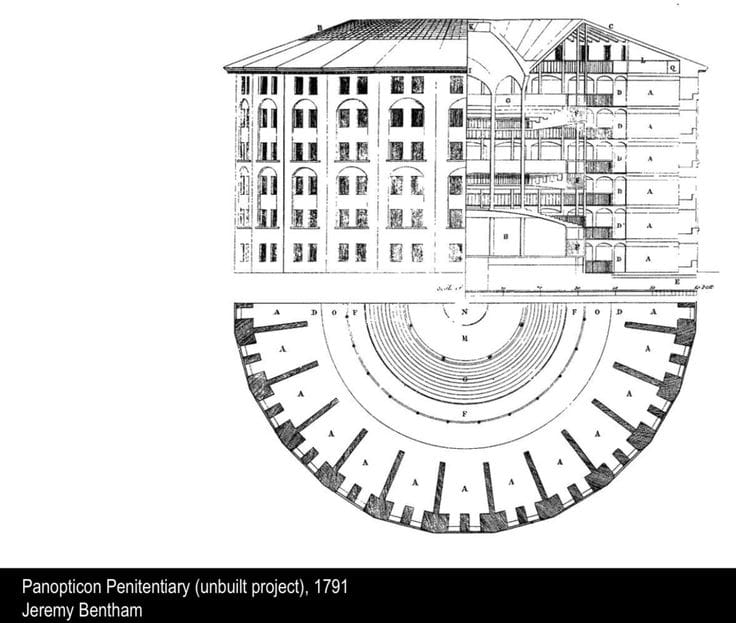
Foucault's account explains that legal outcomes are products of power rather than logic. It explains why the code metaphor is not merely imprecise but ideological—it mystifies the actual operation of the legal system by presenting power as procedure, domination as determination, and political choice as technical necessity. But Foucault has a limitation. He provides the diagnosis without the mechanism. He can tell you that legal decisions flow downstream from power, but he cannot explain how the same legal text yields different outcomes at the level of meaning. He is uninterested in semantics as such. He is interested in genealogy, tracing the historical conditions under which certain truth-claims become possible and others unthinkable.
This is enormously valuable. But if you are a practitioner standing in a courtroom, you need to understand what is happening when two competent lawyers read the same statute and reach opposite conclusions in good faith. Foucault shrugs at this question. The text is a pretext; what matters is the power relations surrounding it. Fair enough; but this account remains insufficient.
4. Derrida: Undecidability Without Ontology
Where Foucault locates indeterminacy in the institutional field surrounding the text, Jacques Derrida locates it in the text itself. His argument, developed most explicitly in "Force of Law: The Mystical Foundation of Authority" (1989), is that legal language (like all natural language) is constitutively incapable of the determinacy that the code metaphor assumes.
The law-as-code analogy requires that legal language function like a programming language: syntactically precise, semantically univocal, context-independent. Derrida's central claim is that natural language can never achieve this because meaning is constitutively dependent on context, and context is unbounded. Every application of a rule to a new set of facts is an act of iteration—the rule is repeated in a new context—and iteration always introduces the possibility of alteration. The "same" statutory phrase means something different when applied to facts the legislature never contemplated, and no amount of drafting precision can close this gap.

This is the philosophical engine behind the Critical Legal Studies movement's indeterminacy thesis. Jack Balkin's "Deconstructive Practice and Legal Theory" (1987) showed that legal arguments contain the seeds of their own opposition—every doctrinal principle can be "flipped" by privileging the suppressed term in whatever binary opposition the argument relies on. Duncan Kennedy demonstrated how the same legal materials support contradictory outcomes depending on which interpretive framework is privileged. The CLS conclusion: legal "code" doesn't compile deterministically. Legal reasoning is not computation but rhetoric—sophisticated, institutionally constrained rhetoric, but rhetoric nonetheless.
Derrida's most profound contribution to legal philosophy, however, is not the indeterminacy thesis but the ethics of judgment that follows from it. In "Force of Law," he distinguishes between droit (law, right, positive legal order) and justice. Law is deconstructible; it is a contingent system of conventions, texts, and institutional practices that can always be otherwise. Justice, by contrast, is not deconstructible. It is the horizon toward which law aspires but can never fully reach. Every legal decision involves an irreducible moment of undecidability—the judge must decide, but no rule can fully dictate the decision. A truly just decision cannot be the mechanical application of a rule (that would be calculation, not justice); it must pass through the experience of undecidability and emerge as a singular, responsible response to a singular situation.
This is powerful. But like Foucault, Derrida ultimately cannot explain what is happening when meaning proliferates. He can show that it does (with his characteristic wit and brilliance) but his account of why reduces to the structural properties of différance: the endless deferral and differentiation that constitutes signification. This is a transcendental argument about the conditions of language in general. It tells you that all language is under-determinate, which is true but unhelpful for understanding why legal interpretation is especially contested, or what distinguishes a plausible reading from an implausible one, or how two interpreters can genuinely disagree rather than merely talking past each other.
Deconstruction can dismantle the formalist claim that texts have single correct meanings. It cannot reconstruct a positive account of how meaning works; it can only show that meaning/semantic content is never fully stable. Derrida gives us semantics without ontology. Foucault gives us power without semantics. Both are necessary. Neither is sufficient. To fully account for this particular phenomenon, we need to turn to earlier and more theory-heavy explanations, in particularly, the phenomenology of Edmund Husserl.
5. Husserl: The Ontological Ground
The resources for completing the picture—for providing the ontological foundation that Foucault and Derrida both gesture toward but never articulate—were available before either of them wrote. They are found in Edmund Husserl's Logical Investigations (1900–01), the founding text of phenomenology, and specifically in a distinction that has received almost no attention in anglophone legal philosophy: the distinction between Sachverhalt (state of affairs) and Sachlage (situation of affairs).
For Husserl, a Sachlage is the underlying ontological configuration—the way things actually stand in the world. A Sachverhalt is a propositional articulation of that configuration, a particular way of grasping and expressing it in language. The crucial insight is that the relationship between them is one-to-many. The same situation of affairs can be expressed through multiple, non-equivalent states of affairs. The underlying ontological configuration underdetermines its propositional articulation. This is not a deficiency of language. It is a structural feature of the relationship between intentional acts and their objects.
Husserl's broader framework explains why. Every act of consciousness is intentional, id est, directed toward an object. But no single intentional act exhausts the object it intends. Every perception involves a horizon of co-given but unarticulated meaning, what Husserl calls Überschuss, excess or surplus. When I see a house from the front, the back of the house is co-intended but not directly given. When I grasp a legal situation, the aspects I articulate are accompanied by a horizon of aspects I do not and cannot articulate in the same act. The object always exceeds the act that intends it.
Applied to legal interpretation, this yields a far more powerful account of indeterminacy than anything available from Derrida or CLS. A statute refers to a situation of affairs, namely, a complex of social relations, harms, purposes, and normative commitments. Any particular reading of that statute is one Auffassung (apprehension) that constitutes the legal object in a determinate way while leaving other constitutive possibilities in the horizon. The prosecutor and the defense attorney are not processing the same inputs through the same code and getting different outputs due to a bug. They are performing different intentional acts directed at the same underlying Sachlage, and that Sachlage genuinely supports both constitutions. The indeterminacy is not in the language (Derrida), not in the power relations (Foucault), but in the thing itself/noumenon. The legal situation is ontologically richer than any single propositional articulation of it.
This is why the code analogy fails at the deepest level. Code operates on formally defined objects with determinate properties. Law operates on situations of affairs that are given to consciousness through intentional acts that always involve horizonal excess. The "inputs" to a legal argument are not data points. They are intentional objects constituted through particular acts of apprehension, and those acts are always perspectival, always partial, always accompanied by a fringe of unarticulated co-given meaning that another interpreter, from another perspective, can draw into the foreground.
6. Heidegger: The Hermeneutic Radicalization
Martin Heidegger takes Husserl's insight and drives it still deeper. In Being and Time (1927), Heidegger argues that every act of interpretation operates within a Vorstruktur, a fore-structure of pre-understanding that determines in advance what can show up as meaningful. This fore-structure has three components: Vorhabe (fore-having, or the totality of involvements within which the thing to be interpreted is already encountered), Vorsicht (fore-sight, or the perspective from which the interpretation approaches its object), and Vorgriff (fore-conception, or the conceptual framework within which the interpreted thing will be articulated).
There is no "view from nowhere" from which a legal text could be read without presuppositions. The textualist judge and the purposivist judge are not applying different methods to the same text. They are operating within different fore-structures that disclose the text differently, that let different aspects of the legal situation show up as salient, relevant, and determinative. The textualist's fore-structure privileges linguistic convention and legislative process; the purposivist's privileges social function and normative coherence. Each fore-structure opens up certain possibilities of meaning and forecloses others. Neither is "neutral." Neither is "biased." Both are conditions of understanding as such.
This is not relativism. Heidegger is emphatic on this point. Some interpretations are more sachgemäß (more appropriate to the thing itself) than others. The hermeneutic circle is not vicious; it is the condition of all understanding. But it does mean that the formalist dream—reading the code, running it on the facts, getting the answer—is not merely difficult to achieve in practice but ontologically impossible. Understanding is always already interpretive, and interpretation is always already situated within a tradition, a practice, a form of life.
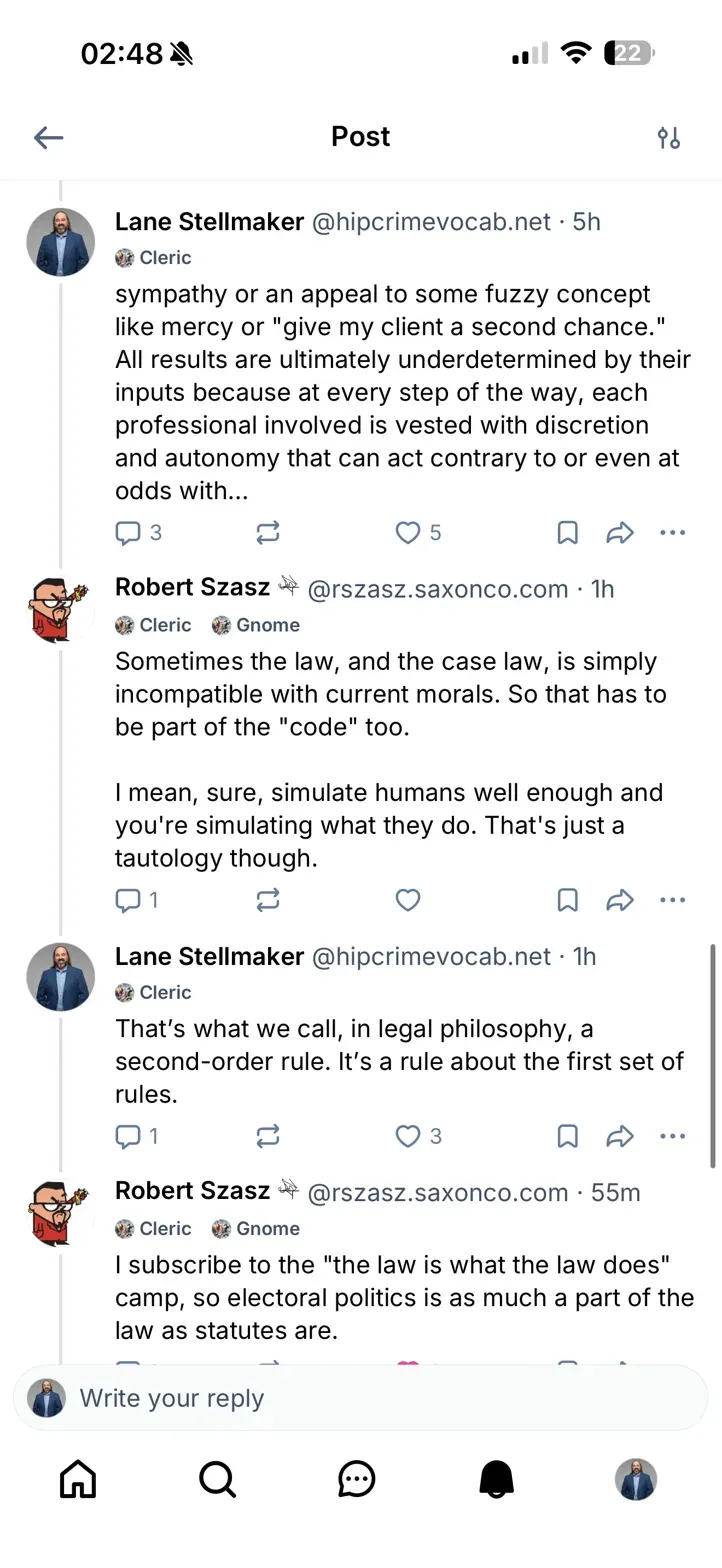
One of the more incisive interventions in the Bluesky thread came from Robert Szasz, who asked: "From the statutes and the case law, can you predict how socioeconomic status will impact the outcome of a case?" The answer, obviously, is no—not reliably. But the phenomenological framework explains why in terms that go beyond mere cynicism about judicial bias. Socioeconomic status does not appear anywhere in the "code." It is not a legal input. But it shapes the Vorstruktur within which every participant in the legal process apprehends the situation. The judge's background, the jury's composition, the quality of counsel (which is in part a function of economic resources), the credibility attributions that track race and class and education and accent—these are not external distortions of an otherwise pure process of legal reasoning. They are constitutive of the interpretive situation within which legal meaning is disclosed. They are part of what Heidegger calls Befindlichkeit, or the situated attunement, the mood or disposition, within which understanding always already operates.
The formalist cannot account for this except as corruption. The Foucauldian can describe it but only as power. The phenomenologist can explain it as a structural feature of interpretation itself: understanding is always perspectival, always situated, always shaped by the interpreter's position in a world of practical involvements.
7. Phenomenological Jurisprudence: What CLS Was Missing
We can now state the thesis directly: legal decisions are downstream from ontological structures of relations, particularly, power relations.
Foucault correctly identifies that legal decisions flow downstream from the exercise of power. Derrida correctly identifies that legal texts are structurally underdeterminate. The Critical Legal Studies movement correctly draws the practical conclusion: legal reasoning does not determine outcomes; it rationalizes them. But none of these positions can explain why this is the case in a way that avoids reducing law to either cynicism (it's all just power) or nihilism (meaning is impossible).
Phenomenological jurisprudence—grounded in Husserl's semantic ontology and radicalized by Heidegger's hermeneutics—provides the ontological foundation that CLS, Derrida, and Foucault's asymptotes never reach. Legal indeterminacy is not a failure of legal language. It is not a consequence of judicial bias. It is not merely an effect of institutional power (though all of these are real and operant within the phenomenology of legal language). Rather, legal indeterminacy is a feature of the intentional relationship between legal meaning-acts and the situations of affairs they intend. The legal situation is always richer than any propositional articulation of it. Every interpretation is perspectival and horizonal. Understanding is always already hermeneutically situated. And the surplus of meaning that makes legal contestation possible is grounded not in the deficiency of signs but in the plenitude of the things themselves.

This gives us something that CLS never had: a non-cynical account of legal indeterminacy. If indeterminacy is merely power (Foucault) or merely the instability of language (Derrida), then legal reasoning is at best sophisticated mystification—an elaborate con that dresses political will in the robes of logical necessity. But if indeterminacy is ontological, if legal situations genuinely exceed any single articulation, then the adversarial process, the plurality of interpretive perspectives, the ongoing contestation over legal meaning are not failures of the system. They are appropriate responses to the nature of the object. Law needs multiple perspectives not because it is broken but because the things it addresses are inexhaustibly rich.
Let's do it, then. Let's make our critical turn: the phenomenological account does not negate the Foucauldian insight. It grounds it. Legal decisions flow downstream from the exercise of power because the situations they address are ontologically under-determinate, and where determination fails, power fills the gap. The ontological surplus in every legal situation creates a space of undecidability, and that space is where power operates. This is not a counsel of despair. It is a call to honesty about what law is and what it cannot be... and to build institutions that acknowledge the ineliminable role of judgment, perspective, and responsibility in every legal act, rather than institutions that pretend these roles away behind the fiction of mechanical application.
The philosopher who saw all of this first was Adolf Reinach, whose The A priori Foundations of the Civil Law (1913) used Husserl's framework to argue that legal relations—promises, claims, obligations, rights—have their own eidetic structure, their own essential features that obtain prior to and independently of any positive legal system. Reinach was killed at the Battle of Flanders in 1917 at the age of thirty-four, and the tradition of phenomenological jurisprudence he inaugurated was largely orphaned. What took its place—legal positivism, legal realism, CLS, law and economics—each grasps part of the elephant. None grasps the whole. It is only by adopting the standpoint epistemology of phenomenology and applying that ontic structure to the law that our legal reasoning begins to make sense, both from the praxic and theoretical standpoints.
The code metaphor is comforting. It tells us that law is a system, that disputes are debugging exercises, that better engineering can yield more just outcomes. But law does not operate on formally-defined objects. It operates on human situations: situations of inexhaustible richness, irreducible complexity, and ontological surplus. The honest response to that reality is not better algorithms. It is better judgment, exercised by people willing to confront the undecidability at the heart of every legal act and take responsibility for the power they wield in resolving it. It is not by deferring that responsibility to external moral codes. We must grapple with our own situatedness within the situation of affairs, our being thrown-into-the-world, with our responsibility to wield the organs of deferred power such as law with wisdom, humility, and tempered by knowledge of our own fallibility.
This is where judges, lawyers, prosecutors, and litigants often run into the greatest irritation and heartache within the courtroom: when they forget that law is a human endeavor carried out by human agents utilizing human reason to attempt to resolve human problems in a public and fair manner. There is no magic that happens, just people trying their best.