
The Sword and the Necessity: On the Vice President's Augustinian Embarrassment
Augustine does not celebrate the just warrior. He grieves the necessity that produces him. Vance treats "just war" as a permission slip… and lectures a lifelong Augustinian on Augustine.

On April 14, 2026. Hours after Pope Leo XIV celebrated Mass at the Basilica of St. Augustine in Annaba, Algeria, on the very ground where Augustine of Hippo served as bishop for thirty-four years, Vice President JD Vance stood before an audience at the University of Georgia and said this: "When the pope says that God is never on the side of people who wield the sword, there is more than a 1,000-year tradition of just war theory." He then helpfully advised the Pope to "be careful when he talks about matters of theology."
Let us be careful, then. Let us talk about theology. Let us talk about Augustine.
1. What Augustine Actually Said
The phrase "just war" has become, in the mouths of American conservatives, a kind of talisman, a magic word that transforms any military adventure into a crusade. Wave the phrase at a conflict and it becomes blessed. Abracadabra. Bellum justum. The bombs are sanctified and God rides on the wing of every Cruise missile, delivering righteous wrath to the enemies of God, who just happen to be perfectly coextensive with the enemies of the current US regime.
But this is not a good reading of Augustine. It is not even close.
In City of God, Book XIX, Augustine addresses the misery of war directly. His argument is not that war is good, or that God smiles upon the warmaker, or even that the righteous may kill with clean consciences. His argument is that the wrongdoing of the opposing party compels the wise man to wage war, and that this wrongdoing (not the war itself) is the thing to be lamented:
"But the wise man, they say, will wage just wars. Surely, if he remembers that he is a human being, he will rather lament the fact that he is faced with the necessity of waging just wars; for if they were not just, he would not have to engage in them, and consequently there would be no wars for a wise man. For it is the wrongdoing of the opposing party which compels the wise man to wage just wars; and this wrongdoing, even though it gave rise to no war, would still be matter for human grief."
Read that passage carefully. Augustine is not celebrating the just warrior. He is grieving the necessity that produces him. The wise man does not want to wage war, even a just one. He laments that he must. And the source of that grief is not the war itself, it is the moral failure, the iniuria, the wrongdoing of the other side that forces the confrontation into existence. War, even just war, remains an evil, a necessary evil, perhaps, but an evil whose necessity is itself a cause for sorrow, not triumphalism.
This is the tradition Vance and Johnson invoked. This is what they got wrong.
2. Necessity: The Thread from Hippo to the Common Law
Augustine's formulation is not unique to theology. It maps, with remarkable precision, onto one of the oldest and most persistent concepts in Anglo-American jurisprudence: the doctrine of necessity.
In criminal law, necessity operates as a justification defense. A person who commits what would otherwise be a crime (trespassing to escape a wildfire, breaking a window to rescue a drowning child, even, in extremis, using lethal force in self-defense) is excused not because the act was good, but because the circumstances left no reasonable alternative. The act remains a harm. The defense of necessity does not transmute it into a virtue. It acknowledges that the actor was placed in a situation where every available option was bad, and chose the least bad one.
Self-defense is the paradigm case. When you kill an attacker to save your own life, the law does not congratulate you. You have available to you an affirmative defense, not a defense to prosecution. It excuses you. It is confession and avoidance; you must confess to the wrongful act but avoid its consequences through the operation of some greater doctrine. The killing is still a killing. The legal system simply recognizes that the moral culpability belongs to the aggressor (the person whose wrongdoing created the lethal situation in the first place). Sound familiar?
Augustine's just war operates on exactly this logic. The iniuria (the wrongdoing) of the opposing party creates the necessity. The war is "just" not because it is righteous, but because the alternative (submission to injustice, the abandonment of the innocent) would be worse. The wise man laments because he knows that even the justified application of force is a tragedy, not a triumph. Peace is always to be preferred. The whole Augustinian framework presupposes that war is a failure state, a catastrophic breakdown in the moral order that occasionally requires a violent remedy, much as a surgeon amputates a limb to save a life, but no one celebrates the amputation. And this is reflected in the philosophical underpinnings of modern society.
3. Hegel and the Dialectic of Wrong
The philosophical architecture here runs even deeper than the common law. In the Philosophy of Right, Hegel takes up the question of wrong (Unrecht) and punishment in a way that illuminates the Augustinian structure from a different angle.
For Hegel, a wrong (a crime, an injustice) is a negation of right. It is a particular will asserting itself against the universal. And punishment, or the forceful restoration of right, is the negation of that negation: the universal reasserting itself against the particular will that violated it. Punishment is not revenge. It is not the expression of the punisher's righteous anger. It is the logical consequence of the crime itself. The wrong, by its own internal logic, demands its own annulment.
This is the dialectical version of Augustine's necessity. The wrongdoing of the aggressor does not merely justify the response; it generates the response as a logical and moral necessity. The state (or, in Augustine's framework, the wise ruler) does not act out of its own desire for violence. It acts because the wrong has created a situation in which not acting would itself constitute a wrong, a failure to uphold the universal, a passive complicity in injustice.
But notice what Hegel does not say. He does not say that the punisher is morally pure. He does not say that the act of punishment is good in itself. He says that the wrong creates its own negation, and that the negation, while necessary, is part of a dialectical process whose telos is the restoration of right, not the glorification of force. The entire movement aims at reconciliation, not perpetual conflict.
Augustine, Hegel, and the common law of necessity all converge on the same insight: the justified use of force is a response to a prior moral failure, and its justification is always provisional, always sorrowful, always aimed at the restoration of a peace that should never have been broken.
4. What Vance Gets Wrong (Theologically, Philosophically, and Personally)
So when JD Vance stands at a podium and asks, with rhetorical indignation, "How do you say that God is never on the side of those who wield the sword?" (invoking the liberation of France from the Nazis as his proof text) he is making precisely the error that Augustine warned against.
Vance treats "just war" as a positive category. In his hands, it becomes a license, a theological permission slip that allows the warmaker to claim divine favor. If the war is just, then God is on our side. If God is on our side, then our cause is righteous. And if our cause is righteous, then the Pope should sit down and be quiet.
But Augustine says the opposite. Augustine says the wise man laments the necessity of just war. Augustine says the grief belongs to the wrongdoing that caused the war, not to the war's justice. Augustine says (and this is the point that Vance either does not understand or does not want to understand, for I do not believe him to be nearly so stupid or foolish as he pretends) that even a just war is a tragedy, and that the proper posture of the Christian before war is not triumphalism but mourning.
Pope Leo, when he says that God is "never on the side of those who once wielded the sword and today drop bombs," is not denying just war theory. He is articulating its deepest premise: that God's desire is for peace, that war is always a departure from the divine intention, and that no one who wages war (however justly) can claim to be doing God's preferred work. The liberation of France was necessary and just. It was also hell on earth, and the Christians who fought in it did not imagine that God wanted Omaha Beach. They understood, in the Augustinian sense, that the monstrous evil of fascism had compelled the violence, and that the appropriate response to victory was not chest-thumping but profound relief that the necessity had passed.
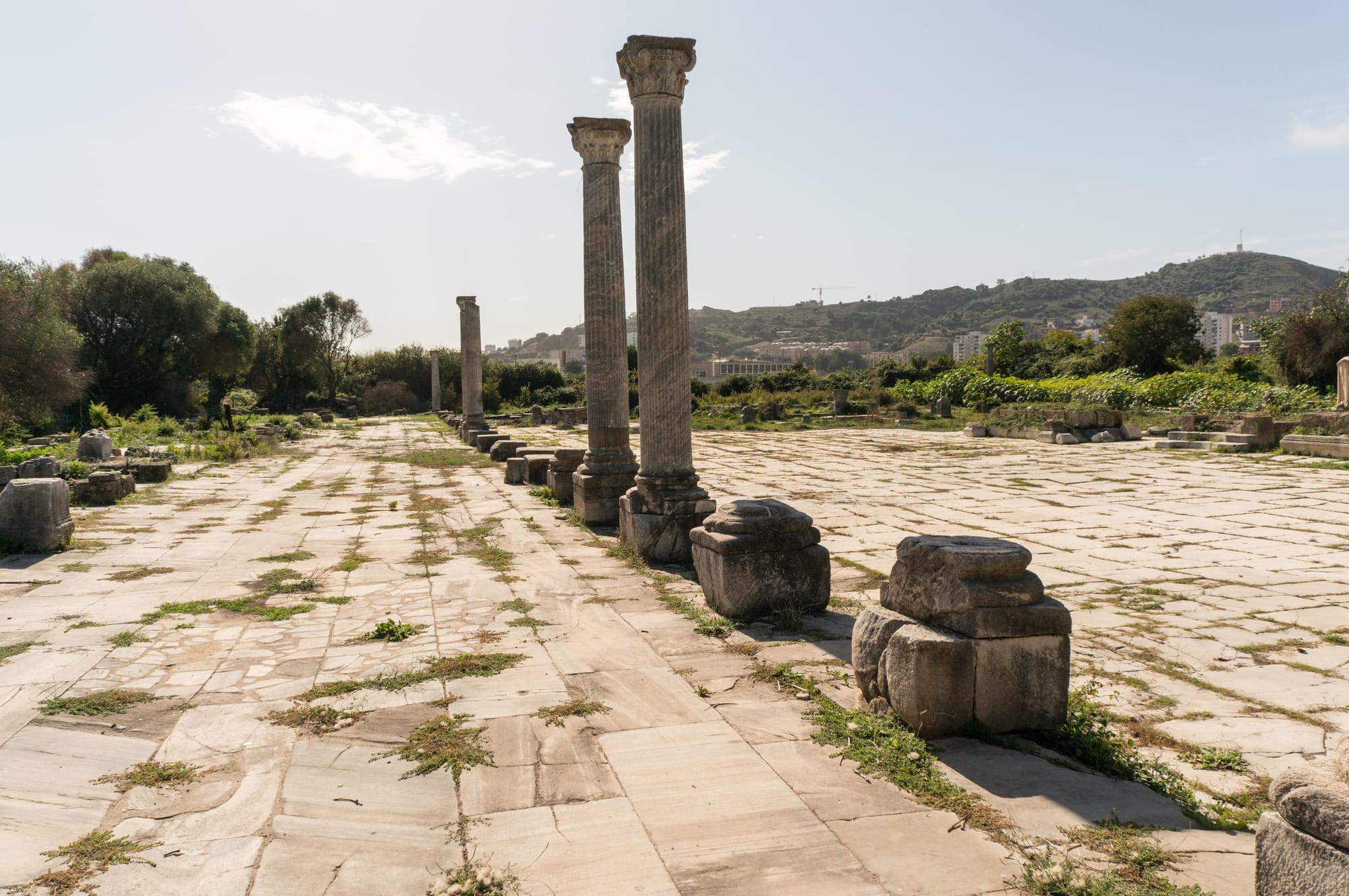
And here is the personal irony so thick it borders on farce: Pope Leo XIV is a member of the Augustinian religious order. He wrote his doctoral dissertation on Augustine's understanding of authority. He attended an Augustinian seminary. He headed the global Augustinian order before his election to the papacy. He traveled to Annaba (ancient Hippo) on the very day Vance made his remarks, to honor the saint at the site of his bishopric.
JD Vance, meanwhile, chose Augustine as his patron saint when he converted to Catholicism a few years ago.
One of these men has spent his life studying Augustine. The other has apparently not gotten past the Wikipedia entry for "just war." And yet it is the latter who advises the former to "be careful when he talks about matters of theology."
5. The Real Question They Don't Want to Ask
The deeper issue, of course, is not whether just war theory exists. It does. No serious Catholic theologian, and certainly not Pope Leo, denies it. The Catechism affirms it explicitly. The question (the question that Vance and Trump and their allied commentators desperately want to avoid) is whether this particular war meets the criteria.
Cardinal McElroy, the Archbishop of Washington, has said plainly that the war in Iran does not satisfy the just war tradition's requirements. The damage must be "lasting, grave, and certain." The use of arms must not "produce evils and disorders graver than the evil to be eliminated." There must be a "serious prospect of success." All other means of ending the conflict must have been shown to be "impractical or ineffective."
When the President of the United States threatens to destroy "a whole civilization," it becomes rather difficult to argue that the use of force is proportionate. When diplomatic channels remain open but largely unexplored, the exhaustion of peaceful alternatives has not been demonstrated. When the stated war aims shift weekly, the criterion of right intention becomes incoherent.
This is what Pope Leo is saying. Not that just war does not exist. Not that no war has ever been justified. But that the Christian tradition demands rigorous scrutiny of every claim to justification, and that the powerful, in particular, must be subject to that scrutiny, because the powerful are the most tempted to mistake their own interests for divine sanction.

6. Peace as the End of Just War
Augustine concludes his discussion of war in Book XIX with a passage that should be tattooed on the forehead of every politician who invokes his name:
"It is therefore with the desire for peace that wars are waged... For peace is not sought in order to provoke war, but war is waged in order to attain peace."
The telos (the purpose, the aim, the end) of just war is peace. Not victory. Not dominion. Not the projection of power. Peace. The entire apparatus of just war theory is oriented toward its own abolition: you fight so that you can stop fighting. The moment war becomes an end in itself (the moment it becomes a tool of civilizational supremacy or geopolitical posturing) it ceases to be just, regardless of the wrong that originally provoked it.
When Vance tells the Pope to "stick to matters of morality" and leave "public policy" to the politicians, he is performing a rhetorical move that Augustine would have recognized immediately and rejected absolutely. For Augustine, there is no domain of "public policy" that exists outside the moral order. The civitas terrena—the earthly city—is always and everywhere subject to moral judgment. The ruler who claims exemption from that judgment is not exercising legitimate authority; he is asserting the kind of arbitrary power that Augustine spent the entire City of God dismantling.
The Vice President chose Augustine as his patron saint. Perhaps he should try reading him.