
Truth is Invariably Superficial: Poe's Purloined Letter, from Lacan to Derrida to Deleuze
Due to your author's absence from the Critical Readings podcast due to a consumptive illness, he was forced to resort to providing your education in this format.

A Letter in Sufferance
I was supposed to spend this weekend's recording of Critical Readings leading our discussion of Edgar Allan Poe's "The Purloined Letter." Illness kept me off the microphone, so this is the segment I would have delivered, sent instead by the slower post. Lacan has a phrase for a letter held at the post office, undelivered: une lettre en souffrance, a letter in sufferance. I can't think of a better description of a post written from a sickbed about a story that never quite gets delivered.
"The Purloined Letter" is about nine pages long. It appeared in The Gift for 1845, issued in September 1844, as the third of Poe's tales of C. Auguste Dupin. A minister steals a compromising letter from a royal lady under her husband's nose. The police ransack his rooms every night for three months and find nothing. Dupin calls on him wearing green spectacles and finds the letter in a card-rack, hidden in plain sight. The story is slight and clever, with none of the charnel atmosphere of Poe's horror tales. It presages Holmes and later detective fiction. It is also, by a wide margin, the most over-read short story of the twentieth century.
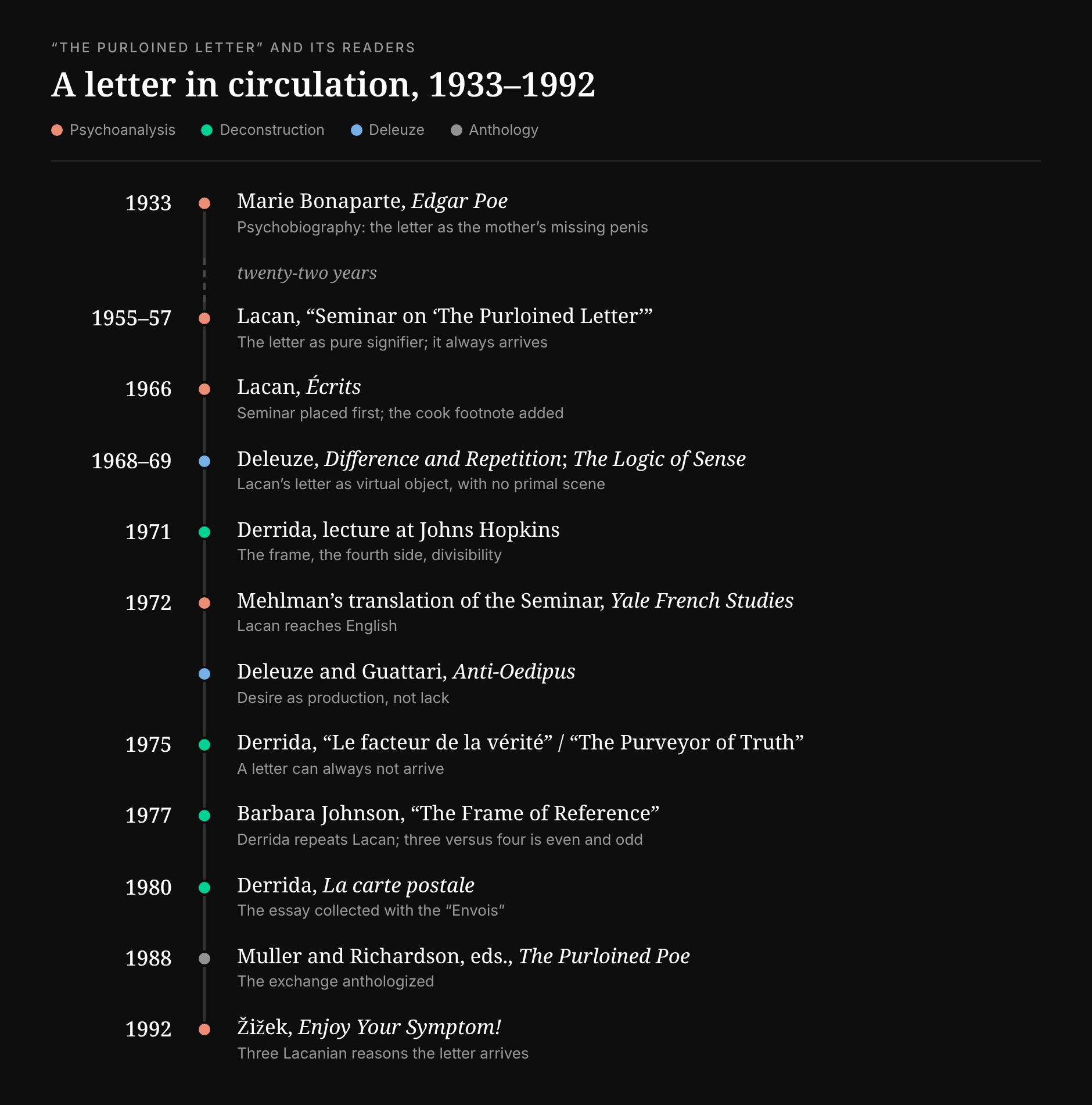
That is because of what happened to it in Paris. In 1955, Jacques Lacan made it the centerpiece of a seminar on Freud's repetition compulsion, and in 1966 he put the written version at the head of Écrits, ahead of everything else. In 1975 Jacques Derrida published a long, hostile, and often very funny critique of Lacan's reading. In 1977 Barbara Johnson published a reading of Derrida's reading of Lacan's reading, and showed that Derrida had done to Lacan exactly what Dupin does to the Minister. By 1988 the whole exchange was collected between two covers as The Purloined Poe, and the tale had become the place where literary theory goes to watch itself think.
Here is the plan. First, the story, with attention to the details the theorists fight over. Then Lacan's argument, then Derrida's, then the reception: Johnson, Felman, Irwin, Žižek, and what the philosophers made of it all, which in some quarters was nothing. Then a short detour through the law of contracts, because the common law took a position on this dispute in 1818 and nobody told the French. Finally, a reading the exchange never quite produced: what Gilles Deleuze would make of the letter. Deleuze actually used Lacan's seminar before Derrida attacked it, and what he did with it suggests that both famous answers are answering the wrong question.
Lacan says a letter always arrives at its destination. Derrida says a letter can always not arrive. My claim, with Deleuze and with Dupin himself, is that the destination was never the point. The point is what the letter does on the way, and where it sits while it does it. Dupin told us where to look in the first of his three stories: truth, he says, is "invariably superficial."
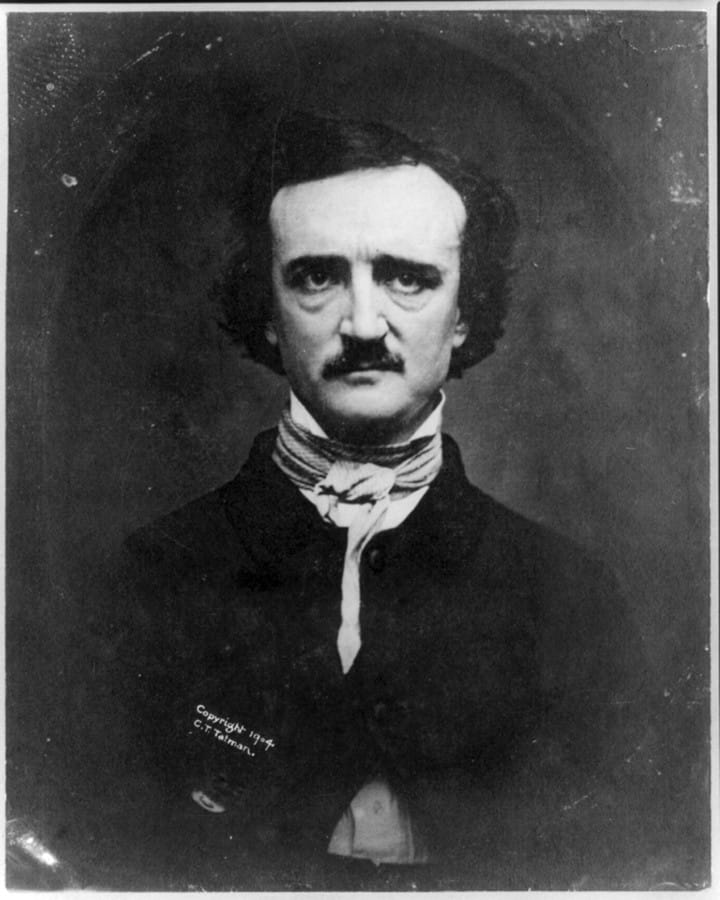
1. The Tale: Nothing Is More Hateful to Wisdom
Poe gives the story an epigraph he attributes to Seneca: Nil sapientiae odiosius acumine nimio, "nothing is more hateful to wisdom than too much cleverness." Thomas Ollive Mabbott, Poe's great editor, could never find it in Seneca, and it isn't there; it seems to come from Petrarch. So a story that would be read nearly to pieces opens with a warning against over-interpretation, signed with a name that doesn't belong to it. Bear this in mind. Every reader in this essay will ignore it, including me, for a time.
The frame comes first, and it matters more than it looks. It is an autumn evening in Paris. The unnamed narrator sits with Dupin "in his little back library, or book-closet, au troisième, No. 33, Rue Dunôt, Faubourg St. Germain," smoking a meerschaum in silence. He is thinking, he tells us, about "the affair of the Rue Morgue" and the murder of Marie Rogêt. That is, the third Dupin story begins by recalling the first two. Monsieur G—, the Prefect of Police, arrives with a problem. Dupin declines to light the lamp: if the matter requires reflection, "we shall examine it to better purpose in the dark."
The Prefect's story reaches us at three removes, what Lacan calls a "double and even triple subjective filter." The royal lady told it to the Prefect, the Prefect tells it to Dupin, and the narrator tells it to us. Poe never names a Queen or a King. We hear of "a personage of most exalted station," a "royal boudoir," and "the other exalted personage" from whom a letter must be hidden. Everyone, Lacan included, reads them as Queen and King, and I will too. It is worth remembering that this is already a reading. We do not know who the correspondents are, any more than we know what the letter says.
Here is what happened. The lady was alone in the boudoir, reading a letter, when the King came in. She tried to put it in a drawer, could not, and left it on the table, face down, address uppermost. Then the Minister D— came in. He saw the letter, recognized the handwriting of the address, and read her confusion. He conducted his business, took out a letter of his own that looked similar, pretended to read it, and set it beside hers. When he left, he took hers and left his. She saw it all and could say nothing, because the King was at her elbow. The Prefect notes the decisive fact, and the narrator puts it into a formula: the Minister's power "would depend upon the robber's knowledge of the loser's knowledge of the robber." He has her letter, she knows he has it, and he knows she knows.
Since then, the Prefect says, the Minister's power has been "wielded, for political purposes, to a very dangerous extent." Only at the end does Dupin say for how long: eighteen months. Finally the lady, "driven to despair," turns to the police. For three months the Prefect has spent his nights ransacking the Minister's hotel. He has divided its surface into numbered compartments, probed cushions with needles, examined the rungs of every chair under a microscope, and gone over the bindings of every book. Nothing would have escaped him down to "the fiftieth part of a line." He has had the Minister waylaid twice by footpads and searched. He has found nothing.
A month later the Prefect returns, still defeated. He mentions that the reward has been doubled, and that he would personally give fifty thousand francs to anyone who helped him. Dupin tells him to write a check for that amount. The Prefect writes it, Dupin unlocks an escritoire and hands him the letter, and the Prefect rushes out without a word.
Then Dupin explains, at length, to the narrator. He tells the story of a schoolboy of eight who won every marble at the game of even and odd by identifying his intellect with his opponent's. He explains that the police failed because they imagined only how they would hide something, and that the Minister was both mathematician and poet. When the narrator objects that there are two brothers, one a mathematician and one a poet, Dupin replies, "You are mistaken; I know him well; he is both." He describes a game played on a map, in which beginners pick the tiny names and experts pick the ones stretched across the whole chart in large letters, which escape notice "by dint of being excessively obvious."
So Dupin called on the Minister in green spectacles, complaining of weak eyes, and let them wander over the room behind the lenses. In a "trumpery filigree card-rack of pasteboard" hanging "by a dirty blue ribbon, from a little brass knob just beneath the middle of the mantel-piece," he saw a letter. It was "much soiled and crumpled" and "torn nearly in two, across the middle." It bore a large black seal with the D— cipher, and it was addressed "in a diminutive female hand, to D—, the minister, himself." The stolen letter had a small red seal with the ducal arms of the S— family and was addressed to the royal personage in a hand "markedly bold and decided." Every visible feature was reversed. Dupin also saw the paper's edges were chafed, and he concluded that the letter had been "turned, as a glove, inside out, re-directed, and re-sealed."
He left a gold snuff-box behind as a pretext and came back the next morning. A man in the street fired a musket, "without ball," as it turned out, and when the Minister went to the window, Dupin swapped the letter for a facsimile he had made at home. He had imitated the D— cipher "by means of a seal formed of bread." Dupin had paid the man in the street himself.
The ending is where the story stops being a puzzle. Dupin says he acted "as a partisan of the lady." For eighteen months the Minister has had her in his power; "she has now him in hers." When D— tries to use the letter against her, he will fall, and Dupin can't resist turning Virgil's line about the easy descent to Avernus on its head: in all kinds of climbing, "it is far more easy to get up than to come down." Dupin calls him "that monstrum horrendum, an unprincipled man of genius." He admits that D— once "did me an evil turn" at Vienna, which he promised he would remember. So he did not leave the facsimile blank. Inside it, in his own recognizable hand, he copied two lines from Crébillon's Atrée et Thyeste:
—— Un dessein si funeste,
S'il n'est digne d'Atrée, est digne de Thyeste.
A design so deadly, if not worthy of Atreus, is worthy of Thyestes. Atreus and Thyestes were brothers. Thyestes seduced his brother's wife, and Atreus took his revenge by serving Thyestes his own sons at a banquet. The story ends on a quotation about two brothers, a stolen wife, and revenge, written by one D to another, and sealed with bread.
2. Lacan: The Itinerary of a Signifier
Lacan gave the seminar on 26 April 1955, during his second year of teaching, which was devoted to Freud's Beyond the Pleasure Principle and the repetition compulsion. He wrote it up in 1956 and published it in La Psychanalyse in 1957. When he assembled Écrits in 1966, he broke chronological order to put it first. Jeffrey Mehlman's English translation appeared in Yale French Studies 48 in 1972; Bruce Fink's complete version, with the mathematical appendices Mehlman left out, came in 2006. Quotations here are Mehlman's, since his is the version the debate was conducted in.
The seminar's claim is stated in its first paragraphs. The repetition compulsion (where we are compelled to repeat traumatic scenes from childhood), Freud's Wiederholungszwang, is grounded in "the insistence of the signifying chain." The symbolic order constitutes the subject, and Lacan proposes to show it "in a story," by tracing "the decisive orientation which the subject receives from the itinerary of a signifier." A fiction is a good place to look, he says, because its arbitrariness lets symbolic necessity show more purely. It is that truth, he adds, "which makes the very existence of fiction possible." Derrida will make a great deal of that sentence. Lacan also notices something every reader of detective fiction feels: this is hardly a mystery at all. Everything a crime story normally withholds, the culprit, the method, the motive, "is carefully eliminated here at the start of each episode." We know who took the letter and how before the Prefect has finished talking. The episode reached the same place from the genre side. Dr. Keane observed that the story gives the reader nothing to solve with, and the hosts concluded it is less a puzzle than an exhibition, like watching a skilled whist player play his hand. The rest of the seminar is Lacan's answer to why Poe bothered: the interest is not in what happened but in where the letter goes.
Two scenes, three glances
Lacan distinguishes "a drama, its narration, and the conditions of that narration." Remember that he says this, because Derrida will accuse him of ignoring the narration. The drama has two scenes. He calls the first, in the boudoir, the "primal scene," "by no means inadvertently, since the second may be considered its repetition." What repeats is not the characters but a structure of three positions, each defined by a glance:
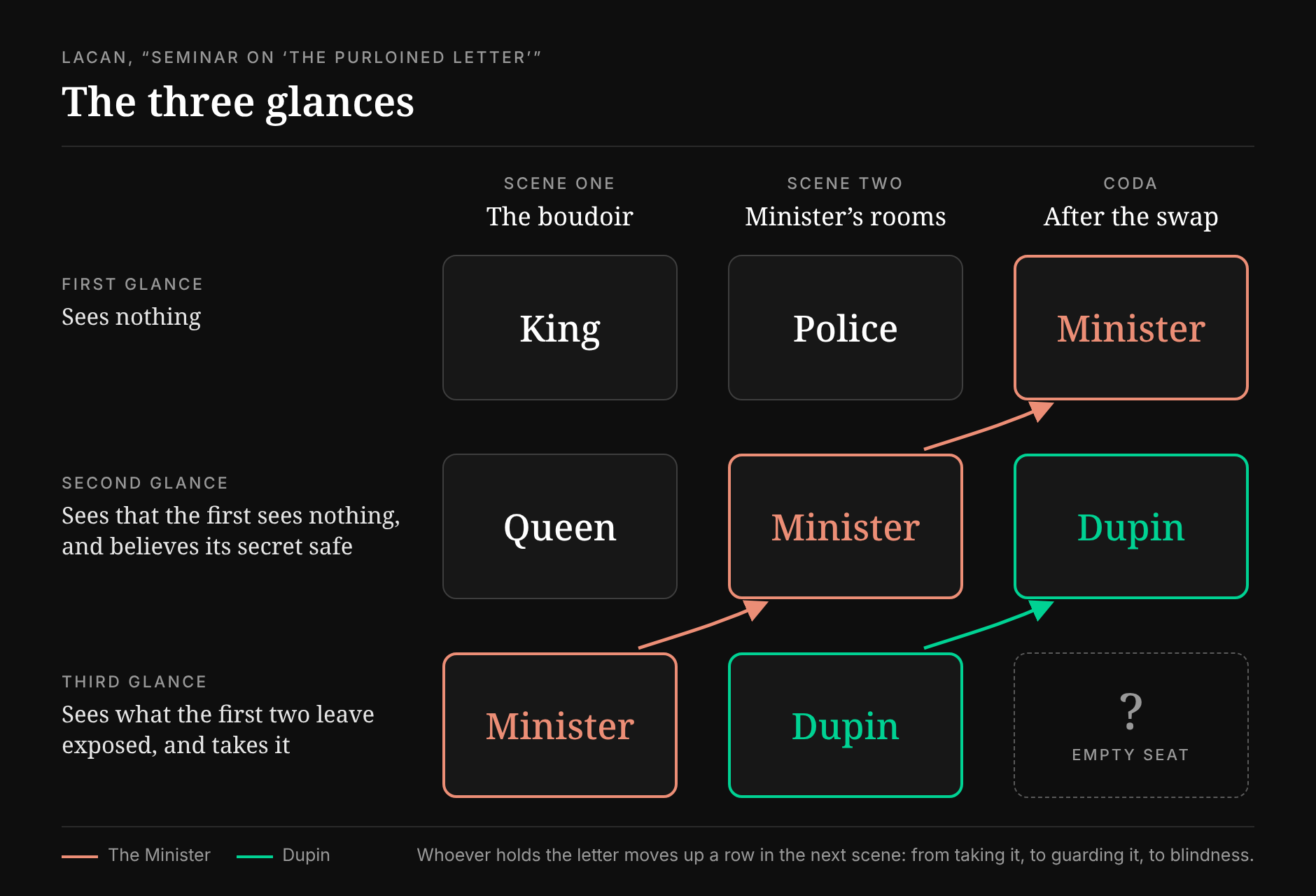
The first two columns are Lacan's explicit scheme. The third is in his text too, though less often noticed. By the end, Dupin is in "the median position previously occupied by the Queen and the Minister," and the Minister has been "reduced to the state of blindness." The third seat in that last column is empty. Keep an eye on who sits down in it.
Lacan's image for the structure is the ostrich, divided among three partners. The first has its head in the sand. The second believes itself invisible because the first can't see it. The third calmly plucks the second's rear. He adds one letter to autruche to get la politique de l'autruiche. His translators hear autrui, other people, in the pun, and Autriche, Austria. I can't help hearing Vienna, where D— did Dupin his evil turn. That small joke is a good sample of the method. A letter changes position and the meaning changes with it.
The police and the real
Why can't the police find a letter in a space they have searched to the fiftieth part of a line? The seminar's answer is the best thing in it. The police have "the realist's imbecility." They think of the letter as an object that is either in a place or not. But "what is hidden is never but what is missing from its place, as the call slip puts it when speaking of a volume lost in a library." A book on the wrong shelf is hidden even in plain view. Only the symbolic can be missing from its place. The real, Lacan says, "is always in its place; it carries it glued to its heel." My co-hosts were kinder to the police than Lacan is. Dr. Cooper pointed out that their method comes from experience: those are the places things usually get hidden. Dr. Potter's verdict was that the method isn't foolish, only restrictive, and she put the failure better than Lacan does: "They will have seen it. They just won't have noticed it." You're told to look for something yellow, and nobody turns it over to find it's green on the other side. That is Lacan's point exactly. The police stop at the reverse of the letter, he says, because "the letter has for them no other side but its reverse."
That is why the letter's content does not matter. Love letter, conspiracy, betrayal, summons: we never learn, and nothing changes. The letter works by its position in a network of glances, and by what it signifies to the people around it. For the Queen, Lacan says, "the letter is the symbol of a pact" foreign to her pact with the King. She cannot defend her possession of it publicly, so its mere existence makes her clandestine. And Lacan is careful to call her its holder, not its owner: "We say the holder and not the possessor." Nobody in the story owns the letter, not even its addressee.
The materiality of the signifier
Two of Lacan's claims will draw Derrida's fire. The first is that the signifier's materiality is odd in several ways, "the first of which is not to admit partition." Cut a letter into small pieces, Lacan says, "and it remains the letter it is." He makes the point through French grammar. You can have de la signification or de l'amour, but you never have de la lettre, letter as stuff, only une lettre. The signifier is "a unit in its very uniqueness, being by nature symbol only of an absence." So the purloined letter "will be and not be where it is, wherever it goes."
The second is the etymology of the title. Baudelaire translated it as La lettre volée, the stolen letter. Lacan says that betrays Poe. Purloin comes from Anglo-French pur and loigner: to put aside, to prolong. The purloined letter is one whose course has been extended, "a letter in sufferance." Then comes the inference that matters most: "since it can be diverted, it must have a course which is proper to it." A letter can be detoured only if it has a route.
Possession and femininity
The characters do not use the letter. It uses them. "Falling in possession of the letter," Lacan writes, "its meaning possesses them." The displacement of the signifier determines subjects "in their acts, in their destiny, in their refusals, in their blindness," and it does so "without regard for character or sex."
Yet sex is exactly what happens to the Minister. To hide the letter he has to adopt the Queen's technique, leaving it in the open, and with it "the attributes of femininity and shadow." He readdresses it to himself in a "diminutive female hand." He receives Dupin in an attitude of ennui and something close to effeminacy, exuding what Lacan calls "the oddest odor di femina." The sign, Lacan says, "is indeed that of woman," and whoever holds it is feminized by it.
The climactic image is the one Derrida will quote back at him. When Dupin enters, the letter screeches across the Minister's office "like an immense female body," and Dupin, eyes veiled by green lenses, has only "to undress that huge body." He goes straight to the spot "between the cheeks of the fireplace." Whether it hangs above the mantel, as Baudelaire translated, or beneath it, as Poe wrote, can be left aside, Lacan says, "without harm to the inferences of those whose profession is grilling." A footnote follows: "And even to the cook herself." Derrida will have a great deal to say about that cook.
The fee, the rage, and the destination
Why does Dupin take money? Lacan sees the analyst's fee. Dupin wants out of the letter's circuit, and money, "the signifier most destructive of all signification," is his exit. Analysts know this, Lacan says. They are the "emissaries of all the purloined letters which at least for a time remain in sufferance with us in the transference."
The exit does not work. Dupin's Crébillon note is a burst of "rage of manifestly feminine nature." Holding the letter, he has taken the Queen's position, and he declares himself "a partisan of the lady." As for where the letter is going, its address "is in the place previously occupied by the King, since it is there that it would reenter the order of the Law."
The last paragraph gives the answer, and the most quoted sentence in the debate. It returns to a formula Lacan has used for years, that "the sender... receives from the receiver his own message in reverse form." And so, he concludes, what the purloined letter, the "letter in sufferance," means is "that a letter always arrives at its destination."
3. Derrida: The Purveyor of Truth
Derrida first gave his reading as a lecture at Johns Hopkins in November 1971. It appeared in Poétique in 1975 as "Le facteur de la vérité," and in English the same year in Yale French Studies 52 as "The Purveyor of Truth." In 1980 it became the third of the four parts of La carte postale; Alan Bass's translation of that book, The Post Card, appeared in 1987. The title is a pun. A facteur is a postman, the one who makes the mail arrive. It is also a factor, a term in a mathematical product. Derrida means both: he wants to ask whether a letter can be guaranteed to arrive, and he wants to count the terms of the story again, because he thinks Lacan miscounted.
It is worth saying first what Derrida grants, because the essay is often summarized as a demolition and it isn't one. Insofar as a critique of naive content-hunting is a necessary step, he says, the seminar "exemplifies a clear progress beyond any post-Freudian psychoanalytic critique." It attends to the letter as a material, formal thing rather than mining it for themes. That is why Derrida bothers with it at all. In a footnote he says that what he is analyzing "is supposed to be" the most rigorous Freudian philosophy, more rigorous than Freud's own. His target is Lacan's rigor, not his carelessness. What Derrida does not grant, as we'll see, is Lacan's claim to have left psychobiography behind.
Psychoanalysis finds itself
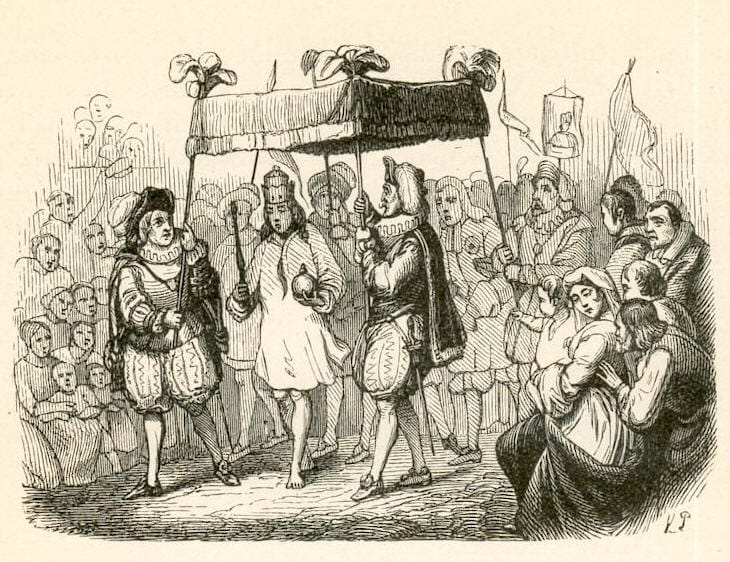
The essay opens not with Poe but with Freud reading "The Emperor's New Clothes" in The Interpretation of Dreams. Freud treats the fairy tale as a disguise laid over the typical dream of being naked in public. Derrida notices that the fairy tale is already about disguise and nakedness, veiling and unveiling. The text Freud explains has staged Freud's explanation in advance. "Psychoanalysis finds," Derrida writes, "all that it finds—in the text that it deciphers. More than itself." That is the problem the Poe essay pursues. What happens when psychoanalysis reads a text that has already put a decipherer, an analyst figure, on stage and shown him finding the truth?
The missing quarter
The first charge is about the frame. Lacan does name the narration, as we saw. But having named it, Derrida says, he reduces it to "commentary," a transparent medium. Lacan says the general narrator "'hypothetically' adds nothing" to the first dialogue and that his role in the second is "entirely different." Derrida answers that it was already different in the first, and that Lacan's treatment of him never changes. The seminar then analyzes only what is narrated, the two triangular scenes, "the internal and narrated side of the narration. Not the narration itself." So: "Where Lacan sees two... there are at least three. And where he sees one or two 'triads,' there is always a supplementary square whose opening complicates the computation." The fourth side of the square is the narrator, and behind him, the scene of writing.
The narrator is not neutral. "The Purloined Letter" opens in Dupin's "little back library, or book-closet," and Derrida draws the moral at once: everything "begins" in a library, among books, "hence nothing begins." Then he goes back to "The Murders in the Rue Morgue." That story says the narrator met Dupin in "an obscure library in the Rue Montmartre," where both were "in search of the same very rare and very remarkable volume." They are never said to have found it. The narrator, whose finances are "somewhat less embarrassed," pays the rent on the house where they live together in perfect seclusion. He describes "the old philosophy of the Bi-Part Soul" and "the fancy of a double Dupin—the creative and the resolvent." So, Derrida observes, the narrator is the first person in the trilogy to pay Dupin, and he is bound to Dupin by a doubling that never shows up in Lacan's triangles. The episode came at the narrator from the other direction. Dr. Potter noted how easy it is to forget this is a first-person story at all; unlike the narrators of "Usher" or "Amontillado," this one is laid back to the point of invisibility. Dr. Keane wondered whether he even knows what the letter says. Then Dr. Potter asked the question Derrida would have liked best: what if he has seen it, and is protecting it from us? A narrator that transparent is not neutral. His transparency is his position.
The doubles multiply from there. The Minister has a brother; Dupin insists the Minister "is both" poet and mathematician, as if the two brothers had merged. Dupin and D— share an initial. Dupin signs his revenge with a quotation about two brothers. Rue Morgue's narrator describes a game of draughts reduced to "four kings," in French quatre dames, four ladies. Derrida's final section is titled "Four of a Kind, Kings—Double." Every character, he argues, comes to occupy every position, so the scheme of three glances breaks down: "There are only ostriches, no one escapes being plucked, and the more one is the master, the more one presents one's rear."
The proper place
The second charge is the deepest one. Lacan said that what is hidden is what is "missing from its place," manque à sa place. Derrida proposes changing "maybe even less than a letter." Drop the accent, and manque à sa place becomes manque a sa place: lack has its place. That, he argues, is Lacan's real thesis. The letter is displaced, but the displacement runs along a proper, circular route to a determinable place. Lacan said so himself: "since it can be diverted, it must have a course which is proper to it," leaving its place "even though it returns to it by a circular path." The letter wanders, and the wandering is guaranteed to end at home. "Something is missing from its place," Derrida writes, "but the lack itself is never missing."
Where is home? Derrida's answer draws on the seminar's imagery and on Lacan's other writing of the period. It is the place of castration, the woman's body read as the site of lack. The seminar finds the letter "between the cheeks of the fireplace" on "an immense female body." In a 1969 preface to the paperback Écrits, Lacan said what the letter conveys along its travels "is that very Femininity which it is to have taken into its shadow," and that the Minister ends up "castrated" with the letter "dangling between the legs of his high mantelpiece." The circuit of the letter is the circuit of the phallus, the "signifier of signifiers," returning to its proper place. Truth becomes a veiling and unveiling of that lack, which Derrida says "brings the entire Seminar into harmony with Heidegger's discourse on truth."

The cook
Then Derrida produces his best piece of detective work. In 1933, Marie Bonaparte, Freud's friend and patron and his representative in France, published a psychobiography of Poe with a foreword by Freud. She read "The Purloined Letter" as the son's restoration of the mother's missing penis. The fireplace, here as in other tales, stood for the mother's cloaca, and the whole arrangement of mantel, knob, and dangling letter was "almost an anatomical chart, from which not even the clitoris (or brass knob) is omitted." She also noted that Baudelaire had mistranslated "beneath" the mantelpiece as au-dessus, "above."
Lacan never mentions Bonaparte. But his seminar raises the same point about Baudelaire's mistranslation and, as we saw, waves it off as a matter for "those whose profession is grilling." Aux inférences de la cuisine, the French has: the inferences of the kitchen. And the footnote: "And even to the cook herself." Derrida notes the footnote was added in Écrits, some ten years after the seminar first appeared. Lacan had read Bonaparte, and he arrived at her destination, the castrated mother, "after a possibly less rigorous textual analysis" than hers. Bonaparte at least read the tale alongside Poe's other stories. Lacan claimed to break with psychobiography and rejoined it at its anchor. Then he sent her to the kitchen. "Why relegate the question to the kitchen, as if to contingency," Derrida asks, "and the woman who replies to it to the rank of cook?" Above or beneath also matters to Lacan's own reading, since a letter above the mantel is not "between the cheeks of the fireplace."
The scene has a structure Derrida enjoys. Bonaparte was the keeper of Freud's letter in France: his friend, his correspondent, his representative, with a foreword in his own hand on the front of her book. Derrida calls her a sort of minister. Freud, dead too soon to know how things turned out, occupies the place of the King. Lacan's whole program was a "return to Freud," recovering Freud's letter from the institution that had misdirected it. So Lacan casts himself as Dupin, restoring Freud's purloined letter to its proper course and taking it from the minister who held it. And in playing Dupin, he repeats Dupin's last act: the gratuitous, signed blow at the one he displaced.
Indivisibility, voice, and dissemination
The third charge concerns Lacan's claim that the letter does "not admit partition." Derrida answers that no material thing is indivisible. A torn letter can simply be destroyed; "it happens." A materiality "deduced from an indivisibility which is not found anywhere, corresponds in fact to an idealization." Only an ideal object stays the same however it is cut. And Lacan's ideal model of the signifier, Derrida argues, is the spoken word: the seminar says, "May it but please heaven that writings remain, as is rather the case with spoken words." The privileged signifier keeps its integrity by being guarded in the voice, as speech, as "full word." That is the compound Derrida names phallogocentrism: the phallus as transcendental signifier, kept intact in a logocentric privilege of speech. "The subject is very divided," he says, "but the phallus is never shared."
Against this, Derrida offers the formula everyone remembers:
The remaining structure of the letter, contrary to the final words of the Seminar... is that a letter can always not arrive at its destination.
This is far subtler than it seems at first glance. Derrida continues: "Not that the letter never arrives at its destination, but part of its structure is that it is always capable of not arriving there." The possibility of loss is not an accident that befalls some letters. It is built into what makes something a letter. "Without this danger... the circuit of the letter would never have even begun." A sending that could not go astray would not be a sending. Derrida would later call this destiny of errancy destinerrance. In a footnote he has the text itself say, in the first person: "I am always the letter that never arrives. At the destination itself."
Dessein, destin
Derrida closes on two small textual facts, and they are the ones I would have led with on air.
The first is Dupin's signature. He leaves a facsimile of the letter whose outside is a forgery and whose inside is authentic: his own handwriting, so the Minister will know who did it. But what he writes is a quotation, sealed with bread, from someone else's play. Dupin's signature is in quotation marks. Then the narrator quotes Dupin quoting Crébillon, inside Dupin's long quoted narration. "What is a signature within quotation marks?" Derrida asks. "This remnant is still literature."
The second is a misquotation. Crébillon's line, as Poe gives it, is Un dessein si funeste, a design so deadly. Lacan quotes it correctly the first time. When he quotes it again near the end, and once more in the 1969 preface, he writes Un destin si funeste, a destiny so deadly. Two times out of three, design becomes destiny. Derrida puts it gently: Lacan is "thus perhaps rendering a meaning to its destination." He credits a Father Peter Coppieters de Gibson with noticing. A seminar whose last word is that a letter always arrives at its destination quietly altered the letter of its text on the way. Derrida thinks it was deliberate, "probably." Either way, the letter did not arrive as sent. It isn't the seminar's only misdelivery, either. Lacan says the police searched the Minister's hotel "for the last eighteen months." Poe says three; eighteen is how long the Minister had held the letter. Derrida quotes that sentence in full and lets it pass.
4. The Third Glance: Johnson and After
The exchange between its principals was over almost as soon as it started. Lacan never published a direct reply, and Derrida did not return to Lacan at length until 1990, nine years after Lacan's death. By then he could recall their first meeting, at the 1966 structuralism conference at Johns Hopkins, where Lacan's opening remark was that they had had to come abroad to meet each other. What kept the debate alive was its readers, and the first of them changed its terms.
Barbara Johnson: "The Frame of Reference"
Johnson published her essay in Yale French Studies 55/56 in 1977, the year she finished her doctorate at Yale. She would go on to translate Derrida's Dissemination. The essay is still the best thing written on the exchange, because it doesn't take a side. It shows that each reader does to the previous one exactly what Dupin does to the Minister.
Derrida accuses Lacan of cutting Poe's story out of its frame. Johnson shows that Derrida cuts Lacan's seminar out of its own frame, reading it apart from the rest of Écrits and attributing to it positions Lacan qualifies elsewhere. Derrida accuses Lacan of finding the letter exactly where he expected to find it, and then finds Lacan's error exactly where he expected to find it. The charge of having missed the frame is itself a frame.
Her best observation is about numbers. Lacan's structure has three terms. Derrida insists there are four. Johnson points out that this is the game of even and odd, the game Dupin describes at the center of the story. Derrida plays even against Lacan's odd, which is exactly what Dupin's schoolboy does: guess the other player's guess, and bet against it. The story predicted its critics. To read "The Purloined Letter" is to sit down at the table and guess.
Then she rereads Lacan's last sentence, and declines to settle it. "A letter always arrives at its destination" may be simply pleonastic: a letter's destination is wherever it happens to arrive. It may mean that the letter has no destination at all. Or it may mean that we all die. She leaves all three standing, and the refusal is the point. No reader gets the last word over the text, including her. Žižek later boiled her reading down to the first option, that the destination is wherever the letter arrives. That version has a tidy consequence. Derrida is right that no letter is guaranteed to reach the address on the envelope, and Lacan is right that every letter arrives somewhere, at someone it then implicates.
The literary reception
Johnson's essay made the exchange a set piece of literary theory. Shoshana Felman, in "On Reading Poetry," used it to contrast two models of psychoanalytic criticism: Bonaparte's, which reads the text to diagnose the author, and Lacan's, which reads the text's own structure of repetition. John T. Irwin, in a long 1986 essay in MLN and later in The Mystery to a Solution (1994), read the whole sequence of critics as a game of one-upmanship. Each reader takes the third seat, sees what the last one couldn't, and becomes visible to the next. In 1988 John P. Muller and William J. Richardson collected the story, the seminar, Derrida, Johnson, and further essays in The Purloined Poe, and the tale became a syllabus unit.
What literary critics mostly took from the exchange was a lesson about reading. Every interpretation is also a position. Every reader occupies a place in the structure being read. And the claim to see the whole board is the surest sign that one has been seated at it. You can take that lesson as Lacanian or as Derridean. It works either way, which is a point in Johnson's favor.
The philosophical reception
Among philosophers the reception split along the usual line.
On the continental side, the exchange was absorbed into larger projects. Jean-Luc Nancy and Philippe Lacoue-Labarthe had already published Le titre de la lettre (1973), a close reading of Lacan's "The Agency of the Letter" that Derrida called "fundamental and indispensable." Derrida's 1990 lecture, "For the Love of Lacan," is collected in Resistances of Psychoanalysis. Slavoj Žižek defended Lacan in the first chapter of Enjoy Your Symptom! (1992), titled "Why Does a Letter Always Arrive at Its Destination?" He gives three answers, one for each of Lacan's registers. In the imaginary, whoever receives a letter recognizes himself as its addressee; this is how ideology hails us. In the symbolic, the sender gets his own message back in inverted form. In the real, the letter that always arrives is death.
On the analytic side, the Poe exchange itself drew little direct engagement. The thesis at its center did, under another name. In August 1971, a few months before the Hopkins lecture, Derrida gave "Signature Event Context" at a conference in Montreal. It argues that every mark must be able to function in the absence of its intended receiver and can always be cited outside its context. That is the philosophical form of "a letter can always not arrive." In 1977, the year of Johnson's essay, John Searle replied in the journal Glyph with "Reiterating the Differences," and Derrida answered with the long, mocking "Limited Inc a b c . . ." Searle's position, roughly, was that the possibility of a speech act's failure is parasitic on its normal success and tells us little about how meaning ordinarily works. Searle was defending the post office: most letters arrive, and a theory built on lost mail gets the order of explanation backward. Read side by side, the two quarrels of the 1970s look like one quarrel, conducted with Lacan on one front and Searle on the other.

Interlude: The Mailbox Rule
Forgive a lawyer a digression. The question of whether a letter arrives at its destination is not only a question for seminar rooms. Courts had to answer it, because contracts were made by post, and they answered it in 1818, twenty-six years before Poe wrote his story.
In Adams v. Lindsell, a firm of wool dealers wrote to a firm of manufacturers offering to sell them wool, asking for an answer "in course of post." The dealers misaddressed their own letter, so it arrived days late. The manufacturers posted their acceptance the evening it came. Before the acceptance reached them, the dealers, assuming silence meant refusal, sold the wool to someone else. Was there a contract? The Court of King's Bench said yes, from the moment the acceptance was posted. Its reason is the interesting part. If the dealers were not bound until they received the acceptance, then the manufacturers should not be bound until they received word that the acceptance had been received, "and so it might go on ad infinitum."
Poe's story runs on the same machinery, with one difference. The Minister's power, the narrator says, "would depend upon the robber's knowledge of the loser's knowledge of the robber," three levels of knowing that stop exactly where blackmail needs them to. The game of even and odd doesn't stop. Lacan says it can "only be repeated in an indefinite oscillation." The court in Adams faced an oscillation of acknowledgments just as endless, and it cut it by decree. The letter is deemed to arrive when it leaves the sender's hands.
The English Court of Appeal pushed the rule as far as it could go in Household Fire Insurance Co. v. Grant (1879). A company posted Grant a notice that it had allotted him shares. The letter was lost and never reached him. When the company failed, its liquidator demanded payment for the shares, and the court held that Grant was a shareholder. A letter that never arrived had made a contract. Lord Justice Bramwell dissented. A letter that never arrives, he said, is not a communication, and the majority's rule had "no reason in it; it is simply arbitrary."
So the common law reached Lacan's conclusion, that a letter always arrives at its destination, from Derrida's premise, that a letter can always fail to. The mailbox rule exists only because loss in the post is structural. Bramwell is Derrida on the bench. The modern American version, Restatement (Second) of Contracts § 63, says an acceptance by an invited medium is effective once it leaves the offeree's possession, whether or not it ever reaches the offeror.
Anyone who practices in majority-rule jurisdictions in the United States lives with both sentences at once. My own native Texas Rule of Civil Procedure 21a says that service by mail "shall be complete upon deposit of the document," postpaid and properly addressed. A few subsections later it adds, "Nothing herein shall preclude any party from offering proof that the document was not received." The first sentence is Lacan, the second is Derrida, and every motion for new trial that turns on a lost notice is fought in the space between them.
I raise this because the law's reason for its conclusion is one neither theorist gives. The law does not say the letter arrives because of its nature, as Lacan does. It does not say the letter might not arrive because of its nature, as Derrida does. It says the letter arrives because we say so, and we say so because a commercial system needs contracts to close. Arrival is not discovered. It is declared, by a court, inside an arrangement of post offices, clerks, rules, and remedies. That is a very Deleuzean way to deliver a letter, and I will come back to it.
There is a second lawyer's point, and my co-hosts made it without the law reports. Nobody in the story is prosecuted. Dr. Cooper called the result a kind of abstract justice: the detective knows, the reader knows, and no court ever hears it. Dr. Keane saw why. The case can't have a public resolution without drawing attention to whatever made the letter dangerous. That is the old problem with blackmail. To prove the crime you have to put the letter into evidence, and putting it into evidence is the injury. The Minister is beyond the reach of the law not because he is powerful, but because the only proof against him is the thing the Queen needs no one to read. So the matter can only be settled out of court, by another theft.
5. A Deleuzean Purloined Letter
Lacan says the letter always arrives. Derrida says it can always fail to. Johnson, at least as Žižek reads her, says that wherever it lands becomes its destination. All of them are answering the same question, and the question is postal: where is this letter going, and does it get there? A Deleuzean reading starts by refusing the question. The question isn't unanswerable. The trouble is that it assumes what matters about a letter is its address.
There are two Deleuzes in this story, and the first one got there before Derrida did.
The first Deleuze: Lacan's letter without the primal scene
In Difference and Repetition (1968) and The Logic of Sense (1969), Deleuze cites Lacan's seminar with admiration. He calls Lacan's pages "exemplary" and takes the purloined letter as his model of what he calls the "virtual object." Real objects are either somewhere or not; virtual objects are and are not where they are. In The Logic of Sense, under the name "Lacan's paradox," it becomes the "paradoxical element" that runs through two series and sets them in motion. In the essay "How Do We Recognize Structuralism?", written in 1967, it is "object = x," the "empty square" every structuralism needs, and Poe's letter is the example Deleuze picks: present in both of Poe's series, belonging to neither, always missing from its place. So far this is Lacan.
But Deleuze changes three things, and each one matters.
First, there is no primal scene. Lacan called the boudoir scene "primal" and the second scene its repetition. Deleuze denies that either series is the original. The two scenes coexist, and each is a displaced version of the other. Repetition is not the return of something that first happened plainly and was then dressed up. In Difference and Repetition, disguise and displacement are what repetition is made of, with no bare term underneath them. Derrida opens his essay by catching Freud trying to undress "The Emperor's New Clothes" to find the naked dream underneath. Deleuze had already denied that there was a naked dream to find.
Second, the empty square is not simply a lack. In The Logic of Sense the paradoxical element appears in one series as an empty place and in the other as an occupant without a place. It is excess and lack at once, depending on which side you look from. Lacan sees only the lack, and so he can locate it. That is Derrida's complaint, that Lacan's lack "has its place." Deleuze keeps Lacan's formula, that the paradoxical element is missing from its place, and then takes away the place. In the structuralism essay the place itself keeps moving; in The Logic of Sense the element is always displaced in relation to itself. A letter like that cannot "return" anywhere, because it never had a home to leave.
Third, the letter is productive. It doesn't signify an absence that subjects organize themselves around. It distributes the positions, generates the moves, and produces sense. The structure exists because the letter keeps moving.
So the first Deleuze already holds the position Derrida will argue for, that there is no proper place, while keeping what is best in Lacan, the letter's power to organize a field. And he does it without ever asking whether the letter arrives.
The second Deleuze: desire does not lack
Then came Guattari, and Anti-Oedipus (1972), and the second Deleuze turned on the Lacan he had borrowed from. What changed was not where the lack sits but the frame around it. The first Deleuze still worked inside a structure of signifiers, and The Logic of Sense still tells the story of sexuality in psychoanalytic terms, phallus and Oedipus included. Anti-Oedipus throws the structure out. Deleuze and Guattari reject the idea of desire as lack, which they trace from Plato through Freud to Lacan. Desire, for them, produces. It connects flows and cuts them. Lack is manufactured afterward, by the family, the priest, the analyst, and the market, and then discovered by psychoanalysis as if it had always been there. They also have a famous complaint about the triangle. Psychoanalysis, they say, "traps all social phenomena in the triangle (mommy, daddy, me)."
Look at the boudoir again with that sentence in mind. A King, a Queen, and a younger man who takes something from her under the King's nose. Lacan found that triangle in Poe and made it eternal by having it repeat. Bonaparte found the same triangle and called it the mother's missing penis. Derrida added a fourth corner. To be fair, he says his doubles are "far from fitting into the symbolic space of the family triangle." But he is still counting corners. The Deleuzean move is not to count the corners differently. It is to ask what the letter is plugged into.
The answer is not a family. It is a court, a ministry, a police force, a political faction, a ducal house, and a market. The letter matters because the Minister has "wielded" its power "for political purposes, to a very dangerous extent." The Prefect says it gives its holder "a certain power in a certain quarter where such power is immensely valuable." The story's Oedipus is a cover for a story about state power.
Not "what does it mean?" but "how does it work?"
Anti-Oedipus gives the method in two sentences: "The unconscious poses no problem of meaning, solely problems of use. The question posed by desire is not 'What does it mean?' but rather 'How does it work?'"
Apply that to the letter, and two things in Lacan's seminar that seemed paradoxical become plain. Lacan says the letter's content doesn't matter. Deleuze agrees, for a better reason: the letter is not a meaning but an operator. Lacan also notices that the letter's power is only ever potential, because the moment the Minister uses it, it vanishes. That is exactly what Deleuze calls the virtual, which is fully real without being actual. Blackmail is a virtual power. The Minister can wield it for eighteen months because he never plays the letter itself. The threat does the work, and the threat lasts only as long as the letter goes unused.
A Thousand Plateaus (1980) supplies the rest. Language, Deleuze and Guattari argue, is first a matter of order-words, statements that do things. Its basic operation is the incorporeal transformation, a change that happens to bodies without touching them. Their example is a judge's sentence, which turns an accused into a convict without laying a finger on him.
The purloined letter is a chain of incorporeal transformations. While preparing the episode, I came to think that the decisive moment in the story is not the theft, and not anything about the Queen keeping the letter. It is the King's entrance. Between two correspondents, the letter is a private communication. With a third person in the room, the same sheet of paper becomes evidence of a betrayal. Nothing about the paper changed. The arrangement around it did. Then the Minister's glance turns the Queen into a blackmail victim, and his theft gives him "ascendancy." Dupin's substitution, invisible to D—, turns the Minister from master into dupe while he stands at the window.
This is also what the mailbox rule was doing. A court that "deems" an acceptance delivered on posting is issuing an order-word. The letter arrives because an assemblage of courts, post offices, and commercial need says it does.
A regime of signs, and its priests
In the fifth plateau of A Thousand Plateaus, Deleuze and Guattari describe a "signifying regime" of signs. A despot sits at the center, every sign refers to another sign without end, and a caste of interpreter-priests stands between the despot and everyone else, endlessly reading. They have a name for the disease of that regime: "interpretosis."
Read the story that way and its cast falls into place with alarming ease. The King is the despot at the center, blind as the despot always is. The police are the regime's bureaucracy, searching every square inch of its territory and finding nothing, because a sign is not a thing in a drawer. Dupin is the priest, the interpreter who knows how signs refer to other signs and who is paid by the regime for restoring the circuit. And the critics are a second priesthood, reading the readers. (Handing out the parts like this is itself a priestly act, and I don't exempt myself.) Lacan is the paranoid form of interpretosis, in which the chain closes and returns to the master signifier. Derrida is the infinite form, in which the chain never closes. Both are still interpreting. The Deleuzean exit is to stop interpreting, at least in the priestly sense, and start asking what the story does.
Royal science and the Gothic
The episode's best thread came from Drs. Potter and Keane, and it has a Deleuzean shape. Dr. Potter asked whether a story with no ghosts is still Gothic, and answered that it is, in its way of knowing. The police search the way Victor Frankenstein searches the house on his wedding night, every corner in order, while the creature is already with Elizabeth. Dupin knows by putting himself in another's place. She reached for Ruskin, for whom Gothic stonework is alive because no two carvings repeat. Dr. Keane made the point industrial: the police have a method they can reproduce on any case, and the one thing it cannot reproduce is thinking from inside someone else's head.
Ruskin's version is famous: "You must either make a tool of the creature, or a man of him. You cannot make both." Deleuze and Guattari turn the same distinction into a theory of knowledge in the twelfth plateau of A Thousand Plateaus. Royal science, the science of the State, works by reproducing: it fixes a point of view, lays down a metric, and applies one procedure everywhere. Nomad science works by following the singularities of its material as it goes. Their example is the Gothic cathedral. "The ground-level plane of the Gothic journeyman," they write, "is opposed to the metric plane of the architect," and the State's answer to the journeymen was to take over the building site.
Now look at how the Prefect searches. He divides the Minister's hotel into numbered compartments and inspects each to the fiftieth part of a line. That is striated space in Deleuze and Guattari's sense: a territory gridded, measured, and covered point by point. It fails because the letter isn't located in the grid. It is a singularity, the one paper that is wrong in exactly the right way, and Dupin finds it by following the Minister's mind, not by measuring his rooms. Dr. Cooper put the police's dilemma precisely: a method that covered every possibility would no longer be a method. Royal science fails here not through stupidity but by being a science.

Faces
One thing it does is read faces. We never see the Minister read the letter. He recognizes the handwriting of its address and then reads the Queen's face. From her confusion he knows everything. Dupin's schoolboy, the one who wins at even and odd, works the same way: "I fashion the expression of my face, as accurately as possible, in accordance with the expression of his," and then waits to see what thoughts arise. The Minister receives Dupin behind a mask of ennui. And Dupin, for his part, takes off his face. He wears green spectacles so that he can look without being seen to look.
A Thousand Plateaus has a whole plateau on faciality. The face, Deleuze and Guattari argue, is a system of a white wall, on which signification is inscribed, and black holes, where subjectivity lodges, above all the eyes. Power reads faces, and the face is an apparatus of capture, which is why they insist it is something to be dismantled. Dupin's green lenses do that to his own face. They blank out the black holes. In a story where every other character gives himself away through his face, the detective wins by making his own face illegible.
Surfaces
The police search in depth. They probe cushions with needles, go over every joint with a microscope, take the tops off tables, and examine "the moss between the bricks." The letter is on the surface, hanging from a knob in a cheap card-rack. Lacan made the point well: the police think of the real as something buried, and the letter isn't buried. But he still found the letter's meaning in a depth, in the place where the woman's body is supposed to lack.
The Logic of Sense is a book about surfaces. Sense, for Deleuze, is an effect produced at the surface of bodies, like the Stoics' incorporeals, and the great error of philosophy and psychoanalysis alike is to look for it in heights or depths. Nothing is deeper, he writes, than "the surface and the skin." Years later, in his book on Francis Bacon, he quotes Paul Valéry's version of the thought: the deepest thing in a person is the skin. Poe had already put the same idea in Dupin's mouth, in the first Dupin story: truth is "invariably superficial," and "the depth lies in the valleys where we seek her."
Notice what D— did to the letter, too. He turned it "as a glove, inside out." The inside became the outside. Lewis Carroll, whom Deleuze reads throughout The Logic of Sense, invented a purse for Sylvie and Bruno Concluded sewn so that its inside is its outside, which means the whole world is inside it. The Minister's letter is a Fortunatus's Purse. There is no depth in it to search. It hides by being all surface.
The forger
Dupin's victory is a forgery. He doesn't just take the letter. He leaves a facsimile, and he makes its seal out of bread.
Look at what the facsimile copies. It isn't the original letter, with its small red seal and bold hand, but the letter "in its present state," as Lacan says: turned inside out, readdressed in a woman's hand, resealed in black with D—'s own cipher. Dupin copies a disguise, and the copy succeeds because the original has no privilege. The Minister never checks.
In "Plato and the Simulacrum," an appendix to The Logic of Sense, Deleuze distinguishes a copy, which resembles an original, from a simulacrum, which is built on a difference inside itself and produces resemblance only as an outward effect. The facsimile is a simulacrum in exactly this sense, a copy of a disguise of a letter whose contents nobody knows. Derrida, at the end of his essay, describes the same thing as "a labyrinth of doubles without originals, of facsimile without an authentic." Deleuze and Derrida agree on the fact. They disagree about its tone. For Derrida, the missing original keeps truth deferred. For Deleuze, the simulacrum is an affirmative power, what he would later call, in Cinema 2, "the powers of the false."
In 1966 Deleuze wrote a short piece on detective fiction, "The Philosophy of Crime Novels." In the classical detective story, he says, the search for truth is wholly philosophical, whether the detective works by deduction or by induction. The French Série Noire gave that up. Its police have nothing to do with truth. What it shows instead is an "astonishing compensation of error," and the power of falsehood becomes the real detective element. "The Purloined Letter" is classical in form. But Dupin does not catch a criminal. He outforges a forger, collects a fee, and signs his revenge with a quotation. The truth the genre promises arrives on paper with a bread seal.
Line of flight, and its capture
So what is the story about, if not a letter's destination? A Deleuzean reading would say it is about a line of flight and the machinery of capture that closes over it.
Start with the Queen. Whatever the letter says, it binds her to someone outside the pact that binds her to the King. Lacan saw this: the letter puts her in "a symbolic chain foreign to the one which constitutes her faith." Deleuze and Guattari found the same thing in Kafka, whose letters to Felice they read as a "diabolical" pact standing in for the marriage contract he feared. In Deleuze's terms, the letter is a line of flight, a connection that escapes the royal assemblage. In Dialogues Deleuze distinguishes the traitor from the trickster. The trickster cheats in order to take possession of fixed properties or seize a territory. The traitor betrays the dominant order itself. The Queen, whatever passed between her and the house of S—, is the story's only traitor in that sense. Everyone else is a trickster.
Then follow the captures. The Minister captures her line of flight and converts it into political power. The police are set to capture it on her behalf and fail. Dupin captures it and hands it back to her, so that she can restore her standing in the very pact she slipped. And he is paid for it.
That payment is the delivery the story lingers over. We watch the letter pass to the Prefect, but we never see it reach the Queen. What we do see, step by step, is a check for fifty thousand francs, filled out and signed, passing from the Prefect to Dupin. In Anti-Oedipus, capitalism is the machine that decodes every flow into money. Here a royal secret, carrying honor, sovereignty, and perhaps love, is converted into a sum on paper and paid out. Lacan called money the signifier "most destructive of all signification" and read Dupin's fee as an exit from the circuit. Deleuze would say it is not an exit but the circuit's completion. A flow of desire is recoded as a flow of money, and the letter's line of flight ends as a line in a checkbook.
And another debt is being paid. D— once did Dupin "an evil turn" at Vienna, which Dupin promised, "quite good-humoredly," that he "should remember." Anti-Oedipus takes up Nietzsche's account, in the Genealogy of Morals, of how memory was bred into human beings for the sake of debt, so that a creditor could remember what he was owed. Dupin keeps accounts. His Crébillon note collects a debt with the image of a man served his own children at dinner. Under the triangle of King, Queen, and Minister there is a ledger.
In the middle
Derrida, as we saw, says the story begins in a library, among books, "hence nothing begins." He means it as a disturbance of origins. Deleuze would agree and draw a cheerier conclusion. A Thousand Plateaus opens with the rhizome, which has no beginning or end and is always in the middle, between things. "The Purloined Letter" starts in the middle of a series, recalls two earlier affairs, and is narrated by a man in the middle of a friendship we only half understand. The letter is always caught between hands. We never see it written, and we never learn what it says. Its whole existence in the story is passage.
Dr. Cooper opened the episode by bringing up Melville's "Bartleby, the Scrivener," and he was right to. At the end of that story the narrator passes on a rumor that Bartleby had once been a clerk in the Dead Letter Office in Washington, sorting mail that would never be delivered. "For by the cart-load they are annually burned." "Dead letters! does it not sound like dead men?" Deleuze wrote one of his late essays on Bartleby, and what held him was the formula, I would prefer not to. It is, he says, "neither an affirmation nor a negation"; it "hollows out a zone of indetermination." Put Lacan's question to the man who spent his days among letters that had neither arrived nor gone astray, only stopped. Will the letter reach its destination, or can it always fail to? He would prefer not to. So the Deleuzean answer to both famous sentences is thus: a letter does not arrive or fail to arrive. It passes through a series of arrangements, and in each one it does something. It transforms a Queen, empowers a Minister, defeats the police, enriches a detective, and gives two generations of theorists something to fight about. The interesting question is never where it is going. It is what it does on the way, and who profits from the trip.

Coda: Torn Nearly in Two
One detail has been waiting since the beginning. When Dupin finds the letter in the card-rack, it is "torn nearly in two, across the middle." Lacan noticed the tear. He mentions the letter's "being but half torn," barely a page after declaring that you can cut a letter into small pieces and it remains the letter it is. Derrida says a letter can always be divided, and that its divisibility is what lets it go astray. Poe, more than a century before either of them, tore the letter nearly in two and stopped. It is neither whole nor divided. It hangs in the middle, from a dirty blue ribbon, in plain sight, and it does its work there.
I said I would keep an eye on the empty seat in Lacan's third column, the glance that sees what the first two leave exposed. Lacan sat in it, and Derrida showed him where he was sitting. Derrida sat in it, and Johnson showed him. Johnson knew perfectly well she was sitting in it, which is the closest anyone has come to getting up. I am sitting in it now, and so, by the end of a post like this, are you. There is a last structural joke here, at my expense. The episode had three hosts and three readings of the epigraph, and one host missing, who then wrote the whole thing down afterward from outside the room. Lacan would count the triangle. Derrida would point to the fourth, the one who narrates. Am I that narrator? Are you, dear and constant reader? A Deleuzean reading does not escape that chair, either. But Deleuze would say that escape was never the point. The question is what you make while you're sitting, meerschaum in hand, pondering purloined letters and Poe on an October eve hopefully not too dark nor dreary.
"The Purloined Letter" begins and ends with borrowed words, epigraphs, quotations, a style I am content to ape myself (and see, a "Murders in the Rue Morgue" pun for you, at this, the end). It opens with a sentence attributed to Seneca that Seneca apparently never wrote, warning against too much cleverness. It closes with two lines of Crébillon, copied by Dupin as his signature and sealed with bread. Between them, a letter whose contents no one ever learns passes through half a dozen hands and two generations of theory. It is quotation all the way down, and every piece of it reaches us through someone with a stake in it.
This essay was supposed to be an hour of conversation on Critical Readings. Instead it went out by the slower post, a letter in sufferance. Whether it reached you is, I am told, a matter of some philosophical dispute. In Texas, at least, service by mail is complete upon deposit with the mail. Consider yourself served.
Works Cited
Poe, Lacan, Derrida, Bonaparte
- Edgar Allan Poe, "The Purloined Letter," The Gift for 1845 (issued September 1844). Text and notes in Thomas Ollive Mabbott, ed., Collected Works of Edgar Allan Poe, vol. 3 (Harvard UP, 1978), online at the Poe Society of Baltimore.
- Edgar Allan Poe, "The Murders in the Rue Morgue" (1841).
- Jacques Lacan, "Seminar on 'The Purloined Letter,'" trans. Jeffrey Mehlman, Yale French Studies 48 (1972): 38–72, as reproduced at lacan.com. Complete translation in Écrits, trans. Bruce Fink (Norton, 2006).
- Jacques Derrida, "The Purveyor of Truth," trans. Willis Domingo, James Hulbert, Moshe Ron, and Marie-Rose Logan, Yale French Studies 52 (1975): 31–113; reprinted in Yale French Studies 96 (1999): 124–197. Also as "Le facteur de la vérité" in The Post Card: From Socrates to Freud and Beyond, trans. Alan Bass (University of Chicago Press, 1987), 413–96.
- Marie Bonaparte, The Life and Works of Edgar Allan Poe: A Psycho-Analytic Interpretation, trans. John Rodker, foreword by Sigmund Freud (Imago, 1949; French original 1933).
Reception
- Barbara Johnson, "The Frame of Reference: Poe, Lacan, Derrida," Yale French Studies 55/56 (1977): 457–505; reprinted in The Critical Difference (Johns Hopkins UP, 1980).
- John P. Muller and William J. Richardson, eds., The Purloined Poe: Lacan, Derrida, and Psychoanalytic Reading (Johns Hopkins UP, 1988).
- Shoshana Felman, "On Reading Poetry: Reflections on the Limits and Possibilities of Psychoanalytical Approaches," in Joseph H. Smith, ed., The Literary Freud (Yale UP, 1980); reprinted in The Purloined Poe.
- John T. Irwin, "Mysteries We Reread, Mysteries of Rereading: Poe, Borges, and the Analytic Detective Story," MLN (1986); and The Mystery to a Solution: Poe, Borges, and the Analytic Detective Story (Johns Hopkins UP, 1994).
- Slavoj Žižek, Enjoy Your Symptom! Jacques Lacan in Hollywood and Out (Routledge, 1992), ch. 1, "Why Does a Letter Always Arrive at Its Destination?".
- Jean-Luc Nancy and Philippe Lacoue-Labarthe, Le titre de la lettre (Galilée, 1973); The Title of the Letter, trans. François Raffoul and David Pettigrew (SUNY Press, 1992).
- Jacques Derrida, "For the Love of Lacan," in Resistances of Psychoanalysis, trans. Peggy Kamuf, Pascale-Anne Brault, and Michael Naas (Stanford UP, 1998).
- Jacques Derrida, Limited Inc (Northwestern UP, 1988), collecting "Signature Event Context" and "Limited Inc a b c . . ."; John R. Searle, "Reiterating the Differences: A Reply to Derrida," Glyph (1977).
Deleuze and Guattari
- Gilles Deleuze, Difference and Repetition, trans. Paul Patton (Columbia UP, 1994), ch. 2, esp. 102–105.
- Gilles Deleuze, The Logic of Sense, trans. Mark Lester with Charles Stivale (Columbia UP, 1990), Sixth Series (36–41) and the appendix "Plato and the Simulacrum."
- Gilles Deleuze, "How Do We Recognize Structuralism?" (written 1967) and "The Philosophy of Crime Novels" (1966), in Desert Islands and Other Texts, 1953–1974, trans. Michael Taormina (Semiotext(e), 2004), esp. 81–83 and 183–86.
- Gilles Deleuze, Cinema 2: The Time-Image, trans. Hugh Tomlinson and Robert Galeta (University of Minnesota Press, 1989), ch. 6.
- Gilles Deleuze, Francis Bacon: The Logic of Sensation, trans. Daniel W. Smith (University of Minnesota Press, 2003).
- Gilles Deleuze and Claire Parnet, Dialogues, trans. Hugh Tomlinson and Barbara Habberjam (Columbia UP, 1987).
- Gilles Deleuze and Félix Guattari, Anti-Oedipus, trans. Robert Hurley, Mark Seem, and Helen R. Lane (Viking, 1977).
- Gilles Deleuze and Félix Guattari, Kafka: Toward a Minor Literature, trans. Dana Polan (University of Minnesota Press, 1986), ch. 4.
- Gilles Deleuze and Félix Guattari, A Thousand Plateaus, trans. Brian Massumi (University of Minnesota Press, 1987), the introduction and plateaus 4, 5, and 7.
-
- Gilles Deleuze, "Bartleby; or, The Formula," in Essays Critical and Clinical, trans. Daniel W. Smith and Michael A. Greco (University of Minnesota Press, 1997), 68–90.
Law
- Adams v. Lindsell (1818) 1 B. & Ald. 681, 106 Eng. Rep. 250 (K.B.); summary.
- Household Fire & Carriage Accident Insurance Co. v. Grant (1879) 4 Ex. D. 216 (C.A.); summary.
- Restatement (Second) of Contracts § 63 (1981).
- Tex. R. Civ. P. 21a(b)(1), (e); text of the rule as amended effective 2014.