
Always Cooperate: Game Theory and Partisan Politics in Samuel Alito's Post-Racial Fantasy, or... notes on asymmetric disarmament after Callais
For fifty years, Democrats built institutions to prevent themselves from gerrymandering. Republicans built none. Callais did not cause this asymmetry; it exploited it. Always Cooperate is the only strategy in Axelrod's tournaments that loses every round. It loses because it cannot defect.

Justice Alito ended his majority opinion in Louisiana v. Callais last week with a line that ought to be epitaphic. Having just dismantled the operative architecture of Section 2 of the Voting Rights Act under the threadbare pretense of "updating" Thornburg v. Gingles, he offered the country this consolation: if it has now become hard to find evidence of present-day intentional voting discrimination, "that is cause for celebration." The Court, you see, was simply marking the Nation's progress.
This is the rhetorical move of a man stripping the alarm system from a house that is currently being burgled and explaining that the alarm is no longer needed because look how few alarms have gone off lately.
But I want to leave the doctrinal wreckage of Callais aside for the moment. Kagan's dissent does the autopsy with characteristic precision, and the opinion's particular sins (the Boerne sleight-of-hand, the surreptitious resurrection of Mobile v. Bolden's intent test under the cover of "strong inference," the exquisitely cynical distinction of Allen v. Milligan) are not quite where I want to spend my afternoon. I want to use Callais instead as the occasion for a structural question that has been gnawing at me for some years. Why have Democrats, despite controlling the federal government for sixteen of the last thirty-two years and substantial swaths of state power throughout, found themselves in a position where the response to a Republican mid-decade gerrymander in Texas is a panicked ballot initiative in California to suspend the state's own anti-gerrymandering institution for a single cycle, while Republicans face no comparable structural constraint on their map-drawing whatsoever?
The answer, I want to suggest, lies in a thought experiment from the early 1980s that has aged into something closer to prophecy.
Tit-for-tat in the garden
Robert Axelrod's The Evolution of Cooperation (1984) is one of those books that congealed into a vocabulary faster than it was metabolized as an argument. Axelrod ran tournaments in which programmed strategies played the iterated prisoner's dilemma against each other. The dominant strategy turned out to be a small, almost embarrassingly simple program submitted by Anatol Rapoport: tit-for-tat. Cooperate on the first move. Thereafter, do whatever your opponent did last round.

The properties that made tit-for-tat robust are by now part of the ambient liberal-rationalist intellectual furniture. It is nice (it cooperates first); it is retaliatory (it punishes defection immediately); it is forgiving (it returns to cooperation as soon as the opponent does); it is clear (the rule is transparent enough that opponents can learn it). And out of these four properties (niceness, retaliation, forgiveness, clarity) emerges, over many iterations, the surprisingly stable equilibrium we recognize as cooperation.
What is less well metabolized is the fact that three of those four properties are dispositions the player must continuously satisfy, and one is a structural prerequisite the player must possess. Niceness, forgiveness, and clarity are choices. Retaliation is a capacity. You cannot be retaliatory if you cannot retaliate. And here is where the trouble starts.
The argument from civic hygiene
For roughly the past half-century, the American Democratic Party—and more broadly, the educated liberal-professional class for which the Democratic Party serves as electoral vehicle—has organized itself around what we might call the argument from civic hygiene. The argument runs: certain practices (extreme partisan gerrymandering, court-packing, abolition of the legislative filibuster, mid-decade redistricting, the impoundment of appropriated funds, the politicization of the civil service, mass purges of inspectors general) are corrosive of democratic norms, and the way to preserve those norms is to refuse to engage in those practices, to constrain ourselves institutionally against engaging in them, and to model the cooperative move so that the broader political culture might learn from our example.
In its strongest form, this argument is structural rather than aspirational: we don't merely promise not to defect; we erect institutions that prevent us from defecting. California's Citizens Redistricting Commission, established by Prop 11 in 2008 and extended to congressional maps by Prop 20 in 2010, is the paradigm case. The state's Democrats, facing a gerrymandered map drawn by Democrats, voluntarily took the redistricting pen out of their own hands and handed it to a fourteen-member panel of five Democrats, five Republicans, and four independents, on the theory that somebody had to break the cycle of retaliatory mapmaking and it might as well be the side that talks the most about good government. New York followed in 2014. Virginia in 2020. Colorado, Michigan, Arizona, Washington, New Jersey... the geography of independent redistricting commissions is an almost perfect overlay of the geography of educated, civic-minded, professional-class liberalism in the post-Reagan period.
Compare the Republican-controlled states, id est, Texas, Florida, Georgia, or North Carolina (which dismantled meaningful judicial independence and then, post-Moore v. Harper's remand, retained legislative redistricting unencumbered by state-court partisan-gerrymandering doctrine). Then there's the example of Ohio (where the voters actually created a redistricting commission and the legislature simply ignored its rulings until the courts gave up trying to enforce them). And this says nothing of Missouri, Indiana, Tennessee, South Carolina, or, most pointedly Louisiana. Not one major Republican-controlled state has voluntarily ceded redistricting authority to an independent body. Not one.
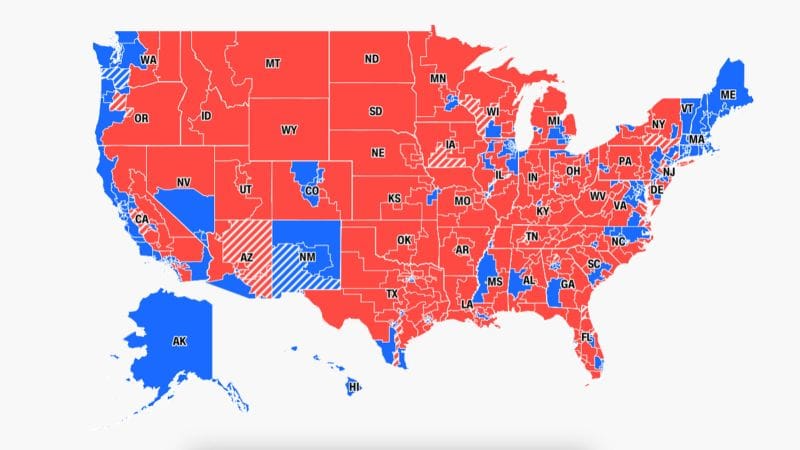
This is the asymmetric disarmament. It is asymmetric in the literal Axelrodian sense: one player has destroyed its capacity to retaliate, while the other has retained its capacity to defect.
Tit, no tat
We can now state the problem with some precision. Callais did not cause the asymmetry. Callais exploited it. The opinion's operative move was to make partisan gerrymandering as a permissible, indeed privileged, districting criterion; the requirement that § 2 plaintiffs "disentangle race from politics" by producing illustrative maps that hit all the State's "specified political goals," up to and including incumbent protection; the demand that racial-bloc voting analysis "control for partisan affiliation" empowers states with full legislative control of redistricting and weak state-constitutional partisan-gerrymandering doctrine. There are roughly twenty such Republican-controlled states. There are about four comparable Democratic ones: Illinois, Maryland, Massachusetts, and (now, by emergency constitutional override) California for one election cycle.
The asymmetry is not 50-50 with friction. It is closer to 5-1.
To put it another way: the Republican Party can use Callais in approximately every state in which it holds power, and states like Tennessee and North Carolina have already signaled moves to do just that, before the ink was even dry on the Callais opinion. The Democratic Party can use it in approximately four. The Court has, with characteristic aplomb, handed an asymmetric weapon to two parties that occupy radically different structural positions, and then announced that the result is just the neutral operation of constitutional law.
What makes this a cooperator's trap rather than merely a bad outcome is the second-order dynamics. A naïve liberal observer at this point reaches for the obvious response: defect! Repeal the commissions! Gerrymander! Match Republican malfeasance with Democratic malfeasance until equilibrium is restored! This is the logic behind Prop 50, which Newsom marketed in precisely those terms: They're not screwing around; we cannot afford to screw around either. The 65–35 vote in favor suggests the California electorate has metabolized the lesson, or at least the immediate emotional content of it.
But notice what Prop 50 actually had to do. It could not simply direct the legislature to draw a partisan map; it had to amend the state constitution to suspend the Commission for one cycle, then return authority to the Commission after 2030. The structural commitment to non-defection was so deep that retaliation required a constitutional amendment ratified by direct popular vote in a special election. This is not Axelrod's tit-for-tat. This is tit-for-tat in a world where every retaliatory move must first pass through a six-month constitutional process that the defecting party does not face. By the time the cooperator is permitted to defect once, in one state, on a sunset clock, the defector has already defected eight or nine times across as many states.
And—this is the deeper layer of the trap—the institutions that make defection slow and difficult were built by the cooperator on the theory that they would constrain everyone equally. The Commission was not built to disadvantage Democrats. It was built to remove gerrymandering from politics. It assumed that the other side, eventually, would build a comparable institution. When the other side declined, the Commission did not adapt. It could not adapt. That was the point. It was built so it could not adapt. Its non-adaptive character was the proof of its civic-hygiene seriousness.
The Schmittian coda
I keep returning to Carl Schmitt on this, against my better judgment and the man's appalling biography, precisely because so many conservative legal scholars are Schmittians whether they'll admit it or not (and many of them will blithely admit it). Schmitt's central charge against liberal constitutionalism was that liberalism systematically dissolves the political into the procedural. The friend-enemy distinction, which Schmitt took to be constitutive of political life, gets refracted through liberal proceduralism into a series of disagreements within a shared rule-bound game. And this works, as long as both parties accept the framing. It fails catastrophically the moment one party recognizes that the rule-bound game itself is the terrain of struggle and begins playing meta-strategically: not winning within the rules but rewriting the rules so that winning becomes structurally guaranteed.
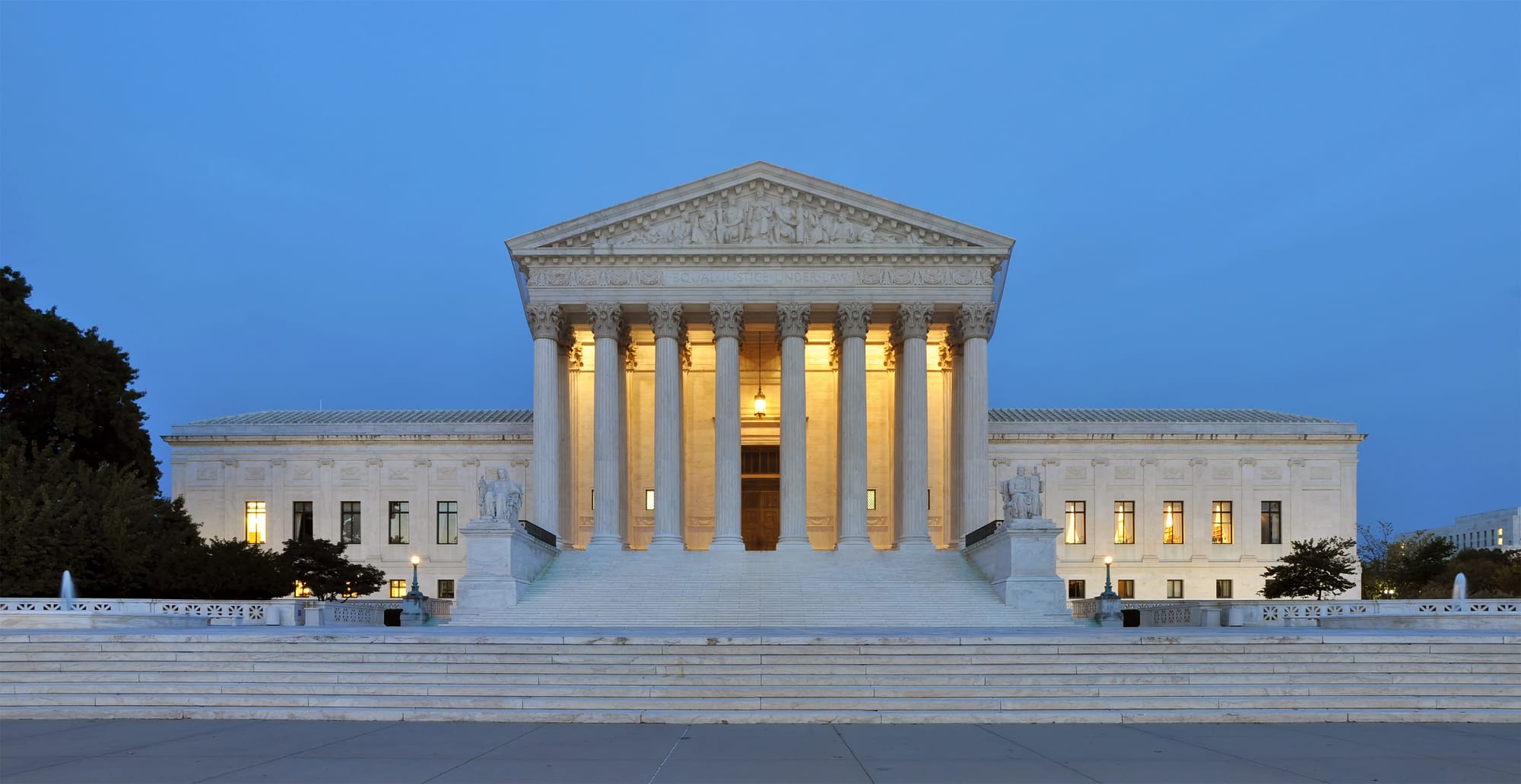
What we are watching in American voting-rights jurisprudence: Shelby County (2013) gutting Section 5; Brnovich (2021) gutting Section 2 as applied to vote-denial claims; Rucho (2019) holding partisan gerrymandering nonjusticiable in federal court; now Callais (2026) gutting Section 2 as applied to vote-dilution claims, is not the playing of a game but the rewriting of one. The Court that rewrote the rules in Shelby County was, of course, the same Court that earlier rewrote them by inventing standards in Bush v. Gore and that simultaneously rewrote them in Citizens United and Dobbs and SFFA and Trump v. United States. There is no game. There is the position one occupies during the rewriting. The cooperators, who are still holding their pieces in the chess opening because that is what one does at the beginning of a chess game, are losing not because they are bad at chess but because they are playing chess. The defectors are playing Calvinball, in which the only permanent rule is that you cannot play the same rule twice.
This is a more precise statement of the problem than the prisoner's dilemma framing alone allows. The prisoner's dilemma assumes a payoff matrix and asks which strategy each player should choose. It does not contemplate the case in which one player has the unilateral power to rewrite the matrix between rounds. That is not prisoner's dilemma. That is something darker, and it has no name in the literature because game theorists do not write papers about games in which one player can edit the rulebook mid-move. (The closest analogue is what Schelling called "metagame" considerations, but Schelling assumed a stable framework around the metagame; this is metagame all the way down.)
What cooperation actually costs
I want to end with the part that the analytic framing tends to suppress, because it matters and because it is the part that will determine whether Democrats can metabolize the lesson without losing the moral coherence that made the cooperative move attractive in the first place.
There is a real cost to defection. The independent redistricting commission in California has, over fifteen years, produced congressional and state maps that are demonstrably less gerrymandered than what either party would have produced left to its own devices. People in California, on balance, have districts that more closely resemble the geographic and demographic shape of the actual communities they live in. This is a real public good. It was generated by Democrats voluntarily relinquishing power. Suspending it for a cycle to retaliate against Texas (even on the carefully time-limited terms Prop 50 specifies) degrades that public good for everyone, including the Democrats who benefit from the suspension. The defection is necessary, if it is necessary, in roughly the way that an immune system's inflammatory response is necessary: it produces collateral damage in the act of fighting the infection, and it cannot be allowed to become the body's permanent state without the body itself being damaged.
The mistake (the cooperator's trap proper) is the assumption that because defection is costly, the cooperator can preserve the public good by refusing to defect. This works if, and only if, the other player is also a cooperator, or can be brought into cooperation by example. It does not work against a player who has read Axelrod's book, recognized that the cooperator's strategy is exploitable, and selected exploitation. Against such a player, refusing to defect does not preserve the public good. It merely transfers the public good, piece by piece, into the defector's column. The cooperator who refuses to retaliate is not modeling a higher virtue. He is voluntarily liquidating the patrimony.
What Callais makes plain—what the asymmetric architecture of American electoral law has been making plain for at least a decade now—is that the choice is no longer between cooperation and defection. The choice is between defection and unilateral cooperation; between an iterated game in which the other player has stopped iterating; between chess and Calvinball. Tit-for-tat, the most successful strategy in Axelrod's tournaments, was robust because it could retaliate. The strategy that loses every time is called Always Cooperate. It loses because it cannot defect even once.
And the most painful inference is that the institutions the educated liberal-professional class spent forty years building (independent commissions, codes of professional responsibility, norms against politicizing prosecutions, restraint in the use of executive power, deference to precedent, refusal to expand the courts, the entire architecture of Pelosi-era proceduralism) are a sophisticated, multi-decade implementation of Always Cooperate. Each one, individually, was a beautiful and worthwhile thing. Many of them I have spent my own career, in small ways, working within and helping to maintain. Collectively, against an opponent who had read the same books and selected the opposite strategy, they describe a slow, dignified, principled, and complete strategic surrender.
The question facing Democrats in the wake of Callais is not whether Callais was correctly decided. It plainly was not. The question is whether the party can recover the capacity to retaliate without becoming what it is retaliating against, and whether the institutions designed to make defection slow and costly can be reconfigured to make selective, time-limited, accountable defection possible without dismantling the entire civic-hygiene project they were built to serve. Prop 50 is one model: defection by direct popular ratification with a sunset clause. It is not, I think, a sufficient model, because it scales badly and depends on each defection clearing a high political bar that the defecting party does not face. But it is at least a model that preserves the question of legitimacy as a question, rather than answering it by fiat.
I do not think there is a clean answer. I am not sure there is even a non-tragic one. The party of civic hygiene has spent fifty years building the cleanest kitchen on the block while the party next door has been running a meth lab and using the hygienic kitchen's plumbing to wash its lab equipment. At some point the question stops being whether to keep mopping and starts being whether the building itself is salvageable, and that question, unlike the question of redistricting, will not be answered by a constitutional amendment in California.
But I am very sure that the line "that is cause for celebration" should be carved into the lintel of whatever building the post-VRA voting-rights regime ends up housed in. It is the laughter of a man who has just won a game his opponent did not know was being played.