
The Socionarrative Structure of Identity: What a Thing Is, What It's Like, What It's Not
We tell stories about art, philosophy, politics, and class. Those stories do more than inform or entertain. They establish what the things are.
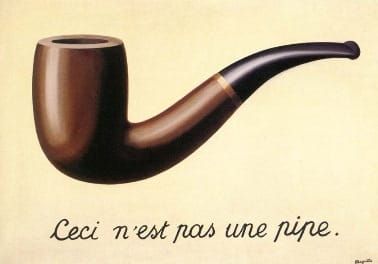
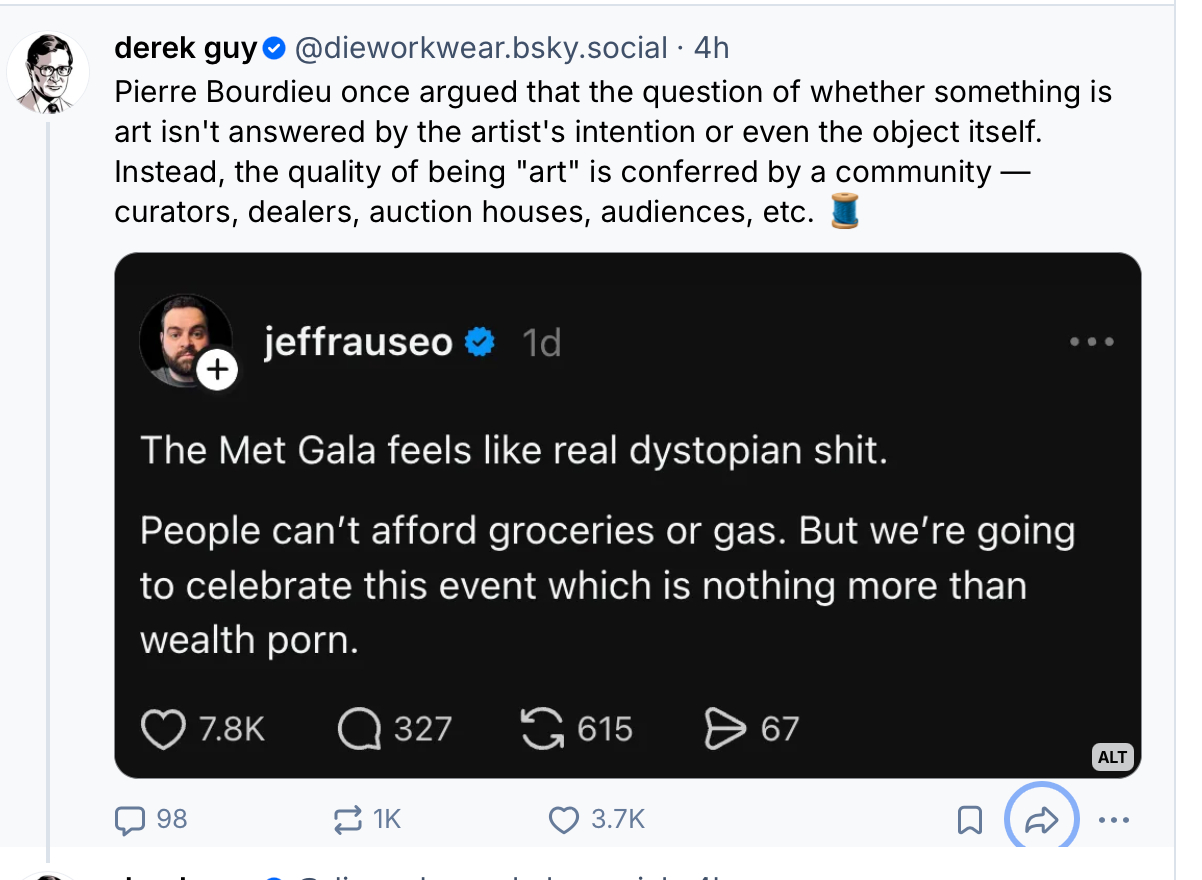
A post by Derek Guy (@dieworkwear) crossed my feed. Someone had called the Met Gala "real dystopian shit" and "nothing more than wealth porn"; Derek replied by invoking Pierre Bourdieu: that the question of whether something is art is not answered by the artist's intention or by the object itself, but by a community of curators, dealers, auction houses, and audiences who confer that status. He was making, in compressed and pointed form, a thesis that runs through twentieth-century aesthetics: Danto's artworld, Dickie's institutional theory, Becker's Art Worlds, and Bourdieu's field of cultural production are all in this neighborhood: art is not the object produced and not the artist's intention but something socially mediated, constituted in the seam between work and audience, work and institution, work and history.
I want to push the claim further. Art is socially mediated because identity itself is socially mediated, and not just for cultural objects. Identity is mediated through narrative, and narrative is the only place identity actually lives.
The constitutive elements of identity
Start with how we predicate. When we say what a thing is, we have three basic moves available:
- A = a. Identity. The brute thing-ness of the thing. The thing is itself, picked out as itself, individuated. Aristotle's claim that to be is to be a thing of a kind. The minimum possible predication: this is this.
- A is like B. Resemblance. Similarity. The use of metaphor and simile. The thing is brought under a likeness. This is the engine of metaphor, of analogy, of Wittgensteinian family resemblance, of every taxonomic move that locates an instance among instances. We never know a thing alone; we know it by its kin.
- A is not C. Difference. The thing is what other things are not. This is the Saussurean point about signs taking value only against the field of what they exclude, and Derrida's différance—which collapses differing-and-deferring into a single operation—is the radicalized version. Identity has a constitutive outside.
The third strand carries more weight than the first two and rewards lingering on. Saussure's structuralist insight was that signs do not refer by pointing at things but acquire value through their negative relations within a system. Cat means what it means partly because it is not bat, not cot, not dog, not kitten. The signified is reached only by way of differences from everything else in the network. Identity, on this picture, is never positive presence; it is the residue of contrast.
Derrida pushed this further with différance, the neologism with the silent a, undetectable in spoken French but visible on the page, which is itself part of the joke. The French verb différer carries two meanings English usually splits apart: to differ (be unlike) and to defer (postpone in time). Derrida insisted that these are the same operation. Meaning is constituted not only by spatial difference within a synchronic system but by temporal deferral; the sign points toward a meaning that is never fully present, always still arriving, always dependent on what has preceded and what will follow. The trace of the absent constitutes what is present; presence turns out to be parasitic on its outside.
The implication for identity is immense. A thing is never simply itself in a present moment. Its identity is constituted through a network of differences that includes a temporal dimension: what it was, what it is being read as now, what it is anticipated to be. The constitutive outside is not just other things off to the side; it is also the past and the future, bracketing and threading through any present claim about what the thing is. Identity is, in this strong sense, never present to itself. It is always already mediated, always already in motion between what it has been refused as and what it has not yet been taken for.
This is why the third strand is not just a logical operation tagged on for completeness. It is the strand that introduces time and absence into predication. To say what a thing is not is to invoke a field of alternatives, a history of refusals, a not-yet of what it might be taken for. The negation does work the affirmation cannot do alone, and the work it does is temporal as much as logical.
These three are usually taught as separate logical or semiotic devices. But they are not really separate, and they are not static. Each of them carries time. A = a is a re-identification across a temporal gap (the thing now is the thing then). A is like B draws lines across the comparative field (a field that itself unfolds0. A is not C defers; it points away, and the away-pointing has duration. Each of the three is already a small narrative: a movement, a contrast, a resolution-or-deferral.
Strung together, they give us the form of story. To say what a thing is, we say what it is, what it is like, and what it is not. Strip out any of those three and the predication degenerates. In other words, these are the constituent elements of a narrative plot which involves, explicates, and defines the identity of everything within it.
Moving from predication to the narrative
A protagonist is who they are (A=a) by being like certain people and unlike others (A~B and A≠C), and these likenesses and unlikenesses are not list-items but events... they happen across the plot. A character isn't a column of attributes. A character is a role being played out.

And this generalizes. Things are characters. A painting is what it is in the way a character is what they are, by sameness across viewings, likeness to other works, difference from non-art. The identity of the painting is not the painting. It is the painting's role in the larger plot the artworld is telling itself.
Where identity does not reside
If identity is narratively constituted, then the standard candidates for identity's location are all wrong, or at least misplaced.
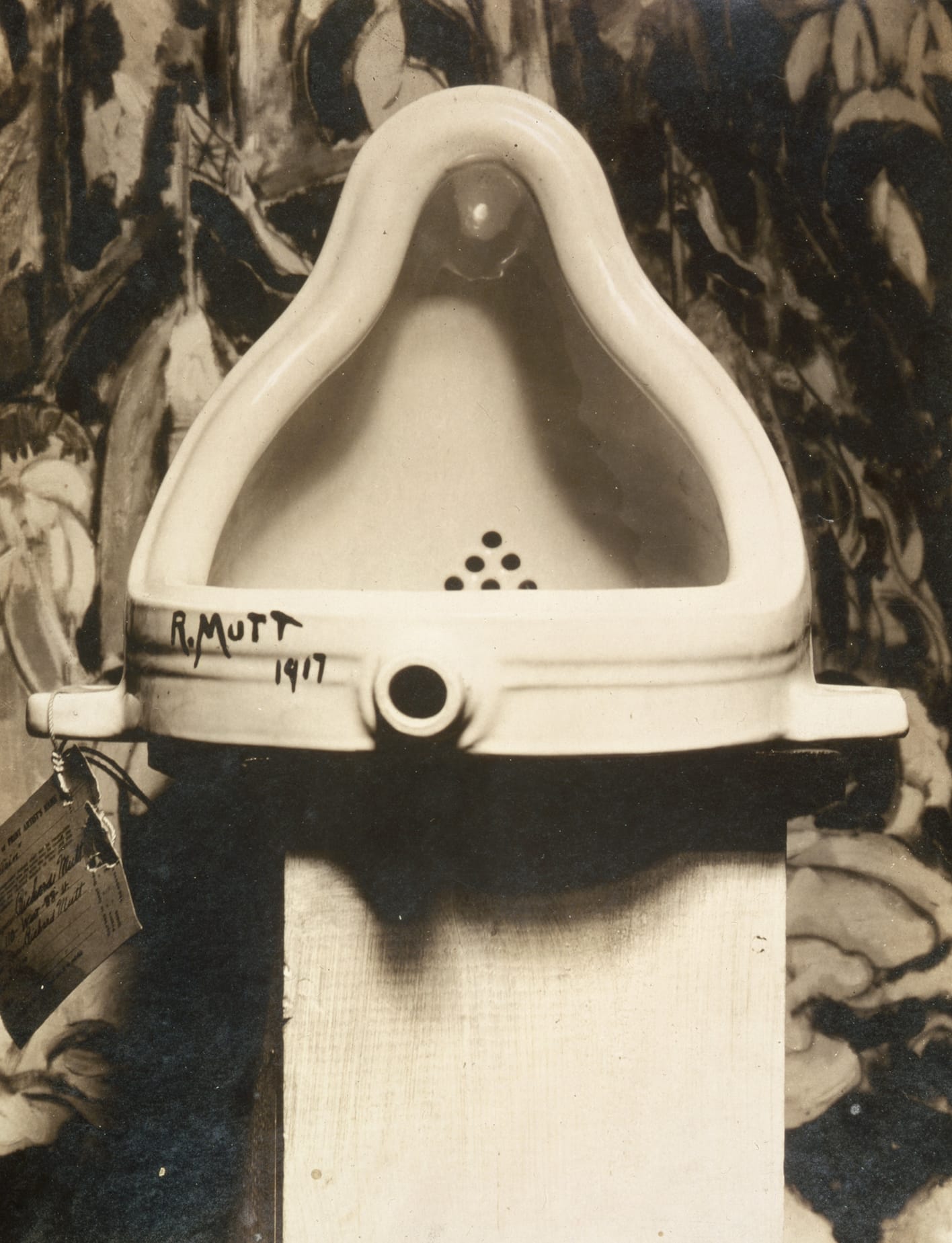
It is not in the thing. Essentialism keeps trying to find identity baked into the object — the Aristotelian substance, the Kantian Ding-an-sich, the chemical analysis of the canvas. But a perfect chemical inventory of Fountain would not tell you what Fountain is. The urinal does not contain its arthood.
It is not in the Umwelt. Jakob von Uexküll, the early-twentieth-century Estonian biologist, gave us this concept to break the assumption that organisms inhabit a single shared objective world that they merely perceive better or worse. Each organism, he argued, lives within its own Umwelt, its species-specific phenomenal world, constituted by the perceptual signs (Merkmale) it can register and the effector signs (Wirkmale) by which it acts back upon its surroundings. The two are linked in what Uexküll called the Funktionskreis, the functional cycle in which perception and action are bound together as a single meaning-making operation. The famous example is the tick, whose entire world is woven from three signs: the smell of butyric acid (mammal sweat), the warmth of mammalian skin, and the texture of hair through which it burrows to feed. Everything else in what we would call objective reality is, for the tick, simply not there.
The concept is genuinely powerful, and I want to register that before I refuse it as the locus of art's identity. Uexküll's biosemiotics has been carried forward by Thomas Sebeok and others into a robust framework for thinking about meaning as something that does not begin with humans. Every organism is embedded in a meaning-world that is real for it, and these worlds overlap, intersect, contest one another, but never simply collapse into a single objective reality. There is a Husserlian flavor to this—a concern for how a world is constituted for an experiencing subject—that has made Uexküll a touchstone for thinkers as different as Heidegger, Merleau-Ponty, Deleuze, and Agamben. The Umwelt concept gets us beyond the dead matter of mechanistic biology without lapsing into a vague vitalism.
For thinking about art, though, the Umwelt concept gets us part of the way and then stops. It is true that Fountain exists differently for the trained gallery-goer than for someone who has wandered in off the street, and differently again for the janitor who has been told to ignore that one fixture in the corner. Each of them inhabits a perceptual world in which the urinal-object is differently weighted, differently threaded with significance. But the arthood of Fountain is not the sum of these individual perceptual worlds, and it is not even their intersection. It is constituted by something that exceeds and conditions each of them, the meta-narrative the artworld is telling itself, into which any given Umwelt is merely tuned in, well or poorly.
Put differently: the Umwelt locates significance in the relation between an organism and its environment. The identity of an artwork is not in that relation. It is in the social-historical narrative that preassigns roles to objects, into which individual Umwelten are oriented after the fact. We need a concept that operates at the level of the meta-narrative, not at the level of the organism-world dyad. The Umwelt is upstream of where the action is.
It is not even in the state of affairs, or Sachverhalt, in the early-Husserlian or Tractarian sense, the object-in-its-relations. That is closer, because at least it is relational. But a state of affairs is still a configuration; it is not yet a story. A configuration of objects-and-relations does not carry plot, and identity needs plot. A still life is not a narrative; it is a frozen frame extracted from one. To find identity, you have to put the frame back into the film.
Identity lives in the narrative.
Identity is a role to be played
What I mean: a thing's identity is the role it plays in the meta-narrative that contains it. The role has action. It contributes to plot. It is characterized (given character) by the three strands working together: individuated as itself, related by likeness to other roles, differentiated from what it is not.
This is, I think, why Paul Ricoeur's narrative identity is right about persons but does not go far enough. Ricoeur worked this terrain more thoroughly than anyone, and the theory developed across Time and Narrative and Oneself as Another is the proper precursor to what I am claiming. He began from a problem about personal identity that the analytic tradition had been worrying for decades: in what sense am I the same person I was thirty years ago, given that almost everything about me has changed? Locke had answered with memory; Parfit had answered with psychological continuity; Ricoeur thought both missed what was actually at stake.
His move was to distinguish two senses of identity that French and Latin keep separate but English collapses. Idem-identity is sameness, or the thing being numerically and qualitatively the same across time, the way a stone is the same stone. Ipse-identity is selfhood, or the thing maintaining itself as a who, the kind of identity that shows up in keeping a promise. Ipse-identity does not require that I be qualitatively the same person who made the promise; it requires that I sustain a self capable of binding itself across time. And that self, Ricoeur argued, is a narrative achievement. I am who I am because I can tell the story of how the person who made the promise is still the person now keeping it.
Narrative identity, on this picture, is what bridges idem and ipse. It does so through what Ricoeur, building on Aristotle's Poetics, called emplotment (mise en intrigue), or the operation by which disparate events are gathered into a story with beginning, middle, and end, with motivation and consequence, with character. The threefold mimesis of Time and Narrative—prefiguration in lived experience, configuration through emplotment, refiguration in the reader's reception—describes how we move from the temporal flow of life into story and back into life again. Identity emerges in that loop, and only there. It is not a metaphysical given that narrative happens to capture; it is constituted in the looping itself.
Ricoeur is right, and it is this insight I want to extend with my own theory of narrative construction. His framework is built around persons because that is the case where the stakes are most morally vivid: the promise, the responsible self, the agent who can be called to account. But the structural insight is more general than persons. Anything that has identity has it because it is gathered into a plot. A nation has identity because a story is told about it. An institution has identity because a story is told about it. A painting has identity because a story is told about it. A urinal-on-a-pedestal has identity because a story is told about it. What Ricoeur diagnosed for the self is, I think, the universal form of how individuated things come to be individuated at all. In other words, phenomenology and Ricouer are great when taken from the first-person perspective about studying the philosophical subject-as-self. But if we want to make the Heideggerean move and investigate metaphysics more generally, we have to move beyond the phenomenological reduction and ask why it is we are doing this in the first place. We must tell the next chapter of the story.
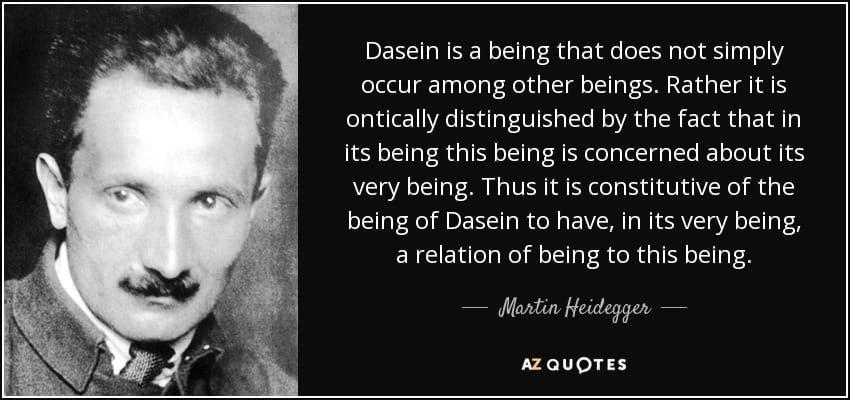
The next chapter has to start with Dasein, because Heidegger is the closest predecessor to the move I want to make, and the closeness is exactly what makes the distinction worth drawing carefully. Dasein—Heidegger's analytic of the entity whose being is an issue for itself, structured by care (Sorge), thrownness (Geworfenheit), and projection (Entwurf)—broke with substance-metaphysics in just the way my view needs it broken. He got us out of the trap of looking for identity inside the thing, and located it instead in the how of existing across time. But he reserved Dasein for the entity that has being as an issue: for us, more or less. The mere objects in the world he sorted into Vorhandensein (present-at-hand) and Zuhandensein (ready-to-hand), neither of which has the existential depth he grants to Dasein. The hammer and the urinal do not get to constitute themselves through projection toward death; they are, in the Heideggerian frame, ontologically lesser. This is exactly the line my view crosses. The painting and the gallerist are not in different ontological categories when it comes to how they are individuated. Both are cast into roles by the meta-narrative, and the casting is the constitutive operation in both cases. The difference between them is a difference in narrative agency, not a difference in the kind of being either has.
The deeper disagreement is about authorship. Dasein authors itself; that is the whole point of Entwurf. Identity, for Heidegger, is what one projects oneself toward, what one takes up out of one's thrownness, what one owns or fails to own, and the contrast between authentic self-authorship and the inauthenticity of das Man is what carries the normative weight of Being and Time. My view runs the other direction. Even Dasein, on my account, gets cast. The social meta-narrative assigns roles to persons before any individual takes up the project of self-authorship, and the projection Heidegger valorizes is always a negotiation with castings that precede it. Das Man is not the fall from authentic self-authorship; it is the medium in which identity is constituted in the first place. There is no projection that is not already a re-projection of a casting one has been handed. The existential analytic of Dasein needs to be relocated into a social-narrative analytic of role-casting, and the ontological privilege of the human dissolves into a more general account of how anything comes to be the kind of thing it is.
Alasdair MacIntyre arrived at a kindred conclusion from a different route. After Virtue, his 1981 broadside against the moral incoherence he diagnosed in modernity, builds toward a positive thesis about the narrative structure of human action. MacIntyre's claim is that an action (a real action, not a mere bodily twitch) is unintelligible apart from the narrative context that makes it the kind of action it is. Someone digging in a garden might be exercising, or preparing supper, or planting a memorial, or pursuing a long-running feud with a neighbor about property lines. The bodily motion is identical across these descriptions. The action is different in each case, and which action it actually is depends on which story it belongs to.
From this, MacIntyre argued that human lives themselves have a narrative structure, that the unity of a life is not a metaphysical given but a narrative achievement, the gathering of one's actions, commitments, practices, and traditions into a coherent story of which one is the protagonist. The famous formulation is that I can only answer the question what am I to do? if I can first answer the prior question of what story or stories do I find myself a part? Practical reason, on this account, is constitutively narrative. There is no Archimedean point outside story from which to deliberate well; the goods one pursues are intelligible only within the practices and traditions that give them shape, and practices and traditions are themselves narrative structures extended through time.
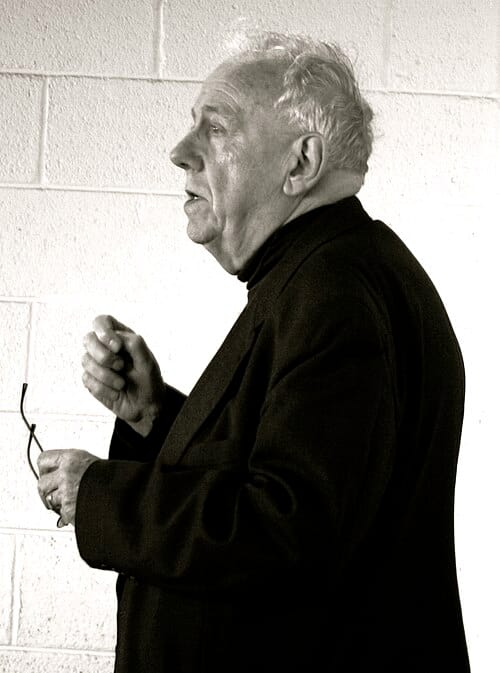
The line about being storytelling animals appears in this context. It sounds, on first reading, like a humanist commonplace; yes, we like narratives, we have always liked narratives, we are the species that tells tales around the fire. But MacIntyre means something stronger and stranger. The storytelling is not decoration on a life that would otherwise be intelligible without it. The storytelling is constitutive. Strip the narratives away and you do not get a clearer view of bare action; you get bodies twitching, motions without acts, a world unsorted into doings.
I am pushing this further still. What MacIntyre says about action and the unity of a life, I think holds for individuated things in general. The unity of a thing is also a narrative achievement. Not just my life as a coherent project, but the painting as a coherent painting, the nation as a coherent nation, the artwork as a coherent artwork. Strip the narrative and you do not get the thing-in-itself standing nakedly available for inspection. You get pigment, canvas, frame; territory, population, border; metal, porcelain, signature — in none of these cases the thing whose identity was supposed to be at issue. No story, no things... and this is not poetry. It is the structure. It is metaphysical.
The return to art
Now the Bluesky thread reads differently. The claim that art is socially mediated is not a deflation. It is a precise location-claim. Art is not located in pigment-on-canvas or the threads sewn carefully into a suit (the thing). Art is not located in the artist's intention (the Umwelt of the productive consciousness). Art is not defined solely by terms of pointing to what art is not. Art is located in the meta-narrative that places this object in the role of art, the artworld's ongoing story about what art is, what it is like, and what it is not.
This explains a lot of what looks strange about art if you start from object-essentialism. It explains why a deauthentication does not just change a painting's price but actually changes what it is: the role has been recast, the plot rewritten. It explains why Fountain works as art: Duchamp recruited a urinal into a role it had not previously been able to occupy, and the artworld, after some sputtering, accepted the casting. It got us talking about what Duchamp did, what he meant, and what art could be. By discussing the identity of art, even those who rejected Duchamp's purported thesis (here is an object, it is art) were contributing to the narrative about art. It became a part of the story about Duchamp and Fountain. And in doing so, we all learned what Fountain was, who Duchamp was, why he said he did it, why people thought he did it... all of the sorts of discussion that make up a narrative. The narrative was not merely the means or the mode by which the identity of a thing was constituted; it was the very constitution of it itself, as inseparable as substance or essence. The narrative explains why outsider art is structurally peculiar: the role it fills is precisely the role of work made outside the role-assigning narrative, which is a meta-role, and which the artworld has had to invent a slot for.
It also tells you why disputes about what counts as art are not silly or facile diversions from "real" intellectual exercises. They are not arguments about pigment; they are arguments about plot. Who gets to author the meta-narrative? Whose castings stick? When a critic says that is not art, they are not making a chemical observation. They are refusing a role-assignment. They develop a counter-narrative, but counter-narratives are not a refusal to engage with the primary narrative. They are simply another thread within the ongoing story, the rise of the antagonist. They play on the third strand of identity, difference and negation.
The Met Gala, or: who refuses the role?
Which brings us to the case the thread was actually about. Fashion is one of those domains where we can watch the role-assignment happening, contested, and refused, in something close to real time.
By any production-side criterion, fashion at the level the Met Gala showcases is art-adjacent at minimum. There is conceptual ambition (Margiela, Comme des Garçons). Art-historical reference (Schiaparelli's collaborations with Dalí, the McQueen archive). Material innovation. Skilled handwork at a level the Met itself has staged retrospectives of, e.g., Savage Beauty, Manus x Machina, the Schiaparelli show. The 2019 Camp theme literally took its instructions from a Sontag essay. And yet fashion is consistently denied the role of art. The denial comes from two directions that look opposed but converge.
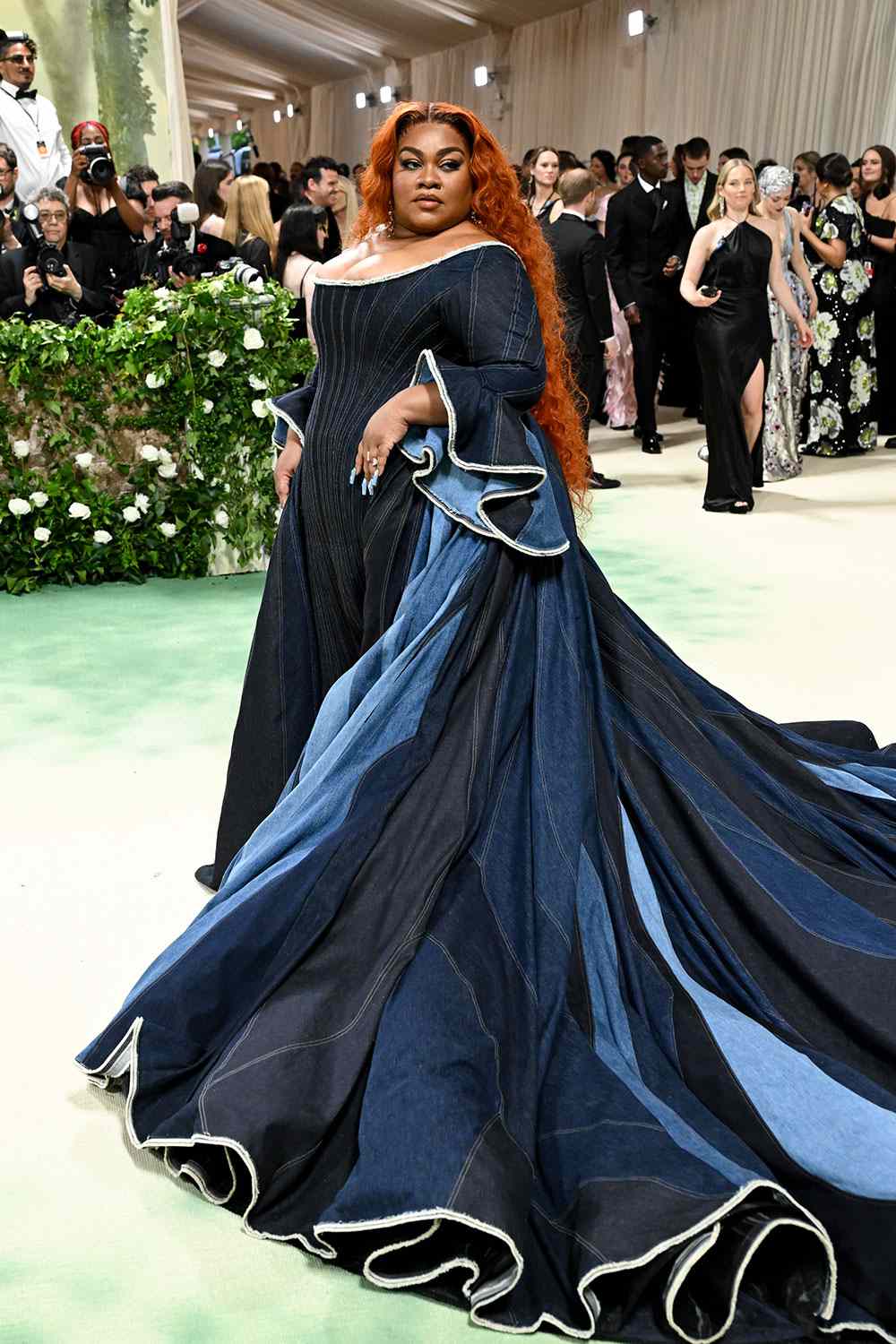
From the left, the refusal runs through commodity critique. Fashion is the commodity form at its purest. It is produced for sale; it is worn by the very wealthy; its supply chain runs through underpaid garment workers; the Met Gala itself is a parade of wealth so concentrated it is faintly obscene. The pro-worker narrative cannot recognize this as art because to do so would be to launder the commodity. Art, on this story, is supposed to stand somewhere outside the cash nexus, or at least to register the cash nexus critically. The Met Gala does not register it; it displays it, in chiffon.
From the right, the refusal runs through a different vocabulary but lands in the same place. Fashion is frippery. It is decoration. It is what women care about when they are not being serious. Real art is Beethoven or Tolstoy or the Sistine Chapel, great things, enduring things, masculine-coded things. Fashion is faddish, ornamental, tied to female display. This refusal is the older one. It is the entire history of the gendered hierarchy of arts that Parker and Pollock spent a career documenting in Old Mistresses, in which textile, decoration, and the applied arts were demoted precisely as women came to dominate them.
And from somewhere in the middle, there is the notion that none of this matters in the most existential way, because gasoline costs a fortune, wars are happening, people are dying, and how can we, when staring down so much, devote our limited time and intellectual efficaciousness to debating something which has no major, practical effect? The very idea that we might be using words like "masculine-coded" or "the form of the commodity" is offensive to the people who are sleeping unhoused tonight!
But all of these refusals are narrative acts. None of them are chemical observations about textile or atelier labor. They are role-refusals, the meta-narrative declining to cast fashion as art. And the fact that the left, right, and ostensible center refuse for incompatible stated reasons is itself diagnostic. The convergence shows you what the meta-narrative is actually defending: a category of "art" that floats above commerce and above femininity, beyond the bounds of pragmatism, and with an idea for the numinous that refuses to sully itself with the grimness of base materiality, which has historically been the property of men with patrons.
You can also see, from inside this framework, why the refusal is unstable. Fashion keeps trying to author itself into the role. The Costume Institute's name is itself a hedge—costume, not couture, not fashion, not art, meant for the theater, for entertainment, for consumption—but the gala happens at the Met, and the institution's gravitational pull does role-assignment work no matter what the wing is called. Schiaparelli puts a lobster on a dress with Dalí; you can refuse to call this art, but the refusal will require active narrative effort in the same way the solipsist must make an argument to a being whose reality he denies. McQueen runs models down a runway in tableaux that quote Goya and Velázquez; the refusal there will require more effort. The role keeps trying to be assigned, and the meta-narrative keeps trying to refuse it, and the friction of that contest is most of what the Met Gala actually is, every May, on cue.
Notice what this means for the leftist objection. The critique of the Met Gala—that the gala is a wealth-display, that fashion is mercantile, that the workers are exploited—is not wrong. Those things are true. But they have always been true of art at scale. The Sistine Chapel was patronage; Renaissance painting moved through guilds with their own labor politics; the gold leaf came from somewhere. We have agreed, by long narrative work, to forget those production conditions when we talk about the Sistine Chapel as art or gaze in wonder at the paintings of Botticelli. The question is not whether fashion is more compromised than other arts. It is whether the meta-narrative will do the same forgetting-work for it. And it largely will not, because the femininity and the visibility of the wealth make the forgetting harder.
This is, I should say, a Bourdieusian point, and one that surfaces a productive tension in Derek's original invocation. The Bourdieu of The Rules of Art and The Field of Cultural Production is the friend of the social-mediation thesis: art is what the field confers art-status upon, full stop. But the Bourdieu of Distinction is the diagnostician of how that conferral actually works, how aesthetic judgment is the engine of class reproduction, how taste functions as cultural capital convertible to and from economic capital, and how the field sustains itself by misrecognizing this conversion as something else (genius, sensibility, eternal value). The Met Gala troubles the leftist not because economic capital is purchasing cultural legitimacy there—that purchasing happens at every museum gala, every Venice Biennale, every Sotheby's evening sale—but because at the Met Gala the conversion is visible. The masks slip. What is normally laundered through genteel circuits of patronage, criticism, and curation is on the red carpet in real time, posing for cameras. The leftist outrage is not philosophically wrong; it is a Bourdieusian moment in which the operation of the field has briefly become legible to outsiders, and the legibility is intolerable.
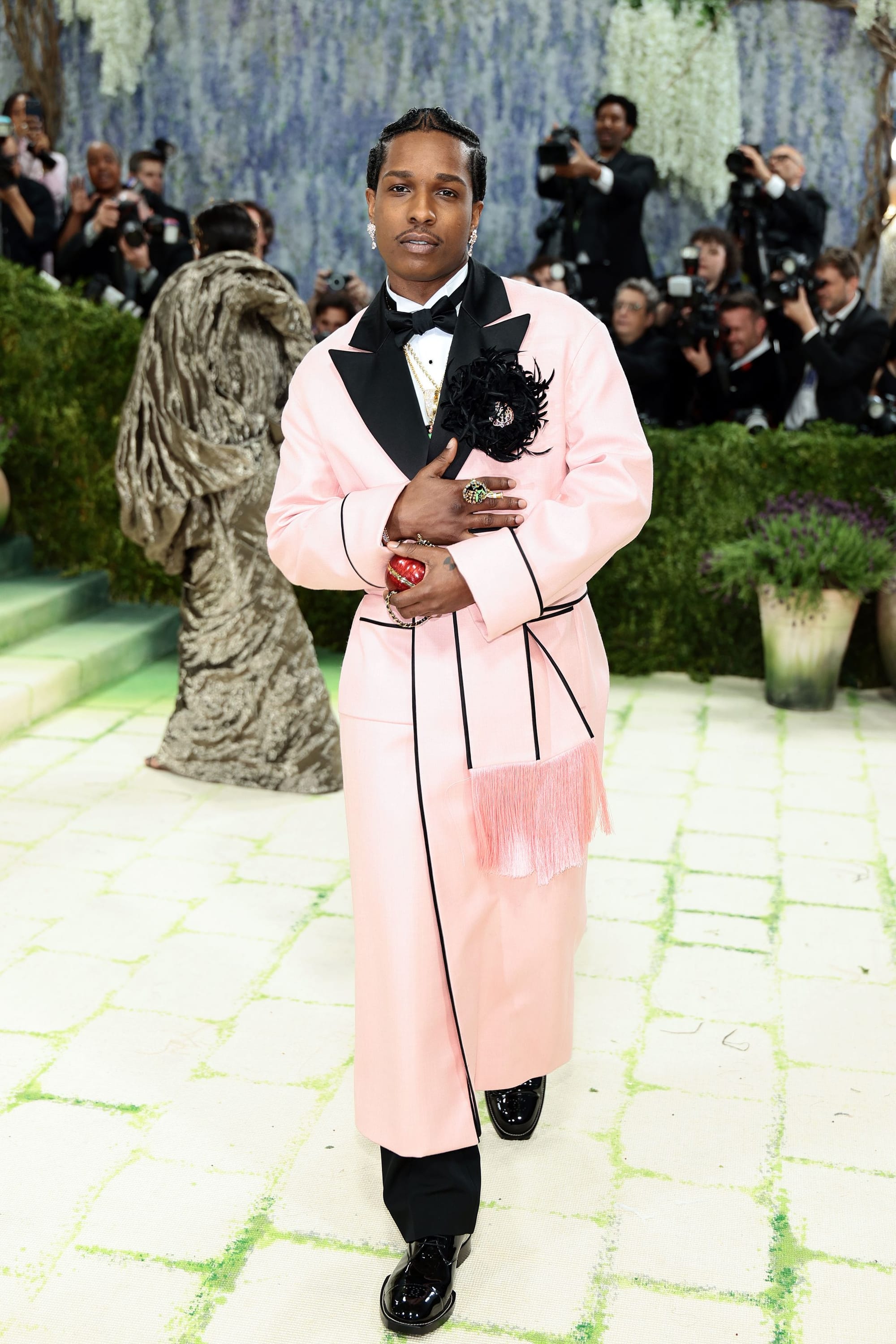
So invoking Bourdieu cuts both ways. Yes, art is socially mediated and the meta-narrative could in principle cast fashion in the role of art. But Bourdieu is also the theorist of why the role gets assigned to some objects and not others, and the answer always points back at the class structure of the assigning community. The narrative theory of identity I am sketching here does not dissolve the leftist critique. It locates it. The wealth-porn objection is not a complaint about pigment-or-textile; it is a contest over who gets to author the meta-narrative and what the authoring is doing to the rest of us when the lights go up on the Met steps.
The right's frippery objection is doing something more straightforward — it is the explicit form of the historical demotion. It does not need to forget anything; it is openly refusing the role. But notice that even this refusal cannot do without the framework. To say fashion is not art is not to make a discovery. It is to take a position in a plot.
The interesting question, then, is not is fashion art? The interesting question is: what story are we telling that makes the question even possible, and whose interests does each available answer serve?
In short, when we start investigating reality-as-narrative, when we start taking metaphysics seriously not only as an intellectual discipline but realize its inherent narrative structure and the roles within, we can subject it to the same types of investigations and criticisms as we would any story. And when we learn the story metaphysics tells, who its heroes and villains are, and why such stories are told (to whom and for what purpose? What values does the tale impart?) we find that much more is revealed than in simple analysis, phenomenological reduction, or existential investigation alone.
Coda
The three strands of narrative identity theory (A=a, A~B, A≠C) are not just the structure of predication itself. They are the loom on which the narrative of any thing is woven. The thing's identity is what the loom produces. The thing itself is the warp; the social meta-narrative is the weft; the role is the cloth.
You cannot find the cloth by examining the thread.