
The Angel Must Hang: Race and Racialization in Melville's "Billy Budd"
Melville built his white Handsome Sailor on a Black one, then walked Billy Budd through every position America reserved for Black men. The manuscript shows how.

Melville's last work of fiction, Billy Budd, opens with somebody other than young William Budd.
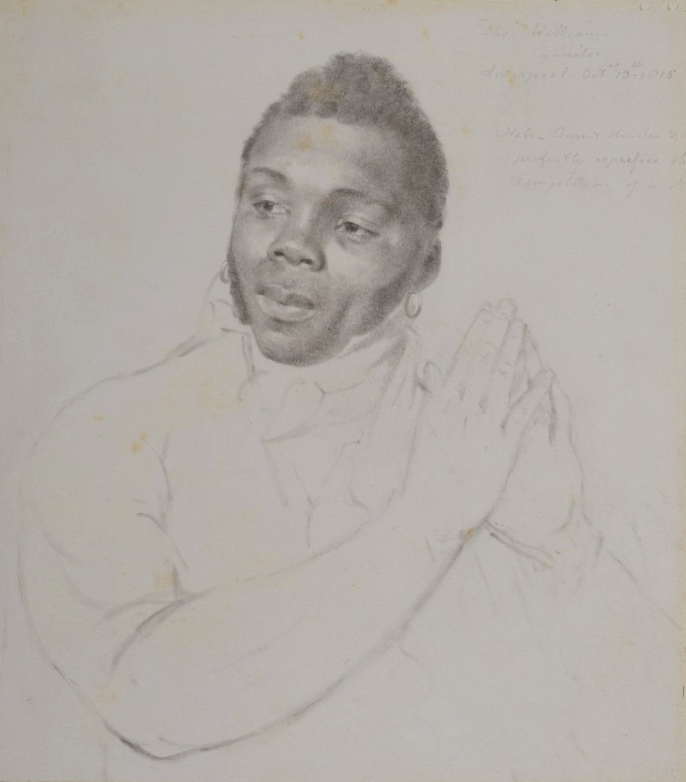
In the days before steamships, the narrator tells us, you could see on any waterfront a sailor whom his shipmates surrounded "like Aldebaran among the lesser lights of his constellation." This was the Handsome Sailor. To illustrate the type, the narrator stops to remember one he saw in Liverpool, "now half a century ago": "a common sailor, so intensely black that he must needs have been a native African of the unadulterate blood of Ham." He wore gold hoops in his ears, a silk handkerchief loose on his chest, a Scotch bonnet with a tartan band. His shipmates were a mix of "tribes and complexions" fit to stand before the first French Assembly as "Representatives of the Human Race," and they took visible pride in the stares he drew. Then the narrator writes "To return—" and the man is gone. He never appears again, at least not literally on the page.
But Melville tells us Billy Budd is an instance of the same type, "though with important variations made apparent as the story proceeds." The first variation arrives in the same sentence: Billy is explicitly described in white terms, with the term "welkin-eyed." Elsewhere he has yellow curls, and a complexion in which "the lily was quite suppressed, and the rose had some ado visibly to flush through the tan."
This week's two episodes of Critical Readings are on Billy Budd. What I couldn't shake while reading it was how this emphatically white young man gets treated, which is... not like white men were being treated at the time Melville was writing after the American Civil War. Billy is a foundling who doesn't know his father. He draws a suspicion that nobody, the narrator included, can explain. He is convicted of a crime he did not commit, by a court convened to ratify a sentence already pronounced, and he is hanged before a crowd. Billy is drawn as a white man and handled like a Black one.
So I went looking for whether Melville meant him to be read that way. The answer is in the manuscript, and it's more interesting than yes.
"White forecastle-magnate"
Billy Budd was never finished. Melville was still revising it when he died in 1891. What survives at Harvard's Houghton Library is a working draft of more than 350 leaves: deletions on deletions, slips of paper cut from one draft and pinned to another, some leaves built up in layers. When the narrator says that "truth uncompromisingly told will always have its ragged edges," he is also describing the physical object.
John Bryant directs the Melville Electronic Library and has spent years sequencing those revisions. In "How Billy Budd Grew Black and Beautiful" (Leviathan, 2014), he lays out how the opening grew. The book began as a ballad, "Billy in the Darbies," spoken by a guilty sailor awaiting execution, whose crew included "Moor & Swede." A short prose headnote introduced him. It said nothing about race and nothing about a Handsome Sailor.
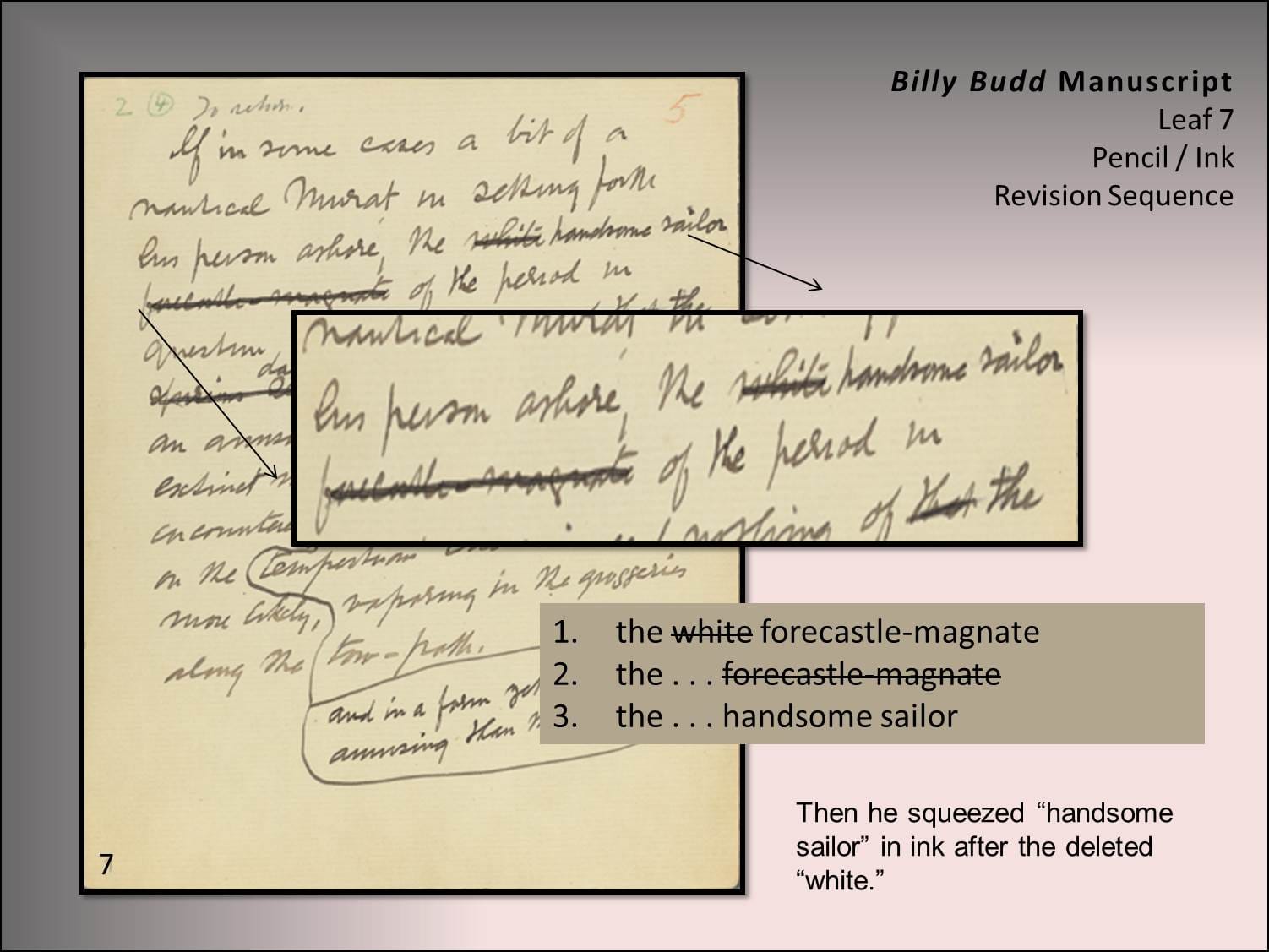
As Melville expanded that headnote, he made Billy a peaceable foretopman and invented Claggart. He also invented the Handsome Sailor type. At first the type was a "forecastle-hero," with no race at all. Then Melville penciled "magnate" over the phrase. When he fair-copied the passage in ink, he wrote "white forecastle-magnate." The Handsome Sailor was white.
In that same fair copy, Melville dropped "Moor & Swede" from the ballad. To compensate, he added to the prose the crew of "tribes and complexions" fit to stand before the French Assembly as Anacharsis Cloots's "Representatives of the Human Race." Bryant thinks that scrap about the crew's diversity may have triggered a memory. Melville cut away the bottom of an early leaf, pinned the top to a fresh sheet, and wrote: "A somewhat remarkable instance recurs to me." Bryant's point is that the transition is literally true. The memory of the Liverpool sailor interrupted Melville's composing, and it went into the text as an interruption.
Then Melville returned to the leaf that read "white forecastle-magnate." He struck "white," struck "forecastle-magnate," and squeezed "handsome sailor" into the margin.
A correction is owed here. Philip Hoare's 2017 New Statesman essay, which asked whether Billy Budd was Black, reported Bryant as believing Melville toyed with making his hero a man of African heritage. That isn't Bryant's argument. In his title, it is the book that grows Black and beautiful, not the boy. Bryant is explicit that the Liverpool sailor is no tanned blond like Billy, and he calls Billy "Anglo-Saxon Billy." The type was rewritten as Black. Billy stayed white.
Liverpool, 1839; Broadway, 1849
Why would a man Melville glimpsed at nineteen surface fifty years later, in the middle of a fair copy?
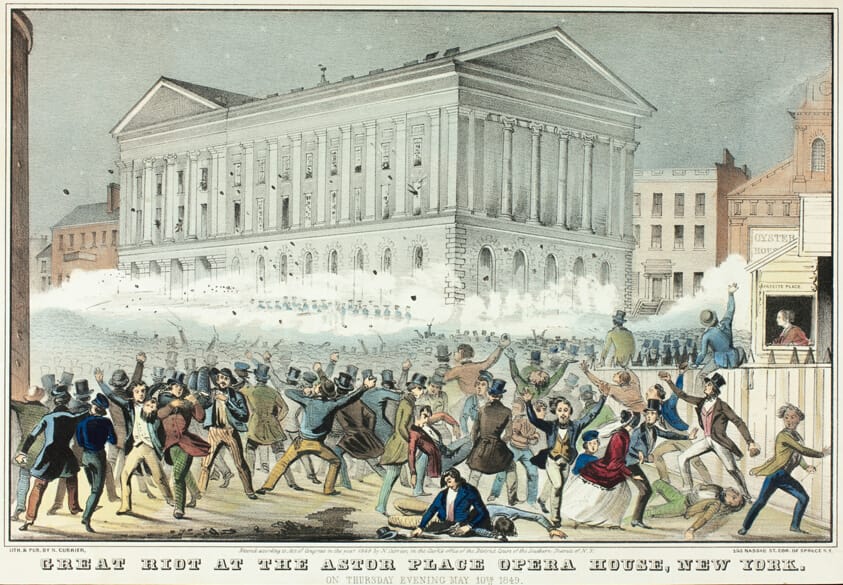
Melville first sailed to Liverpool in 1839 as a green hand on a merchant ship. Ten years later he fictionalized the voyage in Redburn. Britain had only recently abolished slavery in its colonies, and Redburn noticed the difference: "In Liverpool indeed the negro steps with a prouder pace, and lifts his head like a man." The ship's steward, Lavender, walks the streets arm in arm with an Englishwoman, and Redburn remarks: "In New York, such a couple would have been mobbed in three minutes."
As Bryant notes, following Dennis Berthold and Robert K. Wallace, that line was current events. In early May 1849, Frederick Douglass scandalized New Yorkers by walking down Broadway with two Englishwomen on his arms. Days later, the Astor Place rioters made Douglass part of their rallying cry. Redburn's conclusion is withering: "we Americans leave to other countries the carrying out of the principle that stands at the head of our Declaration of Independence."
Bryant calls what Melville carried from all this a "black consciousness," and he is careful with the phrase. He doesn't mean that Melville thought himself Black, or that he presumed to know Black lives from the inside. Melville kept his distance from every consciousness but his own. Bryant means a lifelong, unsentimental awareness:
- Melville's grandfather Peter Gansevoort bought and sold enslaved people.
- After New York's emancipation in 1827, Melville's grandmother kept her former slave, Chris, as a maid, and his mother still called Chris "the slave" in family letters.
- Melville's Manhattan school stood two blocks from the African Free School, where James McCune Smith was educated. Smith is the earliest recorded Black reader of Moby-Dick.
- The Black figures in Melville's books, from Lavender, Daggoo, Fleece and Pip to Babo, keep tripping up his white readers' expectations.
Bryant's best comparison is to Pip. In Moby-Dick, Ishmael breaks off to address the reader: "Nor smile so, while I write that this little black was brilliant, for even blackness has its brilliancy." He anticipates the white reader's smirk and interrupts it. "A somewhat remarkable instance recurs to me" is the same move. The narrator steps out of his story, and the reader looks up to find a Black man standing at the head of a book about a white one.
"Unadulterate"
The leaf that introduces the Liverpool sailor carries a second set of revisions, and they are stranger.
Melville first described the man as a "native born African," "a son of Ham." The phrase leaned on one of the most poisonous misreadings in the history of interpretation. In Genesis 9, Noah curses not Ham but Ham's son Canaan, to be "a servant of servants." Over the centuries the curse migrated to Ham, and Ham was assigned black skin. The result became a scriptural license for the Atlantic slave trade and for American slavery. Bryant traces that history through David Brion Davis's Inhuman Bondage.
In Bryant's most probable sequence, Melville's pencil worked the phrase in three steps:
- He cut "born" from "native born."
- He changed "son of Ham" to "best blood of Ham" and moved it to the end of the clause.
- He changed "best" to "unadulterate."
What's printed is "a native African of the unadulterate blood of Ham."
Bryant reads the sequence as a progressive de-stigmatizing. A son of Ham is heir to a curse. "Best blood" confers aristocracy. "Unadulterate," not the expected "unadulterated," gestures at an original purity that owes nothing to the curse and carries none of the era's anxiety about mixing. On this reading, the revisions make the Black sailor Billy's natural equal. Carolyn Karcher, in Shadow over the Promised Land, had already called the Black Handsome Sailor Melville's "finest . . . statement about race."
Not everyone agrees. Gregory Jay, in "Douglass, Melville, and the Lynching of Billy Budd," reads the gold earrings, the silk scarf and the bonnet as emblems of Jim Crow. The jovial sallies and flashing white teeth invite the same objection. Bryant concedes the gambit is precarious. A rhetoric of pure blood can feed the racial absolutism it means to mock, and admiration can curdle into fetish. His defense is that, seven years before Plessy v. Ferguson, the risk was worth taking.
Both of them are reading the same paragraph. What neither stresses, and what I think matters most, is that the language of blood doesn't stay in that paragraph. In the next chapter, Melville uses the same vocabulary for Billy.
"Saxon strain"
Here is Billy as the narrator first describes him: "Cast in a mold peculiar to the finest physical examples of those Englishmen in whom the Saxon strain would seem not at all to partake of any Norman or other admixture." And a page later: "Noble descent was as evident in him as in a blood horse."
Set those lines beside "the unadulterate blood of Ham," and the opening chapters become a matched pair: two Handsome Sailors, two unmixed bloodlines, both described in the breeding vocabulary of the 1880s. Melville wrote race the way his culture did, as a matter of blood. Then he did something his culture didn't do. He took the pure-blooded white one and walked him, station by station, through the positions America reserved for the other.
Start with what Orlando Patterson calls natal alienation: the severing from any genealogy, which Patterson identifies as the core of slavery.
- Asked where he was born, Billy says, "Please, sir, I don't know." Asked who his father was: "God knows, sir."
- He was found in a basket hanging from a door-knocker in Bristol, "a presumable by-blow."
- Had he protested his impressment, the protest would have been "as idle as the protest of a goldfinch popped into a cage."
- The captain who will condemn him had privately rated him a "King's bargain," which the narrator glosses as "a capital investment at small outlay or none at all."
- He is admired as "a fine specimen of the genus homo."
That is the vocabulary of property.
When Claggart brings his accusation to Vere, the narrator gives him the look of "the envious children of Jacob" showing their father "the blood-dyed coat of young Joseph." That is the story of a favored son sold into slavery by his brothers.
When the charge lands, Billy's rose-tan looks "struck as by white leprosy." I can't prove Melville had Numbers 12 in mind, where Miriam is struck leprous, white as snow, after speaking against Moses's Cushite wife. But he knew his Bible, and in that moment whiteness is the affliction.
On the night before his hanging, the narrator calls Billy a barbarian outright. He is as much a barbarian as the British captives marched as "living trophies" in Germanicus's triumph, or the young Angles brought to Rome "(as to-day converts from lesser isles of the sea may be taken to London)," whose "curled flaxen locks" moved Pope Gregory to call them angels. Melville leaves out where Bede says Gregory first saw them: up for sale in the Roman market. The Saxon was once the merchandise.
Meanwhile, the only man aboard whom the text marks as racially suspect is the accuser. Claggart's pallor is "tinged with a faint shade of amber" and seems "to hint of something defective or abnormal in the constitution and blood." His chin is "beardless as Tecumseh's." A trace of accent suggests he isn't English by birth. The suspicion he casts on Billy is his own, turned outward.
So did Melville mean Billy to be read as Black? No. Every description underlines his whiteness. But Melville built Billy's type on a Black man, wrote Billy's whiteness in the language of the stud book, and then showed that it protected him from nothing. In Billy Budd, race is a position, not a substance.

The record
I spend a good part of my working life reading records. On appeal you can't argue what happened. You can argue only what the record says happened, and the record is written, almost always, by the State.
Billy Budd is a book about how a record gets made. Vere pronounces sentence over Claggart's body before any court has sat: "Struck dead by an angel of God! Yet the angel must hang!" The surgeon wonders whether the captain has come unhinged, and the officers would rather hold Billy for the admiral. Instead, Vere convenes a drumhead court of three on the spot, testifies as its only witness, and then argues it into conviction. He portrays all roles, as prosecutor, witness, and judge all in one, quite to the contrary of the common law tradition. Their buttons, starry Vere tells them, attest allegiance to the King, not to Nature (a statement of legal positivism against natural justice). Under the Mutiny Act, "Budd's intent or non-intent is nothing to the purpose."
Richard Weisberg has argued at length that the proceeding was irregular. Richard Posner defended it as a wartime commander's reasonable call. Melville had family on both sides of that question:
- His cousin Guert Gansevoort was first lieutenant of the Somers in 1842, when three sailors were hanged at sea after a hurried proceeding.
- His father-in-law, Chief Justice Lemuel Shaw of Massachusetts, personally opposed slavery and enforced the Fugitive Slave Act anyway.
Billy gets no appeal. The only record is the one the Navy publishes afterward. In an "authorized" naval chronicle, Claggart becomes a loyal petty officer stabbed by a ringleader. The chronicle explains the crime by explaining the criminal: "tho' mustered into the service under an English name the assassin was no Englishman, but one of those aliens adopting English cognomens." It invents a knife, a foreign weapon for a foreign man.
This is where the book confirms the reading I couldn't shake. The State doesn't hang Billy because it takes him for an alien. It hangs him for a blow (which I argued was involuntary but Dr. Cooper pushed back on), and then makes him an alien so the hanging will make sense to everyone who reads the record. The racialization comes after the verdict, as justification.
Bryant's chronology adds a detail worth sitting with. The newspaper account entered the manuscript early, in the same stage that invented Claggart, before Vere existed. Melville had the official lie before he had the judge.
Mingo Jack
Melville began the ballad that became Billy Budd in 1886 and was still revising the novella when he died. Bryant sets those dates against the numbers. After Reconstruction, lynching became a terror aimed overwhelmingly at Black Americans. By 1886, reported lynchings of Black victims had overtaken those of white victims. While Melville was revising, they made up about sixty percent of the total, and in 1890 they reached eighty-five. A reader of the national papers could expect news of about seven lynchings a month.
One of them happened close to Melville. On March 5, 1886, Samuel Johnston, known as Mingo Jack, was jailed in Eatontown, New Jersey, about thirty miles south of Manhattan, accused of assaulting a white girl. A mob hanged him outside his cell. The Times and the Herald covered the inquest and its evasive witnesses for the better part of two months.
Melville had written about such mobs before. "The House-top," his poem on the 1863 Draft Riots, recoils from mobs that lynched Black men a few blocks from his own house.
Bryant says plainly that a book which opens with a Black Handsome Sailor and ends with the dubious hanging of a white one can't help but call up lynching. But he stops short of calling the novella a condemnation of lynching, because no explicit textual link exists. Gregory Jay's essay takes that step in its title.
I'd add only the shape of the thing:
- A beautiful young man.
- An accusation that springs, if Eve Sedgwick is right about Claggart, from the accuser's own suppressed desire. The narrator allows that Claggart might "even have loved Billy but for fate and ban."
- A summary proceeding and a hanging before an assembled crowd.
- Afterward, relics.
Lynch mobs carried off pieces of rope as trophies. Billy's shipmates follow the spar he hung from, from ship to dockyard and back, because "a chip of it was as a piece of the Cross." It is the same ritual turned inside out, and I don't think the inversion is an accident.
The objection
The strongest objection comes from Toni Morrison's Playing in the Dark and its account of the Africanist presence in white American fiction: Black figures who exist to give white protagonists their meaning and then leave the page.
The Liverpool sailor fits that description almost too well. He gets one paragraph, no name, and no voice. He is a "black pagod" receiving homage like the Assyrian bull, all barbaric good humor and flashing teeth. He lends the Handsome Sailor its glory. Then the narrator writes "To return—" and goes back to the white boy, whose story it is.
Bryant's account doesn't fully escape this, and to his credit he doesn't pretend to. Melville's distance from the inner lives of his Black characters is real. His admiration risks becoming fetish. And the language of pure blood can be read as endorsing what it means to mock.
Still, I don't think the objection and the reading cancel each other. Melville's revisions moved the figure of masculine beauty from white to Black. They cut the curse out of the phrase that described that figure. Then, across a hundred pages, the book showed whiteness failing to protect the white man who inherited the beauty.
What Melville didn't do was give the Liverpool sailor a story of his own. That absence is one of the book's ragged edges, and it is worth leaving visible. We must surmise that such a storied author as Melville might have sewn up this dangling thread in a later revision.
Ragged edges
"The symmetry of form attainable in pure fiction," the narrator says near the end, "cannot so readily be achieved in a narration essentially having less to do with fable than with fact. Truth uncompromisingly told will always have its ragged edges."
The book ends three times:
- In the narrative itself.
- In the chronicle that turns Billy into a foreign assassin.
- In a ballad the sailors get printed at Portsmouth, where Billy speaks for himself from the darbies, the irons, waiting for dawn.
The ballad is where the book started, with a guilty man. By the end, Melville had made him innocent, and had made the State's record the place where he became guilty again.
Billy Budd didn't grow Black because Billy did. It grew Black because Melville, revising as lynching became a national terror aimed at Black Americans, went back to the first page of a story about a white sailor and put a Black man at its head. Then he cut the curse out of the words that described him. Everything that happens to Billy afterward happens to a man who should have been safe.
This discussion is explicated on the podcast by myself and Dr. Keene around minute 28:00. We brought it back to the liberal philosophies of Rosseau and Paine and the idea of the "noble savage," and whether this conceptualization re-objectifies Billy Budd and the other Handsome Sailors, further alienating them from their humanity.
Ultimately, it's difficult to conceptualize Budd in solely racialized terms, though there must be an element of that in the reading. Budd is also Adam, and the "second Adam" (Jesus). His death recalls the crucifixion. Because Melville is such a subtle and wonderous author, we need not ascribe to him some mere crude allegory, but layers upon layers of metaphor and meaning. Budd represents all of them, as well as the innocent Black people being unjustly convicted and murdered down the street from his home. But "representation" is again too rough and ragged a word. Billy is no mere exemplar. Billy is a lesson for us if we but listen.
Sources and further reading
- John Bryant, "How Billy Budd Grew Black and Beautiful: Versions of Melville in the Digital Age," Leviathan 16.1 (2014): 60–86. doi:10.1353/lvn.2014.0013
- John Bryant, Wyn Kelley and Christopher Ohge, eds., Versions of Billy Budd: A Fluid-Text Edition, Melville Electronic Library
- Harrison Hayford and Merton M. Sealts Jr., eds., Billy Budd, Sailor (An Inside Narrative): Reading Text and Genetic Text (University of Chicago Press, 1962)
- Carolyn L. Karcher, Shadow over the Promised Land: Slavery, Race, and Violence in Melville's America (LSU Press, 1980)
- Gregory Jay, "Douglass, Melville, and the Lynching of Billy Budd," in Frederick Douglass and Herman Melville: Essays in Relation, ed. Robert S. Levine and Samuel Otter (UNC Press, 2008)
- Philip Hoare, "Herman Melville's mystery: was Billy Budd black?" New Statesman, July 2017
- Toni Morrison, Playing in the Dark: Whiteness and the Literary Imagination (1992)
- Orlando Patterson, Slavery and Social Death (1982)
- David Brion Davis, Inhuman Bondage (2006)
- Richard Weisberg, The Failure of the Word (1984)
- Eve Kosofsky Sedgwick, Epistemology of the Closet (1990)