
Working the Refs: How Media Consolidation and Cartelization Shapes Narrative Reality
The press that brought down Nixon now pays settlements to the president. How the "liberal media" myth turned into an ownership strategy, and why the generation that walked away from television walked into someone else's feed.

Two Settlements
In August 1974, a president resigned because a pair of newspaper reporters, a special prosecutor, a federal judge, and months of televised Senate hearings made it impossible for him to stay. In July 2025, a television network paid a president $16 million to make a lawsuit over the editing of a 60 Minutes interview go away, three weeks before the federal government approved the merger its parent company needed. Fifty-one years separate those two events. This essay is about what happened in between.
The usual version of this story is about bias. One side says the press is liberal; the other says it's corporate; both sides commission studies; nothing is settled, because everyone is making the wrong arguments. Bias is a property of content. What I want to talk about is a property of structure: who owns the means of telling a country what is happening to it, what those owners need from the state, and what they are willing to trade to get it. And then I want to talk about how that shapes everything downstream: what we think about, perceive of, and ultimately, cognitively understand reality to be.
The thesis is simple enough to state up front. The "liberal media" was never mainly a description. It was a strategy, and one of the most successful in American political history. It was born as a grievance, consecrated by Watergate, weaponized by talk radio, monetized by Fox, and finally cashed out as ownership. The institutions it accused spent half a century trying to disprove it through deference, and in the end they were simply bought by the people making the accusation. What we have now is not a free press with a slant. It is a cartel: a handful of firms whose survival depends on government permission, and a government that has learned to pay for coverage in permission. Under that arrangement there is no incentive to inform the citizen. There is only an incentive to keep them where their attention can be monetized.
A Tiny and Closed Fraternity
The grievance is older than Watergate. Nicole Hemmer's Messengers of the Right traces it to the late 1940s and '50s: Clarence Manion's radio program, Henry Regnery's publishing house, the circle around Human Events and National Review. That first generation of conservative media activists built their outlets on the premise that mainstream "objectivity" was a mask for liberal opinion. Liberal bias wasn't something conservative media discovered. It was the founding assumption that justified conservative media's existence. The two were born together.
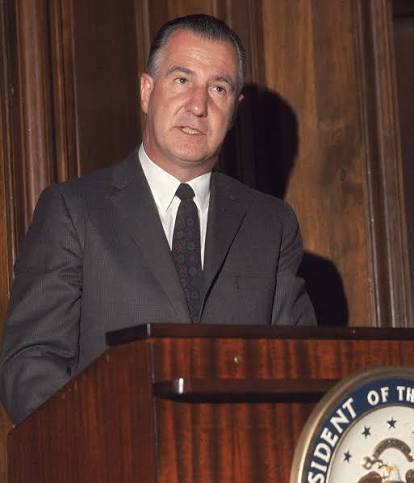
What the movement lacked was reach. That arrived on November 13, 1969, when Vice President Spiro Agnew stood up in Des Moines and, in a speech drafted by Pat Buchanan, told a live national audience that network news was controlled by a "tiny and closed fraternity of privileged men, elected by no one." Buchanan had promised Nixon the speech would terrify the networks. Agnew made one more point that night, about government licenses, that nobody took very seriously at the time. Hold onto it. We'll come back to it.
Inside the White House, meanwhile, someone drafted a fifteen-page memo titled "A Plan for Putting the GOP on TV News." It proposed producing pro-administration video segments in-house and shipping them directly to local stations in the forty largest markets, around the networks entirely. Its theory of the medium was blunt: "People are lazy. With television you just sit—watch—listen. The thinking is done for you." In the margin, a young Nixon media adviser named Roger Ailes wrote that it was "basically an excellent idea." The plan never launched. Ailes would get another chance in 1996.
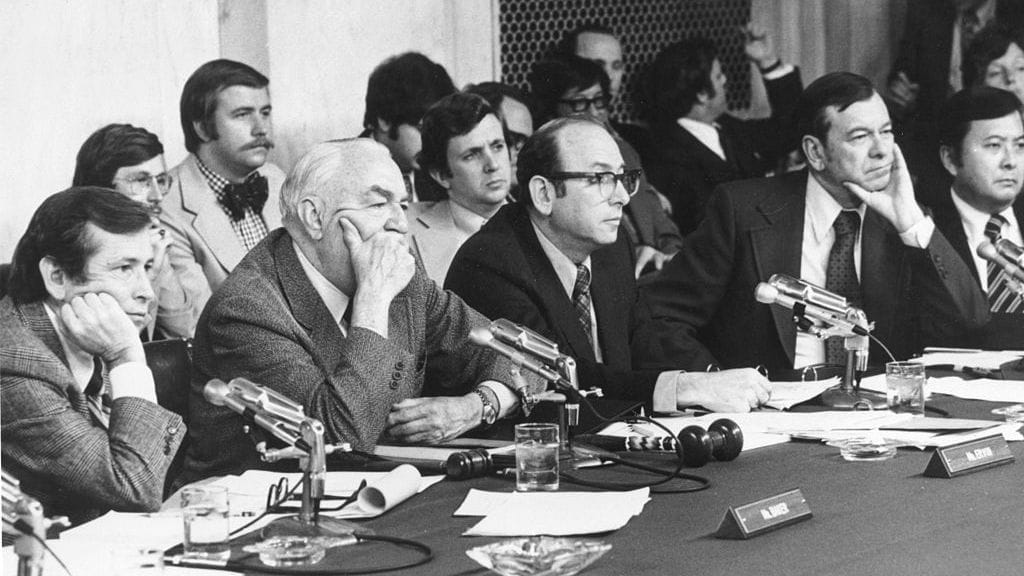
Then came Watergate. The break-in was in June 1972; by August 1974 Nixon was gone, and Agnew had already resigned over a separate bribery scandal. For the press, Watergate became a founding myth: the adversarial watchdog, vindicated. For the right, it was proof. The fraternity Agnew had warned about had, in their telling, done exactly what he said it would, unmaking a president the voters had just returned in a forty-nine-state landslide. Watergate didn't create the right's hostility to the press. It consecrated it, and gave it a martyr.
Ollie's Lesson
Iran-Contra should have been Watergate's sequel. In November 1986, a Lebanese magazine, Ash-Shiraa, revealed that the Reagan administration had been secretly selling arms to Iran; the proceeds, it emerged, had been diverted to the Nicaraguan Contras in defiance of a congressional ban. The following summer, Congress held televised hearings.
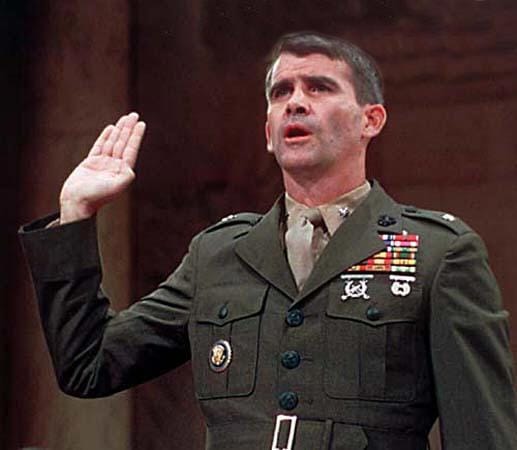
What the right took from those hearings was not the lesson Congress intended. Lieutenant Colonel Oliver North sat before the committees in his Marine uniform, acknowledged shredding documents, and turned the proceeding into a referendum on whether Washington could persecute a patriot. The papers called it "Olliemania." North went on to a career in talk radio and a long run on Fox News. The investigation designed to expose him launched him instead. That was the lesson: a scandal is a broadcast, and a broadcast can be counter-programmed. Whoever controls the second channel controls what the first one means.
The second channel was being built that same year. In the first half of 1987, Congress passed a bill to write the Fairness Doctrine, the FCC rule requiring broadcasters to cover controversial issues and air contrasting views, into statute. It cleared the Senate 59–31 and the House 302–102. Reagan vetoed it, and in August the FCC abolished the doctrine 4–0. Reagan's first FCC chairman, Mark Fowler, had already supplied the philosophy's slogan: television, he said, was "a toaster with pictures." While the Fairness Doctrine may not have been the linchpin against right-wing dominance of the media, it is certainly a factor.
The next summer, a Sacramento host named Rush Limbaugh went national, syndicated on 56 stations by a former ABC Radio executive who gave the show to stations for free in exchange for its ad time. Within a few years he was on hundreds of stations. Whether repeal caused Limbaugh or merely cleared his path is genuinely disputed; the doctrine never directly governed syndication, and AM radio was desperate for anything after music fled to FM. But the order of operations is not in dispute. First, the rule requiring opposing views was abolished. Then came a format whose entire premise was that there were no opposing views worth hearing, only a liberal media to be mocked for three hours a day.
Working the Refs
At the 1992 Republican convention in Houston, RNC chairman Rich Bond kept waving a Houston Chronicle headline at reporters as proof of the press's bias against the Bush-Quayle ticket. Then, in a moment of candor to the Washington Post, he explained what he was actually doing. "If you watch any great coach, what they try to do is 'work the refs.'" Yell at the referee long enough and maybe he gives you the next close call.
Four years later, Pat Buchanan, the man who had written the Des Moines speech, told the Los Angeles Times that his own presidential campaign had gotten balanced coverage, and then shrugged: "we kid about the liberal media, but every Republican on Earth does that."
This is what makes the liberal-media story so durable. It doesn't need to be true to work. It only needs to be repeated, and it only needs to be believed by the people it's really aimed at, who are not the audience but the journalists. In Manufacturing Consent (1988), Edward Herman and Noam Chomsky listed "flak" among the five filters that shape the news: organized negative response that makes certain kinds of coverage expensive. The liberal-media charge is flak industrialized. A newsroom that knows every story critical of Republicans will draw a campaign, and that stories critical of Democrats mostly won't, learns to pre-correct. It adds the extra conservative guest, softens the verb, reaches for the "both sides" frame. Nobody has to order this. The incentive does it.
Is there anything to the charge? At the level of culture, yes. A much-cited 1996 Freedom Forum survey found that 89 percent of Washington bureau chiefs and congressional correspondents had voted for Bill Clinton in 1992. But culture is not structure. Reporters don't own anything. In the mid-1990s, the networks belonged to General Electric, Westinghouse, Disney, Time Warner, and Rupert Murdoch. Bias in a newsroom shapes adjectives. Ownership decides who gets hired, what gets funded, and which stories die in meetings nobody hears about. The right grasped this distinction long before the left did. It complained about the reporters. Then it bought the companies.
1996: The Year Things Changed
If there is a single year in which the modern American media environment was assembled, it's 1996. People like to point to 2008 or 2016, but they're probably younger millennials or zoomers, and we shan't countenance such things here.
In February, Bill Clinton signed the Telecommunications Act, one of the most heavily lobbied bills in American history, and (this matters) a bipartisan one. Among much else, it eliminated the national cap on radio ownership, which had held any single company to about forty stations. A San Antonio outfit called Clear Channel Communications owned a few dozen. By 2002, by the FCC's own count, it owned roughly 1,200, about one of every ten radio stations in the country. Along the way it bought Jacor, whose Premiere Radio Networks syndicated Rush Limbaugh. The largest owner of radio stations in America now also owned the company that distributed its most powerful political voice.
In July, NBC and Microsoft launched MSNBC. In October, Rupert Murdoch launched the Fox News Channel and put Roger Ailes in charge, a quarter century after his note in the margin of the Nixon memo. Fox promised to be "fair and balanced," which only works as a slogan if your audience has already accepted that everything else is unfair and unbalanced. Twenty-five years of flak had done that work in advance.
Consolidation and conservatism fit together for reasons that were partly ideological and mostly economic. Syndicated talk is cheap. A chain that owns 1,200 stations doesn't need 1,200 local hosts and local newsrooms; it needs a satellite feed. Critics documented Clear Channel stripping local news departments out of the stations it acquired and filling the hours with national programming, and national talk on AM radio meant Limbaugh and his imitators. The format the right had built was the format consolidation wanted.
Then the politics stopped being merely economic. After September 11, a list of more than a hundred "lyrically questionable" songs, John Lennon's "Imagine" among them, circulated among Clear Channel stations. In March 2003, as the Iraq invasion began, Clear Channel stations sponsored and promoted a series of pro-war "Rally for America" events, some drawing tens of thousands, which then appeared on the news as spontaneous patriotic sentiment. The company's chairman was a longtime Republican donor; its vice chairman, Tom Hicks, had bought the Texas Rangers from an ownership group headed by George W. Bush. A media company was manufacturing the crowd it then reported on. Walter Lippmann had a phrase for this in 1922: the manufacture of consent.
The Liberal Media Goes to War
If the liberal-media charge had been a description rather than a strategy, Iraq should have refuted it for good.
In September 2002, the New York Times ran Judith Miller and Michael Gordon's aluminum-tubes story on its front page; administration officials were citing it on the Sunday shows that same morning. In February 2003, three weeks before the invasion, MSNBC canceled Phil Donahue's prime-time show, then the highest-rated program on the network. A leaked internal memo called him "a difficult public face for NBC in a time of war" and fretted that his show could become a home for antiwar voices while competitors were waving the flag. In 2004, the Times learned that the Bush administration was wiretapping Americans without warrants; at the White House's request, it held the story for roughly a year, publishing in December 2005.
The point isn't that the reporters were secretly conservative. Most weren't. The point is that when the stakes were highest, the "liberal media" functioned as a ministry of information for a Republican war, because its structure demanded it: owners who were themselves government contractors (NBC's parent, GE, built military jet engines), reporting that lived on access, a decade of flak, and a cable competitor setting the patriotic tempo. The Donahue memo said so in as many words. The fear wasn't that Donahue was wrong. The fear was Fox.
The Right Owns, the Left Rents
By the mid-2000s the asymmetry was complete, and it was an asymmetry of ownership far more than of opinion.
Fox worked. Economists Stefano DellaVigna and Ethan Kaplan, exploiting the patchy rollout of the channel across local cable systems, estimated that Fox persuaded 3 to 8 percent of its non-Republican viewers to vote Republican in 2000. Gregory Martin and Ali Yurukoglu later found that the effect grew between 2000 and 2008 as viewership rose and the slant sharpened. Fox didn't just reflect its audience. It manufactured more of it.
Local television followed radio's path. Sinclair Broadcast Group, controlled by the Smith family, built one of the largest station groups in the country and fed its local newsrooms centrally produced "must-run" segments. In 2018 it had anchors at dozens of stations read an identical script warning about one-sided "fake" stories in the media. Deadspin cut the clips together into a montage of trusted local faces chanting in unison: "This is extremely dangerous to our democracy." It was the 1970 memo, realized half a century late: the GOP on TV news, delivered through the stations you trust precisely because they're local.
The left tried to answer in kind and mostly failed. Air America launched in 2004, went bankrupt in 2006, and shut down for good in 2010, though it gave Rachel Maddow her start. MSNBC found a profitable liberal audience in the Bush years, but it found it as a programming strategy inside General Electric and then Comcast, never as an institution owned by people who shared its politics. When cable's economics collapsed, Comcast spun it off with the rest of its cable networks. It's now called MS NOW, and as of this writing its reporters are in federal court fighting a White House ban.
Hemmer makes the deeper point. When liberals tried to copy conservative media, they copied the product without the infrastructure: no movement behind it, no audience whose identity was organized around it. Conservative outlets were built by owners who were also political actors. Liberal outlets were market segments inside conglomerates whose only politics was the next quarter. The right owns. The left rents. And a renter can be evicted.
Meanwhile, the Kids Logged On
While the right was buying transmitters, a younger cohort was building something else.
The early web's insurgent media was not a left-wing preserve. Its first great scoop belonged to Matt Drudge, who in January 1998 published the Lewinsky story Newsweek had been sitting on. But during the Bush years the energy shifted. Josh Marshall's Talking Points Memo kept Trent Lott's nostalgia for Strom Thurmond's 1948 campaign alive in 2002 until the national press had no choice but to notice. Daily Kos, Eschaton, Firedoglake, and hundreds of others became the place where people who never believed the aluminum-tubes story could find each other. The "netroots" were real. They were also, crucially, unowned.
That was their virtue and their fate. Blogs built audiences, not assets. They had no licenses to lose and none to leverage, no transmitters, no carriage deals. When money arrived, it arrived as an exit. The Huffington Post, launched in 2005 on about a million dollars, sold to AOL in 2011 for $315 million. Most of the blogosphere didn't sell so much as dissolve, first into Facebook, then into Twitter, then into whatever feed came next. The independent web became content for platforms.
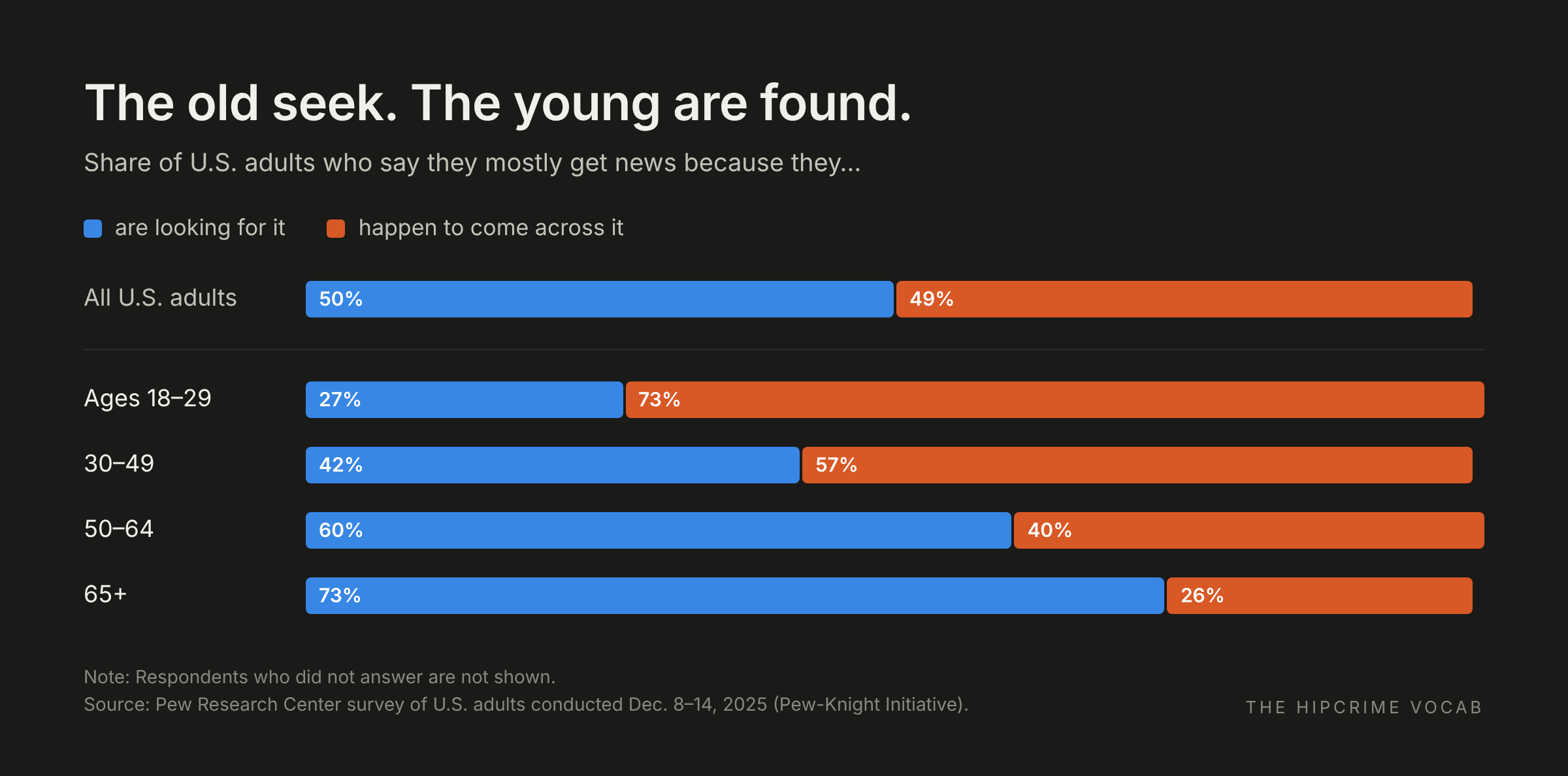
And the age split hardened into two separate realities. Television news is now overwhelmingly an older person's medium: the average Fox News viewer, per Nielsen, is 69 years old, and among Americans 65 and older who get news from TV, 75 percent get it mostly from cable, satellite or broadcast. Meanwhile, 43 percent of adults under 30 regularly get news on TikTok. The starkest number, though, is about posture rather than platform. In a December 2025 Pew survey, 73 percent of Americans 65 and older said they mostly get news because they go looking for it. Among those under 30, 73 percent said the opposite: the news mostly finds them.
The old seek; the young are found. And the old vote, while the youth are mostly content to bitch about the results of voting. A media system that holds the country's most reliable voters inside a single, owned, televised reality doesn't need to win the young. It only needs the young to be somewhere else.
The Feed Has a Landlord Too
Here is where the story the left likes to tell about itself goes wrong. The young didn't escape the owned media. They moved into a different building with the same landlords.
In January 2026, TikTok's American operations passed to a new joint venture in which Oracle, the private-equity firm Silver Lake, and the Emirati fund MGX each hold 15 percent; the recommendation algorithm is being retrained on American data and secured in Oracle's cloud. Oracle's co-founder is Larry Ellison. In October, Larry Ellison's son David closed the $110 billion merger of Paramount and Warner Bros. Discovery, putting CBS News and CNN under one roof. One family now controls two of the country's most important television news operations and, through Oracle, helps oversee the algorithm from which more than four in ten Americans under 30 regularly get news. X belongs to Elon Musk. And the podcast circuit Trump worked so assiduously in 2024 was not, by and large, a left-wing space.
The old divide was supposed to be between captured broadcast media and a free internet. The real divide now is between two kinds of capture. Broadcast capture works one-to-many: a single reality, delivered nightly, to people who go looking for it. Algorithmic capture works many-to-one: an individualized reality, assembled continuously, for people who wait for it to arrive. The first produces a congregation. The second produces a crowd of one. Neither produces a public.
Licensed by Government
Back to Des Moines. Near the end of his attack on the networks, Agnew complained that they were enjoying "a monopoly sanctioned and licensed by government." In 1969 that was a complaint. By 2025 it was a lever, and the people pulling it were Agnew's heirs.
Look at how the last two years fit together:
- December 2024: ABC settles Trump's defamation suit for $15 million, payable to his presidential library.
- July 2025: Paramount pays its $16 million. CBS cancels Stephen Colbert's Late Show days after he calls the settlement "a big fat bribe." The FCC then approves the Skydance merger 2–1, after Skydance promises an ombudsman to field complaints of bias at CBS News; FCC chairman Brendan Carr hails the deal as a chance to restore balance to a "once-storied" network.
- July 2025: Congress rescinds $1.1 billion for public broadcasting. The Corporation for Public Broadcasting votes to dissolve that winter.
- September 2025: Carr goes on a right-wing YouTube show and says of Jimmy Kimmel, "We can do this the easy way or the hard way." Within hours, Nexstar and Sinclair, owners of 66 of ABC's 230 affiliates, pull the show, and ABC suspends it. Nexstar has a $6.2 billion merger pending before Carr's FCC.
- October 2025: Bari Weiss becomes editor-in-chief of CBS News after Paramount buys her outlet, The Free Press. Nearly the entire Pentagon press corps turns in its credentials rather than accept Pete Hegseth's new rules; the Pentagon announces a replacement corps of more than 60 journalists, mostly from right-wing outlets and influencer shops, and Hegseth declares access "a privilege, not a right."
- March 2026: Two weeks into the Iran war, Carr warns that broadcasters running "fake news" should correct course before their license renewals come up. Days later, the FCC's Media Bureau approves Nexstar's purchase of Tegna without a full commission vote, waiving the 39 percent national ownership cap for a company that will reach 54.5 percent of TV households. Nexstar's CEO thanks the president.
- August 2026: The FCC votes 2–1 to repeal the cap entirely, a limit Congress wrote into law, replacing it with "case-by-case review," which is to say, with Carr's discretion.
- September 2026: The White House bans CNN, MS NOW, and Politico from its grounds. The official White House website maintains a "Media Offenders" page with an "Offender Hall of Shame."
- October 2026: Skydance closes on Warner Bros. Discovery. The settlement that cleared the deal required an independent board to oversee the editorial integrity of CBS News and CNN, which tells you what everyone involved assumed the risk was.
Some make take issue with my diction here, but fuck 'em. "Cartel" is the right word, and I mean it in something close to the political scientists' sense. Richard Katz and Peter Mair coined the "cartel party" to describe parties that stop competing for the public and start drawing their resources from the state. Media companies in 2026 need things only the government can give: license renewals, merger approvals, cap waivers, a seat in the briefing room. The government needs something only they can give: an audience that hears the war is going well. Nobody has to sign anything. The approvals flow toward the companies that behave, and the companies behave because the approvals flow.
The old broadcast business sold audiences to advertisers. The media scholar Dallas Smythe called it the "audience commodity": the product was never the programming; it was you. The cartel sells the audience twice, once to advertisers for money and once to the state for permission.
None of this is total, and it's worth saying so. Fox and Newsmax reporters walked out of the Pentagon alongside everyone else. CNN, MS NOW, and Politico sued and won a temporary restraining order. The current president of the White House Correspondents' Association is Fox's Jacqui Heinrich, the same reporter Tucker Carlson, in texts surfaced by the Dominion litigation, wanted fired in 2020 for fact-checking the president. Plenty of journalists are still doing the job. The cartel isn't the reporters. It's the floors above them.
Refeudalization
In 1962, Jürgen Habermas described the bourgeois public sphere, the coffeehouses, journals, and salons where private people came together to reason about public matters, and then described its decay. As mass media consolidated and the market and the state moved in, he argued, the public sphere was "refeudalized." Publicity reverted to something like what it had been at a medieval court: not a space where the public reasons, but a stage on which power displays itself before the public. The people are still present. They are just present as an audience.
That is the precise shape of what the cartel produces. Under this arrangement, the purpose of a newscast is not to inform the citizen, since an informed citizen is harder to govern. Its purpose is to hold them: to keep the viewer inside a stable, legible, emotionally satisfying account of the world in which the government is easy to approve of and its opponents easy to fear. The Dominion litigation showed the mechanism with unusual clarity. Fox's own hosts privately dismissed the 2020 stolen-election claims while worrying, in writing, that telling their viewers so would send them to Newsmax. Fox paid $787.5 million to settle. The audience wasn't being informed. It was being retained.
The 1970 memo understood this from the start. The thinking is done for you. I've argued in the Stage Four series that we now live in Baudrillard's fourth order of simulacra, where the image no longer bears any relation to a reality behind it. This is the political economy underneath that. The simulation is not an accident of technology or a failure of media literacy. It's a product. It has owners. The owners have a regulator, and the regulator has a president.
After the Refs
The right spent fifty years working the refs. It turned out the refs were for sale, as any good sports fan has known since the dawn of televised sports. Fuckin' zebras, man.
That's the lesson the left's own media history should have taught it, and mostly hasn't. The bloggers of the 2000s were braver and more accurate than the networks about the biggest story of the decade, and it didn't matter, because they owned nothing that couldn't be bought, absorbed, or simply outscaled. The generation that left television for the internet didn't leave the owned media. It traded one landlord for another.
So the question for anyone who still wants to inform rather than hold isn't about tone, or bias, or balance. It's about structure. What kind of media can't be bought by the next Ellison or squeezed by the next Carr? There are partial answers already. Newsrooms owned by the people who work in them, like Defector, which the former staff of Deadspin (the same Deadspin that made the Sinclair montage) founded in 2020 after quitting en masse when their private-equity owner told them to stick to sports. Journalist-owned shops like 404 Media. Nonprofits funded by many members rather than one billionaire. Open protocols instead of proprietary platforms: email, RSS, the open web.
None of these will ever be as big as Skydance, and that's the point. Concentration is what made capture cheap. You can bend a network with one merger approval. You can't bend a thousand small presses that way.
But what this requires is that you cultivate a media diet composed of trusted sources that you regularly verify against others. It requires effort; you can no longer be a passive receptor of the news. You must be an active hunter and participant in the discourse in order to approach anything regarding consensus reality. And many people will shirk that duty rather than embrace it.
Agnew was right about one thing. A tiny and closed fraternity, elected by no one, really does decide what most Americans see and hear. He identified the wrong fraternity, probably by design. As George Carlin said, there is a club, but we ain't in it.