
Wrong Case, Wrong Turn: What Liberals Get Wrong About "Citizens United" and Why
Citizens United is the villain everyone can name. But the money flooding our elections runs through a much older case, and the fix this moment calls for is bigger than overruling one decision.
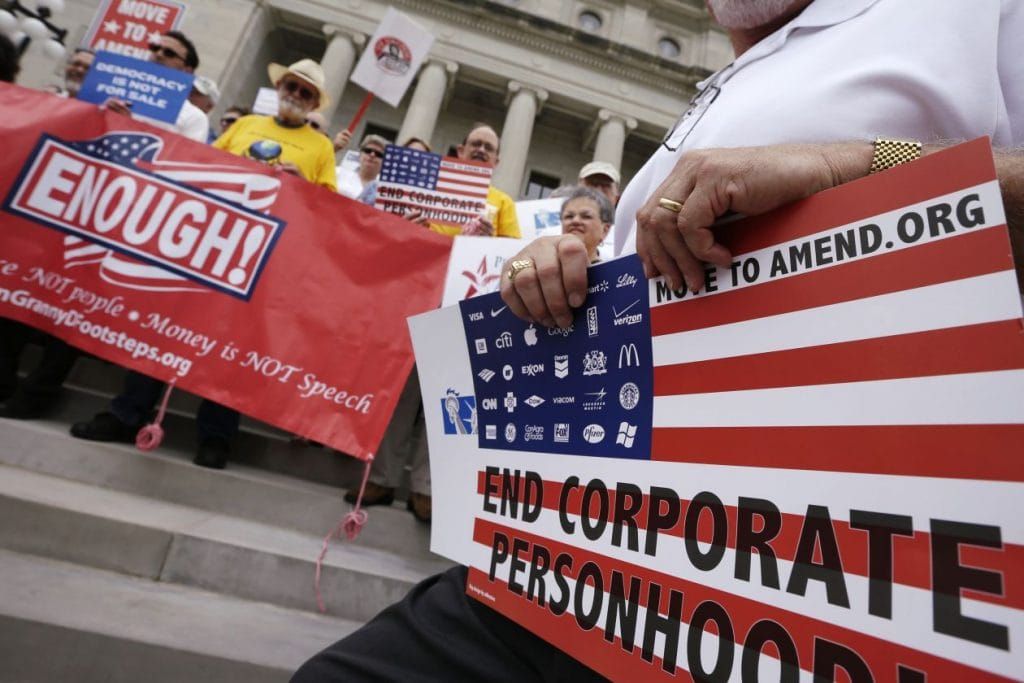
Last Tuesday, for only the fourth time since the Second World War, one party took both chambers of Congress in a midterm. Democrats flipped seven Senate seats, several of them in states that hadn't sent a Democrat to the Senate in decades. In Georgia, Jon Ossoff won reelection by eighteen points after a campaign in which the policy he returned to more than any other was a constitutional amendment to overturn Citizens United v. Federal Elections Commission. He has been calling this moment "an opening, not for restoration, but for reformation," and the reformation he has in mind starts with a case he once called the worst court decision in modern American history.
I'm glad that money in politics has become a front-line issue instead of something candidates promise to fix at fundraisers. But I want to slow everyone down for a minute, because "overturn Citizens United" has become one of those phrases that does far more emotional work than legal work. When most people say it, they mean something like get the billionaires and the dark money out of our elections. I share that goal completely. The trouble is that Citizens United is not, legally speaking, what put the billionaires and the dark money there. Overruling it, even by constitutional amendment, would leave most of that machinery running.
So this post does three things. First, it explains what Citizens United actually decided, which is both narrower and stranger than its reputation. Second, it explains why undoing it wouldn't touch most of what people hate about money in politics. Third, it argues for something more ambitious and, I think, more honest: federal elections paid for by the public, and only by the public.

What the Case Was Actually About
Citizens United is a conservative nonprofit corporation. In 2008 it produced Hillary: The Movie, a roughly ninety-minute documentary attacking then-Senator Hillary Clinton during her run for the Democratic nomination. It wanted to put the film on cable video-on-demand and promote it with television ads.
That plan ran into two federal provisions. The first was the long-standing ban on corporations and unions using their general treasury funds for "independent expenditures," meaning communications that expressly advocate the election or defeat of a federal candidate. In one form or another, that ban dated back to the Taft-Hartley Act of 1947. The second was Section 203 of the Bipartisan Campaign Reform Act of 2002 (McCain-Feingold). It extended the ban to "electioneering communications": broadcast, cable, or satellite ads that mention a clearly identified federal candidate within 30 days of a primary or 60 days of a general election. Corporations weren't silenced entirely. They could still speak through a PAC, a separate fund raised from employees and shareholders under the ordinary contribution limits. What they couldn't do was reach into the corporate treasury.
Citizens United lost in the district court. It reached the Supreme Court as a fairly narrow dispute over whether a video-on-demand documentary was the kind of thing Section 203 covered. Then the Court did something unusual. After the first argument, it ordered the parties to come back and brief whether it should overrule two of its own precedents. One was Austin v. Michigan Chamber of Commerce (1990), which had upheld a state ban on corporate independent expenditures. The other was the part of McConnell v. FEC (2003) that had upheld Section 203 on its face. A case about a movie became a case about the whole architecture.
On January 21, 2010, the Court ruled 5–4, in an opinion by Justice Kennedy, that the government may not ban independent political spending by corporations and unions. The decisive move was categorical: "independent expenditures, including those made by corporations, do not give rise to corruption or the appearance of corruption." Preventing corruption is the only interest the Court accepts as strong enough to justify restricting campaign spending. Independent spending had now been declared incapable of corrupting as a matter of law. So the ban fell, Austin was overruled, and so was that part of McConnell.
It's worth being precise about what the Court did not do, because this is where the popular account usually goes wrong.
It did not let corporations give money to candidates.
The ban on corporate contributions directly to federal campaigns goes back to the Tillman Act of 1907 and is still in force. A corporation can no more write a check to a senator's campaign today than it could in 2009.
It did not touch contribution limits
It didn't change the limits to contributions of any kind, from anyone.
It upheld disclosure, 8–1
Only Justice Thomas would have struck down the disclaimer and disclosure requirements. Kennedy's majority went out of its way to praise disclosure, explaining that prompt, internet-age reporting lets citizens "see whether elected officials are 'in the pocket' of so-called moneyed interests." Hold onto that; it matters later.
It did not open the door to foreign money.
The Court expressly declined to decide that question. Two years later it summarily affirmed a ruling upholding the ban on election spending by foreign nationals (Bluman v. FEC, 2012).
It did not invent corporate personhood.
Corporations have been treated as "persons" for many constitutional purposes since the nineteenth century. The Court had already protected corporate spending on ballot measures in First National Bank of Boston v. Bellotti (1978). The majority's reasoning wasn't that corporations are people. It was that political speech is protected no matter who is speaking, and the speaker's identity isn't a permissible reason to suppress it. You can think that reasoning is wrong, but "corporations are people" is a slogan about a different argument.
The Older Case Behind the Famous One
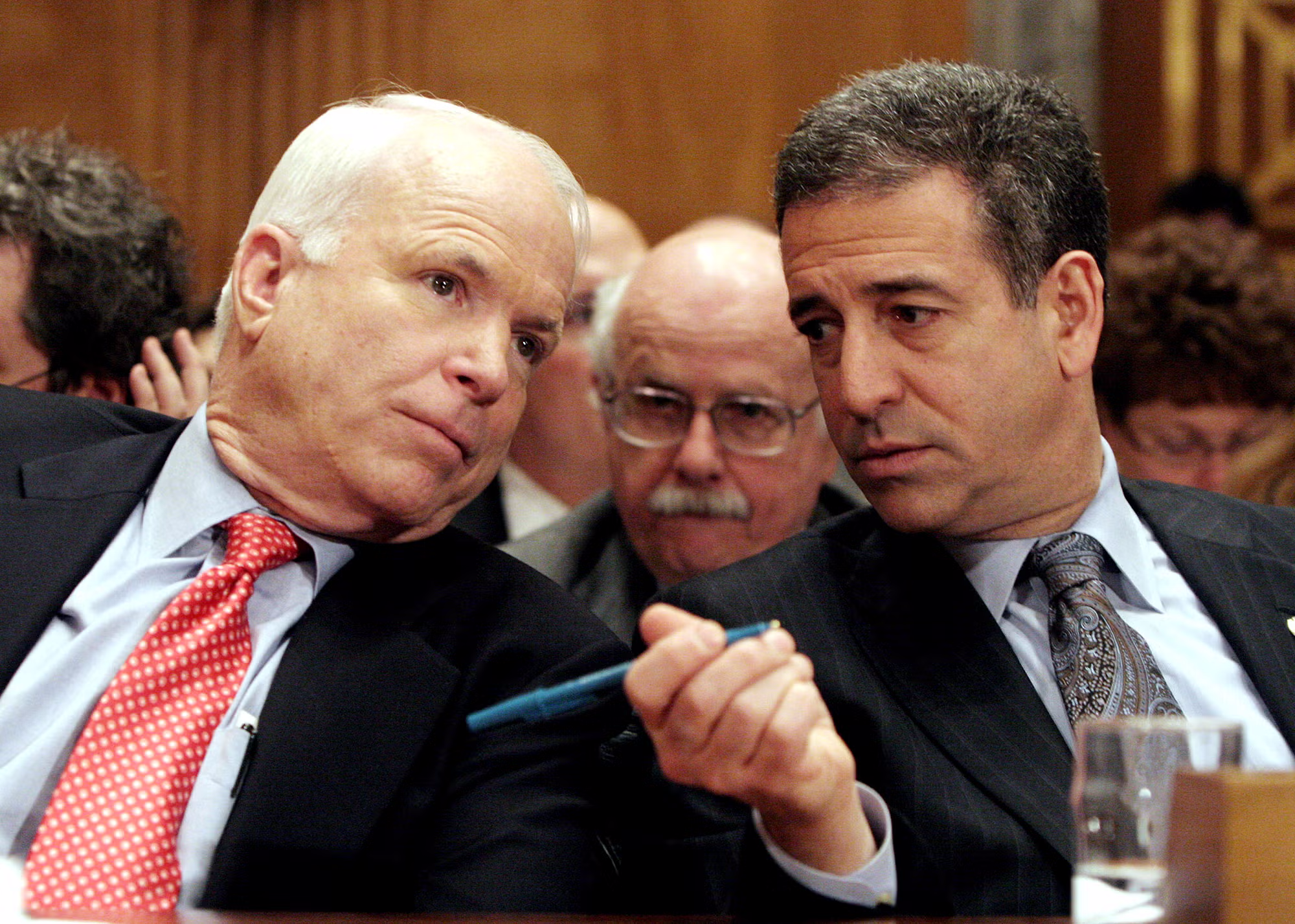
If Citizens United didn't build the system, who did? The answer is a 1976 case that almost nobody outside the election-law bar can name: Buckley v. Valeo.
After Watergate, Congress overhauled the Federal Election Campaign Act, and the 1974 amendments were genuinely comprehensive. They limited what individuals could contribute to candidates and what anyone could spend independently to support or oppose a candidate. They capped how much candidates could spend of their own money and how much a campaign could spend overall. They also created a new Federal Election Commission and public financing for presidential elections.
Buckley cut that statute in half, and the cut runs right through everything since. The Court drew a line between contributions, money you give to a candidate, and expenditures, money spent communicating. Contribution limits survived, because a large contribution to a candidate carries an obvious risk of quid pro quo corruption. Expenditure limits did not. The Court struck down the caps on independent spending, on candidates' personal spending, and on total campaign spending. Its theory was that limiting how much money can be spent on communication necessarily limits the communication itself.
People summarize this as "money is speech." That isn't quite what the Court said, but it's close enough to what the Court did. And the most consequential sentence in the opinion is the one that closed the door on the most natural reason to limit spending:
"[T]he concept that government may restrict the speech of some elements of our society in order to enhance the relative voice of others is wholly foreign to the First Amendment."
That sentence took political equality off the table as a reason to regulate election spending. From 1976 on, the only interest that could justify a limit was preventing corruption or its appearance. For fifty years the Court has defined "corruption" more and more narrowly, until today it means something close to bribery.
Read in that light, Citizens United wasn't a revolution. It completed Buckley's logic. Suppose spending is speech, only corruption justifies limits, and money spent independently of a candidate can't be a quid pro quo. Then there's no principled reason to treat a corporation's independent spending differently from an individual's, and individuals had been allowed to spend unlimited sums independently since 1976. Austin had tried to get around this with an "antidistortion" rationale: the idea that huge piles of corporate wealth distort the political marketplace. But antidistortion is political equality in a disguise, and Buckley had already ruled political equality out. Austin was living on borrowed time from the day it was decided.
The Court has also explicitly refused to reconsider Buckley. In Randall v. Sorrell (2006), Vermont defended its own spending limits by asking the Court to revisit Buckley's expenditure holding. The Court declined and struck the limits down. Buckley is the real wall. Citizens United is just the most recent brick anyone remembers.
What Actually Changed After 2010
So what did change in 2010? Three things, and only one of them is in the Citizens United opinion.
Corporations and unions can spend from their treasuries.
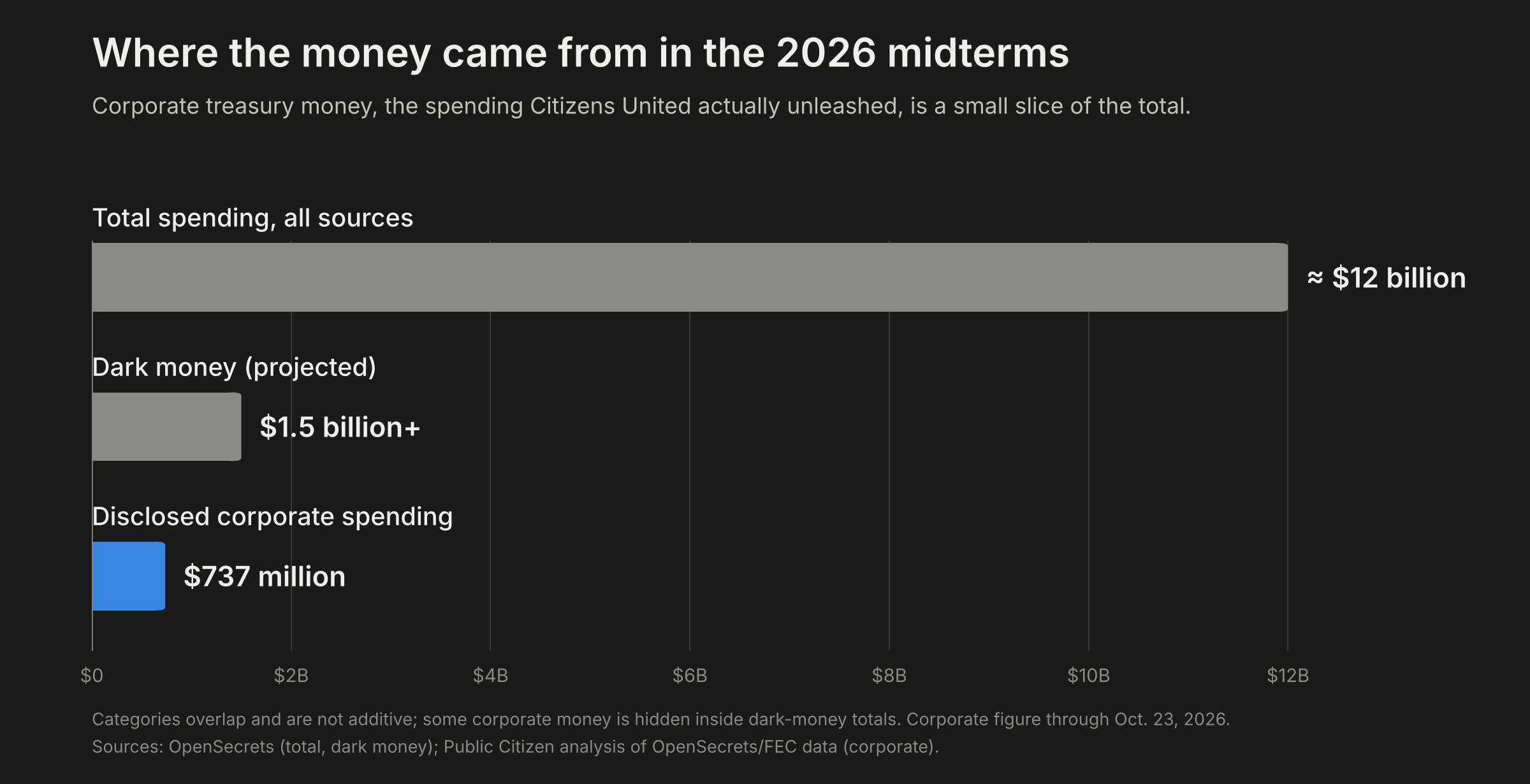
That's the actual holding. For years corporations used it more cautiously than critics feared, because public companies have shareholders and customers to worry about. That caution is gone. Public Citizen counted a record $737 million in corporate election spending this cycle as of late October. That's more than 40 percent of all disclosed corporate election spending since 2010, much of it from the crypto, AI, and tech sectors.
Super PACs.
Two months after Citizens United, the en banc D.C. Circuit decided SpeechNow.org v. FEC. Its reasoning was a syllogism: if independent expenditures can't corrupt, then contributing to a group that only makes independent expenditures can't corrupt either, so limits on those contributions are unconstitutional. The government didn't seek Supreme Court review, the FEC issued advisory opinions that summer, and the super PAC was born. The Supreme Court has never actually ruled on it. SpeechNow, not Citizens United, is what lets one person write an eight- or nine-figure check to a political committee. Citizens United supplied the premise; SpeechNow drew the conclusion.
Dark money.
Nonprofit "social welfare" organizations under 501(c)(4) and trade associations under 501(c)(6) can engage in politics as long as it isn't their primary activity, and they don't have to publicly disclose their donors. They can buy ads directly. Or they can give to a super PAC, which reports the nonprofit as its donor, and the trail ends there. The major party-aligned super PACs on both sides have nonprofit twins for exactly this purpose. In June of this year, the Republican Senate Leadership Fund took in more than $24 million from its affiliated nonprofit, One Nation. The Democratic Senate Majority PAC took in $28 million from its own, Majority Forward. OpenSecrets projected that dark money in these midterms would pass $1.5 billion. None of this comes from Citizens United. It comes from the tax code, from an IRS that has never seriously policed the "primary purpose" line, and from an FEC built with six commissioners, three per party. That is an agency designed to deadlock.
A note on "soft money," since people use the term loosely. In the 1990s, soft money meant unlimited donations to political parties for nominally "party-building" activities outside federal limits, the era of donors sleeping in the Lincoln Bedroom. McCain-Feingold banned it, McConnell upheld the ban, and the ban survived Citizens United. Later in 2010 the Court summarily affirmed it again (RNC v. FEC). Party soft money is still illegal. What plays its role today is super PAC and nonprofit money: soft money with extra steps.
And the steps keep getting fewer. McCutcheon v. FEC (2014) struck down the aggregate limit on how much one donor can give across all candidates and committees. That made the giant joint fundraising committee possible, where a single donor writes one enormous check that gets split among a candidate, the national parties, and dozens of state parties. Then this June, in NRSC v. FEC, the Court struck down 6–3 the limits on how much parties can spend in coordination with their own candidates, overruling a 2001 precedent. Very large checks can now go to the party, and the party can spend without limit in coordination with the candidate. The Court was careful to say it wasn't deciding anything about super PACs coordinating with candidates. Not yet.
Why "Overturn Citizens United" Misses the Target
Put those pieces together and the problem with the slogan is clear. Suppose the Court overruled Citizens United tomorrow, or an amendment reversed its holding. What would happen?
Billionaires would barely notice.
Unlimited independent spending by individuals comes from Buckley, not Citizens United. Elon Musk spent more than $400 million on politics this cycle. By Public Citizen's count, about $10 million of that went through a corporate entity. The rest was his money, spent as an individual. Super PACs might lose their legal footing, since SpeechNow built on Citizens United. But a billionaire who can't give to a super PAC can still buy the ads himself.
We've seen this before.
In 2004, six years before Citizens United, wealthy donors on both sides poured tens of millions of dollars into "527" groups: Swift Boat Veterans for Truth on the right, America Coming Together and the Media Fund on the left. The big-money independent campaign wasn't invented in 2010. It was opened up to corporations and made more convenient for everyone else.
Corporate money is a small slice.
The $737 million corporate figure is a record, and an alarming one. But OpenSecrets put total spending this cycle close to $12 billion. Even allowing for corporate money hidden inside nonprofits, most of the flood comes from individuals, and above all from the very richest.
Dark money is a disclosure problem, and Citizens United endorsed disclosure.
Eight justices said Congress may require it. Closing the nonprofit loophole would take an ordinary statute, not an amendment: any entity that spends on federal elections, or gives to anyone who does, would have to disclose its donors back to actual human beings. Versions of that bill, the DISCLOSE Act, have been introduced for sixteen years and have repeatedly died by Senate filibuster. One caveat: Americans for Prosperity Foundation v. Bonta (2021) tightened the scrutiny applied to donor-disclosure rules, so any new law needs careful drafting. But campaign disclosure is still the firmest constitutional ground in this whole area. Dark money persists not because the Constitution protects it but because Congress has never passed the law.
The amendment drafters already know all this.
The leading proposals in the current Congress go well past Citizens United. Democracy for All, Citizens Over Corporations, and the Free and Fair Elections Amendment would all empower Congress and the states to limit the raising and spending of money generally. That reaches Buckley, and Free and Fair Elections names Buckley outright. The people writing the amendments understand that Buckley is the target. The marketing says Citizens United because Citizens United has name recognition. I understand why. But it has a cost: when an amendment sold as "overturning Citizens United" turns out to do much more, its opponents get to call it a bait-and-switch.
Then there's Article V: two-thirds of the Senate (67 votes), two-thirds of the House (290), and ratification by 38 states. Democrats will hold around 54 Senate seats. Every amendment attempt since 2010 has failed. If we're going to try the hardest thing in American politics, the problem should actually be solved when we're done.
The Problem Is Upstream of the Ballot
Given the "bluenami" that just happened, it may be tempting to say that there's nothing wrong with our democracy and this is alarmist, but that is because we are not being clear about what the problem actually is. Republican super PACs out-raised Democratic ones for much of the cycle, and Democrats won anyway. James Talarico faced more than $200 million in outside spending against him in Texas, and he won. Doesn't that prove money doesn't buy elections?
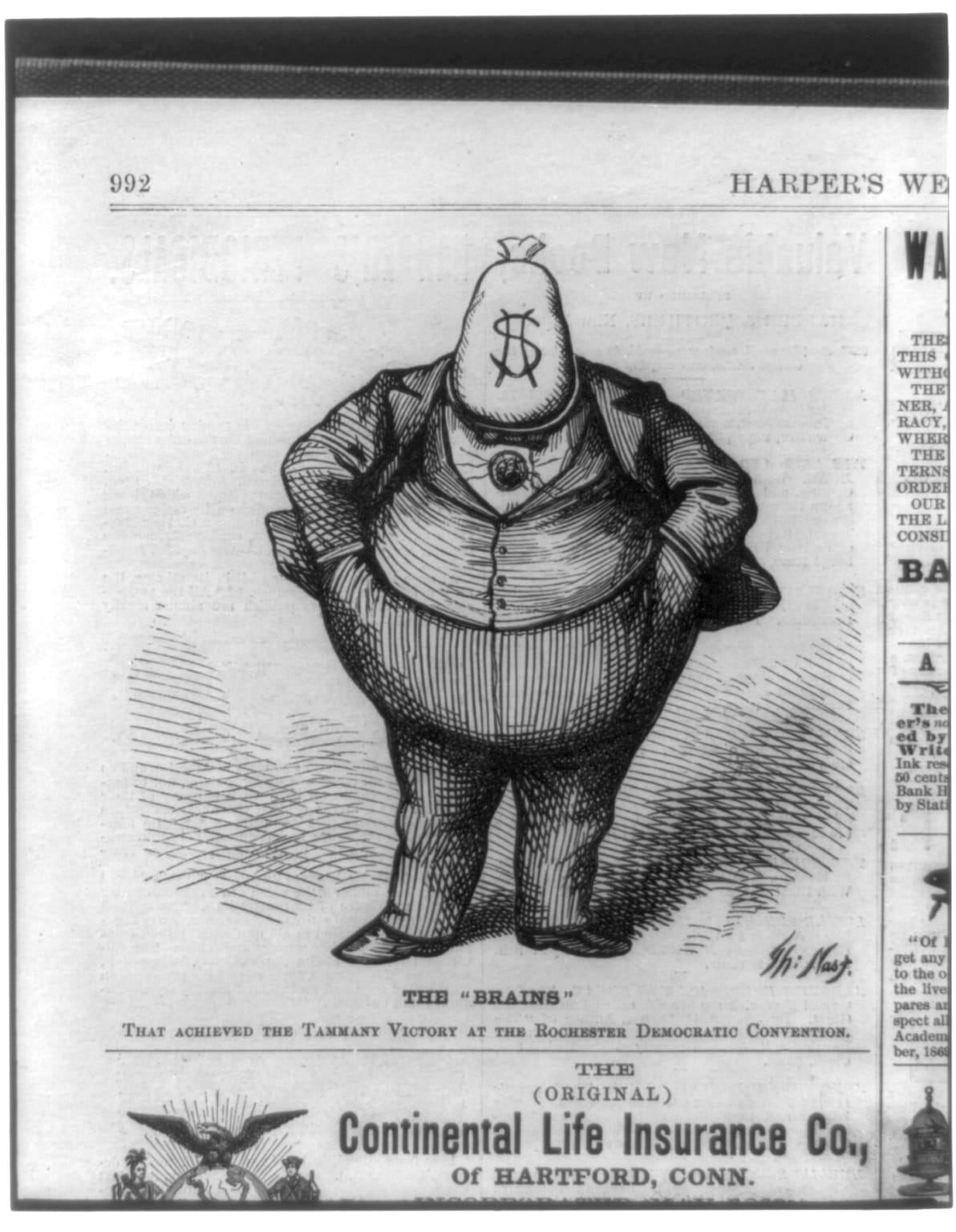
It proves that money doesn't reliably buy outcomes in a wave year. But buying outcomes was never the deepest problem. The deeper problem happens before anyone votes. Candidates who can't raise money don't become candidates. Members of Congress have been advised by their own party committees to budget around four hours a day for "call time," dialing wealthy people for money, and the people they call are the people whose concerns they hear. The donor class doesn't need to swing a general election when it has already narrowed the field in the primaries, shaped which bills get written, and established whose calls get returned. Lawrence Lessig calls this "dependence corruption." It isn't bribery. It's a legislature that has come to depend on its funders alongside, and in competition with, its dependence on its voters.
The founders thought about this. In Federalist No. 57, Madison asked who would elect the House of Representatives: "Not the rich, more than the poor; not the learned, more than the ignorant; not the haughty heirs of distinguished names, more than the humble sons of obscurity and unpropitious fortune." Our system has quietly added a second electorate in front of the first, the donors, who vote before the voters do. The Buckley line of cases can't see this, because the only corruption it recognizes is a quid pro quo. Justice Stevens saw it in his Citizens United dissent: "While American democracy is imperfect, few outside the majority of this Court would have thought its flaws included a dearth of corporate money in politics."
Both of the dueling slogans, "money is speech" and "money isn't speech," miss the mark. Buckley is right that communication costs money. Its mistake was treating the election as a marketplace, where more speech is always better and the loudest buyer is simply exercising a liberty. But an election isn't a marketplace. It's a procedure for counting equal votes, and its legitimacy depends on that equality. Anyone who has tried a case knows procedures like that. We don't let a litigant buy extra minutes of closing argument, and nobody thinks the trial is less free for it. The fairness of the structure is what makes the speech inside it mean something.
The Better Solution: Let the Public Pay
Here's what I think we should do instead. Stop tinkering with who may spend how much through which vehicle. Take private money out of federal campaigns altogether and pay for them publicly.
The idea isn't new, and its history explains why half-measures fail. Presidential public financing began in 1976, and every major-party nominee took general-election funds until 2008. That year Barack Obama became the first to decline them, because he could raise more on his own, and no major-party nominee has taken them since. The system died because it was voluntary: once opting out paid better, everyone opted out. States and cities have built better versions, including Maine's and Arizona's Clean Elections programs, Connecticut's Citizens' Election Program, New York City's matching funds, and Seattle's democracy vouchers, which the Washington Supreme Court upheld in 2019. They all share one weakness. They're optional, and they sit next to an unlimited private system that can swamp them. Arizona tried to fix that by giving publicly financed candidates extra money when privately funded opponents and outside groups outspent them. The Supreme Court struck that down in Arizona Free Enterprise Club v. Bennett (2011).
The lesson is that public financing only works if it's the entire system and there's no shadow system beside it.
The bill I'd want looks something like this:
-
Public funding for every qualified candidate. Candidates qualify by gathering a modest number of signatures or small qualifying contributions (say, $5 each) from voters in their district or state. That's enough to screen out vanity campaigns but low enough that a schoolteacher can do it. Qualified candidates get a grant for the primary and, if they make the general-election ballot, a grant for the general. The amounts follow a formula based on the office, the population, and media-market costs, and an independent commission sets them, not the incumbents who would benefit. Independent and third-party candidates qualify on the same terms. Party committees are publicly funded on the same basis.
-
No private money into campaigns. No contributions to candidates, and no self-funding. The public grant is the campaign budget.
-
No outside campaign spending. During the election period, no person, corporation, union, nonprofit, or committee may spend more than a small de minimis amount on paid communications that expressly advocate for or against a federal candidate, or that are the functional equivalent of such advocacy. Paying an influencer to post counts as a paid communication.
-
Protect the press and the citizen. Bona fide news, commentary, and editorial content is exempt, in any medium. Unpaid individual speech is untouched: a blog post, a conversation, volunteering, a yard sign you printed yourself. The de minimis threshold protects ordinary people spending small sums, and membership organizations can still talk to their own members. Issue advocacy stays free. The line is paid, candidate-directed electoral spending, not public debate.
-
Disclosure as the backstop. Any paid communication that refers to a federal candidate during the election period must report its funders, traced back to natural persons. That catches whatever the definitions miss.
-
Real enforcement. Replace the six-member FEC with a commission that has an odd number of members and real investigative power. Add a private right of action, so enforcement doesn't depend on whether the commissioners agree to do their jobs.
As for cost: this cycle's roughly $12 billion in total spending, public and private together, comes to about $6 billion a year. That's less than a tenth of one percent of a federal budget near $7 trillion, and a public system would likely cost far less once the arms race is gone. Democracy is cheap. We've just been letting other people pay for it, and they've been getting their money's worth.
One other thing to note is that I think this could pass strict scrutiny because it is content-neutral. It does not try to limit outside spending from any identifiable group or on any basis other than it applies blanket, across-the-board.
Why This Needs an Amendment, and Why That's the Point
It being content-neutral is only half the analysis. Parts of my point 2 and almost all of point 3 probably run afoul of current precedent.
Buckley upheld presidential public financing only because it was voluntary; a candidate who wanted to raise and spend privately had a constitutional right to do so. Randall refused to reconsider. Arizona Free Enterprise struck down even indirect pressure on privately funded speakers. NRSC shows which way this Court is heading. A statute like the one above would be enjoined before the ink dried.
That isn't an argument against the bill. It's an argument about what the amendment should say. If Democrats are going to attempt an amendment, and they are, it should be drafted to authorize exactly this, not to restore the pre-2010 status quo that already gave us the 527 era.
Something like:
Section 1. To protect the political equality of all citizens and the integrity of elections, Congress and the States may provide for the public financing of campaigns for public office, and may prohibit or limit contributions and expenditures, other than through such public financing, made to influence the nomination or election of candidates.
Section 2. Nothing in this article shall be construed to abridge the freedom of the press, or to authorize any law that discriminates on the basis of viewpoint.
Section 1 does exactly what Buckley forbade: it makes political equality a legitimate government interest. Section 2 builds in the guardrails, protecting the press and requiring viewpoint neutrality, so the power can't become a tool for incumbents to silence their critics. The statute supplies the details. The amendment supplies the premise.
Is this un-American? Look at peer democracies, none of them authoritarian. The United Kingdom caps what parties, candidates, and "non-party campaigners" may spend, and it has banned paid political advertising on broadcast television and radio since commercial television began in the 1950s. The European Court of Human Rights upheld that ban in Animal Defenders International v. United Kingdom (2013). Canada caps spending by third-party advertisers during elections, and its Supreme Court upheld those caps in Harper v. Canada (2004). The challenger was Stephen Harper himself, then running a conservative advocacy group, two years before he became prime minister. These countries made a different judgment than Buckley did about what free speech in elections requires. On this question, we're the outlier.
I think there is a tendency among American free speech experts to see access and speech as the same thing, which it isn't. If Elon Musk can spend half a billion dollars on his own preferred candidates, he has reliably more access than almost any other single advocacy group that cannot raise that much money, even if they tried. So he gets to speak more because he can buy more access? That hardly seems like it ensures every voice get heard. Public financing of elections, on the other hand, puts us on even playing field and actually lets more voices be heard by not gating access based on personal wealth or amassed donations. By limiting the financing of campaigns to public funds, you do not infringe on anyone's right to speak (because speaking through soft money donations simply isn't a kind of speech). Elon Musk can still go on his wholly-owned social media platform or bribe his podcaster buddies or hell, buy a TV station if he wants to put out his message. But he is not going to be able to do it in the form of directly financing the campaigns of his preferred candidates.

The Objections, Taken Seriously
"Spending limits protect incumbents."
This actually has some bite, because name recognition matters. Political scientists have long found that challengers get more out of each dollar than incumbents do, because incumbents already have name recognition, staff, official communications, and free media coverage. Badly designed caps can lock incumbents in. The answer is a high floor: grants large enough for a challenger to compete, set by an independent commission, indexed to costs, and if anything tilted toward challengers. Today most challengers can't raise serious money at all. A system that guarantees every qualified challenger a real budget is better for them than the one we have.
"Who counts as the press?"
This was the sharpest point in the Citizens United majority. Media companies are corporations too, so why should a network or a newspaper's editorial board get to speak without limit when a nonprofit can't distribute a documentary? Line-drawing will be hard (as all line-drawing problems are), and lower courts will have to do some of it. But federal law has distinguished between producing news and commentary as a regular business and buying airtime to influence an election since the press exemption of 1974, and that line has proven workable. There will be edge cases. Hillary: The Movie itself is one: a film sold to viewers like any other film looks like press, while a paid ad blitz for an attack film in the last thirty days looks like campaigning. (This post, for what it's worth, would be untouched.)
"What about the NRA, the Sierra Club, the ACLU?"
They keep issue advocacy, lobbying, litigation, and communication with their own members. What they lose is the ability to buy ads for or against candidates. That is the point. Issue advocacy is hardly the issue; direct candidate advocacy is.
"Money will find a way."
It always has. It moved from parties to 527s, to super PACs, to nonprofits. The functional definition and the disclosure backstop are meant to shrink the channels it can move through. The test isn't whether the new system is perfect. It's whether it beats the one we have.
"I don't want my taxes funding candidates I hate."
Your taxes already pay for elections: the polling places, the ballots, the officials who count them. Campaigns are part of how elections work. As a criminal defense lawyer I see the same principle every week. The state pays for the prosecution and, for the indigent, the defense as well, because a verdict reached without both sides heard isn't one anyone should trust.
"It will never pass."
Neither will any Citizens United amendment, at least not soon. Article V is a long game whichever version you play. The question is what we're building toward while we play it. Plus, this is what we said about Texas going blue, and, well... you know.
Reformation, Not Restoration
Ossoff is right that this moment calls for reformation rather than restoration. But "overturn Citizens United" is a restoration slogan. It promises to bring back 2009, a world where the Swift Boat ads had already run, billionaires could already spend without limit, dark money already existed in embryo, and presidential nominees were about to walk away from public financing for good. The world before 2010 wasn't clean. It was just a little less candid about how dirty things could get.
Reformation means naming the real premise and replacing it. Buckley told us that the equality of citizens is "wholly foreign" to the First Amendment's concern with elections. The answer is an amendment that says the opposite, and a statute that makes our elections belong to the electorate Madison described: "the great body of the people of the United States." Not the rich more than the poor. Paid for by all of us, and answerable to all of us.
If the new majority is going to spend its political capital on a constitutional amendment, and it should, let it be one that, once ratified, actually makes material inroads in the problem, rather than simply looking good on paper and cashing in on name-recognition with voters mired in the media's hellscape without a method of getting out.