
Case's Two Bodies: Cyberspace, the Lived Body, and the Narrative Construction of Identity
Neuromancer is a fantastic treatise on narrative identity, and I hope Apple does it justice.
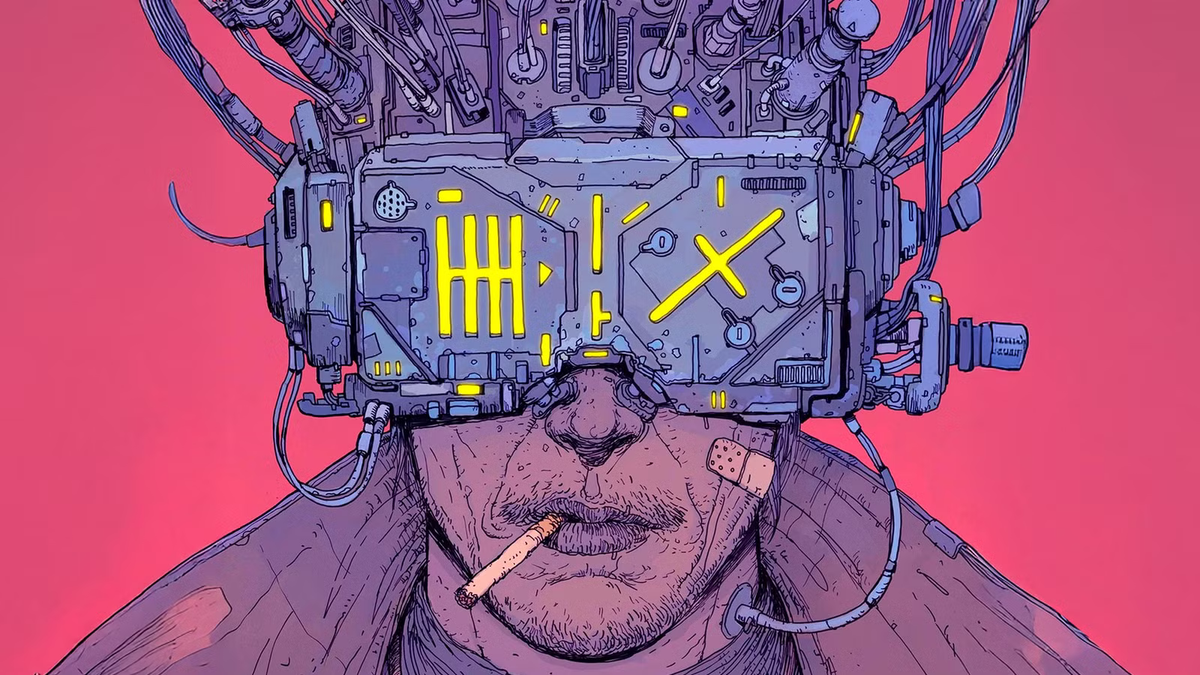
Like many nerds of a certain age, I watched Apple's trailer for the adaptation of William Gibson's genre-defining novel Neuromancer with some degree of pleasure and excitement.
For those of us who grew up in the neon afterglow of the 1980s dystopian views of reality, and especially for those of us who embraced the nascent actuality of cyberspace as a homecoming, Gibson was both our Moses and our Aaron, who showed us the way and led us into the new frontier.
I do not wish to mislead; I did not have a bad childhood. I was not picked on or made the object of violence. My journey to cyberspace was not one of retreat and refuge, but instead of finding a kin. While I was not socially isolated or awkward, cyberspace did provide one benefit to my neurodivergent brain that the analog world did not: interaction was easier.
In the world of flesh, I was constrained by largely unintuitive social rules no one would clearly explain to me, forced to read faces and body language that might as well have been encrypted data to my adolescent brain. The fledgling web, on the other hand, with its proto-social-media in IRC chats, ICQ bots, and Usenet forums, allowed me to be authentically me in a way I could not in face-to-face interaction. Gone were the impositions of timing; I had minutes, hours even, to mull over my responses to come up with something that conveyed the wit and charm I always suspected I possessed but could never summon on-demand. I was not required to spend precious mental effort trying to interpret nuances of face, posture, or tone of voice; everything was direct, literal, and any misunderstanding of sarcasm or ironic meaning could be forgiven or at least indicated with a definite emoticon signaling exactly which of those confusing emotions should modify the meaning of the sentence.
And here was Gibson, asking us to imagine a terrible, no-good, very bad future in which that world, and our identities within it, mattered as much, or perhaps even more, than our identities in the real world.
In real life, Case is a burnt-out shell of a man, barely scraping by, despised and spit upon by the entire world. In Gibson's cyberspace, however, Case becomes the most skilled artisan of his kind. Is it any wonder someone like Case would choose a life in cyberspace? In a much more derivative (and frankly, read in the cool light of 2026, fucking gross and creepy) interpretation, Neal Stephenson's Snow Crash, Hiro Protagonist (yep) is but a lowly pizza delivery driver in the flesh; in cyberspace, he's the greatest swordsman in all the world.
All cyberpunk novels wrestled with this idea of narrative identity in a way that spoke to those of us who found ourselves constituted in two bodies. And none of the scientific or philosophical literature of the time attempted to engage with them on this level, on the level of the phenomenological and simulation, because those were scary "Continental" philosophy, not good, rational, logical, computational analytic philosophy. Even computer science departments, the natural ally of the cyberdenizen, dedicated themselves to the positivistic rationalism of late-20th-century analytic philosophy and sought to render the mutable, semantically-satiated digital reality of cyberspace into the same crude and dull matter of the world inhabited by the ontological naturalists.
This essay will use the reality of cyberspace as both metaphor for and explication of the principle of narratively-constructed identity and hopefully show, by the end, that the existence of a digitally-intersubjective world (constituted by our present digital circumstances, from social media to digital currency) means that recognizing and understanding the narrative construction of identity is more relevant than ever.
1. The Question That Was Never Worth Asking
For roughly thirty years, the entire public philosophical engagement with cyberspace consisted of a single question, asked in a tone of voice somewhere between concern and condescension: but is it real?
Are online friendships real friendships. Is a virtual economy a real economy. Is that money real money. Is that community a real community. Is that, and here the tone always sharpened, a real relationship. The question was posed as though it were an inquiry, and it never was. It was a verdict wearing the clothes of a question, because the frame in which it was asked had already answered it. Real means atoms. Real means the meat. Everything else gets the modifier: virtual friendship, digital economy, online community, each adjective functioning as a quiet quarantine.
This is precisely the operation I described in the socio-narrative structure of identity, running in reverse and for someone else's benefit. Magritte's canvas says "ceci n'est pas une pipe" and the naturalist reads it as a gotcha about representation, a clever little reminder that images are not their referents. But that reading gets the painting backwards. The sentence is true and completely useless. Nobody was going to smoke it. What the painting exposes is that the identity of the thing on the canvas was never settled by its material composition. Pigment and linen do not tell you whether you are looking at a pipe, an argument, a joke, or a very expensive rectangle. What settles it is the story told about it, by whom, to whom, against what.
Ask is cyberspace real and you have already committed to the position that reality is a property distributed by material composition, that things come pre-sorted into the substantial and the derivative, and that the job of philosophy is to check credentials at the door. It is a customs inspection dressed up as ontology.
The question worth asking, the one the phenomenological tradition had been asking for eighty years before Gibson sat down at his typewriter, is not whether a thing is really what it presents itself as. It is how a thing comes to be constituted as what it is: for whom, through what acts, against what background, in the company of which others. Constitution is not a synonym for fabrication. This is the point at which the naturalist reliably stops listening, so let me put it as bluntly as I can. To say that the world is constituted for consciousness is not to say we make it up. It is to say that the world as anything other than an unreachable abstraction, the world as encountered, inhabited, feared, worked in, and lived through, is given to us in acts of meaning-making, and that there is no other world available to have. There is no view from nowhere onto the pipe.
2. The Meat, and Other Bodies
Husserl gave us the distinction the entire cyberpunk canon is running on, and almost nobody in the discourse ever picked it up: Körper and Leib.
The Körper is the body as object. It is the thing the coroner weighs, the thing the MRI images, the thing that shows up in the third person as one more extended object among extended objects, obeying the same physics as a filing cabinet. The Leib is the lived body. It is not a different object; it is the same flesh encountered in an entirely different register. The Leib is the null point of orientation, the here against which every there is measured, the zero coordinate you cannot walk away from. It is the seat of the I can: I can reach that, I can turn toward this, I can lift, dodge, flinch, type. You do not perceive your Leib as an object in your visual field. You perceive from it. It is not what you see, it is what seeing is done out of.
And here is the part that matters: the Leib was never rigidly welded to the Körper. The correspondence between them is an ongoing achievement, not a metaphysical guarantee. This is the entire content of that VR study I wrote about in Husserl's Wings, where a week of practice was sufficient for the visual cortex to start treating a pair of feathered wings the way it treats arms. The popular science coverage called it tricking the brain, which is the naturalist's reflex: if the Körper has no wings, then the wings must be a deception, and the interesting question becomes how the machinery got fooled. But nothing was fooled. Something was constituted. The subjects developed an I can that had wings in it, because that is what the I can does when you give it something to do.
Now go back to Case, and notice what Gibson actually wrote.
The standard reading of the meat, the one that shows up in every undergraduate paper on the novel, is that Case is a Cartesian adolescent, a mind-body dualist with a drug problem, who holds the flesh in contempt because he wants to be pure information. Read that way, Gibson is diagnosing a pathology and the novel is a cautionary tale about the seduction of disembodiment. It is not a stupid reading. It is just a reading that takes Case's vocabulary at face value and misses what the plot is doing.
Consider the punishment. Case's employers do not imprison him, exile him, or maim him. They damage his nervous system with a wartime mycotoxin, precisely and surgically, so that he can no longer jack in. What has been taken from him is not access to a place. It is the I can. He is left with a body that can still eat, walk, score, and bleed, a body that functions in every way a coroner would care about, and that body has become, for him, nothing but Körper: a thing among things, in which he is trapped rather than situated. His degradation over the opening chapters is not the degradation of a man denied a hobby. It is the phenomenological catastrophe of a Leib reduced to a corpse he happens to be riding around in.
And look at how the matrix is described. Not, primarily, in the language of vision. In the language of motion. Distance, approach, vertigo, orientation, the sudden lurch of scale. Kinaesthesia, not spectacle. Gibson, who famously wrote the book on a manual typewriter without any real experience of computers, and who therefore had nothing to describe from, went looking for the phenomenal structure of the thing rather than its technical implementation, and landed on spatial-motor predicates. He was not describing a screen. He was describing a body.
So the meat is not the flesh, and Case's contempt is not dualism. The meat is the Körper considered as the whole story. It is what your body becomes when you are only ever an object in it. This is why the novel's much-quoted disdain lands as tragedy and not as manifesto: Case is not wrong that he is more himself in the matrix. He is wrong that this means there is a self that could dispense with embodiment. He has two bodies and he thinks he has to choose.
3. The Fifth Meditation, Held on IRC
The stronger objection to everything I have said so far is not about bodies but about other people. Fine, the objection runs, grant that a lived body can extend into a mediated space. But real interaction is face-to-face. Text is a shadow of it. You are not encountering a person on IRC, you are encountering characters, and mistaking the two is the fundamental error of the extremely online.
The trouble with this objection is that it depends on a picture of ordinary face-to-face encounter that has never survived a serious look.
Husserl's Fifth Cartesian Meditation is a sustained struggle with a problem that seems trivial until you try to say something rigorous about it: how is another consciousness given to me at all? Not how do I infer one, which is the analytic reformulation and a change of subject, but how is the other actually present in my experience? And the answer, worked out at agonizing length, is appresentation. What is given to me directly is a body, its comportment, its expressive behavior, its purposive orientation toward the same world I inhabit. The interiority is co-given with that, indicated by it, made present through it, and never, at any point, available to me the way my own is. I do not perceive your consciousness. I never have. There is no channel for it. What I have is a body in a world, presenting a surface that means.
Which means the difference between the person across the table and the person on the other end of a text channel is a difference in the density and character of indication. Not a difference in kind. Both are appresented. Both are constituted through expressive material that means without being the thing it means. The face is not a window. It is a very high-bandwidth, mostly-involuntary, culturally-encoded signal that most human nervous systems decode at a speed that feels like immediacy and therefore gets mistaken for transparency.
Most. Not all.
Which is where I get to make the personal claim in the introduction into an argument instead of an anecdote. The standard framing of what the early web offered people like me is compensation: the poor kid who couldn't manage a room found a lesser substitute where the difficulty was reduced. That framing is wrong, and it is wrong in a way that reveals what the naturalist frame does to everything it touches. The room was not richer for me. It was noisier. It was a channel carrying enormous quantities of information encoded in a scheme my decoder did not natively implement, arriving at a rate that permitted no buffering, with a hard real-time constraint on the response. Nothing about that is high-fidelity. That is a lossy channel with a latency requirement.
Text was not a reduction of that channel. It was a different one, and one in which the signal happened to be in the band I could read. Asynchrony was not a crutch, it was a protocol change that removed an arbitrary timing constraint that had nothing to do with meaning and everything to do with the accident of how sound propagates through air. And the emoticon, which the culture is still faintly embarrassed about, is one of the more remarkable things a language community has done in living memory: within a decade of losing prosody and facial affect, a distributed population of strangers invented a compensating orthography for illocutionary force, standardized it without a standards body, and taught it to everyone. That is not a degraded channel limping along. That is a linguistic community doing exactly what linguistic communities do, at speed, in public.
The web did not give me a worse version of the world of flesh. It gave me a world in which the constitution of the other happened through material I could actually read. It was, entirely by accident and with no such intention on anyone's part, the largest and most successful accommodation ever built. And we have spent twenty years dismantling it.
4. Idem, Ipse, and the Handle
Here is where the metaphor stops being a metaphor.
Ricoeur draws the distinction the whole argument needs: idem and ipse. Idem-identity is sameness, persistence, the answer to what. It is the fingerprint, the birth date, the unbroken chain of custody from that infant to this adult, the substrate that permits reidentification across time. Ipse-identity is selfhood, the answer to who. It is not a persisting substance and it is not guaranteed by any physical continuity. It is sustained by things like the promise, where I make myself the same across time by an act rather than by a property, and it is articulated in narrative, because the only honest answer to who are you has always been a story.
The two are not the same and they can come apart, which is the entire subject matter of most serious literature. And what narrative does, in Ricoeur's account, is mediate between them: it takes the discordant material of a life, the accidents and reversals and things that simply happened, and configures it into a concordance in which the person is recognizable as a someone rather than a sequence.
Which brings me to my old handle (ironically, drawn from Gibson), and yours. The old hacker moniker. Set out in films like 1995's seminal Hackers as the truest statement of one's identity.
A chosen name performs all three of the operations I laid out in the socionarrative essay, simultaneously and in about eleven characters. It says what a thing is, by predication: this is who is speaking. It says what it's like, by allusion, register, and joke, signaling kinship with a canon, a subculture, a sensibility, a set of people who will get it. And critically, it says what it's not: it is not the name on the birth certificate, not the name the teacher reads off the roll, not the name assigned by the idem record. The handle is a thesis about the self, defended in public, revisable on evidence.
The analytic tradition got closest to this with Dan Dennett's center of narrative gravity, and the way it got close is instructive (which is rare praise from me for Dennett). Dennett saw with uncharacteristic insight that the self is not an item you will find by opening the skull, and that it functions as the organizing focus of a narrative rather than as a thing. But he could only cash this out as a useful fiction: an abstraction we posit because it makes a body's behavior tractable, real in the way the equator is real. Which sounds like a concession and concedes nothing at all, because the naturalist ontology survives intact. The furniture of the universe is still atoms; the self has merely been relocated to the mezzanine of the merely-instrumental, where it can be admired without being taken seriously.
The phenomenological claim is stronger and stranger, and it is the one the cyberpunks were groping toward: constitution is not fiction. A self constituted in narrative is not a convenient story about something else that is more truly there. It is not a summary of the atoms. It is the thing itself, given in the only way that kind of thing can be given, which is to say: told, to someone, and taken up.
This is why the cyberpunk novels felt like they were about us while every contemporaneous account of computing felt like it was about equipment. Gibson called the matrix a consensual hallucination, and the word doing the work in that phrase has never been the second one. Consensual. Held in common. Intersubjectively constituted, sustained by mutual recognition, exactly as real as a currency, a border, a marriage, or a court. Which is to say: entirely real, entirely constituted, and not for one second reducible to the substrate.
5. The Great Re-Identification
So we won, and then we lost, and it is worth being precise about how.
The promise of the early network, the thing that made it feel like a homecoming rather than an amenity, was authorship. Multiple identities, chosen names, revisable presentations, contexts that did not leak into each other. In Ricoeur's terms, an environment in which ipse had room to operate without being permanently handcuffed to idem. You could be one person in the Usenet group and another in the channel, and this was not fraud. It was the ordinary human competence of being a different person at work than at your mother's table, finally given some infrastructure.
What we built instead was the most comprehensive idem-identity apparatus in human history, and we let it be sold to us as authenticity.
The real-name policies were the leading edge, and the rationale offered for them was explicitly metaphysical, which nobody seemed to notice at the time. Zuckerberg's position, paraphrased, was that maintaining two (or more!) identities is evidence of a failure of integrity, that the days of doing so were ending, and that this was a moral improvement. That is not a product decision. That is a claim about the structure of the self, made by a man who had a commercial interest in its being true, shipped as a Terms of Service and enforced against several billion people. The war on pseudonymity was not fundamentally about harassment or accountability, whatever was said out loud. It was a war on ipse conducted in the name of idem, because idem is the only kind of identity that can be indexed, joined against other tables, and sold.
The rest followed with a certain grim inevitability. The persistent account as the unit of being. Know-your-customer as the condition of participating in the economy. The verified badge, which is a state-style identity document issued by a private party and rentable by the month. The steady collapse of separate contexts into a single feed where your employer, your mother, your ex, and a hostile stranger all read the same sentence and none of them read it the same way.
And then, from the direction nobody in 1995 expected, the ledger.
I want to be careful here, because the standard critique of cryptocurrency is about fraud and energy consumption and I have nothing to add to it. My interest is narrower and, I think, more damning. Immutability is the point of a distributed ledger. The whole architecture exists to make the record un-revisable, and this is advertised as trustlessness: nobody has to be believed, because nothing can be changed. Consider what that is, structurally. It is idem-identity purified to its final form. A perfect, permanent, append-only account of what a party did, in which forgetting is a bug, revision is an attack, and the possibility of the story being told differently later has been designed out at the protocol level.
Set that against what narrative identity requires: the retelling. The same events, recomposed. Tying back to an earlier thread, this is how Homer's Odyssey came to be: endless oral retellings of the same tale, embellished and modified in a constant mediation between the rhapsodē and the audience. This is not a fringe activity; it is one of the load-bearing operations of human life. It is what confession is, and conversion, and therapy, and the eulogy, and the third-year explanation of why you left your last job. It is, and I say this with the professional interest of a man who has spent his career in courtrooms, what an appeal is. It is why we have expunction and nondisclosure statutes: the state, grinding and reluctant and hedged about with conditions, conceding that a person is not permanently identical to the worst thing in their file, and that a record which can never be recomposed is a sentence that never ends.
The chain does not concede that. It cannot. It was built specifically so that it could not, and the inability was named a feature.
And running alongside all of it, the quieter thing: algorithmic identity. There is a story being told about you right now, continuously, in the third person, by an author you cannot address, on evidence you cannot inspect, to an audience you cannot see, for purposes that are not yours. It determines what you are shown, what you are offered, what you are charged, and increasingly whether you are hired or insured. It is the socio-narrative structure of identity operating at industrial scale with the subject removed from the room.
Notice, too, what kind of story it can tell. It is superb at what a thing is like: the entire mathematics of the recommender is similarity, proximity, the neighborhood, people like you. It is passable at what a thing is, in the thin sense of assigning labels. And it has essentially no representation of what a thing is not, because constitutive negation, the specific and meaningful not-that by which anything gets its edges, is not the same as mere distance in an embedding space. It cannot tell the difference between the thing you have refused and the thing you have not yet encountered. It builds you out of resemblances and hands you back a self with no negations in it, which is to say: no shape.
6. There Was Never an Original Neuromancer, Either
Which returns us, finally, to the trailer.
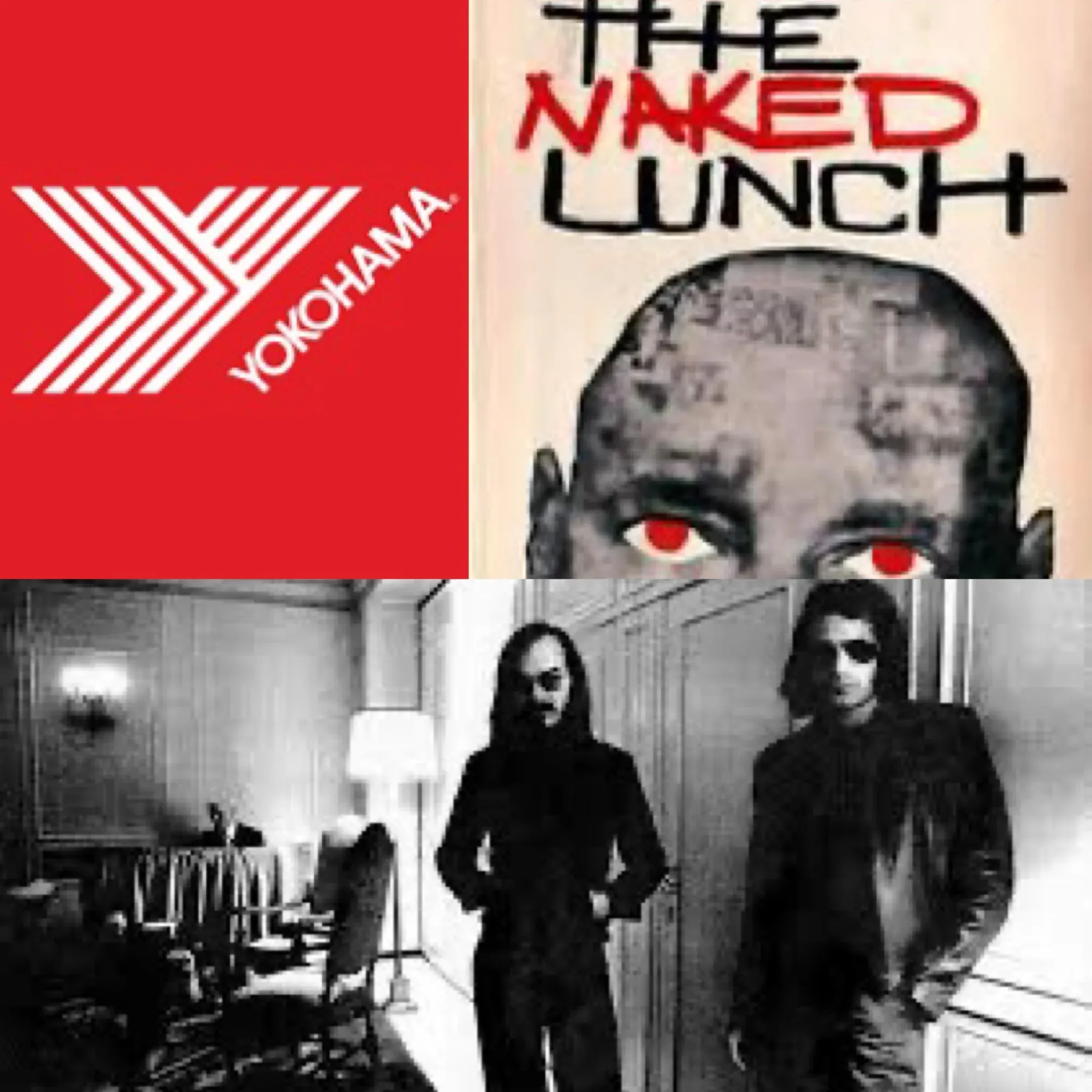
There is a species of complaint already forming about the adaptation, and it will be about fidelity. The book is the original, the show is a derivative, and the derivative will be judged by its distance from the source. I have made this argument before about the Odyssey and I will not rehearse the whole of it, but the shape of it applies here with some force, because Neuromancer is about as composite a text as the late twentieth century produced. Burroughs by way of the cut-up, Chandler and Hammett by way of the tone, Delany by way of the sentence, Japanese economic ascendancy by way of the anxiety, sprinkled with a little Steely Dan (and hey, there's a recursive Burroughs reference too!), and, underneath all of it, a man with no meaningful experience of computers describing a technology he had to imagine from the outside, which is exactly why he got the phenomenology right and the engineering wrong. The novel is a confluence. It is not an origin.
To treat the 1984 text as the authoritative body against which every later version is measured for deviation is to make, in a literary key, the identical mistake the naturalists made about cyberspace: to treat the thing as Körper. Weigh it, catalogue it, check the adaptation's organs against the autopsy report. But a text, like a self, persists as ipse and not as idem. It survives by being retold, and it is not diminished by having been retold, and there is no version of it that is the atoms.
The show will be good or it will be bad. That will turn on whether it understands that the matrix was never a place.
7. Who Holds the Pen
It remains to be seen whether Apple's adaptation will lean into this, or merely be "computer hacking cool, look at this sci-fi dystopia." I worry that our current oligarchic technocrats, the Tessier-Ashpools of lamented recent infamy, are drawing the wrong lessons from the classic sci-fi novel Do Not Create the Torment Nexus.
I did not set out to write a lament for the old web, and I want to resist ending in that register, because the nostalgic version of this argument is both false and politically useless. The early network was not a paradise. It was small, largely male, largely American, largely white, largely academic, and its freedoms were substantially the freedoms of a room where nobody has yet arrived who could be hurt. Much of what came afterward came for reasons, good reasons, and has made the space in 2026 more inclusive, open, and with greater diversity of narratives than 1999.
The point of insisting that identity is narratively constituted has never been that this is comfortable. It is that it is contestable. If the self were a natural kind, a fact of the atoms, then the only questions worth asking about identity would be forensic ones, and the appropriate posture toward the apparatus would be resignation: they have the record, the record is true, that is what you are. But if the self is constituted, told, taken up, and sustained in an intersubjective field, then every question about identity is at bottom a question about authorship. Who is telling it. On what evidence. To whom. With what power to compel the audience. And, most of all: who may revise it, and under what conditions, and how often.
The cypherpunks had the stakes right and the mechanism wrong. They understood that something important was under threat and they built cryptography to defend it, on the theory that the danger was surveillance: a fully-formed private self, existing prior to and independent of the network, at risk of being observed. But the self was never sitting there fully formed and waiting to be spied upon. It is made in the field of mutual recognition, which is exactly the field the platforms own. The deeper threat was never that they would read your story. It is that they would write it, and that the version they wrote would be the one that everyone else, including the institutions that decide things about you, would be reading.
And now, in 2026, we are conducting a substantial fraction of our intersubjective life in the company of entities that have no Körper at all: things constituted entirely in language, given to us wholly through expressive material, appresented and never perceived. I am not going to make a claim here about what is or is not going on inside them, and I would be suspicious of anyone who tells you the question is easy in either direction. My point is narrower and it is about us. We are now negotiating, daily, with a mode of being whose entire givenness is narrative, and we are doing it with a public philosophy that spent forty years insisting the only serious question about the digital was whether the pixels were real.
Case had two bodies, and he believed to the end that he had to choose between them: the meat that had betrayed him and the self he could only assemble at the deck. He was wrong, and the wrongness is the tragedy rather than the moral. He never had two. He had one lived body that could extend, that could be reduced, that could be taken from him and given back, and that was made, all the way down, of the story he and everyone around him kept telling about who Case was.
So are you. So am I. The only question that was ever worth arguing about is who gets to do the telling.