
Nobody's Odyssey: Against Political Readings of Nolan's Film
Nolan's critics and proponents miss the question of a political agenda in 2026's "The Odyssey" entirely. It has no political agenda; its agenda is literary.
Since I put my first thoughts on Nolan's Odyssey into the world, my inbox and mentions have filled with a single accusation wearing two costumes. From the loud side: the film is woke, a DEI Trojan horse, Homer defiled by the human resources office. From the quieter and more respectable side—I am thinking here of the classicist Joel Christensen, quoted in Variety insisting the film is "actually very conservative," its women constrained, its interracial casting a matter of women of color permitted only to marry white men—the film is reactionary in progressive drag. These two readings loathe each other. They cannot both be correct. And neither of them are. What strikes me, having now sat with the film, is that they are wrong in precisely the same way.
Both mistake a coherent aesthetic program for a political one, and then quarrel over which team the program is playing for. But the agenda in Nolan's Odyssey is not left or right. It is a sustained, almost systematic act of demythologizing, and once you see it you cannot unsee it, because it governs nearly every change he makes to the poem.
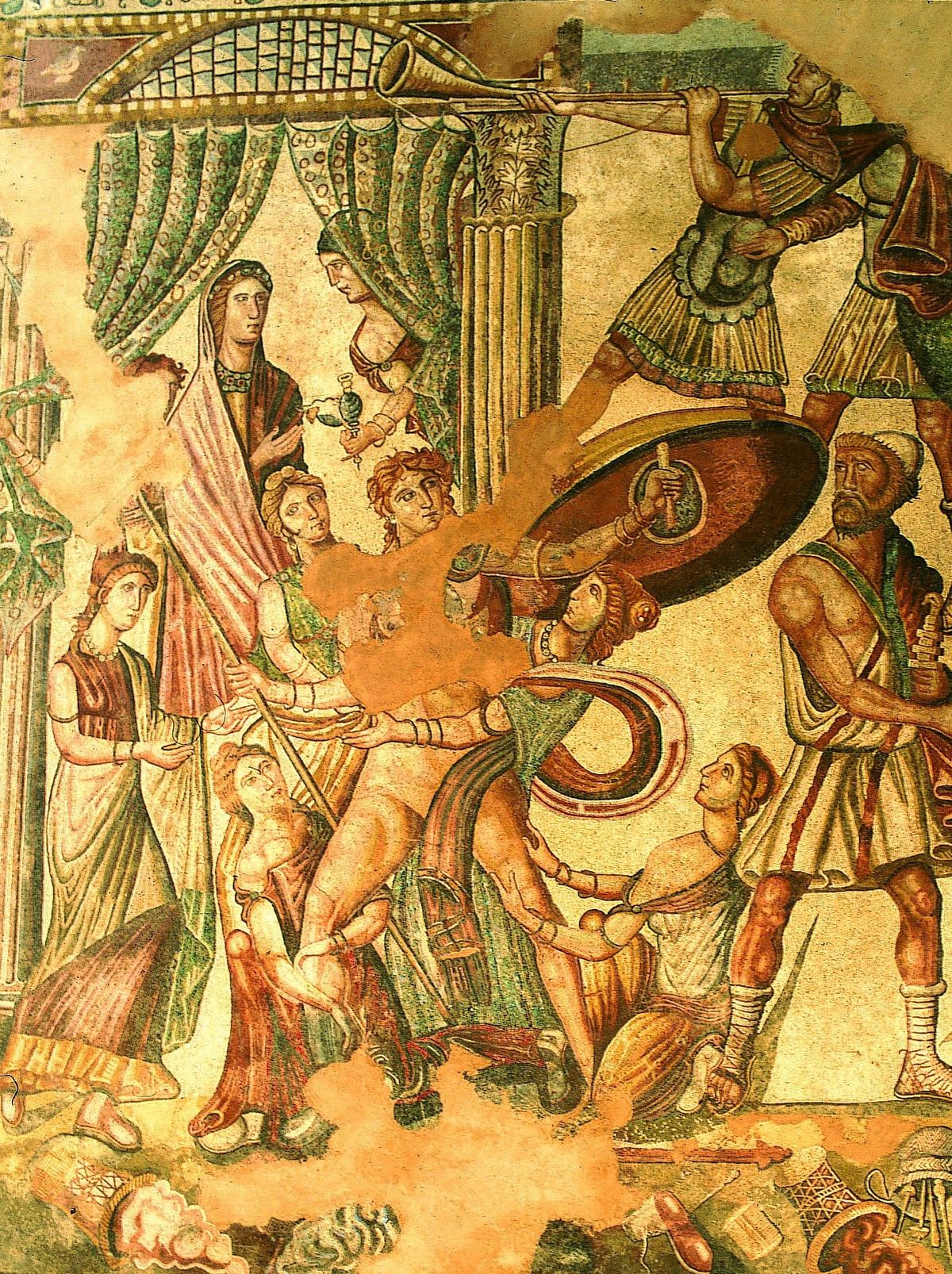
Watch where the gods go. In Homer, the machinery of the divine is the load-bearing structure of the plot: Athena descends, Poseidon curses, Hermes rescues, Zeus tips his scales. Nolan pulls that machinery out and replaces it, very nearly every time, with human motive. Athena (Zendaya) is demoted from a goddess in the rafters to an unseen intelligence, an architect of Odysseus's survival (and possibly a projection of his psyche) who reads more like his own cunning externalized than like Olympus intervening. Circe's sorcery is recontextualized as protest rather than caprice. Polyphemus loses the curse mechanism entirely. And (the cleanest example, the one I'd point any skeptic to first) the slaughter of the suitors is rebuilt from a divinely-sanctioned massacre into an act of self-defense. Rather than having Athena come and set blood feuds aright as a deus ex machina, Nolan contrives to give Odysseus and Telemachus an excuse for the violence.
That last change is the tell, and it is smarter than the "it's just neater" praise it's been getting. Homer needs a god at the end of Book 22 precisely because the killing of a hundred-odd suitors is vengeance, and vengeance incurs a blood-debt. The suitors' families are owed a feud; only Zeus's thunderbolt and Athena's imposed amnesty can cancel the ledger and stop the cycle. Nolan reframes the killing as defense of the home against men who struck first, and a justified killing incurs no debt. There is nothing for a god to descend and forgive, because there is nothing to forgive. He has essentially turned the climax into a defense-of-habitation case, and the legal logic of that is what lets him retire the deus ex machina without leaving a hole. No god required, because no debt outstanding. It is of a piece with everything else: the numinous drained out, the human motive left standing in its place.
That is an agenda. It is a naturalizing, anti-war humanism, and it is a defensible and interesting one. It is also completely orthogonal to the culture war being fought over the film's head. The right sees brown faces and cries woke; Christensen sees constrained women and cries conservative; both are projecting a partisan valence onto a picture whose actual project is neither. Nolan is not litigating our mid-2026 grievances. He is arguing with Homer about whether we still need the gods to explain ourselves to ourselves. You can dismiss the "political agenda" charge, in other words, not by denying that the film has an agenda but by correctly naming the one it has.
THE WOMEN, AND WHOSE FAULT THEIR EDGES ARE
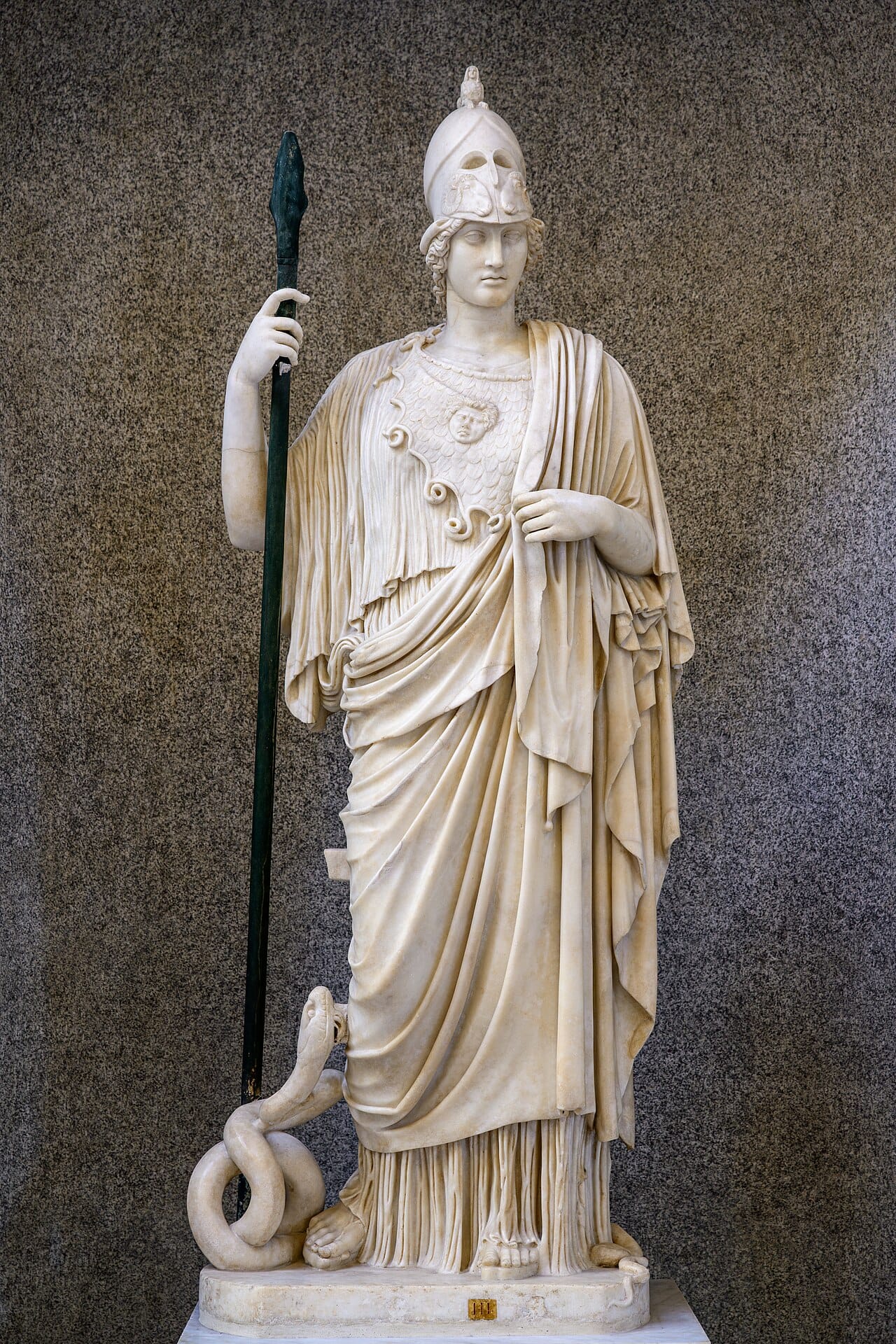
I initially thought, upon first reflection, that Nolan committed his usual sin of denying interiority to the women in his narratives. For example, I'd suggested there was little interiority on offer beyond Circe and Penelope, who get the most screen time of the women in the film. That was wrong, or at least badly imprecise, and the reviewers currently running the "Nolan has finally learned to write women" victory lap are closer to the truth than I was. Hathaway's Penelope is one of the strongest performances in the picture. Nyong'o, in double duty, is extraordinary, displaying both Helen's dismay at the violence done in her name and Clytemnestra's rage at the daughter taken from her to satisfy Agamemnon's lust for power. There is real interior life here.
But I also can't sign the victory lap, because it mistakes emotional depth for agency, and the distinction turns out to be the whole ballgame. Nolan's women feel deeply, and they almost always feel deeply about something a man has done. Helen apologizes for the blood spilled in her name. Clytemnestra avenges a daughter her husband slaughtered. Penelope holds the kingdom against the suitors. Circe's magic is reframed as a response to soldierly rape and pillage. The inner life is genuine; the self-direction is close to nil. That is interiority instrumentalized, pointed toward lamenting, legitimating, or reacting to male action, and toward the machinery of the male homecoming. It is not, whatever the enthusiasts say, a feminist use of it. Circe and Penelope feel like exceptions because each actually governs a domain of her own—the island, the household's stratagems—rather than merely responding to a man's.
Here is where I'd correct Christensen rather than agree with him. He says the roles are constrained, and where individual women feel flattened he isn't wrong to notice it. But he locates the constraint in the wrong place. The Odyssey is famously the one of the most generous ancient texts we have to female interiority—Penelope and Circe and Calypso and Nausicaa and Arete and Anticleia and Helen and Athena—and the entire Emily Wilson project rests on the claim that that interiority is already in the Greek, and that centuries of translators suppressed it. We cannot blame Homer for a poverty Homer does not have. Where Nolan's women feel constrained, the constraint is authorial, not inherited. It is his loyal-husband Odysseus, his sedating Calypso, his naturalizing lens that do the flattening, not any thinness in the poem.
Christensen charges that women of color in the film are given little more agency than to marry white men, but this is the same colorist reading that I chastised the racists for turned on its head, and it does the progressive cause no good merely to adopt the framing of its interlocutors. Skin color is not treated as a category in the film; no one remarks on Himesh Patel's skin color or the skin color of the bard who opens the movie. They simply exist within the film's world, with no more mark of their phenotypic characteristics than that Eumaeus is blonde or Penelope a brunette. And Christensen's point is defeated by the story itself; how much more agency do we need to give a woman of color than to avenge her slain daughter by thrusting a dagger into the throat of her husband, the most powerful man in the world?
Which turns Christensen's point inside out and hands it back as something more useful. Yes, the roles are constrained. But they are constrained by Nolan's coherent aesthetic program, not by an ideology and not by the source. Which is, once again, exactly the thesis: the film has an agenda; it simply isn't the one anyone is fighting about.
Take Penelope, and the moment I think every reviewer has walked past. She tells Telemachus, straight to his face and with that fuzz just arrived on his chin, that she cannot be Ithaca's queen in her own right—that the convention of the thing will hand a rule she has in fact been exercising to a boy on the strength of his beard—and then she tells him what she would do if the choice were hers: bar the doors of the hall with the suitors inside and burn it down. That is not a wistful complaint about custom. It is the massacre, named aloud, in her own voice, before Odysseus has strung anything. She is a competent sovereign stating her vengeance outright, and the reviewers who noticed only that she's capable have read the capability as loyalty, as her holding the throne for her husband. But the speech reframes it as thwarted sovereignty with a homicidal edge, and once you hear it that way the bow contest stops being merely Odysseus's opportunity and becomes the residue of Penelope's own design: her stratagem, her shaming of the men who presumed. Note what the film then does with the fire she named. It routes the actual killing through the men—a smaller, legally cleaner blaze than the one she described—and lets her keep the bow-shaming while the sanctioned violence transfers to male hands. This has real scholarly cover: Winkler's argument that Penelope's cunning mirrors her husband's, that the marriage's ideal in the poem is homophrosyne, two schemers evenly matched. If the vengeance is hers first, Nolan is dramatizing precisely that reading. And the irony undoes the sentimental take completely: the very speech that grants Penelope her interiority is an indictment of the waiting those reviewers are busy celebrating. Her depth is an argument against her own legend, and it is bloodier than they think.
Then there is Nyong'o. She brings a startling vulnerability to Helen—that scene where she tells Telemachus to carry an apology to Penelope for the violence done in her name is one of the film's quietest and best—and a genuine, earned rage to Clytemnestra with the drowned child behind her eyes. And notice how Nolan gives us that child. He never names Iphigenia; there is no Aulis, no oracle, no Artemis demanding a girl for a wind, no Orestes to act further deepening the tragedy. There is only an image: Agamemnon carrying a crying child toward the place of sacrifice while Clytemnestra's grief scores it from somewhere behind him. That un-naming is the demythologizing program again, working at the level of a single cut: the goddess and her bargain stripped out, leaving a father who killed a child and a mother who will remember. It makes Clytemnestra more human and less cultic, which is exactly the trade Nolan makes everywhere else. My only real complaint about those beats is that we never see Orestes struggle with the murder of his own mother; it's disposed of in a line from Menelaus to Telemachus, that he had to "avenge his father," and we move on. There could be a thematic resonance there if Telemachus had felt the need to try to avenge his father, but Menelaus does not know of Odysseus's captivity in the film.
So look at what that asymmetry exposes. Nolan tragedizes Clytemnestra, gives her the sympathetic, motive-driven fury that properly belongs to Aeschylus, not to Homer, for whom she is barely more than a cautionary foil to Penelope. And then he keeps the Homeric shrug for her son's matricide: no Furies, no reckoning, Orestes praised and waved through. Nolan went Aeschylean on the woman and Homeric on the man. Whatever that is, it is not the conservative instinct; siding with Clytemnestra over Agamemnon never has been. Which is one more reason the "reactionary" reading doesn't hold: the film's sympathies, where it has them, run the other way.
And this is exactly why crediting the women's interiority does not rescue Christensen. It corrects him. If Helen and Clytemnestra carry real inner life, then the flattening elsewhere isn't a policy of constraint; it's uneven authorship. But look, too, at the shape that inner life is allowed to take, because Clytemnestra and Penelope turn out to be the same figure drawn twice. Nolan gives each the full moral charge of a crime and then declines to let her spend it herself: Clytemnestra's motive is shown but unnamed, Penelope's vengeance is spoken but unspent, and in both cases the film discharges what the woman is owed into a man's hands: through Orestes, through Odysseus. That is my interiority-without-agency thesis at its cleanest, and these two scenes are its best evidence. The women hold the fire; the men are permitted to light it. Which brings us to the clearest casualty.
THE CALYPSO COLLAPSE
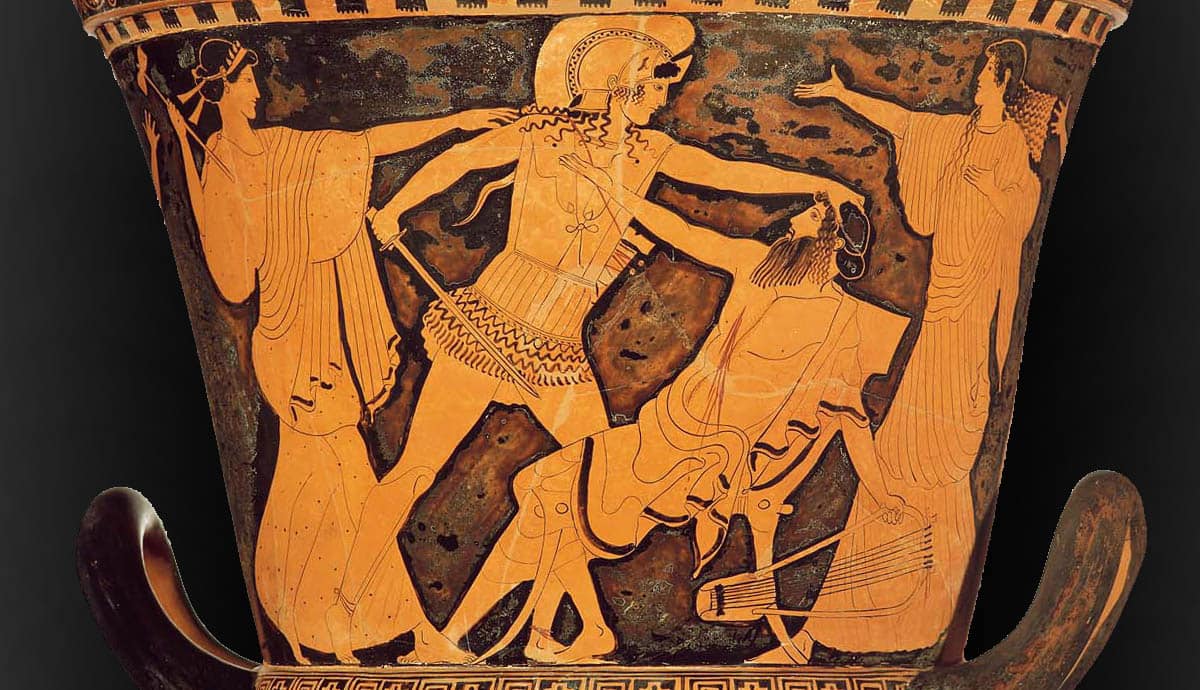
I was puzzled by the whole Ogygia sequence, and I've decided the puzzlement is the point. Nolan collapses Calypso into the Lotus-Eaters, so that her seven years become seven years of her feeding Odysseus lotus petals to blunt the agony of losing his crew (the crew destroyed in the storm after they kill and eat the cattle of Helios). On its face this is elegant compression. In practice it does two things, and the second is damning.
First, it de-eroticizes the episode entirely. Homer's Ogygia runs on a single unbearable tension: Odysseus lies with the goddess each night and weeps for home each day, unwilling beside the willing… a captive who is also, bodily, complicit. That antithesis is the whole moral texture of the passage, and it is the sharpest test the poem sets for its hero's longing. Nolan swaps the sex for sedation, which is of course consistent with his fully domesticated, loyal-husband Odysseus. Fine. But look what it costs Calypso. It strips her of the very interiority those Elle and ThePrint reviewers insist Theron was given. A goddess with desire becomes a nurse dispensing an anesthetic. The immortal who wants him is reduced to a plot function that keeps him offstage until the reunion is due.
This is my single best piece of evidence, and it proves the authorial-constraint point cleanly, because there is nothing in Homer forcing it. Homer hands Nolan a Calypso of enormous pathos and appetite. Nolan chooses the nurse. When even a sympathetic critic like Slate's Dana Stevens notices the hollowness (she wanted to know more about Calypso's memory of those seven years, and found Theron wasted in a role asking little more than that she look sensational) she reads it as a missed opportunity. I'd read it as structural: a woman beyond Circe and Penelope demonstrably reduced to a device, and reduced by Nolan, not by Homer.
NO ONE, OMITTED
While I'm cataloguing the compressions: I mentioned in my review that the Laestrygonians felt like a retread of Polyphemus, and I've worked out why, and it's the same wound twice. The two are already cousins in the poem—both cannibal-giant episodes—but Homer distinguishes them by function. Polyphemus is cunning and escape, and the naming that earns Poseidon's curse; the Laestrygonians are sheer, uncontestable slaughter, loss with no lever to pull. Nolan cuts the thing that made the first one not the second: the Outis gambit, Odysseus naming himself Nobody, the single most famous trick in the entire poem. Remove the metis and Polyphemus is just a big monster, the Laestrygonians are bigger monsters with plate armor and swords, and you have shot the same scene twice.
And it is close to self-sabotage, because—by the film's own ending, with its meditation on names and memory and who gets to tell the story—this is a movie that wants to be about identity. To cut the poem's foundational pun on naming and identity, the "I am no one" that is later reversed into the boast that brings down the curse, is to throw away the exact material the film's own themes are reaching for: Odysseus shedding his skin as the hero of the Trojan War and becoming, in the end, just the man who loves his wife and son. My two complaints here are really one: the redundancy is a symptom, and the excised gambit is the cause.
And for what? I keep asking myself. If the project is de-mythologizing, as I suspect given the film's tagline of "in an age of apparent magic," then the two episodes I mention (plus Circe) are the clearest that there is supernatural agency at work. We see Circe work actual magic, and there is little doubt Polyphemus is anything but a monster out of myth and legend. So why treat us to Odysseus's men marveling that Polyphemus can speak if not to have him engage in a battle of wits with the cleverest trickster? Why show us actual magic on Aeaea if the rest of the film is going to be about providing mundane explanations (even to the point of turning Calypso from a sorceress herself into a chemist)? If they had kept the Outis, removed the Laestrygonians, and given Calypso some real interiority, it would strengthen the film by showing there is some supernatural agency, but only at the outer edges of the world.
SAIL BEYOND THE SUNSET
The self-defense reframing I praised above does one more thing: it clears the ground for the film's real ending. With no blood-debt to settle and no god descending to settle it, Odysseus is free to do something Homer never lets him do, which is to abdicate in favor of Telemachus and sail off with Penelope, at her urging, rather than repeat Agamemnon's ruinous appetite for conquest.
This is not Homeric. It is pure Tennyson. "Ulysses" ends on exactly this structure:
This is my son, mine own Telemachus, / To whom I leave the sceptre and the isle — and the old king shoves off to sail beyond the sunset.
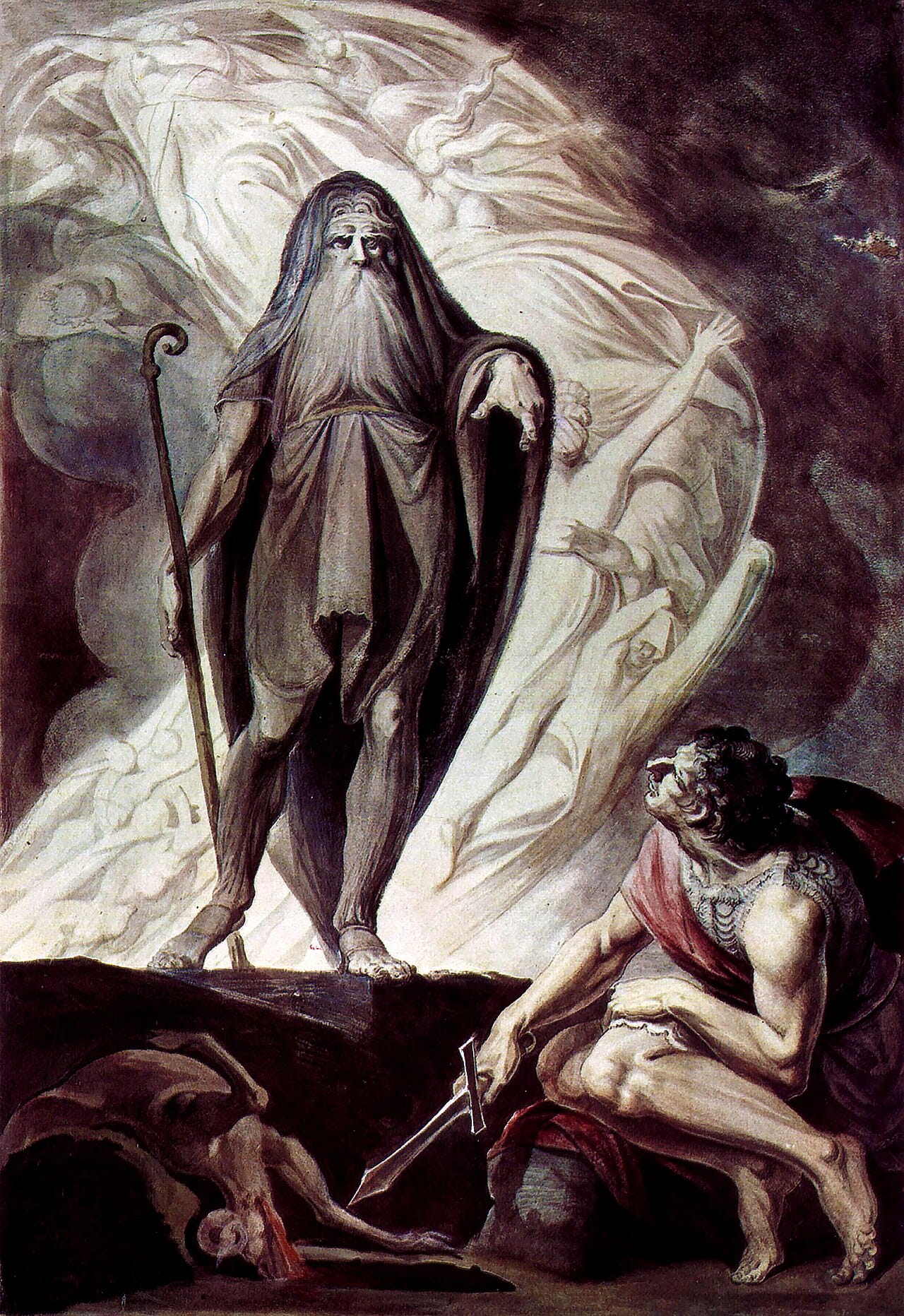
Behind Tennyson stands Dante's Ulysses in Inferno XXVI, the restless voyager who abandons Ithaca for the open water and forbidden knowledge; and behind both stands the prophecy of Tiresias in Book 11, the further journey inland with the oar. Nolan is quoting the Romantic afterlife of the poem, not the poem itself.
But here is the detail that ties the borrowing back to everything else he's doing. Tennyson's Ulysses and Dante's both leave the wife behind: she is the aged spouse barely worth a line, the domestic tether the hero transcends. Nolan brings Penelope along, and makes the voyage her idea. Even his most Romantic gesture gets filtered through the loyal-husband lens and handed to Penelope as agency. It is the domesticated Tennyson: the wanderer's escape rewritten as a marriage's shared choice. Say what you will about the change, but it is not a conservative one, and it is not an incoherent one. It is the same program—the human motive, the equal partnership, the god sent home—carried all the way to the shoreline.
BAD CLINE, GOOD HESIOD
I have to take my two hats off one at a time here, because the film's largest swing is one where the (rank amateur) scholar in me and the (rank amateur) critic in me disagree, and pretending otherwise would be dishonest.
Nolan hangs the whole thing on a frame in which the Trojan War, and Odysseus's raiding wake behind it, sets off the catastrophe that ends the Bronze Age: the trade-route collapse, the fall of the palace world, the long dark that follows. As history, this is bad Cline. The mono-causal "the great war ended the age" is exactly the model that systems-collapse scholarship has spent decades dismantling in favor of a compounding tangle of drought, earthquake, internal revolt, and the disruption of exchange. If you want the archaeology, the film is wanting.
But as myth, it is good Hesiod. The Greeks mythologized their own transition precisely this way: Hesiod ends the Age of Heroes with the wars at Thebes and at Troy. Nolan is being faithful not to the excavation report but to the way the culture that produced the poem understood its own vanishing. And an adaptation of a myth owes its fidelity to the mythic frame, not to the stratigraphy. By that standard the collapse conceit is legitimate, a feature where it mythologizes, and a bug only where it archaeologizes.
The one place it genuinely overreaches—and here the scholar wins—is the specific equation of Odysseus's crew with the Sea Peoples. That is not Hesiod. That imports a live and contested archaeological hypothesis into the mythic frame, and in doing so it invites the empirical scrutiny that the Hesiodic framing was safe from. The film is on firm ground when it is Hesiodic and on sand when it turns Egyptological. That is the clean line, and I'll hold it as dearly as Priam held Troy's walls until the coming of Odysseus and his cunning.
Yet even as history it does its dramatic work, which is why I can't simply dismiss it. Recasting Odysseus and his men as the raiders-who-cannot-go-home universalizes his guilt; it makes the violence trailing every "hero" into a force with civilizational consequences; and it retroactively darkens the sack of Troy from triumph into apocalypse. It externalizes Circe's complaint: even heroes, even "good men," by Odysseus's standards, turn to raping and pillaging when things get tough. Even when Odysseus tells them it will be their death to eat Helios's cattle, they do so. And even when Himesh Patel's Eurylochus gives Odysseus the reason (that he'd rather die in a storm at sea than starving on a beach in full view of fat cattle), the act is one of demythologizing. Does Tiresias's nekyia-born prophecy come true because it is the will of the gods, or is it self-fulfilling because Eurylochus and Odysseus believe it? Eat your heart out, Plato. That is the anti-war reading doing its job, and it is the thematic keystone the whole demythologizing arch has been building toward. Wanting as history. Load-bearing as theme.
So: does the film advance a coherent political agenda? No. Or rather, everyone who says so has mistaken the coherence for the politics. There is a program here, ruthless and mostly consistent, and it is aesthetic and theological before it is anything the culture warriors would recognize. Nolan sends the gods home, hands their functions to human beings, and asks whether we can still bear the weight of our own stories without them. He turns a myth about the passing of an age of heroes into a mythologizing of an actual archaeological/historical era by making a modern myth about it. That the loudest voices on both flanks read this as a referendum on [current year] politics tells you a great deal about them and almost nothing about the movie, the actors, or Nolan as a filmmaker. And in that regard, the ink spilled on the page about it has failed in its duty to you, the viewer, to educate and illuminate.
Which, I suppose, is only the oral tradition doing what it always does. Every generation makes its own Odyssey, and then argues that everyone else's is corrupt. I am doing it right now. So are they. The difference is worth naming: I think the film is arguing with "Homer." The culture warriors think the film is arguing with them.