
God in the Distance (The Braided River, Part 6)
The God of Israel was not there at the start. He was made, late, out of older and stranger gods: a storm-god of the southern deserts welded to El, the high god of Canaan, and inheriting his council, his bull, and his wife.
1. Everyone assumes they know about God.
Ask almost anyone raised within reach of the Christian West, believer or not, what kind of god the Bible has, and you will get the same answer in two registers. He is one. He is eternal, without beginning, the same yesterday and today and forever. He is the God of Abraham and of Moses and of Isaiah and of Jesus, one continuous singular deity running the length of the book, who simply and necessarily is. The believer affirms him and the atheist denies him, but they are denying and affirming the same thing: the One, the singular eternal ground, present from the first verse and presupposed by the last. The argument between them is about whether he exists. It is not about what he is, because on what he is they already agree.
Though they agree, they are both wrong in the way this series has now (hopefully) taught you to expect. The One was not there at the start. He was made, late, out of older and stranger materials, by a long process that the finished tradition then read backwards into its own beginnings so thoroughly that the seams became invisible. Every previous installment has shown some new (or otherwise "foreign" to our present ahistorical conception) sediment entering the river from upstream: the Watchers, the lake of fire, the Persian dualism, the Greek soul. This one turns to the riverbed. The claim here is the hardest of the series to feel, precisely because it touches the thing under everything else, and it is this: the source was a confluence too. There never was a single wellspring.
2. Not every utterance of a word for "god" denotes the same thing in extension.
Before we can watch Yahweh being assembled we have to put down something we are carrying, because if we carry it into the evidence we will not see the evidence at all. We have to put down the modern word god.
When a modern person, believer or not, reaches for the concept, what comes up is a very particular object, and it is a late one, not only because it involves the modern English word "god" but all of the important, largely-unconscious cultural and ideological baggage of what a "god" is. We presume, naively, that the ancient Egyptians, Chinese, Vedic, Semitic, and Indo-European civilizations all more or less had the same nebuluous "god" concept. That concept is immaterial, having no body and no location, present everywhere and nowhere. It is omnipotent, omniscient, omnipresent, impassible, simple, the ground of being and the answer to why there is something rather than nothing. It is related to by belief, a matter of inward propositional assent, and by faith, and it is the proper object of something called religion, a bounded domain of life distinct from politics and kinship and economics. Almost none of this would have been intelligible to an Iron Age West Semite, and the parts that would have been intelligible he would have found odd.1 The category religion itself, as a separable sphere, is not ancient; it is a construction of the early modern West, and projecting it back onto people who had no such category quietly rewrites them before we have read a word.2
A god, to the people who gave us this material, was a powerful person. He had a body, and could be more than one place because he could have more than one body, and the boundary of his selfhood was fluid in ways our metaphysics has no slot for.3 He was located: he lived on a mountain, in a temple, in a region, and he could be the same god in two places and yet, in cult and epithet, locally distinct, the way the one Virgin is venerated as a hundred local Madonnas. He ate; sacrifice was food, smoke the pleasing savour rising to a being who was hungry. He had kin, a wife, sons, a household and a court. He stood in a society of other such powers, ranked, related, quarrelling. And he was related to not by belief, a question that would have puzzled him, but by fidelity: by covenant, by treaty, by the patron-client bond, the same vocabulary a vassal used with a king. The question was never whether you believed in him. It was whose you were.
Attend, because the whole post turns on this. The familiar contest, monotheism against polytheism, one god against many, is itself a grid laid down late and from outside, and it is a slightly wrong question to put to this world. The deep change we are about to trace is not only a change in the number of gods. It is a change in the very essence, the kind of thing a god was. The tradition did not merely subtract gods until one was left. Under its feet, while it counted, the surviving god quietly became a different sort of being from the one it had started with, and the count and the transformation are not the same event, though the tradition remembers them as one.
3. The Canaanite milieu in the background.
Start where Israel started, which was not outside Canaan looking in but inside Canaan all along. The older picture, a people arriving from elsewhere and conquering a land of foreigners, does not survive contact with the archaeological record. The highland villages where Israel first becomes visible in the Iron Age are, in their pottery, their houses, their bones, continuous with the Canaanite lowlands; the material culture shows settlement and emergence, not invasion and replacement.4 Israel was a Canaanite people who came, eventually, to tell a story about not being one. To find the gods of its infancy we therefore look next door, and next door, for once, has left us its library.
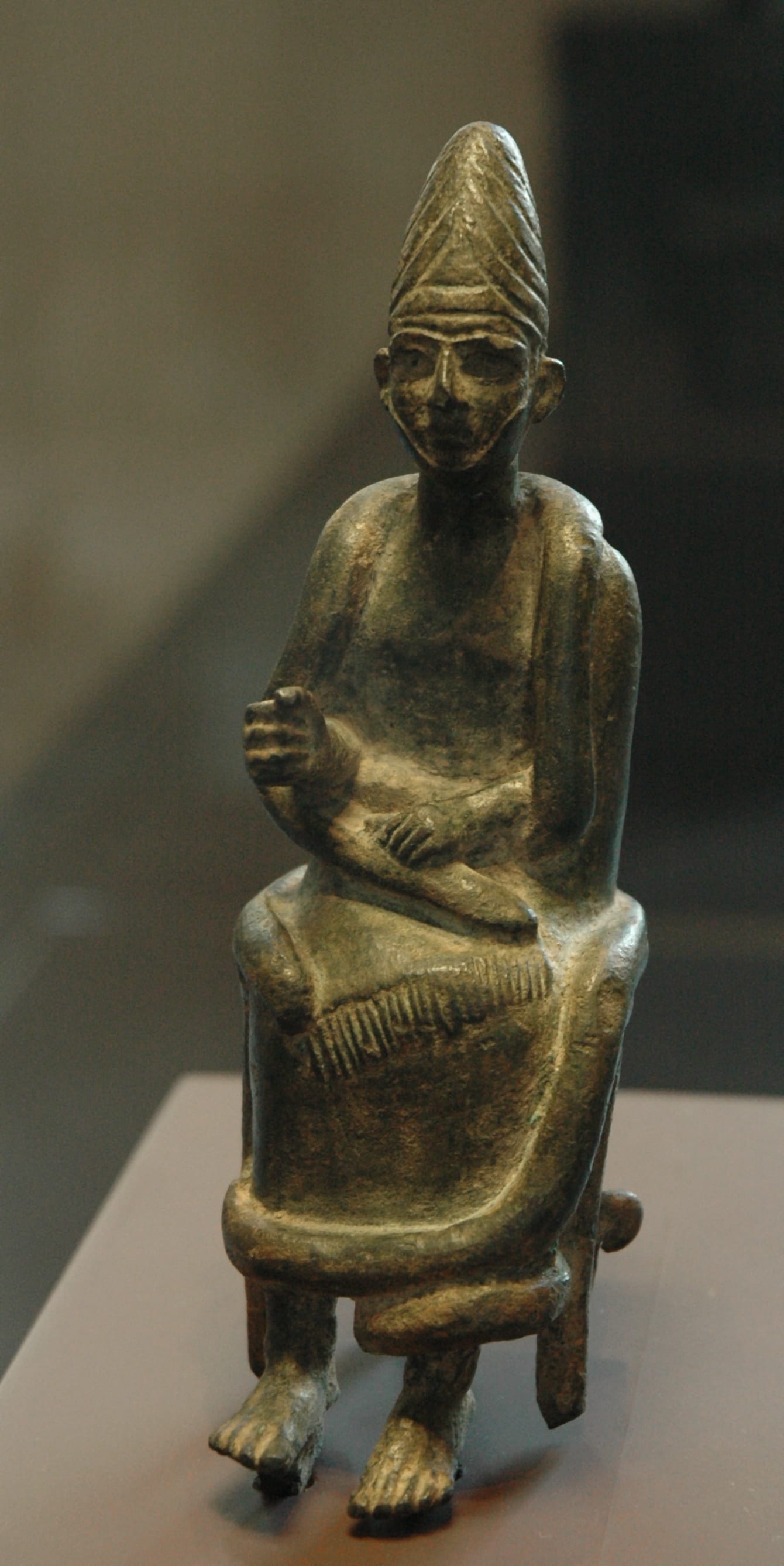
The tablets of Ugarit, the Late Bronze city on the Syrian coast, give us the West Semitic pantheon in its own words, written down a little before Israel emerges and describing the world Israel was born into. At the head stands ʾĒl: the aged one, grey-bearded, "father of the gods and of men," the kindly and compassionate, the bull, the wise, who dwells "at the source of the rivers, amid the springs of the two deeps."5 Beside him is his consort ʾAṯirat, Asherah, "creatress of the gods," mother of the divine family. Their household numbers some seventy sons. Among the active powers is Baʿal, the storm-god and warrior, who fights the Sea and Death and wins the kingship. And around El sits the puḫru, the assembly, the council of the gods over which the old father presides.
Now hear the Hebrew. The ordinary word for god in the Hebrew Bible is ʾēl; the plural-form word for God is ʾĕlōhîm; the high-god title is ʾĒl ʿElyon, God Most High. These are not Israelite coinages. They are the Canaanite high god's own name and style, taken up as the very vocabulary of divinity. And the patriarchs, when the book is candid, worship precisely ʾĒl, under his Ugaritic-sounding epithets: ʾĒl Shaddai, ʾĒl ʿElyon, ʾĒl ʿOlam, ʾĒl Roi, ʾĒl Bethel. Jacob raises an altar and names it, in so many words, ʾĒl ʾĕlōhê Yisrāʾēl, "El, the God of Israel" (Gen 33:20).6 The God of the fathers, by the names the fathers call him, is El the Canaanite high god. So far there is no Yahweh in the story at all.
4. The emergence of the two and later conflation.
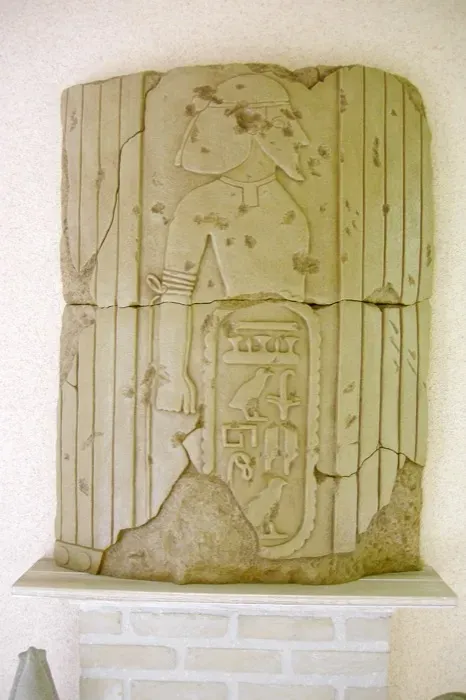
Where, then, does Yahweh come from? Not from the Canaanite heartland but from the deep south, the deserts below Judah: Edom, Seir, Teman, Paran, Midian. The oldest poetry in the Bible, older than the prose that frames it, still remembers him arriving from there like weather coming up over the hills. Yahweh marches out from Seir, and the earth shakes and the mountains quake (Judg 5:4-5). He comes from Sinai, dawns from Seir, shines forth from Mount Paran (Deut 33:2). God comes from Teman, the Holy One from Mount Paran (Hab 3:3). And from outside the Bible entirely, Egyptian topographical lists of the fourteenth and thirteenth centuries, carved at Soleb and Amarah-West, name among the nomad clans of exactly that southern region "the land of the Shasu of Yhw," the earliest trace of the divine name anywhere, attached not to Israel but to desert herders in Yahweh's home country.7 Yahweh begins as a southern god of storm and war, carried north, most likely, by some of the very groups who would become Israel.
So there were two gods: El the Canaanite high god of the highland settlers, and Yahweh the storm-god out of the southern deserts. And then, at the hinge of the whole tradition, the two became one. This is the central event of Israelite religion, and the remarkable thing is that the text preserves the seam rather than hiding it. The Priestly writer, joining the southern god to the patriarchs' god, simply states the join: "I am Yahweh. I appeared to Abraham, to Isaac, and to Jacob as ʾĒl Shaddai, but by my name Yahweh I was not known to them" (Exod 6:2-3).8 That is a theologian telling you, with admirable nerve, that the god of the fathers and the god of the name are being identified after the fact, and that the names do not originally match. Yahweh takes over El's identity entire: his fatherhood, his age, his wisdom, his compassion, his council, even his bull, so that the calf at Bethel and the calves of Jeroboam are not a foreign apostasy but the old El iconography surviving under the new name, and the fight in Exodus 32 is a fight over whose image Yahweh may wear. The name ʾēl becomes simply Yahweh's word for "god." The merger is so complete that within a few centuries no one can see it.
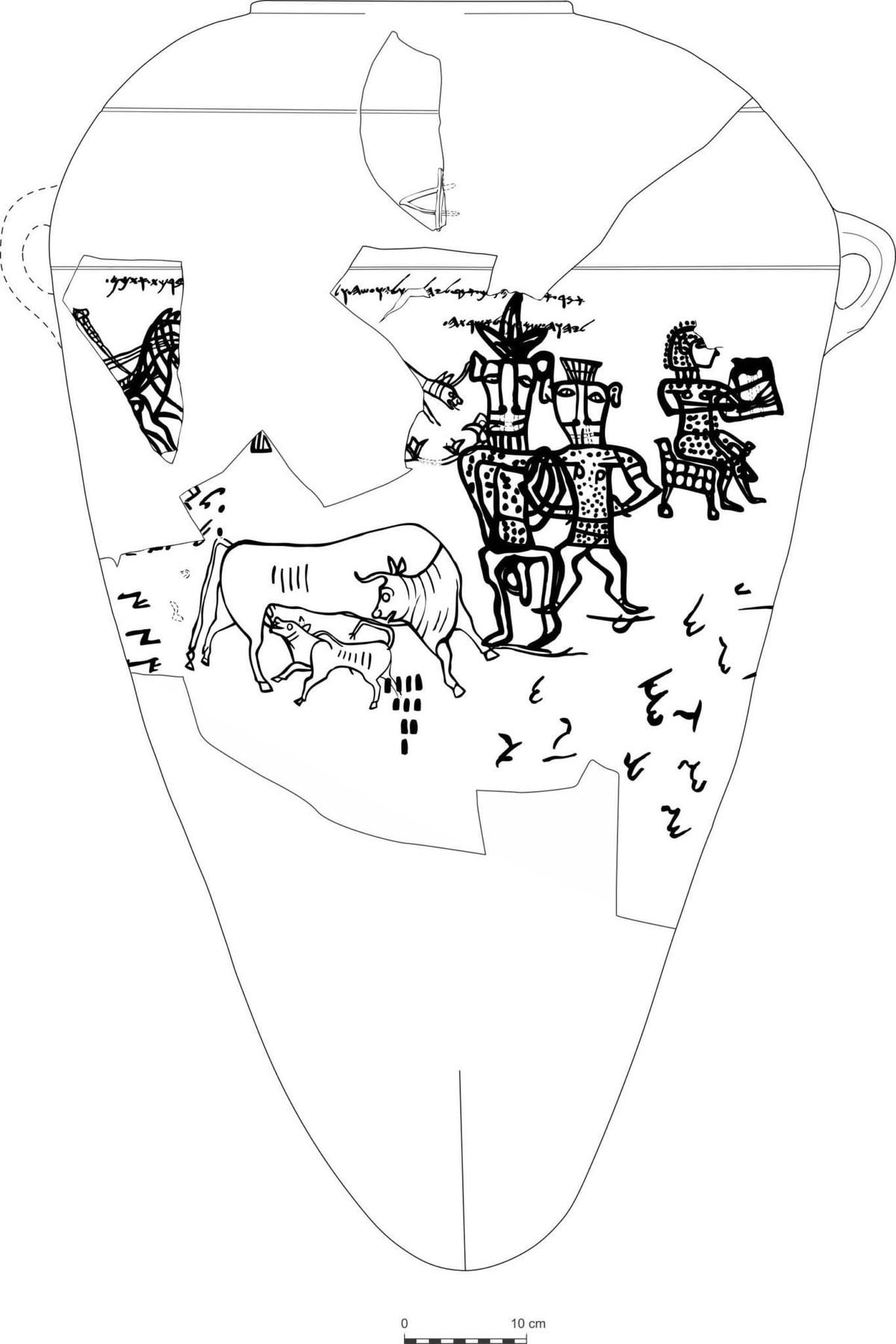
Except that, for a while, the join still shows in one telling place: Yahweh, like El, has a wife. The inscriptions from Kuntillet ʿAjrud in the Sinai, around 800, bless their recipients "by Yahweh of Samaria and his Asherah" and "by Yahweh of Teman and his Asherah."9 Read what is actually there. There is more than one Yahweh, a Yahweh of Samaria and a Yahweh of Teman, local manifestations of the one god exactly as the Bronze Age manner would lead us to expect. And the consort has come across with everything else. Asherah was El's wife at Ugarit; she is Yahweh's wife in eighth-century Israel, inherited along with the council and the bull and the name. The God of Israel, at the source, was married.
5. The council of the gods
Even after El and Yahweh have fused, Yahweh is for a long time not the only god there is. He is Israel's god, the greatest of the gods, the one to whom Israel owes exclusive fidelity, but the others are real and present, ranked beneath him. This is monolatry, the worship of one god among many, and it is not a defective monotheism or a stage Israel was ashamed of. It is the plain content of the oldest texts, and a few of them survived the later editing as fossils, the join still visible in the rock.
Take the most extraordinary of them, the Song of Moses. "When ʿElyon, the Most High, gave the nations their inheritance, when he divided humankind, he fixed the boundaries of the peoples according to the number of the bənê ʾĕlōhîm, the sons of God; for Yahweh's portion is his people, Jacob his allotted share" (Deut 32:8-9). Read it without a thumb on the scale. The Most High parcels out the seventy nations of the world among the sons of God, one divine son to each people, and Yahweh receives Israel as his allotment. That is two tiers of divinity, ʿElyon above distributing and the divine sons below receiving, with Yahweh one of the sons given a nation to hold; and it maps with eerie precision onto El's seventy sons at Ugarit and the seventy nations of Genesis 10. The Masoretic Hebrew "improved" the embarrassing line to read "sons of Israel," but the Dead Sea Scroll of Deuteronomy and the Greek translation both preserve the older "sons of God," and the logic of the passage needs them.10
Or take Psalm 82, which stages the scene directly. "God takes his stand in the divine council; in the midst of the gods he holds judgement." The KJV renders this as "[the congregation of the mighty]https://www.biblegateway.com/passage/?search=psalm 82&version=KJV." The New English translation is more direct, using the phrase "assembly of El."
Yahweh rises in the assembly of the gods and arraigns them, the other ʾĕlōhîm, for ruling the nations unjustly, and sentences them: "you are gods, sons of the Most High, all of you; nevertheless you shall die like men, and fall like any prince." A courtroom full of gods, found guilty and condemned to mortality. The psalm is not denying that the other gods exist; it is killing them off, which is a different and more interesting thing, and it shows the council still fully populated at the moment the demotion begins.11 The same assembly stands behind Psalm 29's summons to the bənê ʾēlîm to ascribe glory, behind the sons of God who present themselves in Job, behind the "let us make" of Genesis. The council is everywhere in the older strata. Yahweh began his career as its most powerful member, not its only one.
6. The wife in the attic
Return to Asherah, because her fate is the clearest single case of the whole process, the demotion happening where we can watch it. She is El's consort at Ugarit and Yahweh's at Kuntillet ʿAjrud; she turns up again at Khirbet el-Qom, near Hebron, where an eighth-century tomb inscription has a man blessed "by Yahweh and by his Asherah."12 Her cult object, the ʾăšērâ, a stylised tree or wooden pole, stood inside the Jerusalem temple itself for most of that temple's working life. The books of Kings, which loathe her, are forced to record her presence in the act of removing her: Manasseh sets up a carved Asherah in the house of Yahweh (2 Kgs 21:7), and Josiah, two generations later, brings the Asherah out of the temple, burns it in the Kidron valley, beats it to dust (2 Kgs 23:6). You do not carry out of the temple a thing that was never in it.
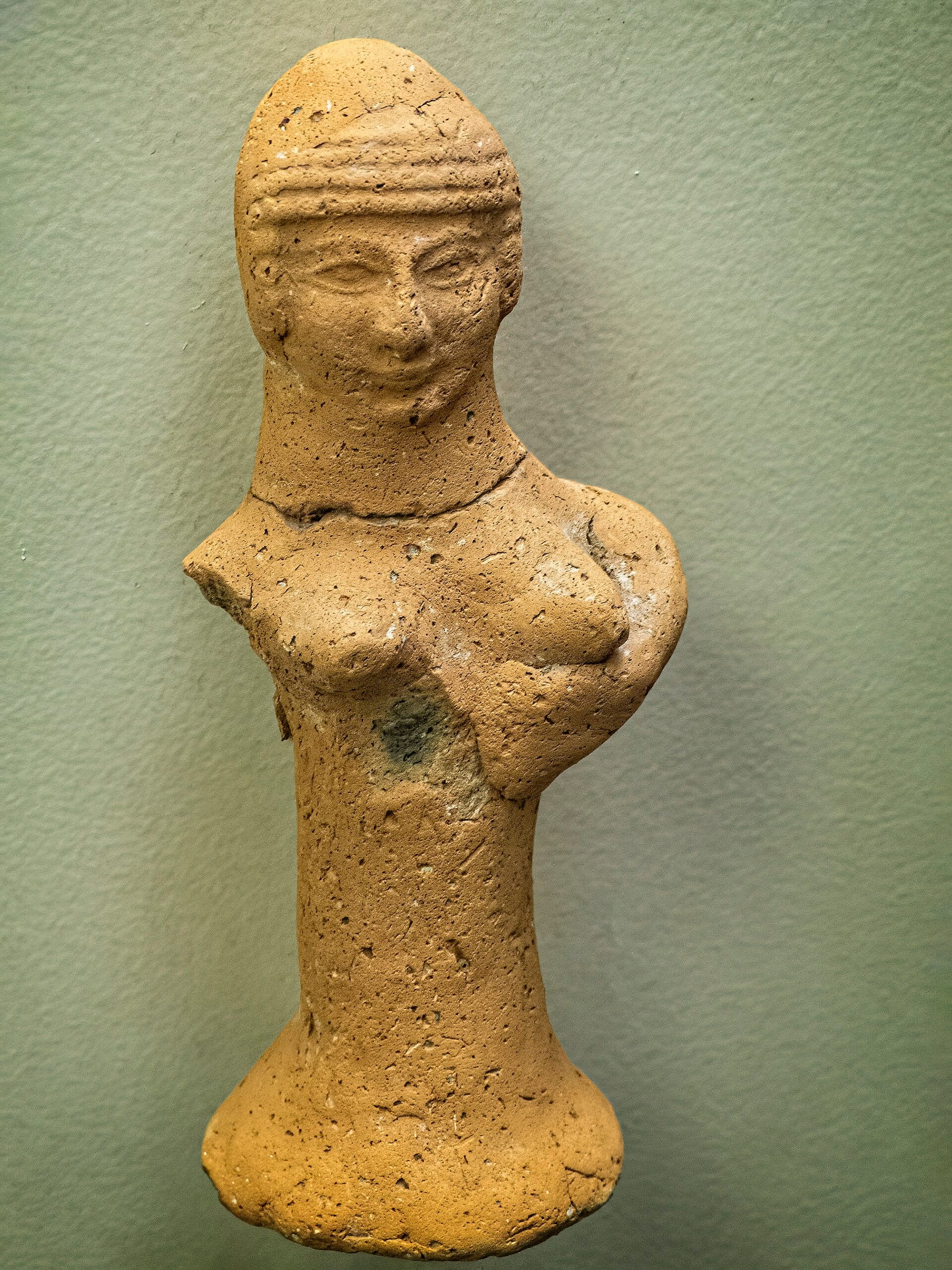
And below the official cult, in the houses, she persisted longer still. The Judean pillar figurines, the small clay images of a woman supporting her breasts, turn up in their hundreds in ordinary domestic settings right through the monarchy, the household piety of people who went on wanting a goddess in the home whatever the reformers in the capital decreed.13 The point to hold is the direction of travel. The goddess is not a late foreign infection that pure Yahwism contracted and then cured. She is there at the source, the high god's wife inherited by the storm-god along with his throne and his title, and the purging of her is the late and effortful event, not her presence. The Bible keeps her mostly as a thing being torn down, and the tearing-down is the evidence that she had been standing.
7. The narrowing of monotheism
How does a people that worships one god among many come to insist there is only one? Not by argument and not by revelation falling out of a clear sky, but by a political and priestly programme, sustained over generations and then sealed by catastrophe. The Deuteronomistic movement of the seventh century is the engine: a reforming party with a vision of one god, in one temple, served one way, and a deep hostility to the older diffuse landscape of local shrines, sacred trees, standing stones, household gods, and the dead. Its monument is the reform of Josiah, around 622, when a conveniently discovered law-scroll authorises a purge: the high places defiled, the bāmôt and the masseboth thrown down, the Asherah burned, the vessels made for Baal and for the host of heaven dragged out, the cult of the dead and the diviners swept away, the worship of Yahweh concentrated in Jerusalem alone (2 Kgs 22-23).13
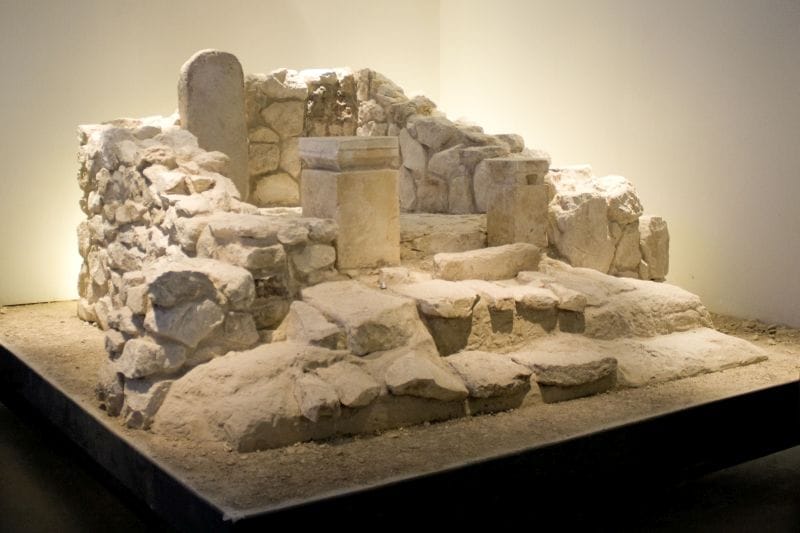
This is reform we can sometimes touch. At Tel Arad, in the Judahite south, archaeologists found a real temple of Yahweh, with an altar and a small holy of holies containing two standing stones and two incense altars; and at some point in roughly this horizon the sanctuary was carefully decommissioned, the altars laid down and buried rather than smashed, as though taken out of service by people who still half-revered them.14 The centralising reform in the dirt: one legitimate temple, and the rivals respectfully closed. But notice that the reform, for all its violence, is still working within monolatry. The commandment it serves says "you shall have no other gods before me," ʿal-pānāy, before my face, in my presence: a demand for exclusive loyalty that takes the existence of the other gods entirely for granted. It forbids serving them. It does not yet say they are not there.
8. There is no other
The last step, from "worship none but Yahweh" to "there is no god but Yahweh," is taken in the exile, and it is taken because the exile leaves no other move. In 587 the Babylonians take the city, burn the temple, end the monarchy, and carry the leadership off, and in the theology of the ancient Near East this can only mean one of two things. Either Marduk of Babylon has defeated Yahweh of Judah, the ordinary verdict when one nation's god goes down with its city, or else there is a stranger possibility: that Yahweh was not defeated at all, that he used Babylon as the rod of his own anger against his own people, and that he therefore commands Babylon too, and Persia after it, and every nation, because in the end there are no other gods to command. The second reading is the desperate and magnificent one, and it is the one the exilic prophet chooses.
The voice we call Second Isaiah makes the leap explicit and hammers it: "I am the first and I am the last, and besides me there is no god" (Isa 44:6); "I am Yahweh, and there is no other; besides me there is no god" (45:5); and, closing even the dualist escape, "I form light and create darkness, I make weal and create woe; I am Yahweh, who does all these things" (45:7).15 The council does not so much vanish as get reassigned. Some of its members become ʾĕlîlîm, nothings, mere wood and stupidity, the idols the prophet mocks; others are kept on the payroll at a steep demotion, no longer gods but messengers, malʾākîm, angels, a celestial civil service retained while the deity it once served is dissolved upward into the single sovereign will. The sons of God of Deuteronomy 32 and the gods of Psalm 82 do not get deleted. They get reclassified according to a more modern cosmological hierarchy, one that would not have made sense to the originators.16
One sidelong glance before we leave this, and only a glance, because the ground is Part 4's. Israel was not the only people in these centuries turning a god into the god. The Iranian reform attributed to Zarathustra pushed, on the usual reading, toward a sole uncreated lord, Ahura Mazda, the Wise One, raised above the lesser powers; and that impulse too was contested and partly undone afterwards, the Aməša Spənta drifting back toward something like the old gods, the later Zurvanite and Sasanian systems pulling back toward a balanced pair. The same shape in both peoples: a god made into the god, by reform, against resistance, and then read backwards as if it had always been so.17 And the timing should keep us honest. Israel's unambiguous "there is no other" is exilic and post-exilic, which is to say contemporaneous with the Persian encounter that Part 4 traced, voiced by a prophet who calls Cyrus the Persian Yahweh's māšîaḥ, his anointed (Isa 45:1). The logic of catastrophe is enough by itself to explain the leap; we need not make Israel borrow it. But a people resettled by a self-consciously Mazda-praising empire, naming that empire's king its messiah in the same breath that it proclaims the one god, was not making the move in a sealed room. We need not decide the dependence to see the lesson the parallel teaches: the monotheising was, here as in Iran, an event with a date, not the floor of the world.
9. The braided source
Stand back and look at what the riverbed actually is. A storm-god out of the southern deserts, welded to the aged high god of Canaan, and inheriting in the weld everything that god possessed: his council of seventy sons, his bull, his wisdom, his compassion, his very name as the word for divinity, and his wife. The council demoted across the exile into a corps of angels and a heap of idols. The wife carried out of the temple, burned in the valley, and surviving in the cupboards of ordinary houses as a palm-sized woman of fired clay. The whole made into the One only late, under the boot of an empire, by a prophet of genius improvising the most consequential theology in the history of the West out of the wreckage of a city; and then the lateness forgotten, the improvisation read backwards to Eden, until the made thing looked like the bedrock and the question of its making became literally unaskable. ʾĒl and Yahweh are Northwest Semitic to the marrow, and their fusion is internal to that single world; the composition of the God of Israel is a Canaanite story told in a Canaanite family. The source is a confluence, but of waters from one country.
And yet the God most readers of this series actually inherited is not quite even this God. The deity of the catechisms and the philosophers, immaterial, impassible, omnipresent, simple, the ground of being, "God the Father" enthroned in a heaven that is everywhere and nowhere at once, is not the embodied, located, hungry, married person of the Iron Age, and the distance between them is not an accident of emphasis. It is a second confluence, downstream of this one, where the Semitic covenant-god meets a wholly different river: the Indo-European bright sky that fathers, Dyḗus ph₂tḗr, who gives the Greeks their Zeus and the Romans their Iūpiter, and who, by way of the philosophers' divine and the Logos that the last instalment traced, lends the developing tradition its entire vocabulary for a god above the world rather than a person within it. (Keep one small irony for that day: in the Iranian limb of the same Indo-European family the holy cognate turned the other way, daiva souring into daēva, so that the very root which hands the West its deity and its divine hands Iran its word for demon, a thread Part 2 has already begun to pull.) That second weld, where the covenant-god of the Semites becomes the sky-father of the philosophers and the two great rivers of the Western inheritance finally run together, is a story large enough to need its own instalment, and it will have one.
For now it is enough to have walked up to the source and found it already braided. The river does not remember its springs. We are trying, slowly and against the grain of everything the tradition built to prevent it, to give it back the memory. And in doing so, hopefully, we can take what we believe divides us, what makes us distinct, and show that we all fish the same braided river, and if these currents that swept us all along to our modern confluence (which is not the mouth of this river) are what moves us, then perhaps our division, our strife, is contrary to the flow.
1. On "belief" as a modern category mutation, the shift from credo as pledged loyalty ("I set my heart") to belief as assent to a proposition, see Wilfred Cantwell Smith, Belief and History (1977) and Faith and Belief (1979). ↩
2. Brent Nongbri, Before Religion: A History of a Modern Concept (2013), on "religion" as a discrete sphere being an early-modern Western construction projected anachronistically onto antiquity. ↩
3. Benjamin D. Sommer, The Bodies of God and the World of Ancient Israel (2009), on the "fluidity" model of divine selfhood, gods with multiple, fragmentable bodies, and its persistence in the Hebrew Bible. ↩
4. On the indigenous, Canaanite emergence of early Israel from the Late Bronze–Iron I highlands rather than an external conquest, see Israel Finkelstein, The Archaeology of the Israelite Settlement (1988), and William G. Dever, Who Were the Early Israelites and Where Did They Come From? (2003). ↩
5. The Ugaritic portrait of El, "father of the gods," "bull," and dweller "at the source of the rivers, amid the springs of the two deeps," is drawn from the Baal Cycle (KTU 1.1–1.6); see Frank Moore Cross, Canaanite Myth and Hebrew Epic (1973), ch. 1, and Mark S. Smith, The Early History of God, 2nd ed. (2002). ↩
6. On the El epithets (Shaddai, ʿElyon, ʿOlam, Roi, Bethel) attaching to the patriarchal deity, and Gen 33:20, see Cross, Canaanite Myth and Hebrew Epic, 44–75. ↩
7. The Soleb and Amarah-West topographical lists naming tꜣ šꜣsw yhwꜣ, "the land of the Shasu of Yhw": see Thomas Römer, The Invention of God (2015), 36–51, with the southern "Midianite/Kenite" origin of Yahweh and the early poetic theophanies (Judg 5:4–5; Deut 33:2; Hab 3:3). ↩
8. Exod 6:2–3 as the Priestly writer's explicit suture of the Yahweh-name onto the El-Shaddai of the fathers; on the source-critical seam, see Römer, Invention of God, and the standard treatments of P. ↩
9. The Kuntillet ʿAjrud pithoi and the "Yahweh ... and his Asherah" blessings: editio princeps Ze'ev Meshel, Kuntillet ʿAjrud (Ḥorvat Teman) (2012). On whether ʾšrth denotes the goddess or her cult-symbol, see the discussion in Dever (n. 13). ↩
10. Deut 32:8: the reading bənê ʾĕlōhîm / "sons of God" is supported by 4QDeutj (bny ʾlhym) and the LXX (angelōn theou / huiōn theou) against the MT's bənê Yiśrāʾēl; see Eugene Ulrich in DJD XIV, and Jeffrey H. Tigay, Deuteronomy (JPS, 1996), excursus. ↩
11. On Psalm 82 as the divine council convened and the gods sentenced to mortality, see Mark S. Smith, The Origins of Biblical Monotheism (2001), and Smith, God in Translation (2008). ↩
12. The Khirbet el-Qom tomb inscription ("Blessed be Uriyahu by Yahweh ... and by his Asherah"): see Judith M. Hadley, The Cult of Asherah in Ancient Israel and Judah (2000). ↩
13. On Asherah as Yahweh's consort, the temple Asherah, and the Judean pillar figurines as her domestic survival, see William G. Dever, Did God Have a Wife? Archaeology and Folk Religion in Ancient Israel (2005). The reform of Josiah is narrated at 2 Kgs 22–23; on its Deuteronomistic programme of centralisation, see Römer, Invention of God, ch. 5. ↩
14. The Arad sanctuary, its two masseboth and two incense altars, and its apparent intentional decommissioning: see Yohanan Aharoni's excavation reports and Ze'ev Herzog, "The Fortress Mound at Tel Arad," Tel Aviv 29 (2002). ↩
15. On Deutero-Isaiah (Isa 40–55) as the locus of explicit, exclusive monotheism ("there is no other"), and its exilic setting, see Smith, Origins of Biblical Monotheism, 179–94. ↩
16. On the demotion of the council, members reclassified as malʾākîm (angels) or dismissed as ʾĕlîlîm (idols/nothings), see Michael S. Heiser, The Unseen Realm (2015), for the council framework, read critically alongside Smith, Origins. ↩
17. On Zarathustra's monotheising impulse and its later partial reversal (the Aməša Spənta, Zurvanism, Sasanian dualism), see Mary Boyce, Zoroastrians: Their Religious Beliefs and Practices (1979); and Part 4 of this series for the question of Persian influence on Jewish thought. ↩