
Sky Fathers and Bright Ones, or the gods that came with the horses (The Braided River, Part 7)
Part 7 of The Braided River follows the second river to its source: the Indo-European sky-father, reconstructed from the steppe, who gave half the family its very word for god, the same root that in Iran became the word for demon, and who reaches the West still wearing his crown.
1. God is in His Heaven
Say the words slowly. God the Father. Our Father, who art in heaven. The divine. The deity. The Most High. They are so worn with use that they have stopped meaning anything in particular; they have become the smooth river-stones of the inheritance, handled by every believer and, just as reflexively, by every unbeliever who rejects them. The atheist who says he does not believe in a sky-god, the comparative-religion undergraduate who notes that of course the ancients imagined their gods up in the heavens, the poet reaching for the divine to name something she will not call God: all three are speaking a vocabulary they did not invent and whose history they have not been told. They think they are talking about Jerusalem. Half of what comes out of their mouths walked west from somewhere else.
In the last post we followed one river to its source and found that the source was already a confluence. Yahweh, the God of Israel, turned out to be a composite: a storm-and-warrior deity merged with ʾĒl the Canaanite high god, seated for a long time in a divine council, partnered for a long time with a goddess, and only late, and only by deliberate reform, declared to be the one and only. The riverbed that everyone took for bedrock was itself laid down by water. That was the Semitic stream, and following it to the bottom was the work of an entire installment.
This post follows the other stream. Because God the Father in heaven is not a Semitic phrase all the way down. The Father part, the heaven part, the very words divine and deity with which we gild the whole construction: these did not come from the Canaanite hill country or the Babylonian exile. They came off the Eurasian steppe, out of the mouths of horse-herders five and a half thousand years ago, in a language no one has spoken for millennia and which we possess only as a reconstruction, a ghost assembled from its own scattered descendants. The West's God has a Semitic biography and an Indo-European grammar, and the grammar is older than the biography by a wide margin.
What follows is an attempt to walk that grammar back to its headwaters: to the sky-fathers and the bright ones, to the people who carried the words, to the strange inversion by which the very word for god became, in one branch of the family, the word for demon. It is, like everything in this series, an exercise in showing that an inheritance felt as bedrock is in fact sediment, and that knowing this is not a loss but a kind of freedom. There is one further turn of the screw here that the Semitic post did not require, and I want to flag it now so it does not ambush us later: when we reconstruct the Indo-European source, we are doing to those steppe herders something uncomfortably close to what the tradition did to Yahweh. We are manufacturing a clean origin. The honest version of this post has to keep confessing that, and it will.
2. What the words remember
Start with the words, because the words remember more than the believers do.
There is a Proto-Indo-European root that the comparative method reconstructs with about as much confidence as it reconstructs anything: *dyew-, meaning to shine, and by extension the bright sky, the daylit heaven, day itself. From this single luminous root the family threw off two formations that matter enormously for us.
The first is the bare divine adjective, *deywós, celestial, of the bright sky, and so a god: literally one of the shining ones, the bright ones. Watch where it goes. In Latin it becomes deus, god, and dīvus, divine, and it is still sitting inside diēs, day. In Sanskrit it is devá, god. In Old Irish, día. In Lithuanian, diẽvas. In Old Norse the plural tívar means simply the gods. And through Latin it arrives, unannounced, in every English sentence that reaches for deity, divine, deify, divinity. When a modern secularist gestures at the divine to mean a numinous something he is careful not to identify with the God of the Bible, he is using a word that meant belonging to the bright daytime sky before anyone had heard of the Bible at all.
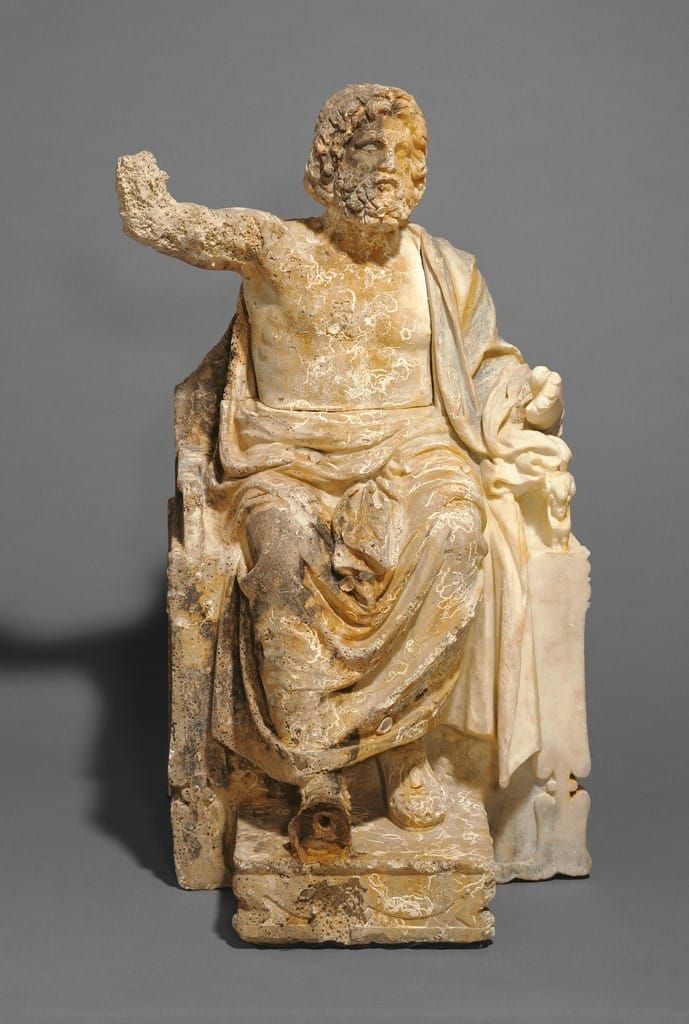
The second formation is the one the title of this post borrows. It is the personified Sky himself, given a title: *Dyḗus ph₂tḗr, Sky Father. Pronounce the reconstructed nominative roughly /ˈdjeːus/ and you can already hear the descendants leaning out of it. In the Rigveda he is Dyáuṣ Pitṛ́. In Greek he is Ζεὺς πατήρ, Zeùs patḗr, the vocative Ζεῦ πάτερ preserving the old address fossil-perfect, and the bare name Ζεύς, which we render Zeus, carries an oblique stem Δι‑ (genitive Διός) that is the *dyew- root showing through; the Greek adjective δῖος, dîos, godlike, is the same stone again. In Latin he is Iūpiter, which is Dyēu- plus pater with the centuries pressing the vowels together, and the archaic doublet Diēspiter shows the diē- still naked. In the Germanic branch the sky-god's name comes down as *Tīwaz, Old Norse Týr, Old English Tīw, and it is hiding, of all places, in your calendar: Tuesday is Old English Tīwesdæg, the day of Tīw, the interpretatio germanica of the Latin diēs Martis, the day of Mars.
Sit with that. Zeus, Jupiter, deity, divine, Tuesday, the Sanskrit deva, the Latin word for day: these are not similar words. They are the same word, refracted through six thousand years and a dozen daughter tongues. And the thing the word originally named was not a person on a throne. It was the lit sky. The bright open daytime heaven, personified, addressed as Father. The oldest god in this family is not a being who lives in the sky. He is the sky, the shining one, and the words for god, for divine, for heaven, and for day are at the root a single idea that we have spent millennia pulling apart and pretending were always separate.
There is already a small honest wrinkle worth keeping, because it will grow into a whole section later. Tuesday is the day of Tīw, and Tīw is etymologically the Sky Father, but the Germanic peoples who built that calendar did not treat him as a sky-father any longer. They had handed his old name to a one-handed god of war and the law-court, a figure who binds the wolf and loses the hand for it, and they mapped that god onto Mars/Ares, not Jupiter/Zeus. The sky-father had already been demoted before the word for him reached your week. The inheritance is real, and it is also never quite what it advertises. Hold the thought.
3. The people who carried it
A word does not reconstruct itself. Behind *Dyḗus ph₂tḗr stands a people, and behind the people a problem.
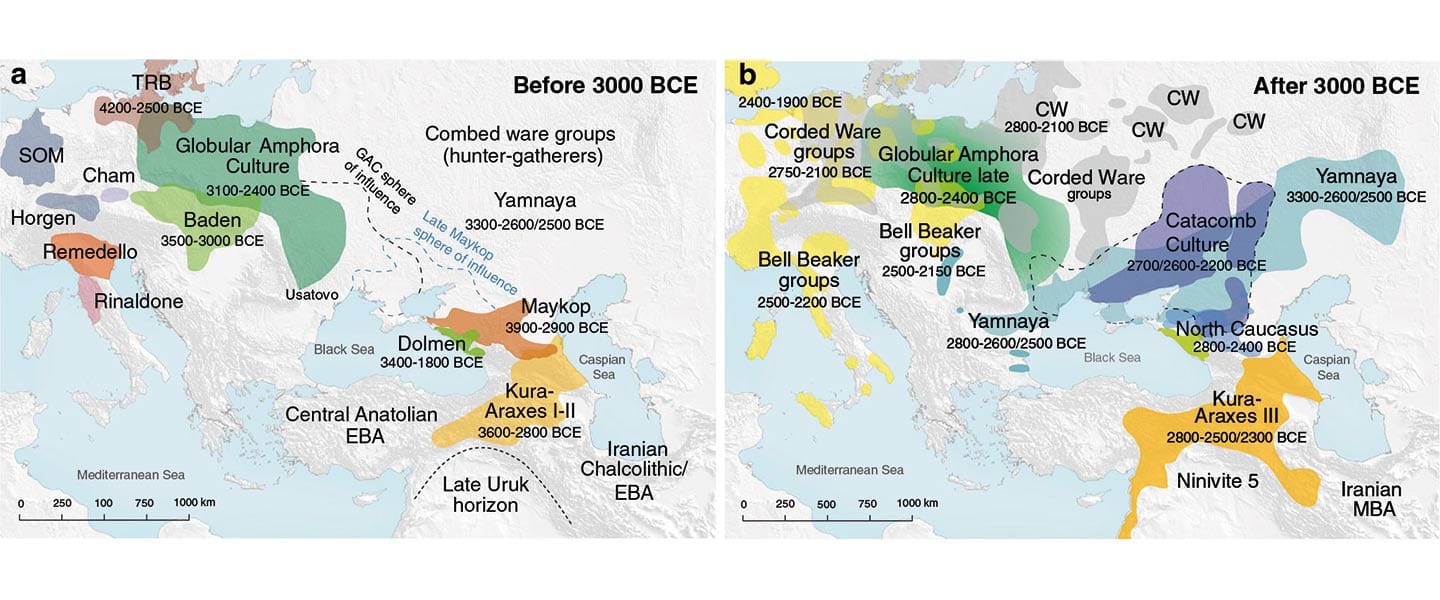
The people first. Proto-Indo-European was spoken, on the standard reckoning, somewhere between roughly 4500 and 2500 BCE, and the reigning candidate for where is the Pontic-Caspian steppe, the grasslands north of the Black and Caspian seas. This is the Steppe or Kurgan hypothesis, associated above all with Marija Gimbutas and given its fullest narrative treatment in David Anthony's The Horse, the Wheel, and Language, which ties the spread of the language family to the domestication of the horse, the invention of wheeled vehicles, and a mobile pastoral economy that could project itself across a continent.1 The archaeological face of these people is the Yamnaya horizon of the late fourth and early third millennia: pit-graves under mounds, ocher-stained dead, a culture of cattle and carts and, eventually, horses.
For most of the twentieth century this remained an argument among linguists and archaeologists, conducted on the soft evidence of pots and roots, and a serious rival held the field: Colin Renfrew's proposal that Indo-European spread not with steppe horsemen but with Neolithic farmers out of Anatolia, carried by the plow rather than the wheel. Then, beginning around 2015, the question was hit by a technology that did not care about anyone's prior commitments. Ancient DNA, recovered and sequenced at scale, let us watch population movements directly in the genome rather than inferring them from grave-goods. What it showed, broadly, was a massive influx of steppe-derived ancestry into Europe in the third millennium BCE, arriving with the Corded Ware horizon, and a related signal reaching South Asia somewhat later.2 The work of David Reich's laboratory and others turned a contested linguistic story into something with a population-genetic spine, and the steppe model emerged, in its broad shape, vindicated.
I want to be exact about the word broad, because this is precisely the kind of place where a writer eager for a clean story will overreach, and the whole method of this series forbids it. The genetic evidence vindicated a steppe dispersal into Europe and Asia. It did not settle every question, and one large question it actively complicated: the Anatolian branch, the Hittites and their relatives, the earliest attested Indo-European of all, sits awkwardly on the family tree and may descend from a stage before the steppe proper, which has pushed some scholars toward a two-stage model with a homeland further south or east and the classic steppe phase as a secondary center. That debate was live and unresolved as of this writing, and anyone who tells you the homeland question is closed is selling something.3
Now the problem, which is the more important half of this section. Everything I have just said about *Dyḗus ph₂tḗr rests on a discipline that reconstructs words and then, cautiously, infers things from the words. The technical name is linguistic paleontology, and its logic is simple: if every branch of the family, from Sanskrit to Celtic, carries the same word for wheel or yoke or sky father, and if the forms line up by the regular sound laws so that we can be confident the word is inherited rather than borrowed, then the thing or the concept was very probably present in the parent culture. The sky-father survives this test with room to spare. He is attested in the Indic, Greek, Italic, Germanic and other branches; the forms obey the sound correspondences; and in two widely separated branches, Vedic and Greek, he carries the identical poetic title, Father in the vocative, which is the kind of shared formula that does not happen by accident. *Dyḗus ph₂tḗr is about as secure as Indo-European reconstruction gets.
But security has a gradient, and it falls off fast. From secure cognate sets we move to reconstructed myths, and from myths to reconstructed social structures, and at each step the evidence thins and the reconstructor's imagination has more room to furnish the rooms it finds empty. The temptation is to assemble all of it into a single confident portrait of an original Indo-European religion, complete and coherent, a clean source from which everything later is mere deviation. Attend: that is exactly the move this series exists to resist. It is the same move the tradition made with Yahweh, projecting a pure origin backward and calling the actual messy history a fall away from it. We are now in danger of doing it to a people we know even less well, who left no texts at all, only their bones and the fossil impressions of their words inside ours. So the rule for the rest of this post is that the gradient of confidence stays visible. The sky-father is bedrock. Much of what surrounds him is sediment, valuable sediment, but sediment, and I will say so as we go.
4. The shape of the inheritance
With that warning bolted to the wall, let us walk through the house, room by room, and get the feel of the system, the way earlier posts got the feel of the Watchers or the Avesta. Treat each of these as more secure the more branches hold it and the more tightly the formulae match, and less secure the more it depends on a single clever reconstruction.
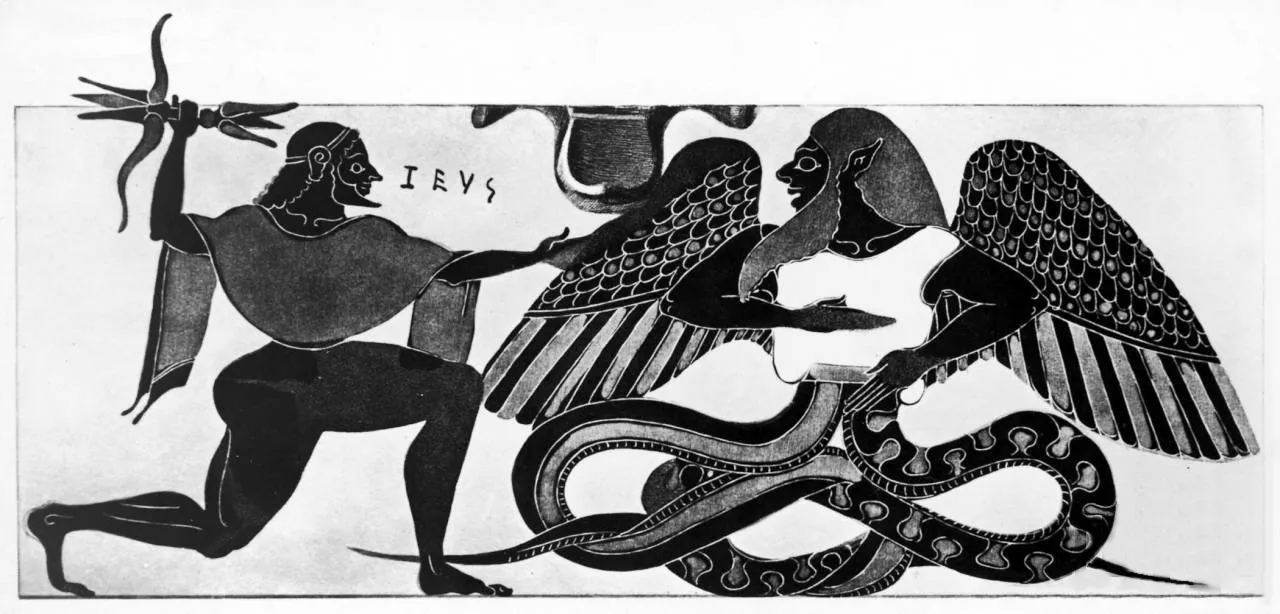
The Sky Father we have. Beside him stands a thunderer. The reconstructed name *Perkʷunos survives in the Baltic Perkūnas and the Slavic Perun and probably the Vedic Parjanya, and it may be bound up with the word for oak, *perkʷus, which is the tree lightning loves to find.4 More important than the name is the function, the storm-god who fights, because attached to him is one of the best-attested narrative inheritances in the whole family: the dragon-slaying. Calvert Watkins devoted an entire book to reconstructing the formula itself, the very verb-and-object pairing *gʷʰen- the serpent, to smite the serpent, recoverable across the branches as a poetic phrase, not merely a shared plot.5 And the plot is everywhere. Indra smites Vṛtra, the serpent who has penned up the waters, and the waters run free. Þórr fishes for the world-serpent Jǫrmungandr. Zeus blasts the hundred-headed Typhon. The Hittite storm-god Tarḫunna kills the dragon Illuyanka. Apollo slays the Python at Delphi. The hero kills the serpent and the cosmos is unblocked; it is the closest thing this family has to a single inherited story.
I flag one thing here that we will need much later and that complicates the neat picture in the most productive way. The dragon-fight is not only Indo-European. The Near East had its own version, older in the written record: in the Ugaritic texts Baal fights Yam, the Sea, and the Hebrew Bible keeps the fossils of Yahweh splitting Rahab and crushing the heads of Leviathan. And older still, in Babylon, Marduk split the sea-dragon Tiamat and built the world from her carcass, the Enūma Eliš giving the combat a cosmogonic turn the others only imply. So when the West's God is finally assembled, the serpent-slayer in him has multiple upstream sources, the Indo-European storm-god and the Semitic storm-god, pouring into the same channel. The motif we will meet again in Michael trampling the dragon and George spearing it is a confluence, not a single descent. File it.
Around the storm-god, the rest of the household. The Divine Twins, young, horse-associated, rescuers, sons of the Sky: the Vedic Aśvins, the Greek Dioskouroi Castor and Polydeuces, the Baltic Dievo sūneliai, the sons of god, and very possibly the legendary Hengist and Horsa, whose names mean stallion and horse. A Dawn goddess, *H₂éusōs, who comes down as the Vedic Uṣas, the Greek Eos, the Latin Aurora, the Lithuanian Aušrinė, and who in Vedic and Greek alike is called by the same epithet, Daughter of the Sky, Daughter of Dyḗus, another of those matching formulae that betray real inheritance rather than mere parallel. A Sun, *Seh₂ul, surviving as Helios and Sol and Sūrya and Sól. The household has a recognizable shape: a luminous sovereign sky, a fighting storm, twin horsemen, a dawn-daughter, a sun. It is, suggestively, a system organized by the sky and its weather, which is what you would expect a mobile people of the open grassland to have made of the world.
Then there is Dumézil, and here the gradient drops sharply and I am going to keep my promise to name the critics. Georges Dumézil spent a career arguing that Indo-European societies were governed by a single inherited ideology, l'idéologie tripartie, a tripartite scheme of three functions: sovereignty (itself split into a juridical and a magical-numinous half, the Mitra and Varuna of the Vedic pair), force or war (Indra, Mars, Þórr), and fertility or production (the Aśvins, the Roman Quirinus, the Norse Freyr). He read the Roman triad of Jupiter, Mars and Quirinus, the Indian ordering of the gods, the Norse triad, and a great deal else as reflexes of this one template.6
It is a beautiful theory, and a great deal of twentieth-century comparative mythology was built on it, and you should treat it with real caution. The classic methodological dismantling is John Brough's, who in 1959 performed the elegant cruelty of finding Dumézil's tripartite ideology, fully and convincingly present, in the Hebrew Bible, a literature belonging to a thoroughly non-Indo-European people.7 The point was not that the Israelites were secret Aryans. The point was that if you can find the pattern wherever you look, the pattern is telling you about the method and not about the Indo-Europeans; a key that opens every lock is not a key. Wouter Belier devoted a book-length structural critique to the whole edifice, and the broader objection has only hardened with time: the comparative data is so rich and so loosely constrained that a sufficiently determined three-fold reading can be imposed almost anywhere, which makes the trifunctional hypothesis very nearly unfalsifiable.8 And there is a shadow over the reception that an honest treatment should not hide, the long argument, pressed most pointedly by Carlo Ginzburg, over how far Dumézil's enthusiasm for a heroic warrior-sovereignty ideology kept company with the politics of the European 1930s.9 None of this proves Dumézil wrong about everything or anything. It does mean that trifunctionality belongs in this post as a contested hypothesis with serious critics, not as a recovered fact, and that is exactly the weight I am giving it.
5. The great inversion
Now the jewel, the place where the etymology stops being a curiosity and becomes the most compressed statement of this whole series I can muster.
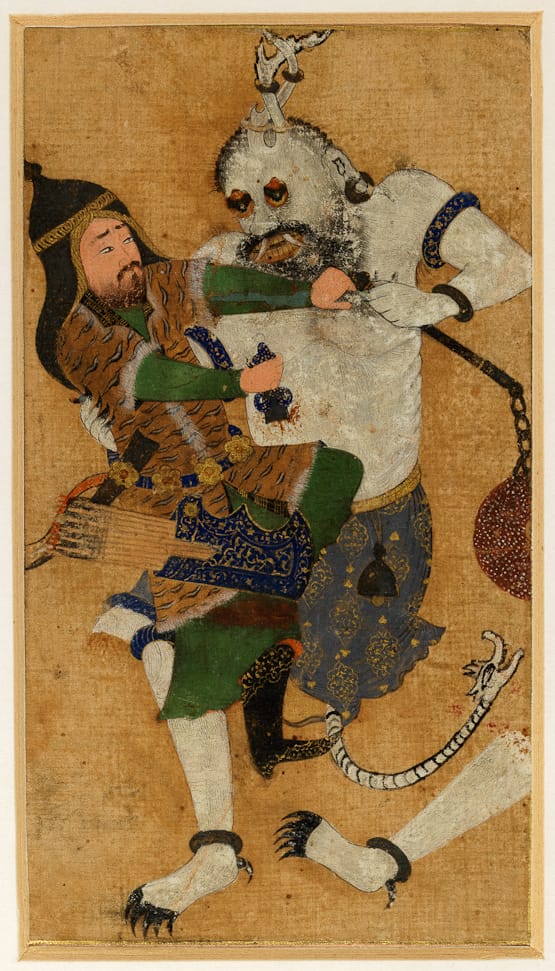
Recall *deywós, the bright one, the god, the word that gives Latin deus and Sanskrit devá. Follow it into the Iranian branch, into the language of the Avesta, and watch what happens to it. There it is daēva, and it does not mean god. It means demon. A false god, an evil spirit, one of the powers that Zoroaster's reform set its face against. From Avestan daēva the word descends through Middle Persian dēw into the New Persian div, the ogre and demon of later Iranian story. The single Indo-European root that hands the West its deity and its divine, that names the bright shining ones, hands Iran its word for the things you must renounce.
We met the engine of this in the Persian post: Zoroaster's reform, which gathered the supreme good under Ahura Mazda and pushed a whole class of the old inherited gods down into the dark. The daēvas are the demoted gods, the bright ones turned malign, and so the word for the worshipped becomes the word for the abjured. But the inversion is even tidier than that, because it runs in both directions at once, in a chiasmus so clean it looks designed. There is a second old word, asura in India and ahura in Iran, an Indo-Iranian title for a lord, a being of mastery and life-force; in the oldest Vedic it is an honorific, and Varuna himself is an asura. In later India that word too inverts, and asura becomes the name of the anti-gods, the demonic adversaries the devas fight. So set the two branches side by side:
In India, deva is god and asura slides toward demon. In Iran, daēva is demon and ahura rises to name the supreme God of all. The same two inherited words, sorted into opposite bins by two peoples who not long before had been one. What is holy in Tehran is hellish in the Punjab, and the words keep the score. Which is not to set these up as some sort of cosmological opposing narratives, fated to clash at the end of time. No, rather, it shows that the river and its flows sometimes double back on themselves in surprising ways.
This ties back to the second post, the one about where demons come from, and it tightens the screw on it. We traced the Christian demonic to the Watchers and the disembodied Nephilim, a Second Temple Jewish elaboration. But step back far enough and there is an older and stranger fact underneath all the genealogies: at the level of the deepest reconstructible vocabulary, the category god and the category demon are not opposites with separate origins. They are one word, *deywós, the bright one, faced in two directions by two daughter cultures. The being you worship and the being you exorcise can share an etymology. The divine and the demonic are not, at the root, enemies from different houses; they are siblings who were given the same name and sent to opposite ends of the moral universe.
The usual disciplinary caution applies, and I will not skip it for the sake of the rhetoric. The lexical pattern is solid; the words and their opposed meanings are not in doubt. What is genuinely contested is the story once told to explain it, the old reconstruction of a literal religious schism, an Iranian reformation that fought and demonized the daēva-worshippers in some datable historical convulsion. That dramatic narrative has been treated with growing skepticism, and the demotion may have been gradual, polemical and semantic rather than a war with a date.10 So take the chiasmus as real and the morality-play behind it as a hypothesis. The inversion happened. Exactly how and when is sediment, not bedrock.
6. The sky-father recedes
Here is the wrinkle that keeps us honest, and it is a strange one, because it cuts against the tidy story I have been telling and we are going to need it to cut, since it is what makes the next post possible.
*Dyḗus ph₂tḗr is the most securely reconstructed deity in the entire family. You would therefore expect to find him reigning, supreme and active, across the branches. He does not. In precisely the traditions that matter most for the deep background of Western religion, the Sky Father has faded by the time we can actually read the texts.
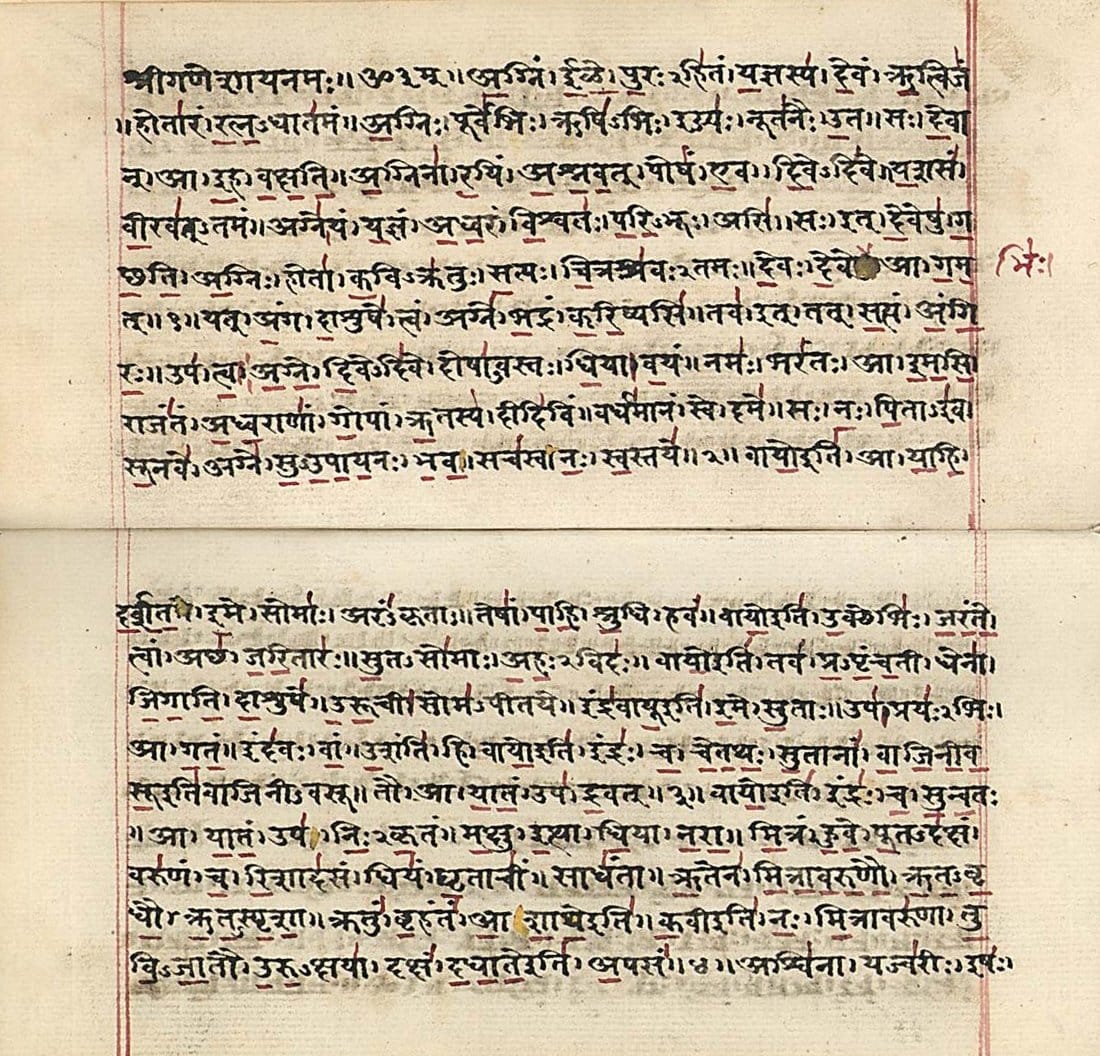
In the Rigveda, Dyáuṣ Pitṛ́ is a minor and largely formulaic presence, invoked in old phrases but not a great active god. The energy of the Vedic pantheon has gone elsewhere, to Indra the warrior, to Varuna and Mitra the sovereigns, to Agni the fire. The sky-father is a faded ancestor, honored and inert. In the Iranian branch the reflex of the old word, as we have just seen, did not fade so much as fall; it went demonic, and the supreme slot was taken by a new formation, Ahura Mazda, who is not the inherited sky-father at all. And in the Germanic world the bearer of his very name, Týr, has been demoted from sky-sovereign to a god of war and the law-court, eclipsed by Óðinn and Þórr, remembered chiefly for sacrificing his hand into the wolf's mouth.
There is one zone where the Sky Father did not fade, did not fall, and was not demoted. He stayed king. In the Greek world he is Zeus, father of gods and men, the reigning sovereign of the pantheon. In the Italic world he is Jupiter, Optimus Maximus, the chief god of the Roman state. The branches in which the inherited sky-father remained supreme are the Mediterranean ones, Greek and Latin, and that is not a trivial accident of mythology. It is the whole hinge of what comes next, because the Greek and Latin worlds are precisely the channel through which the West's religious inheritance actually ran. The fifth post in this series traced how the Greek matrix gave Christianity its immortal soul and its Logos. It is the same channel here. The Indo-European sky-father does not reach Christianity down the Indo-Iranian pipe, where his name became the word for demon and his figure faded to a formula. He reaches it down the Greco-Roman pipe, where he had stayed on the throne, still called Father, still seated in the bright heaven, ready and waiting to be abstracted by the philosophers into a pure and impersonal theos.
Why did the sky-father wither in the east and reign in the west? I do not know, and neither, with any confidence, does anyone else. The honest candidates are guesses: the rising prestige of the warrior and sovereignty functions in the Indo-Iranian world, contact with Near Eastern models of high kingship, the sheer contingency of which cults caught fire and which guttered. Mark it as an open question. What matters for us is not the cause but the consequence. Of all the branches, the one that kept the Indo-European sky-father vigorous and supreme is the one that flowed straight into the Mediterranean crucible where he was going to meet someone.
But we need not let this lack of an answer stymie us or our project. Remember, we are not here for concrete answers; we are here to trace the story of our identity through its historical context. The interest fact is in the mutations of the story, not the supposed "truth" of any particular narrative.
7. Two rivers, one confluence ahead
So here is where we have arrived. Two rivers, traced separately to two sources, neither of them the source the tradition advertises.
One rises in the Canaanite hill country and the Babylonian exile: Yahweh out of ʾĒl and the storm, the council and the suppressed goddess and the late hard reform, the composite Semitic god of the sixth post. The other rises on the Pontic-Caspian grassland in the fourth millennium BCE: *Dyḗus ph₂tḗr, the bright sky personified and addressed as Father, who gives half the family its very word for god and who reaches the Mediterranean, by way of Greece and Rome, still wearing his crown. The two rivers ran apart for three or four thousand years across two entire language families and never touched at the source.
They touch in the eastern Mediterranean, in the Hellenistic centuries, in the same crucible that the fifth post described. And the proof that they touched is sitting in the most familiar sentence in the Christian world, the one a billion people can recite without thinking, which is exactly why no one hears what is in it. Our Father, who art in heaven. The Father is a covenant father, the ʾāb of Israel, the abba of an Aramaic-speaking teacher; that is the Semitic river. But a Father seated in the bright heaven, named by the very word for the luminous sky, is *Dyḗus ph₂tḗr in a Galilean accent; that is the Indo-European river. The prayer is a weld. Every time it is said, two headwaters five and a half thousand years and two thousand miles apart are run together in a single breath by people who have been assured, and who sincerely believe, that the water has only ever had one spring.
How that weld was actually made, how the bright sky-father of the Greeks was philosophized into the abstract divinity of the schools, fused with the covenant god of Israel, and handed on to the creeds as the single Father Almighty, maker of heaven and earth, is the work of the next post. We have now traced both rivers to their separate heads. It remains to stand at the confluence and watch them braid.