
One Story in a Thousand Voices (The Braided River, Part 13)
The discipline, the whole discipline, is to stand. One story, a billion voices.

1. The Sealed Orders
Twelve installments ago, this series ended its first post with a phrase and a promise. The phrase was one story told in a billion voices. The promise was that by the time we arrived here, at the last bend, the phrase would mean something, and mean it honestly: not as the soft ecumenical slogan it resembles, the kind of thing printed on a banner outside a college chaplaincy, but as a claim that could survive everything the series was about to do to it. We have carried it since then like sealed orders, and I will confess that there were stretches of the journey, somewhere around the lake of fire, somewhere in the long dismantling of the God of the philosophers, when I wondered whether the orders would still be legible when we opened them.
They are. Open them with me.
The table was set at the end of the last installment, and I will not re-lay it, only name what sits on it. From Parts 9 and 10: a God who persuades rather than coerces and receives rather than ignores, the fellow-sufferer, in whose life nothing achieved is ever lost. From Part 11: a way of reading across difference that needs no view from nowhere and mourns the lack of one not at all. From Part 12: a theology of religions in which the channels are many without being sealed and connected without being one, and a God whose own life is the sky in which the rivers meet.
Twelve installments of argument. This one is not another. A landing is not a further maneuver; it is the moment the maneuvering stops and the ground receives you. So the register of this post will be warmer than what came before, the apparatus lighter, the voice closer. I have spent two years showing my work. Let me now, with the work shown, simply tell you what I think the phrase means, one word at a time. It has three load-bearing words, and each of them has been through the waters.
2. "One"
Start with the hardest word, because if the series has taught anything it is suspicion of this word. We have spent twelve installments watching the one devour the many, and we know its costumes by now.
We met the one as the buried root: the perennialist's conviction that beneath every tradition runs a single primordial wisdom, and that the differences are so much cultural weathering to be scraped away. Part 11 took that apart with Katz's help: there is no unweathered stone, no experience that arrives unshaped by the tradition that trained the experiencer. The root, dug up, turns out to be a projection of whoever is digging.
We met the one as the hidden channel: Hick's Real, the featureless absolute behind every mask, honored by being unreachable. Part 12 traced that channel upstream and found the God of the philosophers at its source, the actus purus in a new coat, and watched the pluralism built to save every tradition end by overruling every tradition.
And we met the one as the Omega: the point at the end of history where the braid is finally forced into a single channel, whether the enforcer wears Teilhard's cassock or Kojève's professorial gown or the bland smile of a futurist with a convergence chart. Parts 11 and 12 rejected that figure in every costume, and this installment will not be putting the costume back on.
So what is left? After the root is dug up, the channel drained, the Omega refused, what can "one" still honestly mean?
Look at the photograph that opened this series: the braidplain of a New Zealand river seen from the air, a silver lattice of channels dividing and rejoining across a bed of gray stone. Now answer a simple question: how many rivers are in the picture?
One. Nobody who looks at that photograph counts the channels and reports forty rivers. The oneness of a braided river is not located in any channel, not hidden beneath the channels, not waiting at the mouth where the channels will someday be forced together. The oneness is what the channels are doing. It is the unity of a system in motion: one watershed gathering the rain, one gradient drawing everything seaward, one exchange of water and sediment binding every channel to every other, so that no channel is what it is without the rest. The river is one the way a conversation is one, the way a life is one: not by containing a single thread but by being a single weave.
And Parts 9 and 10 gave that unity an address. The one is not a proposition all the traditions secretly assert, nor an essence they all imperfectly copy. The one is the single, ongoing, unfinished life of the God who receives: the divine experience into which the Sufi's night prayer and the Zen sitter's breath and the grandmother's rosary and, yes, the honest atheist's refusal are all actually taken up, none interchangeable with any other, each contributing what only it can contribute. One life. Many tributaries. The one is not behind the many or ahead of the many. The one is what the many are, together, doing.
Which is why the word that follows it matters so much. Because if the one is a life and not a formula, then the only genre that can tell it is the next word in the phrase.
3. "Story"
Why story? Of all the words the phrase could have used, why not one truth in a billion voices, one doctrine, one reality? Every one of those alternatives would have been more respectable, and every one of them would have quietly reinstated the thing the series exists to refuse.
A truth, in the philosopher's sense, is the same from wherever it is viewed; that is nearly the definition. A doctrine aspires to completeness; that is nearly its job description. Say "one truth in a billion voices" and you have said that the voices are so many accents mispronouncing a single sentence, and you are back at the hidden channel before the ink dries. The nouns of system cannot hold the thing the series has found, because the thing the series has found is not a system. It is a history. And the genre of history, as lived from inside by finite creatures, is story.
Consider what a story is, structurally, and notice that every feature answers to something the series built.
A story is told from somewhere. There is no story from nowhere; narration is perspective or it is nothing. The view from nowhere that Part 11 burned was always the fantasy of an account with no teller, and the word "story" refuses the fantasy in advance. Ricoeur, who has been a quiet citizen of this series since its hermeneutic turn, spent his last great books arguing that this is not a limitation on human identity but its very fabric: we do not have selves the way we have kidneys; we compose them, narratively, out of memory and anticipation and the stories others tell about us, revised at every telling.1 What is true of a person is true of a people. A tradition is a civilization's narrative identity: not its warehouse of propositions but the long, self-revising story by which it knows itself. That is why the genealogies of Parts 2 through 8 never functioned as debunkings, however much they may have stung. You do not debunk a story by discovering it has sources. Every story has sources. What we did in those installments was tell the story of how the story got told, which is not the story's refutation. It is the story's next chapter.
A story is constitutively unfinished while it is being lived. A system can be complete; a story in progress cannot, and the demand that it be complete is the demand that its protagonists die. This is the process insight wearing narrative clothes: the God of Parts 9 and 10 is not the author who wrote the ending before the beginning, but something stranger and better, which the next section will need a Russian critic to name.
And a story can hold what argument cannot. A contradiction in a system is a fatal flaw; a tension in a story is the plot. The traditions' collisions, which Part 12 refused to dissolve, are unbearable if the traditions are rival systems, because rival systems demand a verdict. They are simply the situation if the traditions are voices in an unfinished story, because a story is precisely the kind of thing that can carry unresolved voices forward, not despite the tension but by means of it. Anyone who has lived inside a family knows this. The family's story is not the account on which all members agree; no such account exists. The family's story is the argument itself, sustained across generations, revised at every funeral and every birth, one story precisely because the voices will not merge.
Which brings us to the third word (well, phrase), and to the section where I finally get to introduce the one new guest at this last table.
4. "A Billion Voices"
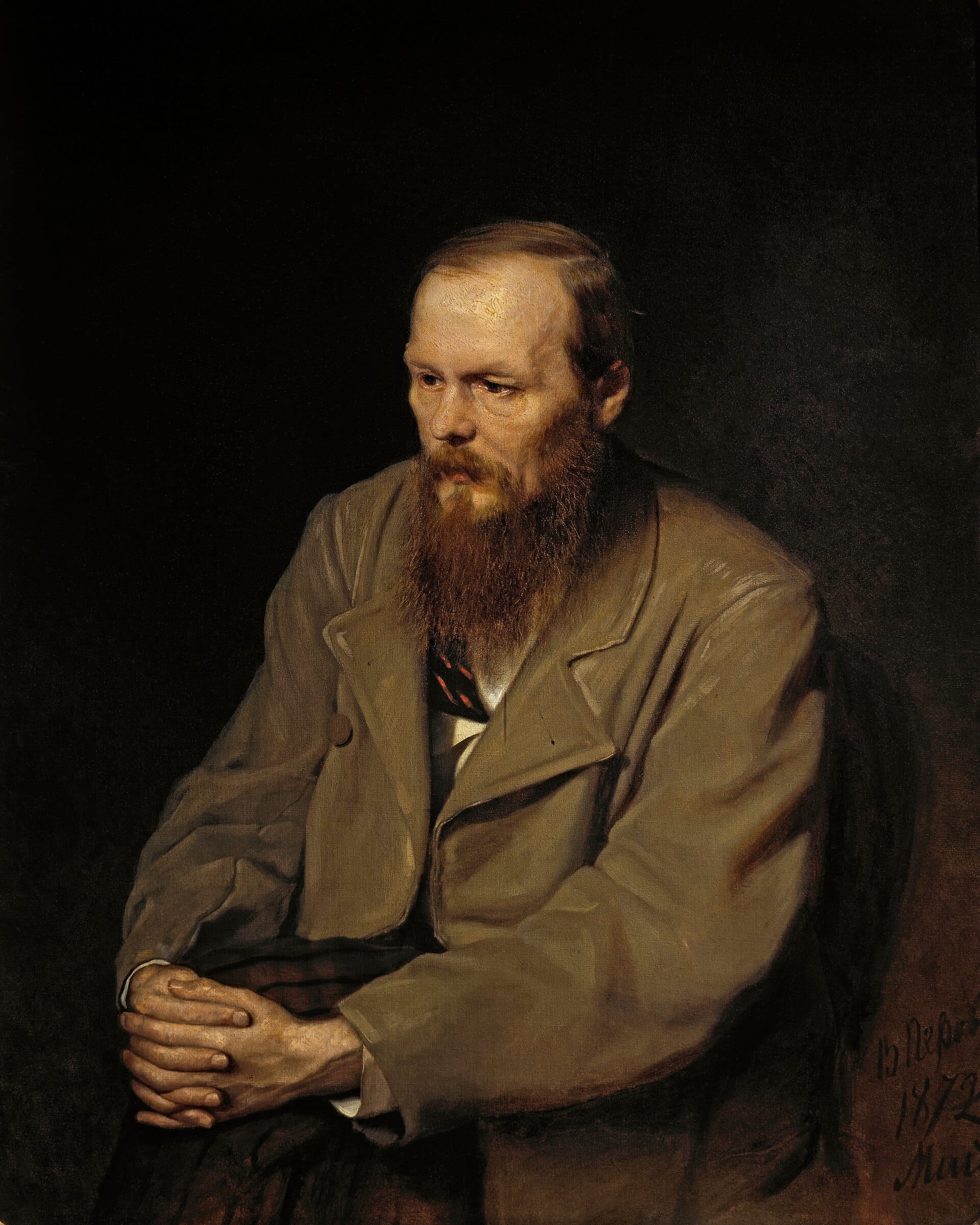
His name is Mikhail Bakhtin, and he spent his life, much of it in Soviet internal exile, thinking about a problem that turns out to be our problem wearing literary dress: what is the relation between an author and the voices of his characters?
Most novels, Bakhtin observed, are monologic. However many characters speak, one consciousness rules: the author's. The characters exist to be understood by the author better than they understand themselves; their viewpoints are objects within the author's viewpoint; and when the book ends, every voice has been placed, judged, and subordinated to the single authorial truth that was never itself at risk. The monologic novel, in other words, is exclusivism with a plot. It is also, Bakhtin thought, most of world literature, and no shame in it.
But then there is Dostoevsky (taught to me by Professor Craig Cravens, whose lessons stick with me even to this day). What Dostoevsky invented, on Bakhtin's reading, is the polyphonic novel: a work built as "a plurality of independent and unmerged voices,"2 in which the characters are not objects of the author's consciousness but subjects alongside it, free to argue with each other and with their creator, and never finally absorbed into a ruling perspective. Ivan Karamazov's rebellion is not refuted by the book that contains it. Dostoevsky the Orthodox believer gives his atheist the strongest arguments in the novel and does not defeat them; he answers them, if at all, with Alyosha's kiss and Zosima's life, which is to say with other voices, not with a verdict. The polyphonic author does not renounce his own voice; Bakhtin is emphatic about this. He renounces the monopoly of his own voice. He creates persons free enough to disagree with him, and the work's unity, which is real, is the unity of the dialogue itself, not of a conclusion the dialogue was secretly rigged to reach.
Attend to what we have just described, because we did not set out to describe it. An author whose creative act is the granting of genuine freedom. Voices that are unmerged and irreplaceable, each valuable precisely in its difference. A whole whose unity is not imposed from above or awaited at the end but enacted in the exchange. A creator who does not coerce his characters but, as Bakhtin liked to put it, accompanies them. We have been building this picture for five installments under the names of Whitehead and Hartshorne and Cobb. The God of persuasion, the most moved mover, the one who lures rather than compels and receives rather than overrules: this God is the polyphonic author, and the billion voices are not a problem this God has failed to solve. They are the work. A monologic deity, the unmoved absolute of Part 9, could at most tolerate the many voices as error awaiting correction. The God of Parts 9 and 10 requires them, the way Dostoevsky requires Ivan: because a dialogue of one is not a dialogue, and a love that permits no otherness is not love.
So hear the phrase's third word with the emphasis it has earned. A billion voices: not a billion drafts of one manuscript, not a billion errors triangulating one truth, not a billion masks over one face. Voices, in the full Bakhtinian sense: centers of experience that do not merge, each telling the story from where it stands, each irreplaceable, such that the loss of any voice, the drying of any channel, is a permanent impoverishment of the whole. And the billion includes the voices this series has spent so much time among: the losing sides, the burned books, the Watchers and the Cathars and the readings that did not become canonical, whose water is still in the river whether the river remembers or not. It includes the voices that have gone silent and the voices not yet raised. And it includes, I want to say clearly, the voice of your cousin from the last installment, the one who says there is no story at all. Polyphony that cannot host its own negation is monologue with extra steps. Ivan is in the novel. Ivan stays in the novel. The novel would be a lie without him.
One story, then, told in a billion voices: the unfinished narrative of the world's engagement with the God who receives it, held together not by an authorized version but by the exchange itself, authored the way Dostoevsky authored, which is to say with a freedom so radical it looks, from inside, exactly like being trusted.
That is what the phrase means. Now comes the question the whole series has been walking toward, the one every honest reader has been holding since Part 1, and it is not a theological question at all. It is Tuesday, and you have to live.
5. The Tuesday
Because here is the thing about arguments that come to land: they land somewhere. And the somewhere, for you and for me, is not a seminar room or a symposium or the inside of a book. It is an ordinary weekday in a divided country in a bewildering century. It is a phone that will show you, before breakfast, the worst thing said today by the people you least understand. It is a workplace, a family table, a comment section, a school board meeting. The question the series owes you is not "what should one believe about religious diversity" but something more like: what does any of this ask of a person on a Tuesday?
Let me answer with the discipline Part 12 named three ways, intrareligious dialogue, fusion of horizons, labor of the negative, and let me answer it concretely, because a discipline that cannot survive contact with a Tuesday is a decoration.
It asks you, first, to read your own scripture the way this series reads everything: as a braid, with love. Whatever your channel is, and I mean this whether your channel is the Missouri Synod or Theravada or the fierce secular humanism of a die-hard nonbeliever, it has sources it does not remember gathering. Trace them. Not to debunk your inheritance but to know it, the way you would want to know a person you loved rather than a portrait of them. The believer who learns that hell has a history, that the demonic was assembled, that the creed was argued into being by men with rivals and patrons and bad days, has not lost the faith. She has met it. What she loses is the portrait; what she gains is the face.
It asks you, second, to read your neighbor's scripture as a voice and not a specimen. The Tuesday version of the intrareligious dialogue is almost embarrassingly small: it is reading one book from inside another tradition slowly, or sitting once in a service you do not belong to, or asking the coworker with the shrine by her monitor what Ganesha means in her house, and then, this is the whole discipline, letting the answer be interesting. Not evaluating it against your ruler. Not filing it as anthropology. Letting it be a voice: something said by a subject, from somewhere, that might know something you do not. You will feel your own self-understanding put mildly at risk. That feeling is not a malfunction. That feeling is the fusion of horizons beginning, and Part 11 already told you that you cannot fuse horizons you refuse to bring into view.
And it asks you, third, and hardest, to extend the same reading to your enemy.
I do not mean here that you are simply being charitable, or empathetic, or any such "tolerant" gloss on pluralism. I mean that you must consider their act equal to your own, as motivated by a similar psychological impulse. You must realize the humanity in the other and in yourself; not as Hegelian master-and-bondsman, but as sailors on the same braided river. In my own growth as a person, this has meant that when I find myself reaching to anger, to the hurt, to the desire to exclude and surround myself with only those like me, I must name it. I must say to myself, "Lane, this is the old error." And I must consider that there is no view from nowhere, there is nowhere I can stand in judgment that is solid ground. But there is a swift flow, a current in which I can step, that carries me through the same ebbs and flows as everyone else. Even if the paths we walk are different, we are still walking together. Dialogue and dialectic share lexical roots for a reason, and they presuppose a division, binary, an opposition... but one that is still part of a greater unity. The momentum of each creates a Lagrange point of understanding between them, even in a Babel event. There is a third meaning created within the surplus that we identified; the meaning that survives and grows beyond the intention of the speakers. The received meaning. The meaning perceived by others. The thing that grows from discourse and dialogue and the dialectic itself. And this belongs to both poles and to neither; it is the possibility of new growth. Name it hope, if you must. Name it folly. But it is there all the same, waiting quietly for us to acknowledge it. We view ourselves too often as the final arbiter of truth and reality because we are the only epistemic agent we experience. But we are not alone; we are one among many, and our voice is not for ourselves but for the Other. The story we tell is not just a story we tell ourselves about identity and persistence; it is the narrative we display to others: "this is who I am, this is what I believe, this is how I live." And as much as you want to be heard, so too does your neighbor. Their speaking is an invitation for you to listen, as much as your voice is a plea to be heard.
Because the political payoff of thirteen installments is not a policy and not a side. It is this: the person across the divide from you is a voice, not a specimen, and the Babel event that separates you, the drift of concepts until "triangle" no longer means triangle and "freedom" no longer means freedom, is not proof that the other's world is sealed. Davidson took sealed worlds off the table in Part 11; what remains, when understanding fails, is not impossibility but work undone. That is a harder teaching than it sounds, because impossibility is restful and work is not. If the other side's language were truly incommensurable, you would be excused from the labor of translation, and if their tradition were simply evil, you would be excused from the labor of discernment, and the fantasy of being excused is, I have come to believe, the actual content of most political despair. The series' answer to "the world would be better without them in it" is not that the sentiment is impolite. It is that the sentiment is monologic: it is the demand that the novel contain only voices that agree with the author, and we have seen what that demand does to a God, and it does the same thing to a country. Wonder, not fear; discernment, not judgment: the dispositions are not garnish. On a Tuesday, in this country, they are close to a full-time job.
None of which requires you to conclude that every voice is right, which would be Hick's error, or that no voice can reach another, which would be the shrug. It requires only the discipline: patience at the confluence, honesty about your own sediment, and the willingness to be enriched by water you did not draw. The billion voices are not an obstacle to the one story. They are its telling, and you are one of them, and so, permanently and unmergeably, is the person you cannot stand.
There is a place to learn this posture, as it happens: a poem about a man offered every kingdom and every synthesis, who keeps declining, and then goes home. I have been living inside it all spring, in strange company. Let me end there.
6. The Pinnacle
Since March I have spent my Monday evenings being Satan.
This requires context. On the Critical Readings podcast, we read Milton's Paradise Regained aloud across a run of episodes, in parts: Dr. Cooper, our Roman Catholic, took the narrator; Dr. Keane voiced Jesus; and I, the deist lawyer, was assigned the tempter, which my co-hosts found funnier than I did. And I will tell you what months of speaking Satan's lines aloud teaches you that silent reading does not: the temptations are good. They scan. They build. They are the arguments of someone intelligent who has thought hard about what a serious person would actually want, and by the fourth book they have escalated past bread and past kingdoms to the only offer with any real purchase on a reader of a series like this one.
Milton announced the poem's whole method in its first line, where the narrator introduces himself as the poet "who erewhile the happy Garden sung":3 this is the author of Paradise Lost, returned with a sequel, and everything about the sequel is deliberately smaller. The cosmic war is over; the stage is a desert; the plot is two figures talking; the invocation runs seven austere lines where Paradise Lost took twenty-six. The critics who find the poem cold have understood the surface perfectly and the argument not at all, because the austerity is the argument. A poem about resisting spectacle refuses, formally, to be spectacular. The whole work enacts what it preaches, and what it preaches is the subject of this series' last section: how a finite person stands in the presence of the total offer.
Because that is what Satan's temptations become, spoken in sequence. Read them as a structure and they are a single escalating proposal: let it be finished. Bread: let the body's story be finished. The kingdoms: let history's story be finished, now, by power, with you at the head of it; why wait, why suffer, why permit the slow free play of a billion voices when the right hand on the lever could resolve the plot this afternoon? And then, when power fails, the offer Milton saves for last because it is the one that would have tempted Milton: Athens. The olive grove of Academe, the schools of ancient wisdom, the whole intellectual synthesis of the classical world, offered as a possession. "Be famous then by wisdom,"4 the tempter urges, and what he is holding out, in the terms this series has taught, is the view from nowhere as real estate: the completed system, the final vocabulary, the reading of all the world's voices from a height at which they resolve into one voice, yours. It cost Milton, the most learned poet in English, something visible to write his Christ's refusal of the classical learning Milton himself loved beyond measuring. He wrote it anyway. He understood, being tempted by it himself, that the total synthesis is not wisdom's crown but its counterfeit, and that the difference between loving the world's voices and possessing them is the whole difference the poem exists to draw.
On our episodes we developed a reading of these refusals that I want to bring home to the series, because I think it is the key to the landing. Satan, we argued, functions across the poem as the unwitting architect of Jesus's self-understanding. Milton's Christ, kenotic, emptied, genuinely uncertain of the shape of his own mission, does not arrive in the desert with a plan; he discovers who he is negatively, refusal by refusal, each rejected offer clarifying what the mission is not until the shape of what it is stands clear. The tempter, trying to close the story, becomes the instrument by which the story opens. This is the labor of the negative wearing a Judean desert costume: Bildung by temptation, a self formed not by seizing an answer but by working through, one by one, the answers that will not do. Even the adversary's voice is in the polyphony. Even Ivan is in the novel. Even Satan, speaking his excellent arguments into the desert air, is contributing what only he can contribute, and the God who receives all things receives this too: the refusals that taught the Son his own name.
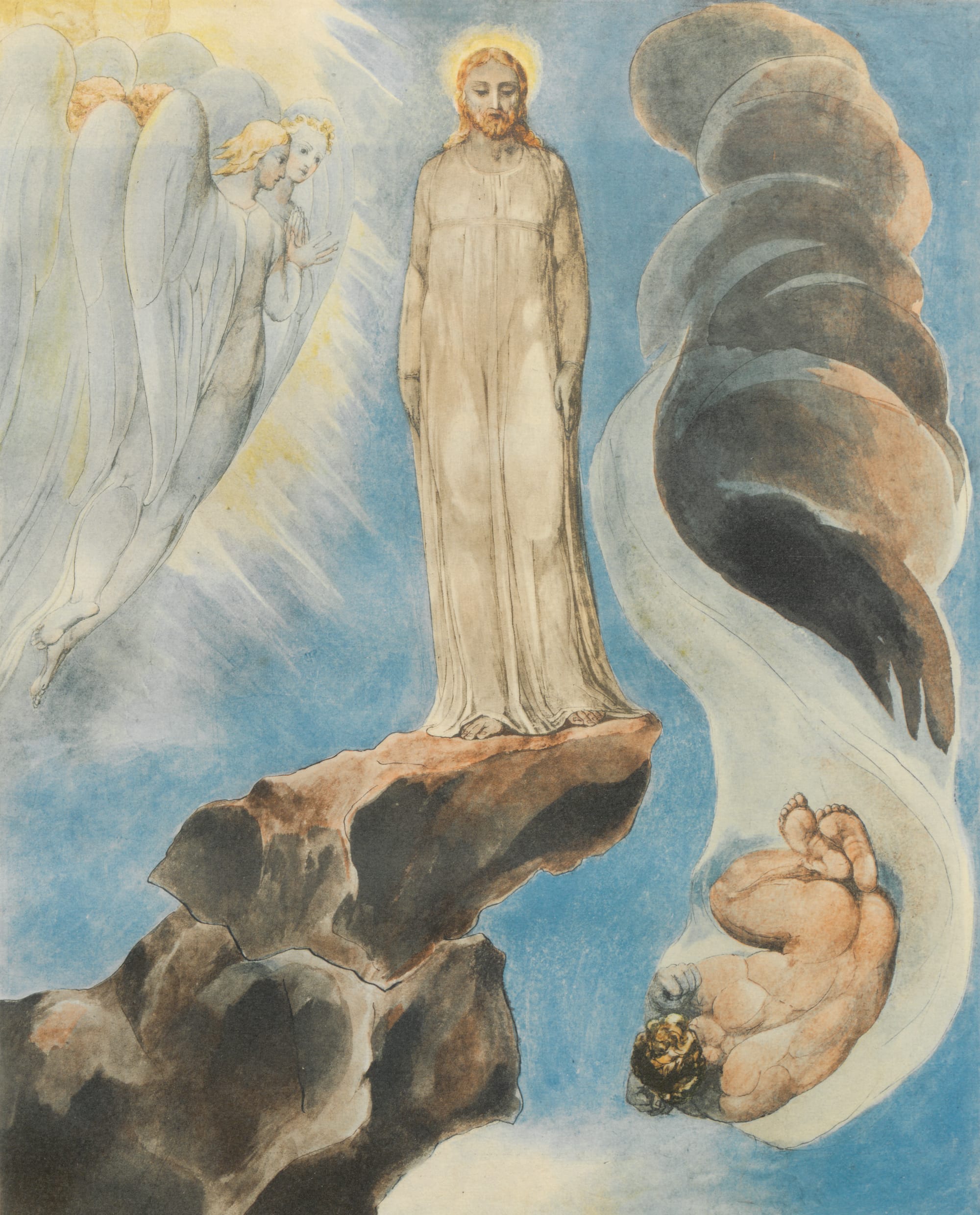
And then the pinnacle. Satan, rhetoric exhausted, sets Jesus on the highest point of the temple and offers the last temptation, which is not an argument at all but a dare: cast yourself down; force the Father's hand; make the angels catch you; end the ambiguity in one falling, spectacular, verifiable proof. And Milton gives his Christ four words and a stage direction that together constitute, I will argue to anyone, the quietest climax in epic poetry:
Tempt not the Lord thy God, he said and stood.5
He said and stood. He does not smite. He does not soar. He does not, and mark this, come down. He performs no synthesis, forces no confluence, provides no proof that would end the world's long argument by spectacle. He stands: upright, at the edge, in the wind, in the unresolved. Standing is the poem's entire answer, and it is this series' answer too, and it is the reason I told you in Part 11 that the resolution I found in my own Gethsemane was modeled on this poem. To stand at the pinnacle is to refuse both falls: the fall into despair, which says the height is unbearable and the abyss at least is certain, and the fall into spectacle, which says the ambiguity is unbearable and must be ended by force, by proof, by the final synthesis, by the world made better through the removal of whoever keeps the question open. Every costume the false one has worn in this series, the buried root, the hidden channel, the Omega, the eradicating thought on the road to Austin, is a way of casting yourself down. The discipline, the whole discipline, is to stand.
And then Milton does the thing that no one, coming from Paradise Lost, could have predicted, and closes his epic with the least epic couplet imaginable. The angels sing their hymn, the banquet is spread and cleared, and the poem's last lines simply say that Jesus,
hee unobserv'd / Home to his Mothers house private return'd.6
Unobserved. Home. His mother's house. Private. After the cosmic argument, the walk home; after the pinnacle, the kitchen; the Son of God, mission clarified, world unsaved as yet, goes back to Nazareth where, we must assume, there was water to carry and a trade to work and a mother who wanted to know how the trip went. The poem lands on a Tuesday. That ending scandalized readers who wanted triumph, and it is the truest thing in the poem, and you already know why, because this series has been teaching its logic for thirteen installments. The story is not finished, and the refusal to finish it by force is not the story's failure but its faithfulness. You come down from the pinnacle not because you fell but because it is evening, and the work of standing is done for today, and it will be there tomorrow.

7. The Sea
So we arrive at our exhaustion, at the point of dispersal into the wider cosmos, and there is almost nothing left to say, which is how you know it is an arrival.
The photograph that opened this series was taken from the air above a braided river in New Zealand: channels dividing and rejoining across gray stone, one river, uncountable strands. Every installment since has been a walk down that riverbed. We have traced channels to their forgotten springs, watched confluences the water itself does not remember, named the dams and the false maps, met the engineers of unity and declined their projects, and found, in the last stretch, a God wide enough to receive the whole braid and a discipline small enough to practice on a weekday.
And now the river reaches the sea, as rivers do, and I owe you one final honesty about that image, because the sea is where landing metaphors go to lie. The sea is not the Omega. The story does not converge here, the channels are not finally one channel, the argument of the world is not over. What actually happens where a river meets the sea is humbler and stranger: the water rejoins the reservoir from which all water comes, and the sun lifts it, and the sky carries it, and it falls again, on every watershed on earth, without regard for whose river it used to be. Panikkar told us where the rivers meet. The sea is not the end of the water. The sea is how the water gets to the sky.
So the series ends the way the poem ends, the only way it honestly can: unobserved, going home, the work not finished because the work is not the kind of thing that finishes. Somewhere tomorrow the rain that was the Jordan falls on the watershed of the Ganges, and the rain that was the Ganges falls on somebody's small gray channel in West Texas, and the one story goes on being told in the only voice it has ever had, which is all of them.
One story. A billion voices. Yours is one of them. And I, for one, am ready to listen.
Go home now. It is Tuesday there.