
The Waters of the Firmament, or The Many Do Not Stand Against the One (The Braided River, Part 12)
The braid is not what is wrong with the inheritance. The braid is the inheritance, and it is a wonder, and you get to walk in it. Panikkar's rain does not undo the plurality of tongues; it is the plurality of tongues, falling as blessing rather than curse.

1. The Question That Was Always Waiting
Eleven installments ago, this series made a wager: that the modern Western spiritual/philosophical inheritance is not a tree with clean branches descending from a single trunk, but a braided river, a system of channels that merge and separate and rejoin, carrying sediment from sources upstream that the water itself has no memory of having gathered. Since then we have walked the banks. We watched the demonic assemble itself from a book that was never canonical, watched hell acquire its geography from Persia and its furniture from Greece, watched the sky father and the storm rider trade thrones, watched the philosophers pour the living God of the burning bush into the marble of actus purus and then watched Whitehead and Hartshorne crack the marble open again. In the last installment we forged the tool this whole project was secretly for: a way of reading across difference that requires neither the ruler that measures every tradition against your own nor the shrug that seals every tradition into a world you cannot enter.
Which leaves the question that has been standing quietly at the end of the dock since Part 1, waiting for the boat to come in.
If the inheritance is braided, what do we say about the other rivers?
Not as a scholarly curiosity. As the live problem it actually is, on the actual street where you actually live. Your neighbor prays five times a day toward Mecca. Your coworker keeps a small shrine to Ganesha beside her monitor. Your cousin has taken refuge in the Buddha, the Dharma, and the Sangha, and your other cousin has taken refuge in the assertion that all of it, every last candle and mantra and creed, is a cognitive malfunction we will someday medicate away. They cannot all be right in any straightforward sense. The traditions make claims, and the claims collide. What happens to us when we die is not a matter on which the Theravadin and the Baptist have reached a negotiated settlement.
The Christian West has historically kept three tools in the drawer for this problem, and the academic theology of religions has names for all three.1 There is exclusivism: my tradition is true, and the others are false precisely where they differ from it. There is inclusivism: my tradition is true, and the others are true insofar as they unknowingly participate in mine, wells fed by my aquifer whether they know it or not. And there is pluralism: the traditions are all, in some sense to be carefully negotiated, responses to the same ultimate reality, paths up the same mountain, blind men at the same elephant.
You will notice that the first two tools are versions of the ruler, and you may suspect, correctly, that this series has been building toward the third. But here is the turn that makes this installment necessary rather than a victory lap: the third tool, in its most famous and most rigorous form, turns out to be a ruler too. It is a subtler ruler, held by a kinder hand, and it measures everything against a standard so abstract that its holders sincerely believe they are not measuring at all. But the genealogist's habit dies hard, and when we trace this pluralism upstream we are going to find, sitting at its headwaters, an old acquaintance: the God of the philosophers, the unmoved and unrelated absolute of Part 9, wearing a new coat and calling itself the Real.
So this installment does the comparative work the series has owed its readers from the beginning. We will take the standard map of the field and show where its edges curl. We will give John Hick, the greatest of the pluralists, the most serious hearing we can manage, and then we will show why his solution re-dams the river. We will meet two thinkers who fail in opposite and instructive directions: Mark Heim, whose mountains are so separate they threaten to become sealed worlds, and Raimon Panikkar, whose rivers meet only in the skies. And then we will make the move that Parts 9 and 10 were built to make possible: we will ask what happens to the whole problem when the God at the center of it is not the impassible absolute that Hick inherited and hid behind a veil, but the fellow-sufferer who understands, the God who receives.
What we will not do is arrive. The landing is Part 13's work. This installment ends at the threshold, with the pieces on the table.
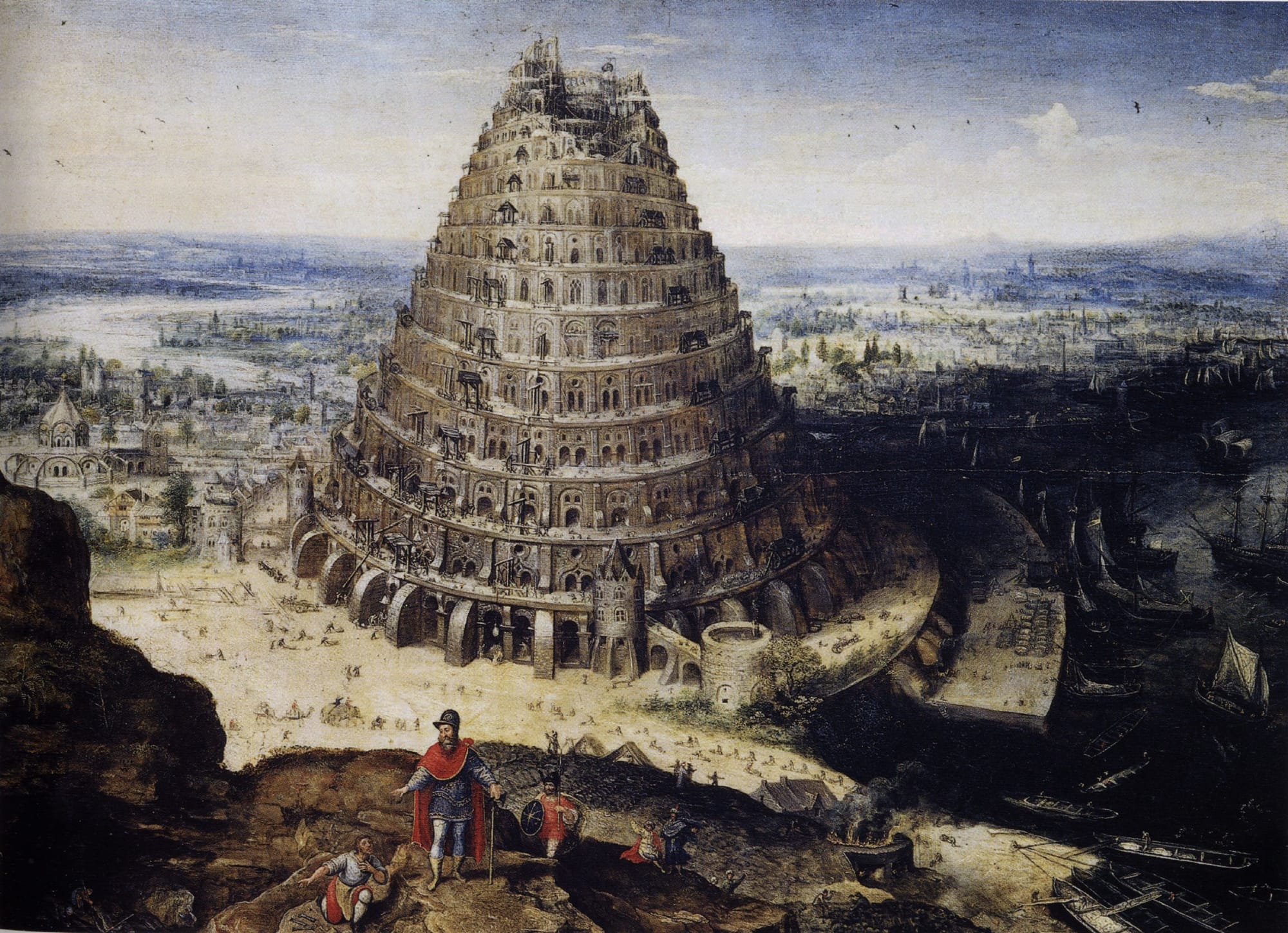
This was motivated, as I said back at the beginning, by a moment in my own life where I confronted the political and social landscape in front of me and felt an essential tension. My long-running philosophical thesis, back from my days contemplating graduate school, back before I had the reading sufficient to even attempt to approach it, was that we were undergoing what I sometimes call a "Babel event," or a place where two people speaking nominally the same language can no longer understand each other because the conceptual reference of their language has shifted.
One of my professors, Ignacio Angelelli, explained conceptual schema thus: imagine we are at a conference for mathematicians, and we are discussing triangles. Each mathematician at the conference has an idea in her head, a concept, of triangles. But we also have access to a shared concept of triangles and triangularity which sits between us, to which we can refer. This metaphor, I would later learn under the tutelage of another, wiser student, was similar to Husserl's surplus of meaning. I had the insight that it was this intersubjective conceptual schema that makes communication possible. After all, my words must cause in you, dear and constant reader, a thought to arise. But that thought will be populated with content according to what you think about certain concepts. Following Quine's indeterminacy of translation thesis, there is no way we can know whether we are speaking of the same things unless at some point we have access to the same basic conceptual information. Most speakers of the same language, or those within a given field of knowledge (which is to say, pace Wittgenstein, those playing the same language-game), will be like our mathematicians and have access to the same concept. But somewhere along the way, people's conceptual schematics can differ by such a large degree that two people can say "triangle" and intend different things. Between them there is no more any surplus of meaning, or perhaps now there are two (or more) divergent meanings sitting in equipoise. And each error of translation we make, each time we take "gavagai" to mean "rabbit" or "temporal slice of rabbit" or "there it runs fast" we compound our errors and inability to have discourse.
Back in Part IV of my series on Deleuze and Guattari's "Capitalism and Schizophrenia" I diagnosed this translation problem at critical mass: the Babel event that prevents understanding, and, without understanding, drives sociopolitical conflict.
And so, one day, as I was driving to Austin for a hearing, no doubt frustrated by some news story I heard that my political opposites were doing something that upset me, I thought to myself, "the world would be better without them in it." And then I immediately chastised myself, because that thought is unworthy of an educated person. Disagreement, even fundamental disagreement, even the rhetoric of others which calls for your own extinction, should not be cause to resort to the same sorts of errors as the fascists make. If the only thing that will assuage your political longings is the utter eradication of those who think differently, then you are committing the same error.
And so I turned back to a topic on which I have some reading, namely, hermeneutics and religion. I took a class on hermeneutics and comparative religion, and it was one of the finest seminar classes I took as an undergraduate. My own religious journey had been something of a formative one for me, abandoning the Christianity of my early youth for the ecumenicism of being a Unitarian Universalist in high school. In college, I took to calling myself first an agnostic and then an atheist, though I never sat well with these definitions. With the rise of so-called "New Atheism" and the rather bigoted positions adopted and advanced by many of its proponents, about halfway through my undergraduate education I stopped calling myself an atheist. It was not an appropriate description, either. Around the time I graduated, I had moved on from the philosophical interest that had consumed my undergraduate years (logical positivism) and began to reject the sort of default-materialism into which I had fallen. A dearly departed friend, Erik Johnson, first convinced me that the notion of causal closure was false and that rejecting dualism, either substance or property, was exactly the kind of metaphysical position I had for so long argued as improper during my positivist phase. As I shed the last vestiges of ontological naturalism, positivism, and materialism, I came to embrace dualism and reconfigure my stance on whether God existed to a more nuanced view of God and the supernatural, spurred by my readings in process philosophy and deistic metaphysics. Nowadays, I consider myself a species of deist, a believer in a God, but not a believer in any particular religion's concept of God. I have re-found my UU faith, and embraced the religious pluralism at the heart of that church. And as I thought about my pluralism, I wondered if I could somehow unify the disparate threads of my education (Heidegger, Husserl, Whitehead, Hartshorne, Ricoeur, Deleuze, and the rest) and the threads of my religious education in such a way that I could come up with a general theory of pluralism that would allow us to bridge Babel gaps in our communication.
The answer I have landed on and spent eleven posts explaining is that of a historico-critical analysis of the origin and evolution of our concepts paired against a pluralist understanding of how these things can exist when seemingly mutually contradictory: the Braided River.
2. The Map and Its Margins
The standard map is Alan Race's, drawn in 1983, and its three territories are the ones named above.2 Like all maps it is a simplification, and like all influential maps it has quietly replaced the terrain in most people's minds. It is worth walking each territory honestly before we start complaining about the projection.
Exclusivism is the oldest position and, historically speaking, the default one. Extra ecclesiam nulla salus: outside the church there is no salvation. Cyprian of Carthage coined the phrase in the third century as an instrument of intra-Christian discipline, aimed at schismatics rather than at Hindus he had never heard of, but the instrument outgrew its occasion.3 By the Council of Florence in 1442 the church could declare with untroubled confidence that not only pagans but Jews, heretics, and schismatics would depart into the eternal fire unless joined to the Catholic church before death.4 The Reformation relocated the boundary without abolishing it, and the twentieth century gave exclusivism its most sophisticated modern statement in Karl Barth, for whom religion as such, including Christian religion, was unbelief, the human attempt to grasp God, saved from itself only by God's self-revelation in Christ.5 Say what you will about exclusivism, and this series has said a great deal, it takes truth-claims seriously. It does the traditions the courtesy of believing they mean what they say.
Inclusivism is nearly as old. Justin Martyr, in the second century, taught that the logos spermatikos, the seed of the Word, was scattered through all humanity, so that Socrates and Heraclitus were Christians before Christ, reasoning by the light of the Logos they did not know by name.6 The position reached its modern high-water mark in Karl Rahner's "anonymous Christians": the sincere Buddhist, the devout Muslim, the righteous atheist may be saved, but they are saved by Christ, through grace they do not recognize, members of a church they have never entered.7 Vatican II wrote a chastened version of this into Nostra Aetate. Inclusivism is exclusivism with better manners, and its problem is precisely the manners: it pays the other traditions a compliment they did not ask for and cannot return without insulting the giver in identical coin. Tell the Vedantin he is an anonymous Christian and he can reply, with perfect symmetry and a small smile, that Rahner was an anonymous Vedantin all along. The compliment is a mirror, and mirrors do not adjudicate.
Pluralism presents itself as the exit from this hall of mirrors: the traditions are neither rivals nor concentric circles but parallel responses to one ultimate reality, none of them the center, all of them orbiting. We will spend the next section inside its strongest version.
But first, the margins of the map, because the map itself has begun to curl at the edges, and the curling matters to everything downstream.
Notice, first, that the typology is a Christian artifact. Its organizing question, who gets saved and how, is a Christian question, indeed a rather specifically post-Augustinian one. Sort the world's traditions by their answer to it and you have already made soteriology the genus of which every religion is a species, which would surprise the Confucian, puzzle the Shintoist, and annoy the rabbi. The map is drawn from one channel's point of view, and it maps the other channels as tributaries or distributaries of the concerns of that one.
Notice, second, that all three positions assume the traditions are answering the same question, so that their answers can agree, conflict, or converge. That assumption is exactly what Part 11 taught us to suspect. If Steven Katz is right that there is no unmediated experience, that the Buddhist's training shapes what the Buddhist experiences all the way down, then the claim that the traditions are "responses to the same reality" is not a neutral observation from which theorizing can begin.8 It is the largest and most contestable claim on the table, and it is doing all of its work before the argument officially starts.
And notice, third, the strangest curl of all, the one Gavin D'Costa turned into a formal argument in the 1990s: pluralism, examined closely, is a covert exclusivism.9 The pluralist says every tradition is a valid path, but every tradition, as actually practiced by its actual adherents, claims rather more than that. The Muslim does not believe Islam is one valid response among many to an ineffable Real; she believes the Qur'an is the final revelation of God. The pluralist must therefore hold that she is wrong about the content of her own faith, wrong in a way that the pluralist, from his superior vantage, can see and she cannot. Every tradition is welcome at the pluralist's table exactly insofar as it agrees to stop being itself. That is not the absence of a ruler. That is a ruler calibrated in units of agreeable vagueness, and the only tradition that scores perfectly on it is late twentieth-century liberal Protestantism, which is, by the sheerest of coincidences, the tradition that built the ruler.
Hold that thought. Now let us meet the man who built it, because he deserves far better than the caricature, and because the way his system fails is the most instructive failure in the field.
3. The Real Behind the Masks
John Hick did not come to pluralism by temperament. He came to it by way of Birmingham.
He began as an evangelical of the strictest kind, converted at university, a Christian philosopher who spent his early career defending a robustly orthodox faith with analytic rigor.10 Then he took a chair in Birmingham, one of the most religiously plural cities in Britain, and did something that the professional theologian is under no professional obligation to do: he went and looked. He worked alongside Muslims, Sikhs, Hindus, and Jews in that city's community-relations struggles, sat in their synagogues and gurdwaras and mosques, and came away with an observation he could not argue himself out of: the same transformation he knew from the saints of his own tradition, the slow turning of a human life from self-centeredness toward something greater than self, was visibly occurring in all of them, at roughly the same rate, with roughly the same failures.
His first formulation was a deliberate provocation: theology needed a Copernican revolution, a shift from a Christianity-centered to a God-centered model of the universe of faiths, with all the traditions, his own included, orbiting the same sun.11 But the model had an obvious problem, and his critics found it immediately: which sun? The personal God of the theistic faiths is not the nirguṇa Brahman of Advaita, which is not śūnyatā, which is not the Dao. Put any one of them at the center and the model is no longer pluralist; it is somebody's inclusivism with the serial numbers filed off.
Hick's mature answer, in his 1986-87 Gifford Lectures, is the most architecturally ambitious construction in the entire field, and its load-bearing wall comes from Kant.12 Distinguish, as Kant did, between reality as it is in itself and reality as it appears to us through the categories of our understanding. Now transpose the distinction into religion. There is the Real an sich, the ultimate reality in itself, which no human concept fits, of which nothing can be truthfully affirmed or denied in any substantive sense. And there are the personae and impersonae of the Real: the divine personalities (Yahweh, the heavenly Father, Allah, Vishnu) and the nonpersonal absolutes (Brahman, śūnyatā, the Dao) through which different traditions, with their different conceptual equipment, have encountered it. The traditions do not describe the Real; they describe its appearances within their frames. And they are validated not by doctrinal accuracy, which is unavailable in principle, but by their fruits: their demonstrated capacity to transform human beings from self-centeredness to Reality-centeredness, a criterion Hick thought empirically checkable and roughly equally satisfied across the great traditions.13
Give the man his due, because his due is considerable. This is not a shrug. It is an argument, built by a serious philosopher over decades, and it accomplishes real things. It takes the other traditions seriously as sites of salvation rather than as errors to be pitied. It has an answer to the scandal of religious luck, the uncomfortable fact that the faith most people die in is a function of where they were born, which no theology of a loving God should be able to read without flinching. It explains both the family resemblance among the mystics and the doctrinal collisions among the theologians. Measured against Florence's cheerful consignment of most of humanity to the fire, it is not merely cleverer; it is morally serious in a way its ancestors were not.
And yet. Attend to where the machinery has to hide the body.
The Real an sich, Hick insists, is beyond all substantive predicates. It is not personal and not impersonal, not one and not many, not good and not evil, not purposive and not purposeless. It cannot be otherwise, because the moment the Real acquires a describable character, one family of traditions describes it better than the others and the pluralism collapses. The ineffability is not an ornament; it is the keystone. But a Real of which nothing can be said is a Real that can do no work. Hick's own salvific criterion, the movement from self-centeredness to Reality-centeredness, quietly presupposes that centering on the Real is good for us, that compassion tracks it and cruelty does not, that the saint is closer to it than the torturer. Why? On what possible basis, if the Real is beyond goodness, beyond purpose, beyond any characterization whatsoever? The criterion needs the Real to be benign; the architecture forbids the Real to be anything. The system runs on a current its own insulation is designed to block.
And now step back and look at the shape of the thing, because the shape is where the genealogist earns his keep. An ultimate reality beyond all predicates, beyond relation, beyond response, untouched by the traditions that orbit it, about which the safest speech is negation. Where has this series seen that before? This is the apophatic ceiling of the God of the philosophers. This is the actus purus of Part 9, the pure actuality with no unrealized potential, the absolute that cannot receive because reception would be change and change would be imperfection, relocated one level up and rebranded. Hick fled the exclusivism of the classical God, and he built his refuge out of the classical God's own materials. The unrelated absolute that could not suffer with the world in Part 10 reappears here as the unrelatable absolute that cannot be touched by any tradition's worship. The personae pray, and nothing hears them; what they address are appearances, and the reality behind the appearances is, by construction, beyond being addressed.
Hick re-dammed the river. He took the braided plurality of the world's engagements with the divine, the very thing his honesty in Birmingham had taught him to honor, and he explained it by positing a single hidden channel underneath, so deep and so featureless that no water in it moves. It is the perennialists' error from Part 11, executed with vastly greater rigor, which only means the dam is better engineered. And D'Costa's curl now closes into a circle: to save every tradition, Hick must overrule every tradition, since none of them takes itself to be worshipping an appearance. The Real behind the masks turns out to be the loneliest God ever proposed, and the pluralism built to honor the many ends by silencing what each of the many actually says.
So the most rigorous pluralism on offer fails. But it fails in a specific direction, toward the hidden single channel, and failures have directions the way rivers do. The next thinker failed the other way, and between the two failures the series' own path runs.
4. Many Mountains
Mark Heim's 1995 book announces its argument in its title, and the argument is contained entirely in a single letter: Salvations.14 Plural.
The pluralists, Heim observed, had been so busy defending the many paths that they never questioned the one mountain. All paths lead to the same summit: it is the picture behind Hick's Real, behind the blind men and the elephant, behind every interfaith poster ever laminated. But suppose we do the thing this series has been recommending for eleven installments and actually listen to the traditions, in their own vocabularies, about where they say they are going. The Theravada Buddhist is not seeking eternal communion with a personal God under a different name; the entire architecture of the path is aimed at the extinguishing of the craving self and its narrative, and to call nibbāna a variant description of the beatific vision is to have understood neither. The Advaitin's mokṣa, the realization that the self was never other than Brahman, is not the Christian's resurrection into a communion of persons; the one dissolves the distinction the other consummates. These are not different descriptions of one destination. They are different destinations, produced by different disciplines, aimed at by whole civilizations of practice.
So Heim proposed the reading that the field had been carefully walking around: perhaps they all get where they are going. Perhaps the ends are real, plural, and genuinely achieved: many salvations, not one salvation under many names. Not paths up one mountain but paths up different mountains, in different ranges, under different weather. He borrowed philosophical scaffolding from Nicholas Rescher's orientational pluralism, the view that rational people reasoning rightly from different orientations will reach different conclusions and are entitled to them, and in a second book he grounded the plurality theologically: a triune God whose own inner life is irreducibly relational has, so to speak, room in the divine plenitude for creatures to realize genuinely different relations to it, each a real end, each a depth of the riches.15
Feel the appeal of this, because it is the precise inverse of Hick's. Where Hick honored the traditions' validity by dissolving their content, Heim honors their content down to the letter. Nothing is a mask; nobody is overruled; the Buddhist means what the Buddhist says, and what the Buddhist says comes true. It is the theology of religions that Part 11's Katz material seems to demand: if experience is constructed by tradition all the way down, then why not ends as well? Heim takes difference more seriously than any thinker in the field, and after three sections of watching unifiers flatten the braid, his refusal to blend feels like clean water.
But failures have directions, and Heim's runs toward the sealed worlds that Part 11 spent its central sections dismantling. Press the many-mountains picture and questions crowd in. If the ends are genuinely incommensurable, in what sense does Heim, a Christian theologian, even recognize nibbāna as a religious fulfillment rather than as a magnificent error, an actually-achieved oblivion? To call it a salvation, even a lowercase one, is already to have translated it into a soteriological frame it does not use for itself; the hospitality smuggles in the very commensuration it renounces. And the deeper problem is Davidson's, from Part 11, section 6. Heim's own book is a performance of the translation his thesis declares impossible: several hundred pages of lucid English exposition of Buddhist and Vedantin ends, intelligible to any patient reader, comparing what supposedly cannot be compared. If the frames were sealed, the book could not exist. The book exists. The frames are not sealed.
And notice, finally, where Heim's mountains all stand: on a trinitarian map. The plurality of ends is grounded in the plenitude of the Christian God's inner relations, which means the whole range, every summit, is surveyed from one summit in particular. Heim is honest about this; his proposal is openly confessional, an inclusivism of a newly generous kind, and he never pretends to the view from nowhere. But that honesty is also the concession: the most serious attempt to let the traditions be fully themselves turns out to be one tradition's account of why the others are allowed to exist.
So now the two failures stand on the table, and their symmetry is the lesson. Hick errs toward the single hidden channel: one featureless Real beneath the braid, honored by being unreachable. Heim errs toward channels that never touched: many real ends, sealed against one another, surveyed from a confessional peak. One dissolves difference; the other absolutizes it. And the reader of this series already knows the figure that refuses both errors, because the reader has been standing in it for eleven installments. A braided river is not one channel wearing many surfaces, and it is not many rivers that happen to share a valley. It is channels that genuinely divide and genuinely rejoin, exchanging sediment at every confluence, distinct without being sealed, connected without being one. What we lack is a thinker who lived that figure rather than merely mapping it. As it happens, there was one, and he described his own life as the experiment.

5. The Dialogue Within
Raimon Panikkar's biography reads like a thought experiment devised by a philosophy department with a budget. Born in Barcelona in 1918 to a Catalan Catholic mother and an Indian Hindu father, ordained a Catholic priest, doctorates in philosophy, chemistry, and theology, and then, in his late thirties, the journey to India that he spent the rest of his life describing in a single famous sentence, endlessly quoted and endlessly reformulated: he left Europe as a Christian, discovered in India that he was a Hindu, and returned as a Buddhist, all without ever having ceased to be a Christian.16 Every serious reader of Panikkar eventually decides whether that sentence is a paradox, a boast, or a report. The wager of this section is that it is a report, and that the thing it reports is the most important datum in the field.
Because notice what the sentence refuses. It refuses Hick: Panikkar does not say the three traditions were appearances of one Real he stood behind; he says he was in all three, and that they remained three. It refuses Heim: the traditions were not sealed summits, because one man walked between them and was changed by each without exiting the others. It even refuses the polite modern evasion of "multiple religious belonging" as a kind of spiritual portfolio diversification; there is nothing diversified about it; it is one life, lived as a confluence.
Panikkar gave the field two gifts. The first is a distinction: interreligious dialogue, the official kind, with conference tables and joint statements, matters far less than what he called the intrareligious dialogue, the one that happens inside a single person when another tradition's claim has actually been heard.17 Real dialogue, he insisted, is not a comparison of notes between fixed positions; it is an encounter in which my own self-understanding is put at risk, in which I may not return the same. The reader of Part 11 will recognize this immediately: it is Gadamer's fusion of horizons, no longer as hermeneutic theory but as spiritual discipline, prejudice deliberately placed where the other's truth can strike it. Panikkar is what the fusion of horizons looks like when someone bets a whole life on it.
The second gift is an image, and for this series it is almost embarrassingly on the nose. In a 1987 essay he considered the great symbolic rivers, the Jordan, the Tiber, the Ganges, and observed that the rivers of the earth never actually meet one another, not even in the oceans. They do not need to, he went on: they meet in the skies, drawn up as vapor, transformed, and, in his breathtaking phrase, "poured down in innumerable tongues"18 upon every watershed below. And mark the noun. The reader who met the Babel event in section 1 should feel the hair rise here, because Panikkar's rain does not undo the plurality of tongues; it is the plurality of tongues, falling as blessing rather than curse. The traditions, likewise, will never merge at ground level, and the attempt to force the confluence produces only flood damage. But there is a level, call it heaven, call it the divine life, call it whatever your channel calls it, at which the waters are genuinely exchanged, and every river is already, right now, carrying rain that fell out of other rivers' vapor. Any reader who has followed this series from the aerial photograph of a New Zealand braidplain in Part 1 will understand why I nearly wrote Panikkar a thank-you note, sixteen years after his death, upon rereading that passage. The braid, it turns out, has a sky.
Underneath both gifts sits his metaphysical intuition, the one he spent his Gifford Lectures elaborating: the cosmotheandric vision, the claim that the divine, the human, and the cosmic are not three stacked stories of reality but three irreducible dimensions of every real thing, so that no genuine encounter with the world fails to be, in some register, an encounter with all three.19 It is process-adjacent without being process; readers of Part 9 will hear the family resemblance to a God entangled with rather than exiled above the world.
Now the weakness, because the method of this series is to name the price of everything it admires. Panikkar does not argue. Pressed for criteria, for the machinery by which one adjudicates when the channels' claims collide, he offers testimony, image, and the standing invitation to undergo what he underwent. Ask him the philosopher's question, how do you know, and you receive the mystic's answer, come and see. This is not evasion, exactly; it may even be the formally correct response, since Part 11 established that there is no criterion available from nowhere, and a resolution that can only be performed rather than proved is still a resolution. But a series that has spent eleven installments doing genealogy, citation, and argument cannot simply end on come and see. Testimony tells us the confluence is livable. It does not tell us why it is possible, what the world must be like, what God must be like, for one life to be a braid without being a contradiction.
For that we need to go back to the God we built in Parts 9 and 10, and ask what he changes.
6. The God Who Receives the Braid
Here is the claim of this section, stated up front so the reader can hold the argument against it: the entire problem this installment has been surveying is an artifact of classical theism, and the God of Parts 9 and 10 dissolves the frame that generated it.
Watch how the frame was built. If God is actus purus, simple, immutable, impassible, pure act with no unrealized potential, then God cannot be genuinely related to the world; relation would mean reception, reception would mean change, and change is forbidden. Now hand that God a plurality of religions. The options come out exactly as Race mapped them. Either one tradition has the true description and the others are in error (exclusivism, with inclusivism as its diplomatic corps), or no tradition has a true description because the absolute is beyond all description, in which case the traditions are equally valid precisely because they are equally wide of an unreachable mark. That last option is Hick, and now we can say precisely what he did: confronted with the classical dilemma, he did not break the frame; he pushed God one level further behind it. The Real an sich is the impassible absolute with the impassibility raised to a metaphysical firewall. Hick's pluralism is classical theism's last move, not its overcoming.
But Parts 9 and 10 broke the frame. The dipolar God of Whitehead and Hartshorne is not pure act; he is unsurpassable relatedness, the most moved mover, affected by all things as no creature is affected. His primordial nature envisions and offers; his consequent nature receives the world's experience into the divine life, where, as Part 10 put it, nothing achieved is ever lost. This God does not sit behind the traditions like a noumenon behind a firewall. He is a participant in every one of their histories, luring, persuading, receiving, and, crucially, being enriched.
Now hand this God the plurality of religions, and watch the dilemma fail to arise.
The traditions do not have to be masks over a featureless core, because the God they engage is not featureless and is not hiding; the ehyeh of Part 10, the I-will-be-there of the burning bush, is in the encounter, not behind it. And the traditions do not have to be sealed summits, because the God who receives them all is one life, one everlasting concrescence into which the Sufi's night prayer and the Zen sitter's breath and the grandmother's rosary are all actually taken up, not as interchangeable specimens of generic religiousness but as irreducibly particular experiences, each contributing what only it can contribute. On this picture the plurality of traditions is not an embarrassment to be explained, a scandal of contradictory reports about a single object. It is more like the plurality of instruments in an orchestra whose score is still being written: a divine life that would be poorer, objectively and permanently poorer, if any channel of the braid ran dry. The many are not evidence against the one. The many are how this One is enriched. Panikkar's rain, falling back on every watershed, turns out to have a process-theological address: the consequent nature of God is the sky in which the rivers meet.
The theologian who worked this out in detail is the one almost nobody outside the process guild has read, and surfacing him is the payoff this section owes you. John B. Cobb, Jr., Whitehead's most consequential theological heir, spent the 1970s and 80s in deep, technical, decades-long engagement with Buddhist thought, and in 1982 published the book whose title names the alternative to everything above: Beyond Dialogue: Toward a Mutual Transformation of Christianity and Buddhism.20 Cobb's proposal is neither Hick's common core nor Heim's separate summits. It is that the traditions have attended to different features of an inexhaustible reality, and have each gotten something right that the others have not; that the Buddhist analysis of dependent origination and the emptiness of substance is, so far as it goes, true, and true about the same world concerning which the Christian witness to a personal, purposive grace is also true; and that the proper aim of encounter is therefore not agreement, not synthesis, not a metatheory, but mutual transformation: each tradition taking the other's truths into itself and becoming, thereby, more adequately itself. Christianity that has genuinely learned from Buddhism does not become half-Buddhist; it becomes a Christianity that understands its own doctrine of creaturely dependence better than it did before. The channels exchange sediment, and the sediment enriches both banks.
Notice what this position requires and what it refuses. It requires a reality inexhaustible enough that two very different nets can both come up full, and a God genuinely open to the future, which is exactly the metaphysics Parts 9 and 10 installed. It refuses the assumption, common to Hick and his exclusivist opponents alike, that the traditions are competing answers to one question, such that at most one can win; on Cobb's account they are often answering different questions, both well, about one world. And it refuses Heim's sealed summits, because mutual transformation is only possible if translation is, which Davidson already established. Cobb is the braided river as theology: many channels, one watershed, real confluences, real divergences, live exchange of sediment, and, downstream, open water that no one has seen yet.
That is the constructive position of this series, stated as plainly as I know how to state it. What it is not, and what it must not be mistaken for, is an answer key. Which brings us to the section where I tell you what you have not been given.
7. The Playground, Not the Courtroom
Attend. This is the section that keeps the whole installment honest, and it begins with a list of what the previous six sections have not handed you.
You have not been handed a criterion from nowhere. Part 11 burned that map, and nothing here rebuilds it. There is no neutral standpoint from which to certify that the process reading of the braid is correct and Hick's is not; the argument above was made from inside a tradition of argument, in a language with a history, by a writer with prejudices he has tried to put in play rather than pretend to have escaped.
You have not been handed a solvent for real contradiction. The traditions still collide. The Theravadin's analysis of the self and the Christian's hope for its resurrection are not, on any honest reading, saying the same thing, and mutual transformation is not a euphemism for pretending otherwise; it is what becomes possible after the collision is acknowledged, not instead of acknowledging it.
You have not been handed a machine for sorting wheat from tares. Nothing above tells you which practices in any tradition, including yours, including mine, are corrupt, cruel, or dead, and this series has spent too many installments in the company of Watchers, hells, and heresy trials to pretend that every channel runs clean. The criteria for that sorting exist, but they are internal, plural, and revisable, which means they must be exercised, case by case, without a warranty.
If this feels like being handed a toolbox where you expected a verdict, good. That is the design, and the design has a pedigree, and the pedigree is Hegelian, so let me be precise about which Hegel, because there are two on the market and the wrong one is the near-enemy of everything this series intends.
The wrong Hegel is the one the twentieth century mostly retailed: Kojève's Hegel, Fukuyama's Hegel, the Hegel of the end of history, in whom the labor of Spirit terminates in a final synthesis, absolute knowing as a museum where the exhibits no longer move, every contradiction reconciled, every path converged, nothing left to do but curate.21 Readers of Part 11 will recognize this figure instantly, because we met him there wearing a Jesuit's cassock: it is Teilhard's Omega in a Prussian coat, the single point at the end of time where the braid is finally forced into one channel. This series has rejected that figure in every costume it has appeared in, and it rejects the Hegelian costume too. The braid does not converge. History does not end. There is no final synthesis in which your working-through is completed for you, and any reading of this installment that hears "process theology plus mutual transformation" as a new candidate for the last synthesis has heard the opposite of what was said. Cobb's open water downstream is open. That is the point of it.
The right Hegel is the one underneath the system-builder, the one the Phenomenology's preface actually describes: the Hegel of the Arbeit des Negativen, the labor of the negative, for whom truth is not a minted coin to be pocketed but the result of a working-through, and for whom the working-through is not the regrettable delay before the answer but the very substance of the life of Spirit.22 Bildung: the formation of a consciousness through its encounters with what negates it, each encounter preserved and transformed rather than discarded, Aufhebung without terminus. On this reading what Hegel offers is not a destination; it is a description of what it is like to be a finite mind honestly at work in history, and it is an exact description of what this installment is asking of you.
Because here is what the toolbox is for. You have a conceptual scheme; Davidson assured us it is not a prison, but it is yours, inherited, mostly invisible to you, and it will not examine itself. You have language games and forms of life; Wittgenstein showed they can be learned, which means yours can be seen, from just enough distance, as one way among the ways. You have prejudices; Gadamer rehabilitated the word so that you could own them as the enabling condition of your understanding rather than denying them like a defendant. The work, the actual work, the work no book can do for you, is to take that inheritance out into the braided history this series has spent eleven installments mapping and put it in play: to trace your own channels upstream, to find the sediment in your water that you did not know you were carrying, to let the other channel's truth strike your self-understanding where it is soft, and to come back changed and still yourself. That is the intrareligious dialogue. That is the fusion of horizons. That is the labor of the negative. They are three names for one discipline, and the discipline is the answer, in the only sense in which an answer is coming.
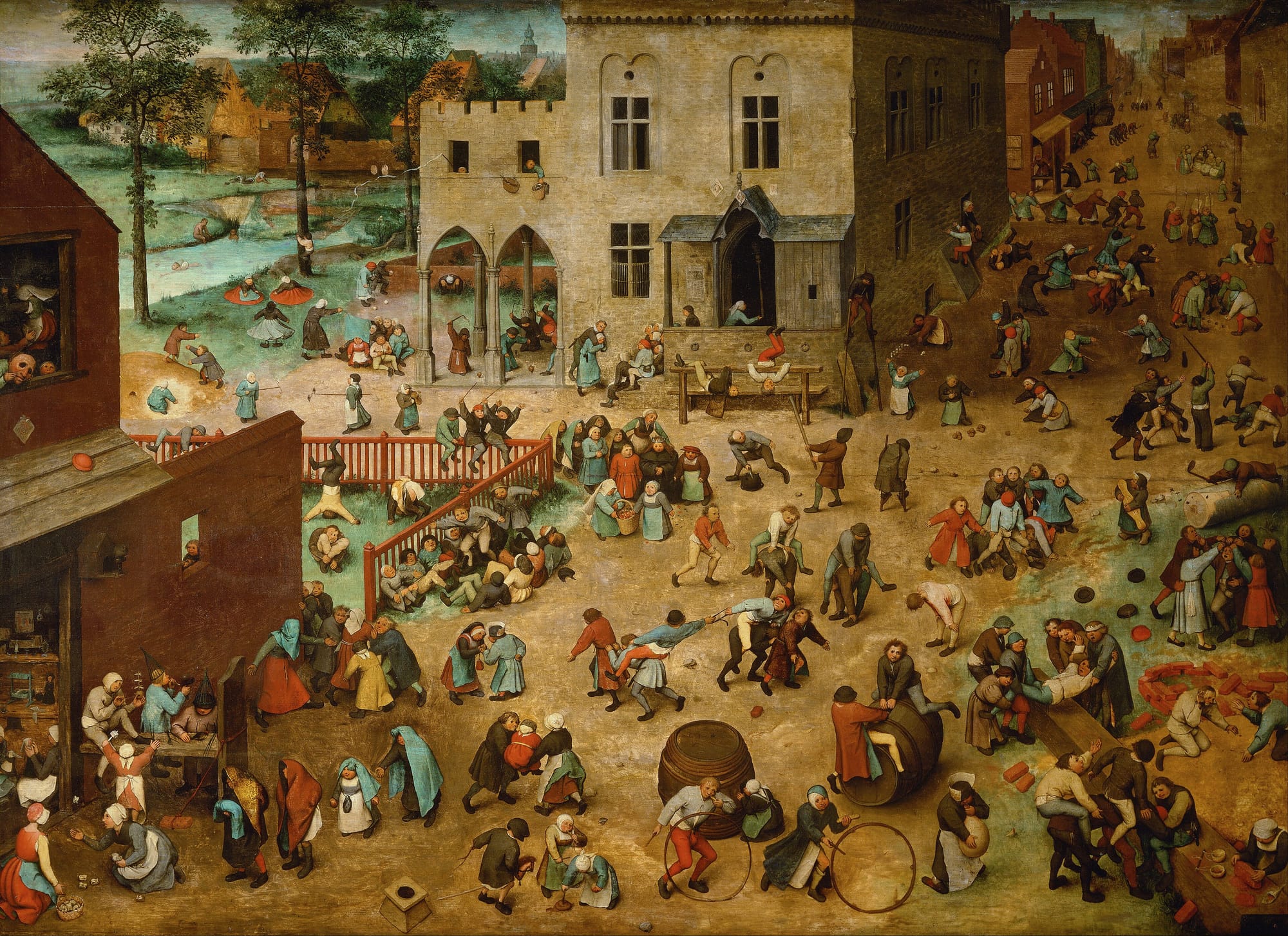
And here is the last reframe, the one I most want to leave in the reader's pocket. Eleven installments of genealogy could be read, and I know some readers have read them, as a mounting problem: the inheritance is not what it claimed to be, the channels are many, the sources are forgotten, and now the ground will not hold still. Read that way, history is a problematic (a word I use with the full sardonic awareness that it is what theory-brained academics say when they mean "problem" and want tenure for it), a source of vertigo, something to be anxious about, managed, gotten past. I am asking you to run the same facts through a different frame. The multiplicity of history is not the problem. It is the playground. It is the widest field of human meaning ever opened to a species, every channel of it carrying real water, every confluence an invitation, every strange rite and alien scripture and untranslatable word a place where a finite mind can learn, stretch, and grow in a direction it could not have invented for itself. The braid is not what is wrong with the inheritance. The braid is the inheritance, and it is a wonder, and you get to walk in it.
Walk it, then, with the two dispositions the whole series has been quietly training. Wonder, not fear: the strange channel is not a threat to your channel; it is rain your channel has not tasted yet. And discernment, not judgment: the judge needs the view from nowhere, needs the ruler, needs the courtroom, and there is no courtroom; but the discerning reader needs only honesty about her own prejudices, patience at the confluence, and the willingness to say, of this practice or that one, in fear and humility and revisable good faith, this gives life, and this does not. Judgment ends inquiry. Discernment is inquiry. The first is a verdict; the second is a walk, and the walk does not end, and that, contra every Omega and every end of history and every last synthesis on the market, is not the bad news.
It is the gospel of the braid.
8. The Threshold
Take inventory, because the table is now set and Part 13 will find it so.
From Parts 9 and 10: a God who is not the unmoved absolute but the most moved mover, the fellow-sufferer who understands, who persuades rather than coerces and receives rather than ignores, in whose consequent life nothing achieved is ever lost.
From Part 11: a hermeneutic for finite minds, no view from nowhere and no need of one, prejudice owned and put in play, horizons fused without being erased, suspicion and retrieval in one discipline.
From this installment: a theology of religions that lets the channels be many without sealing them and connected without collapsing them; a God whose own life is the sky in which the rivers meet; and a practice, three-named (intrareligious dialogue, fusion of horizons, labor of the negative), by which one finite person can actually walk the braid.
What remains is the landing, and the landing was announced in Part 1, in a phrase this series has been carrying like sealed orders: one story told in a billion voices. Every word of that phrase is now load-bearing, and Part 13 will open the orders: what the phrase actually means once "one," "story," and "voices" have all been through the waters of the last twelve installments, what it asks of a person on an ordinary Tuesday, and why the resolution it names was modeled, of all places, on a quiet interior turning in the last book of Milton's Paradise Regained, where the tempter offers every kingdom and every synthesis, and is refused by someone who has learned to wait.
The pieces are on the table. The river is at the threshold of the sea.
One more bend.